
Bhagavad Gita — Dhyana Yoga, Shloka 14
Atma Samyama Yoga
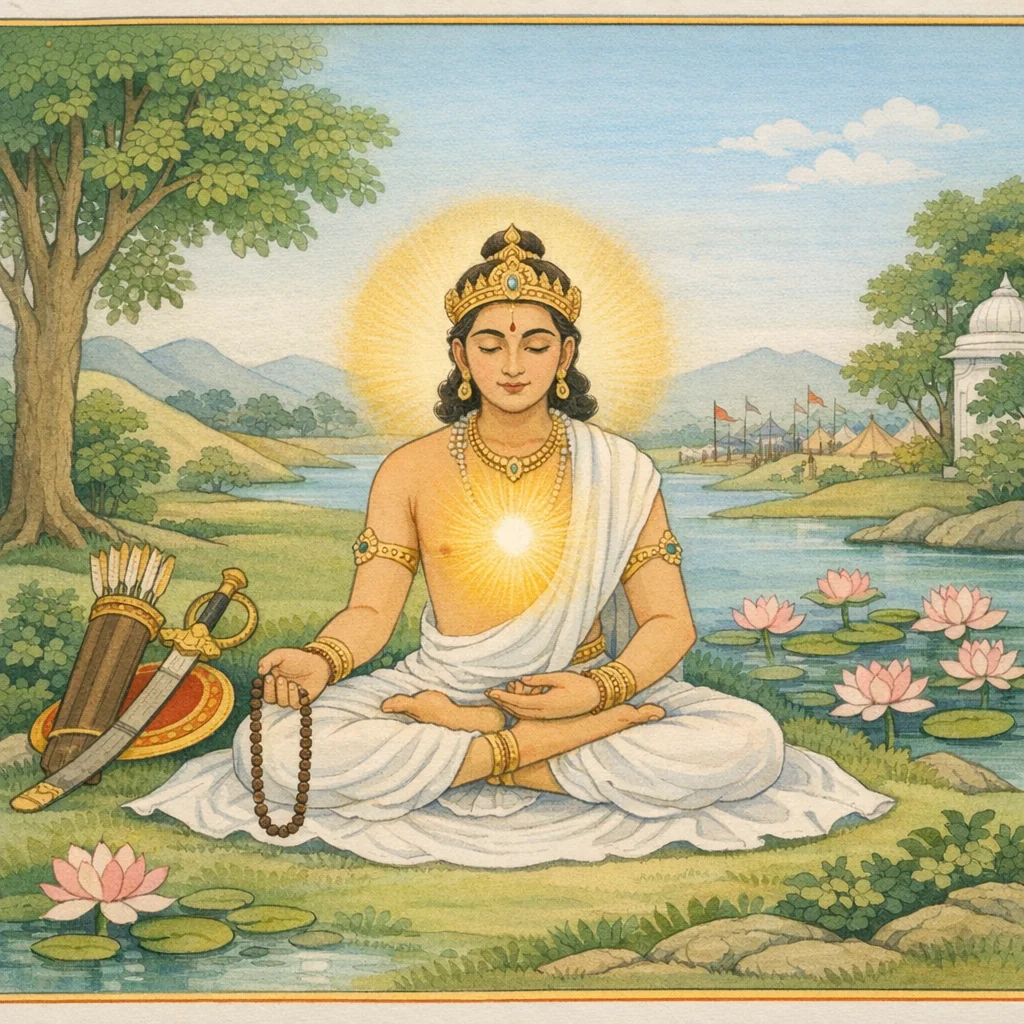
प्रशान्तात्मा विगतभीर्ब्रह्मचारिव्रते स्थितः । मनः संयम्य मच्चित्तो युक्त आसीत मत्परः ॥ ६.१४ ॥
praśāntātmā vigata-bhīr brahmacāri-vrate sthitaḥ | manaḥ saṃyamya mac-citto yukta āsīta mat-paraḥ || 6.14 ||

With the inner being pacified, free from fear, established in the vow of brahmacarya, restraining the mind, fixing the consciousness in Me, and regarding Me as the supreme goal—let him sit, united in Yoga, devoted to Me alone.
शान्त अन्तःकरण वाला, निर्भय और ब्रह्मचर्य-व्रत में स्थित होकर, मन को संयमित करके, मुझमें चित्त लगाकर और मुझे ही परम लक्ष्य मानकर युक्त होकर बैठे।
With a tranquil self, free from fear, established in the vow of brahmacarya, having restrained the mind, with thought fixed on me, disciplined, he should sit, taking me as the highest aim.
‘Brahmacarya’ ranges from a strict celibacy vow (ascetic context) to broader disciplined conduct; translations vary accordingly. ‘Mac-citta/mat-paraḥ’ is read theistically (devotion to Krishna) or, in some philosophical receptions, as concentration on the supreme principle represented by Krishna.
FAQs
Fearlessness and tranquility are presented as prerequisites for sustained inward attention. Ethical restraint (especially regarding desire) is treated as reducing inner conflict and intrusive thoughts.
Fixing the mind on Krishna frames meditation as oriented to the ultimate reality the text identifies with him; the practice is not value-neutral but teleological—aimed at the highest.
The verse integrates meditation technique with moral discipline and devotional orientation, characteristic of the Gītā’s synthesis of yoga and bhakti.
Adopt consistent ethical boundaries that reduce compulsive behavior; use a chosen highest value/ideal (theistic or philosophical) to stabilize motivation and attention.