
Bhagavad Gita — Dhyana Yoga, Shloka 37
Atma Samyama Yoga
अर्जुन उवाच । अयतिः श्रद्धयोपेतो योगाच्चलितमानसः अप्राप्य योगसंसिद्धिं कां गतिं कृष्ण गच्छति ॥ ६.३...
arjuna uvāca | ayatiḥ śraddhayopeto yogāc calita-mānasaḥ | aprāpya yoga-saṁsiddhiṁ kāṁ gatiṁ kṛṣṇa gacchati || 6.37 ||

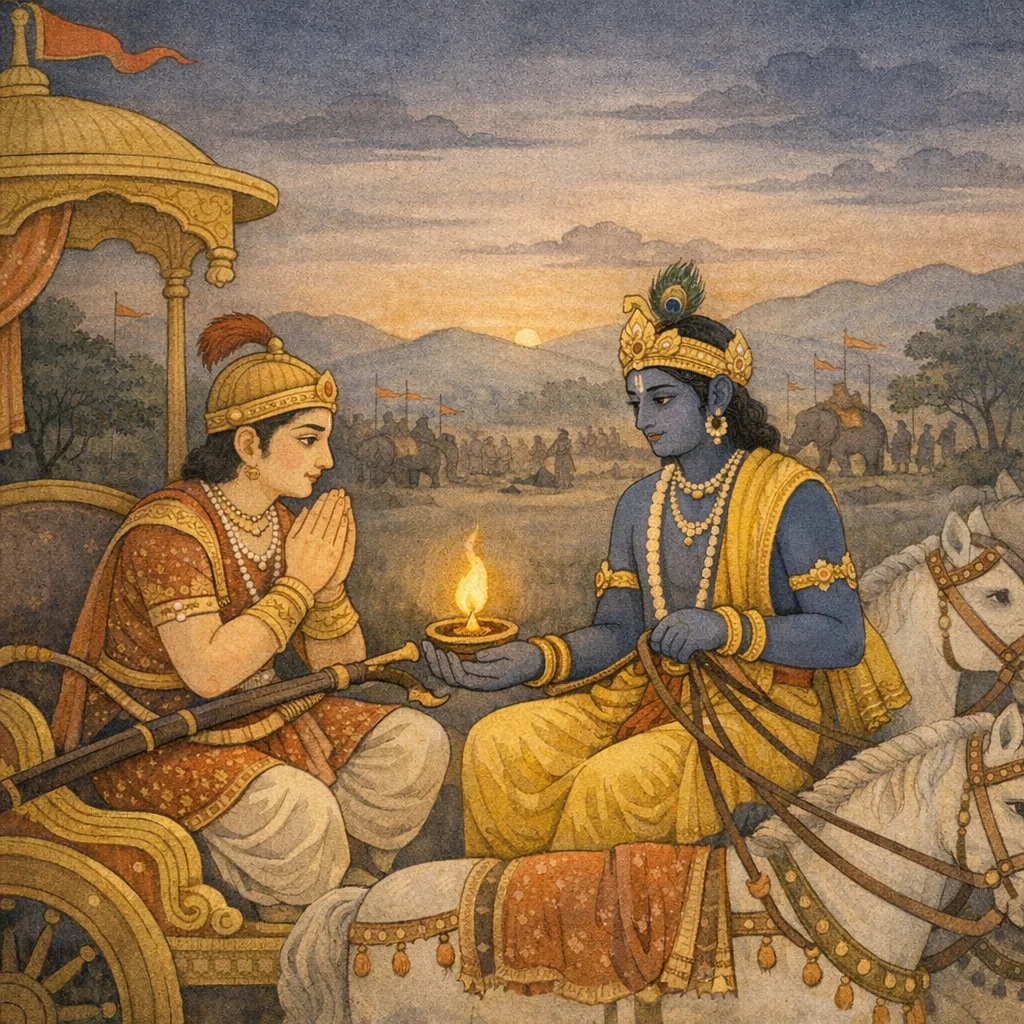
Arjuna said: One who lacks steadfast discipline, yet is endowed with faith, whose mind has strayed from yoga—without attaining perfection in yoga, what end does he reach, O Kṛṣṇa?
Arjuna said: He who is without effort (or discipline), yet possessed of faith, whose mind has strayed from yoga—without attaining perfection in yoga, what end does he meet, O Krishna?
Arjuna said: One who does not persevere, though endowed with faith, whose mind has deviated from yoga—having failed to reach yogic accomplishment, what course (gati) does he take, O Krishna?
The input is truncated but the verse is standard. ‘Ayatiḥ’ is variously read as ‘one who does not strive’ or ‘one lacking discipline.’ The question anticipates later verses on the destiny of the ‘fallen’ practitioner, often discussed across Vedānta and Yoga traditions.
FAQs
The verse highlights the gap between aspiration and sustained practice: confidence may be present, yet attention and habits can drift, raising anxiety about ‘wasted effort.’
Arjuna asks a soteriological question: how traditions account for incomplete practice—whether progress is lost, preserved, or continued across life contexts.
This extends the discussion from feasibility (mind control) to consequences of interruption, prompting Krishna’s subsequent teaching on the non-loss of spiritual effort.
It speaks to concerns about lapses in long-term training: the framing encourages viewing development as cumulative, where partial gains can still shape future choices and resilience.