
Bhagavad Gita — Dhyana Yoga, Shloka 5
Atma Samyama Yoga
उद्धरेदात्मनात्मानं नात्मानमवसादयेत् । आत्मैव ह्यात्मनो बन्धुरात्मैव रिपुरात्मनः ॥ ६.५ ॥
uddhared ātmanātmānaṁ nātmānam avasādayet | ātmaiva hy ātmano bandhur ātmaiva ripur ātmanaḥ || 6.5 ||

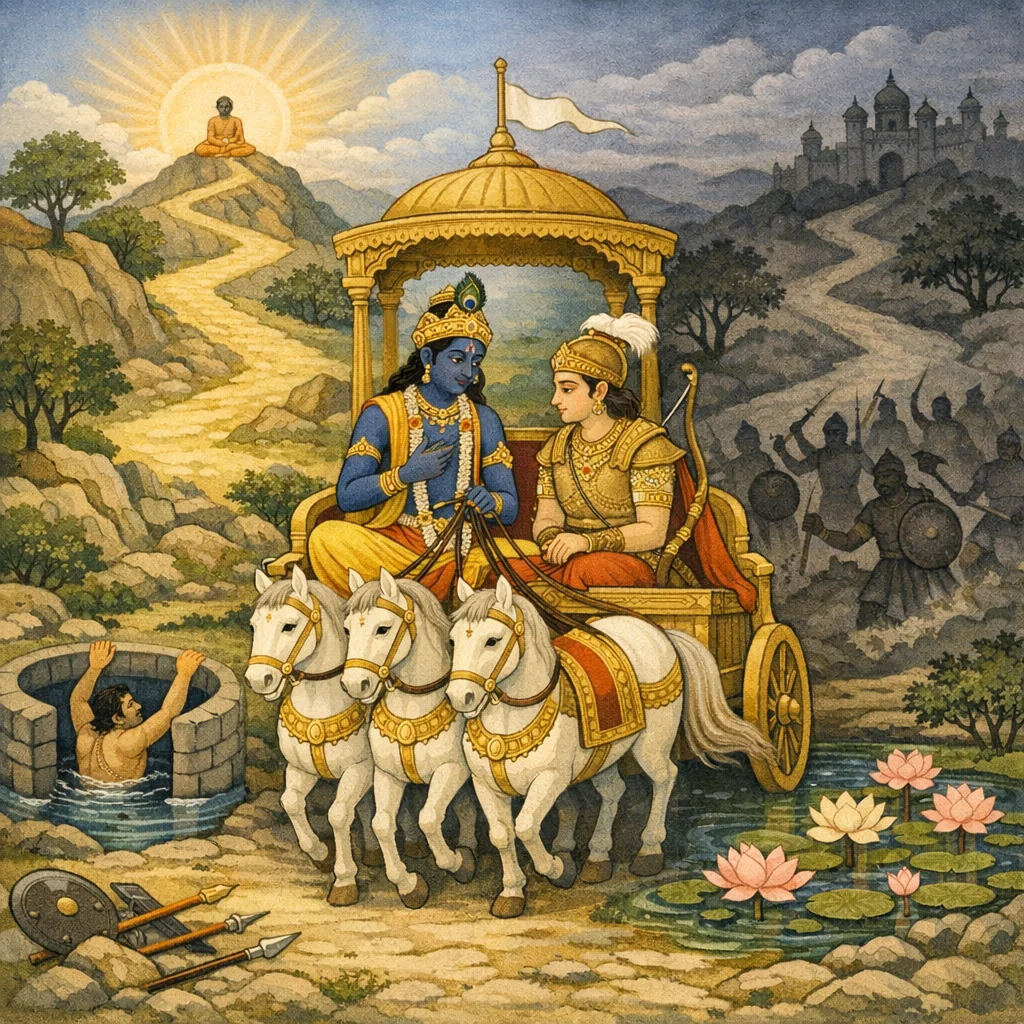
Let a person uplift oneself by oneself; let one not degrade oneself. For the Self alone is one’s friend, and the Self alone is one’s enemy.
मनुष्य को चाहिए कि वह अपने द्वारा अपना उद्धार करे और अपने को गिराए नहीं; क्योंकि आत्मा ही आत्मा का मित्र है और आत्मा ही आत्मा का शत्रु है।
One should lift oneself by oneself; one should not degrade oneself. For the self alone is the self’s friend, and the self alone is the self’s adversary.
“Ātman” here is read variously as (a) the empirical self/mind-personality that must be trained, or (b) the higher self as principle of uplift. Many commentators distinguish lower (mind) and higher (true self) senses contextually.
FAQs
It frames inner struggle as self-regulation: habits and impulses can undermine well-being, while disciplined reflection and practice can restore agency.
The verse can be read as distinguishing the changing psycho-physical self from the deeper self; aligning with the deeper self enables liberation-oriented living.
As Chapter 6 turns to meditation, the text emphasizes personal responsibility: progress depends on training one’s own mind rather than relying on external status or mere withdrawal.
Encourages constructive self-talk, habit formation, and accountability: use routines and reflection to ‘lift’ oneself instead of reinforcing discouragement.