
Bhagavad Gita — Dhyana Yoga, Shloka 46
Atma Samyama Yoga
तपस्विभ्योऽधिको योगी ज्ञानिभ्योऽपि मतोऽधिकः । कर्मिभ्यश्चाधिको योगी तस्माद्योगी भवार्जुन ॥ ६.४६ ॥
tapasvibhyo 'dhiko yogī jñānibhyo 'pi mato 'dhikaḥ | karmibhyaś cādhiko yogī tasmād yogī bhavārjuna || 6.46 ||

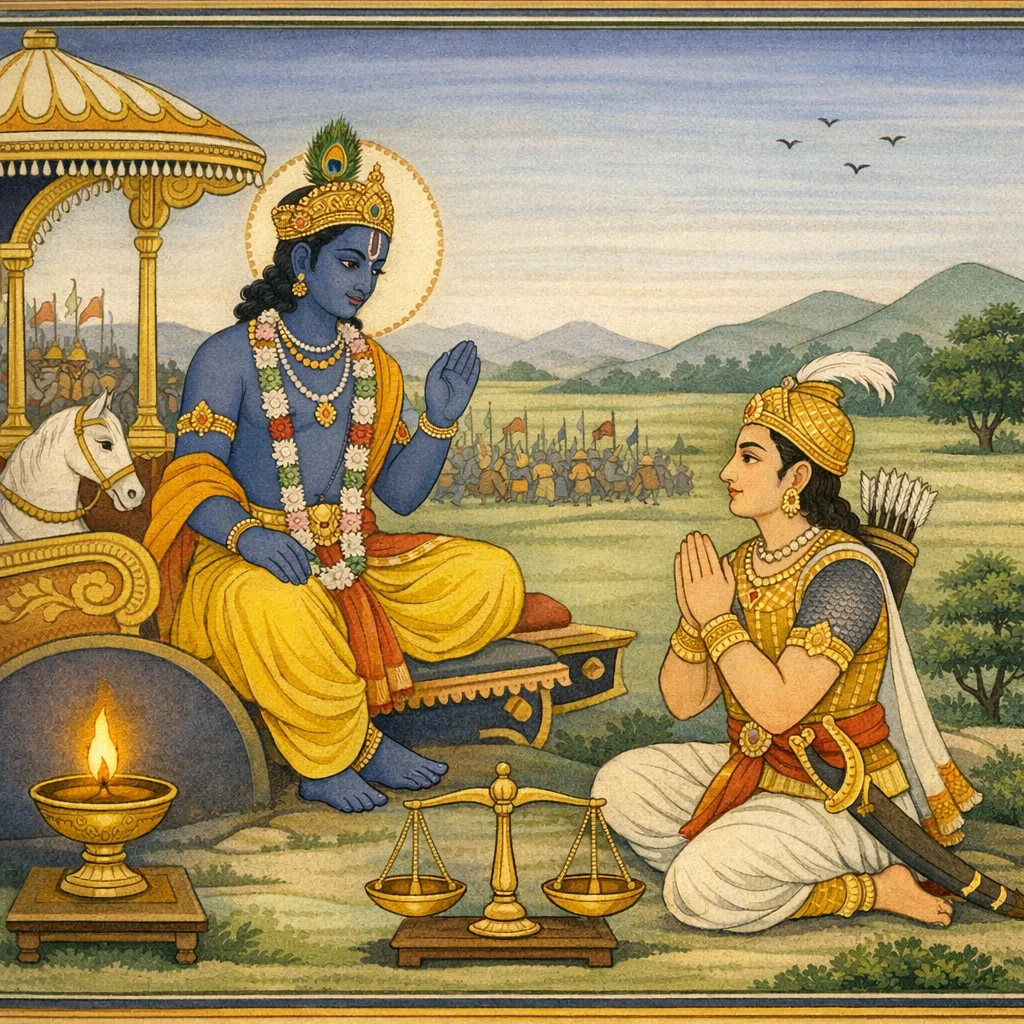
The yogin is held to be superior to ascetics, and even superior to the men of knowledge; the yogin is also superior to the men of action. Therefore, O Arjuna, become a yogin.
“The yogin is regarded as superior to ascetics, and even superior to men of knowledge; the yogin is also superior to men of action; therefore, O Arjuna, become a yogin.”
“The yogin is higher than those of austerity, and is considered higher even than knowers; higher than ritual actors too is the yogin; therefore be a yogin, Arjuna.”
The hierarchy is interpreted variously: some traditions integrate ‘yogi’ as one who unites austerity, knowledge, and action; academic readings note a rhetorical elevation of yoga as a comprehensive discipline rather than a narrow sectarian claim.
FAQs
It commends a balanced discipline that trains attention and motivation, not only external practice (austerity) or abstract understanding (knowledge).
The verse presents yoga as a comprehensive means that can encompass and surpass isolated approaches, orienting the practitioner toward liberation.
After resolving the fate of the incomplete yogin, Kṛṣṇa reasserts the value of yoga and urges Arjuna toward it.
It can be read as prioritizing integrative practice—combining ethical action, reflective insight, and mental training—over one-dimensional self-improvement.