
Bhagavad Gita — Dhyana Yoga, Shloka 30
Atma Samyama Yoga
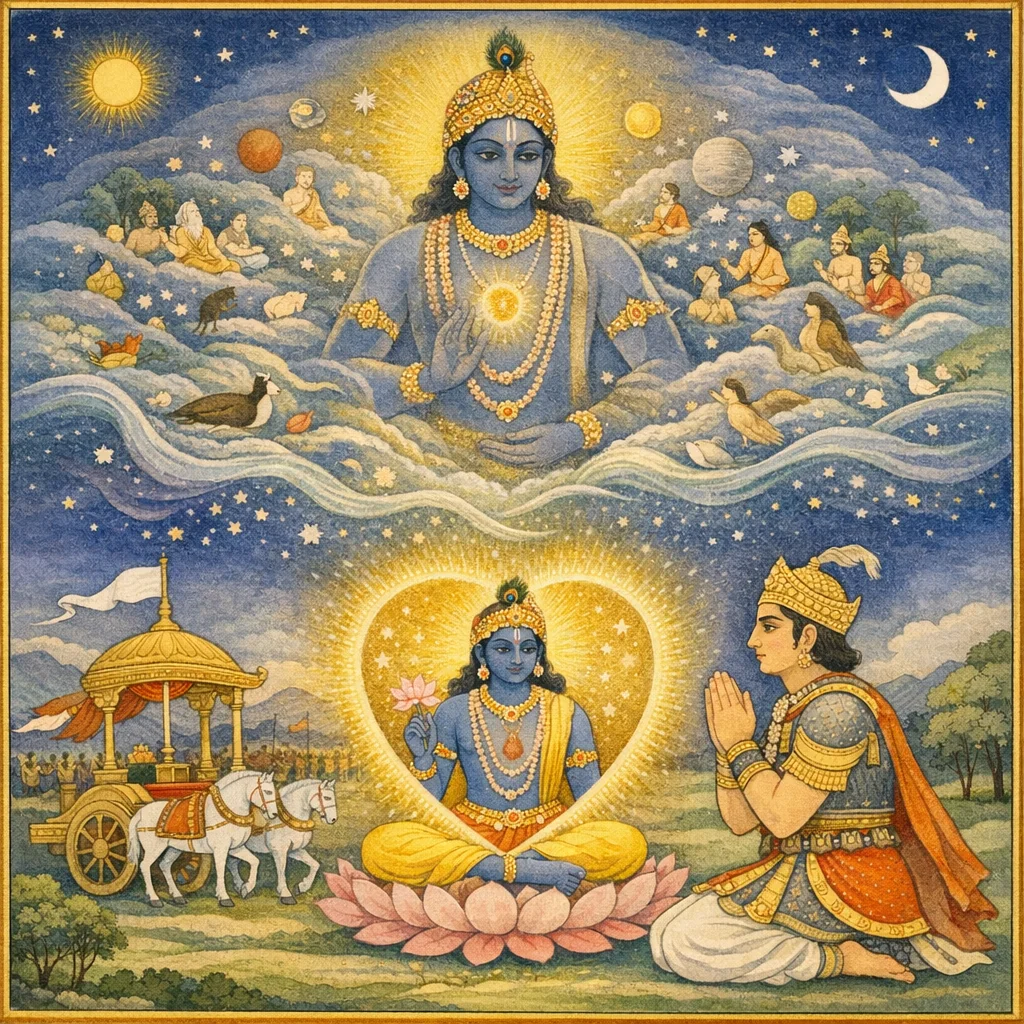
यो मां पश्यति सर्वत्र सर्वं च मयि पश्यति । तस्याहं न प्रणश्यामि स च मे न प्रणश्यति ॥ ६.३० ॥
yo māṁ paśyati sarvatra sarvaṁ ca mayi paśyati | tasyāhaṁ na praṇaśyāmi sa ca me na praṇaśyati || 6.30 ||

He who sees Me everywhere and sees everything in Me—never do I become lost to him, and he is never lost to Me.
He who sees Me everywhere and sees everything in Me—I am not lost to him, and he is not lost to Me.
Whoever perceives Me in all places and perceives everything in Me—of him I do not ‘vanish,’ and he does not ‘vanish’ from Me.
The verse shifts from ātman-language to explicit ‘Me’ (mām), inviting a theistic or personal-absolute reading. ‘Not lost’ is commonly interpreted as unbroken awareness/communion rather than spatial separation; academic renderings preserve the reciprocity of recognition.
FAQs
The ‘not lost’ reciprocity can be read as stabilization of meaning and trust: a worldview in which the sacred is perceived as continuously present reduces existential fragmentation.
The verse presents a participatory metaphysics: the ultimate (here personified as Krishna) is both the ground in which all appears and the reality recognized in all appearances.
It bridges meditative yoga with devotion: the yogic ‘equal vision’ is now framed as seeing the divine everywhere, emphasizing continuity between contemplation and bhakti.
For practitioners, it suggests cultivating a unifying frame (theistic or philosophical) that prevents compartmentalization—bringing daily activity into alignment with one’s highest values.