Adhyaya 285
सूर्य–कर्णोपदेशः (Sūrya’s Counsel to Karṇa on Kīrti and the Kuṇḍala)
Upa-parva: Karna–Indra–Sūrya Saṃvāda (Kundala-dāna Pratiṣedha Episode)
Sūrya addresses Karṇa, affirming his prior beneficence toward self, friends, family, and parents, then reframes the pursuit of lasting fame (kīrti) as incompatible with actions that destroy life (prāṇa-virodha). He argues that meaningful work and social obligations belong to the living—parents, children, kin, and rulers act only while life remains—and that fame is valuable chiefly for one who can experience and operationalize it. The discourse introduces a guarded divine secret (deva-guhya), withheld until the proper time, and pivots to a concrete injunction: Karṇa should not give his radiant kuṇḍala to a mendicant who is in fact Vajrapāṇi (Indra). Sūrya underscores the ornaments’ protective and symbolic power, asserts that Arjuna cannot defeat Karṇa while he retains them (even if Indra’s own force were weaponized), and advises rhetorical strategies to repeatedly and plausibly deflect Indra’s request. The chapter thus integrates moral reasoning (fame versus life), devotion-based admonition, and strategic foresight oriented toward an impending martial encounter.
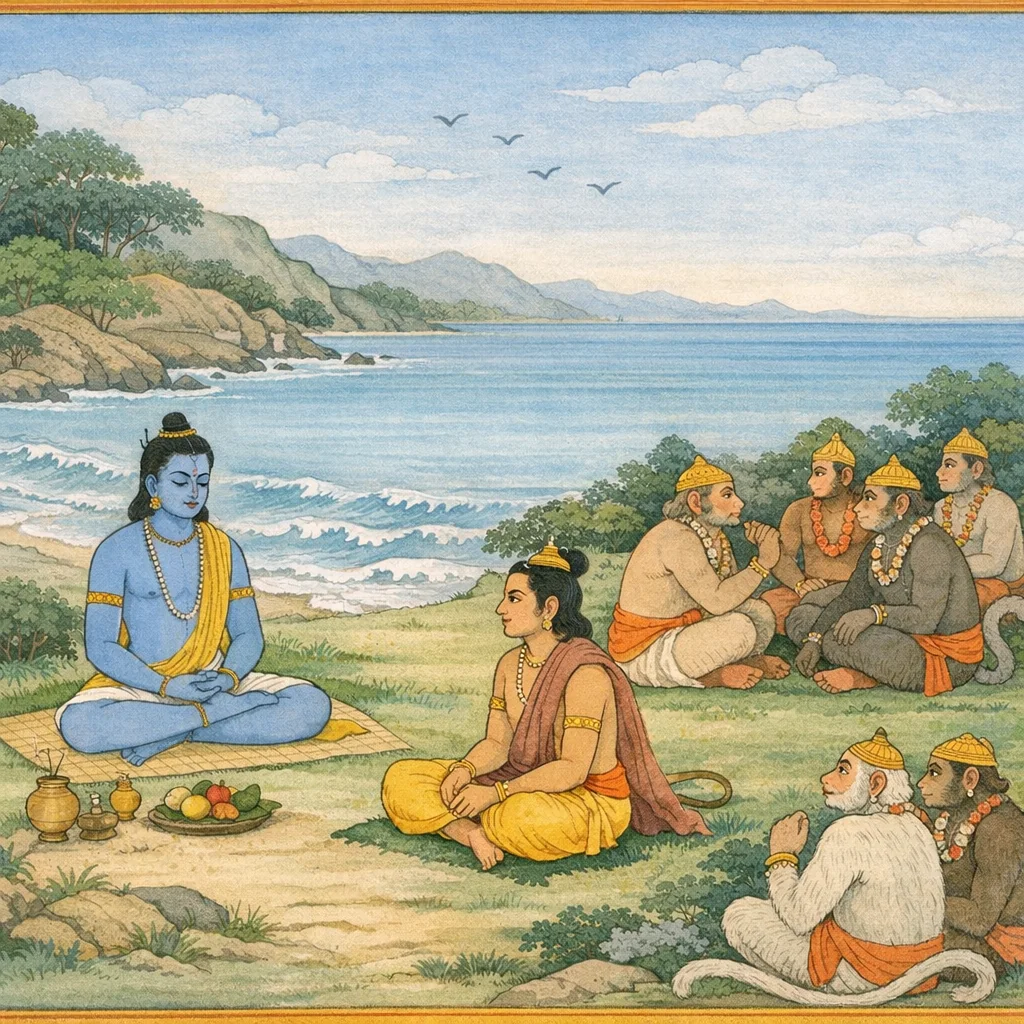
Chapter Arc: समुद्र-तट पर राम के चारों ओर वानर-सेना का महासंगठन होता है—कोटि-कोटि तरस्वी यूथपति, सुषेण, गज, गवय आदि अपने-अपने दलों सहित उपस्थित होकर लंका-गमन की घड़ी को विराट बना देते हैं। → समुद्र अजेय बाधा बनकर सामने खड़ा है। राम उपाय से पहले विनय चुनते हैं—समुद्र की आराधना और उपवास का संकल्प; पर भीतर-ही-भीतर यह भी स्पष्ट कर देते हैं कि यदि मार्ग न मिला तो वे अप्रतिहत महास्त्रों से समुद्र को दग्ध कर देंगे। → राम का निर्णायक संकल्प—‘मार्ग न दिखा तो दहन’—प्रकृति के सामने धर्म-बल और राज-बल का चरम उद्घोष बनता है; इसी निर्णायक क्षण से समाधान का द्वार खुलता है और सेतु-निर्माण की दिशा निश्चित होती है। → विभीषण की सम्मति के अनुसार सेतु के द्वारा राम एक मास में समस्त सेना सहित महासागर को पार करते हैं। मार्ग बन जाता है, अभियान को ठोस आधार मिलता है, और लंका के द्वार पर युद्ध की भूमिका तैयार हो जाती है। → लंका-समक्ष पहुँचकर राक्षस-दूत अपने वास्तविक रूप में प्रकट होते हैं; राम उन्हें अपनी सेना का दर्शन कराकर छोड़ देते हैं—अब अगला चरण सीधे लंका-युद्ध की देहरी पर है।
Shlokas
Verse 1
(दाक्षिणात्य अधिक पाठका ३ श्लोक मिलाकर कुल ७१ ६ “लोक हैं) 3 “+(>9) #2<# # 5-7 त्रयशीर्त्याधिकद्विशततमो< ध्याय: वानर-सेनाका संगठन, है का का निर्माण, विभीषणका अभिषेक और लंकाकी सेनाका प्रवेश तथा अंगदको रावणके पास दूत बनाकर भेजना मार्कण्डेय उवाच ततस्तत्रैव रामस्य समासीनस्य तै: सह । समाजग्मु: कपिश्रेष्ठा: सुग्रीववचनात् तदा,मार्कण्डेयजी कहते हैं--युधिष्ठिर! तदनन्तर सुग्रीवकी आज्ञाके अनुसार बड़े-बड़े वानरवीर माल्यवान् पर्वतपर लक्ष्मण आदिके साथ बैठे हुए भगवान् श्रीरामके पास पहुँचने लगे
Mārkaṇḍeya said: Then, at that very place, while Rāma was seated there together with them, the foremost of the monkeys assembled and came to him at that time, in obedience to Sugrīva’s command. The scene underscores disciplined leadership and collective readiness: a community responds promptly to rightful direction in service of a just cause.
Verse 2
वृत: कोटिसहस्रेण वानराणां तरस्विनाम् । श्वशुरो वालिन: श्रीमान् सुषेणो राममभ्ययात्,सबसे पहले वालीके श्वशुर श्रीमान् सुषेण श्रीरामचन्द्रजीकी सेवामें उपस्थित हुए। उनके साथ वेगशाली वानरोंकी सहस्र कोटि (दस अरब) सेना थी
Mārkaṇḍeya said: Surrounded by a thousand crores of swift and powerful monkeys, the illustrious Suṣeṇa—Vālin’s father-in-law—came forward to Rāma. The scene underscores loyal service and timely alliance: strength is gathered not for pride, but to support a righteous cause through disciplined devotion and solidarity.
Verse 3
कोटीशतवृतो वापि गजो गवय एव च । वानरेन्द्रौ महावीर्यों पृथक् पृथगदृश्यताम्,फिर महापराक्रमी वानरराज “गज” और “गवय' पृथक्-पृथक् एक-एक अरब सेनाके साथ आते दिखायी दिये
Mārkaṇḍeya said: “Then there appeared—each separately—two mighty lords of the monkeys, Gaja and Gavaya, each surrounded by hundreds of crores (vast multitudes) of followers.” The verse underscores the awe-inspiring scale of allied strength gathering in a righteous cause, suggesting that power, when marshalled in support of dharma, becomes a visible sign of collective resolve and protection.
Verse 4
षष्टिकोटिसहस्राणि प्रकर्षन् प्रत्यदृश्यत । गोलाड्गूलो महाराज गवाक्षो भीमदर्शन:,महाराज! गोलांगूल (लंगूर) जातिका वानर गवाक्ष, जो देखनेमें बड़ा भयंकर था, साठ सहस्र कोटि (छ: खरब) वानर-सेना साथ लिये दृष्टिगोचर हुआ
Mārkaṇḍeya said: “O great king, there then came into view Gavākṣa—of the golāṅgūla (langūr) kind—terrible to behold, advancing with an immense host numbering sixty thousand crores.” The passage underscores the awe-inspiring scale of disciplined collective strength gathered in service of a righteous cause, where power is portrayed as effective when organized and led.
Verse 5
गन्धमादनवासी तु प्रथितो गन्धमादन: । कोटीशतसहस््राणि हरीणां समकर्षत,गन्धमादन पर्वतपर रहनेवाला गन्धमादन नामसे विख्यात वानर वानरोंकी दस खरब सेना साथ लेकर आया
Mārkaṇḍeya said: “There was a renowned monkey named Gandhamādana, dwelling on Mount Gandhamādana. He gathered and brought together countless troops of monkeys—numbering in the hundreds of crores and thousands—thus swelling the strength of the vanara host.”
Verse 6
पनसो नाम मेधावी वानर: सुमहाबल: । कोटीर्दश द्वादश च त्रिंशत् पञ्च प्रकर्षति,पनस नामक बुद्धिमान् तथा महाबली वानर सत्तावन करोड़ सेना साथ लेकर आया
Mārkaṇḍeya said: “There was a monkey-chief named Panasa—wise and exceedingly strong. He mustered and brought forward an immense force, numbering ten, twelve, and thirty-five koṭis (crores).”
Verse 7
श्रीमान् दधिमुखो नाम हरिवृद्धो5तिवीर्यवान् । प्रचकर्ष महासैन्यं हरीणां भीमतेजसाम्,वानरोंमें वृद्ध तथा अत्यन्त पराक्रमी श्रीमान् दधिमुख भयंकर तेजसे सम्पन्न वानरोंकी विशाल सेना साथ लेकर आये
Mārkaṇḍeya said: There was a venerable Vānara named Dadhimukha—illustrious, aged among the monkeys, and of extraordinary prowess. He drew together and led forth a vast host of monkeys, all endowed with formidable energy, as the narrative turns toward the mobilization of righteous strength in service of a larger cause.
Verse 8
कृष्णानां मुखपुण्ड्राणामृक्षाणां भीमकर्मणाम् | कोटीशतसहस्रेण जाम्बवानू् प्रत्यदृश्यत,जिनके मुख (ललाट)-पर तिलकका चिह्न शोभा पा रहा था तथा जो भयंकर पराक्रम करनेवाले थे, ऐसे काले रंगके शतकोटि सहस्र (दस खरब) रीछोंकी सेनाके साथ वहाँ जाम्बवान् दिखायी दिये
Verse 9
एते चान्ये च बहवो हरियूथपयूथपा: । असंख्येया महाराज समीयू रामकारणात्,महाराज! ये तथा और भी बहुत-से वानर-यूथपतियोंके भी यूथपति, जिनकी कोई संख्या नहीं थी, श्रीरामचन्द्रजीके कार्यसे वहाँ एकत्र हुए
Markandeya said: “And many others too—leaders of troops and even leaders over those troop-leaders among the monkeys—countless in number, O great king, assembled there for the sake of Rama’s mission.”
Verse 10
गिरिकूटनिभाड़ानां सिंहानामिव गर्जताम् | श्रूयते तुमुल: शब्दस्तत्र तत्र प्रधावताम्,उनके अंग पर्वतोंके शिखरके सदृश जान पड़ते थे। वे सबके सब सिंहोंके समान गरजते और इधर-उधर दौड़ते थे। उन सबका सम्मिलित शब्द बड़ा भयंकर प्रतीत होता था
Mārkaṇḍeya said: “Their limbs seemed like mountain-peaks, and as they roared like lions and rushed about here and there, a tumultuous sound was heard—an overwhelming, fearsome din born of their collective movement.”
Verse 11
गिरिकूटनिभा: केचित् केचिन्महिषसंनिभा: । शरदशभ्रप्रतीकाशा: केचिद्धिड्डुलकानना:,कोई पर्वत-शिखरके समान ऊँचे थे तो कोई भैंसोंके सदूश मोटे और काले। कितने ही वानर शरद-ऋतुके बादलोंकी तरह सफेद दिखायी देते थे, कितनोंके ही मुख सिन्दूरके समान लाल रंगके थे
Mārkaṇḍeya said: “Some of them were lofty like mountain-peaks; some were thickset and dark like buffaloes. Some monkeys appeared white like the autumn clouds, while others had faces red as vermilion.”
Verse 12
उत्पतन्तः पतन्तश्न प्लवमानाश्न वानरा: । उद्धुन्वन्तो 5परे रेणून् समाजग्मु: समन्ततः,वे वानर सैनिक उछलते, गिरते-पड़ते, कूदते-फाँदते और धूल उड़ाते हुए चारों ओरसे एकत्र हो रहे थे
Markandeya said: “The monkeys—leaping up, tumbling down, and bounding across—came together from every side, while others shook and flung up clouds of dust.” The scene conveys the disciplined energy of a mobilizing force: exuberant movement harnessed toward a common purpose.
Verse 13
स वानरमहासैन्य: पूर्णसागरसंनिभ: । निवेशमकरोत तत्र सुग्रीवानुमते तदा,वानरोंकी वह विशाल सेना भरे-पूरे महासागरके समान दिखायी देती थी। सुग्रीवकी आज्ञासे उस समय माल्यवान् पर्वतके आस-पास ही उस समस्त सेनाका पड़ाव पड़ गया
Mārkaṇḍeya said: The vast army of monkeys, resembling a full and swelling ocean, then made its encampment there, with Sugrīva’s consent. The scene underscores disciplined collective action—great strength becomes effective when guided by rightful leadership and orderly coordination.
Verse 14
ततस्तेषु हरीन्द्रेषु समावृत्तेषु सर्वश: । तिथौ प्रशस्ते नक्षत्रे मुहूर्ते चाभिपूजिते,तदनन्तर उन समस्त श्रेष्ठ वानरोंक सब ओरसे एकत्र हो जानेपर सुग्रीवसहित भगवान् श्रीरामने एक दिन शुभ तिथि, उत्तम नक्षत्र और शुभ मुहूर्तमें युद्धके लिये प्रस्थान किया। उस समय ऐसा जान पड़ता था, मानो वे उस व्यूहरचनायुक्त सेनाके द्वारा सम्पूर्ण लोकोंका संहार करने जा रहे हैं
Then, when those lordly monkeys had assembled from every side, and when an auspicious lunar day, a favorable constellation, and a duly honored propitious moment had arrived, Rāma—together with Sugrīva—set out for battle. The scene appeared as though, with that army arranged in battle-formation, they were about to bring destruction upon all the worlds—an image underscoring the overwhelming force of a righteous, well-ordered campaign undertaken at the proper time.
Verse 15
तेन व्यूढेन सैन्येन लोकानुद्)र्तयन्निव । प्रययौ राघव: श्रीमान् सुग्रीवसहितस्तदा,तदनन्तर उन समस्त श्रेष्ठ वानरोंक सब ओरसे एकत्र हो जानेपर सुग्रीवसहित भगवान् श्रीरामने एक दिन शुभ तिथि, उत्तम नक्षत्र और शुभ मुहूर्तमें युद्धके लिये प्रस्थान किया। उस समय ऐसा जान पड़ता था, मानो वे उस व्यूहरचनायुक्त सेनाके द्वारा सम्पूर्ण लोकोंका संहार करने जा रहे हैं
Mārkaṇḍeya said: With that army drawn up in battle-array, the illustrious Rāghava set forth at that time together with Sugrīva, appearing as though, by means of that ordered host, he would overturn and sweep away the worlds. The verse heightens the ethical tension of righteous war: even when the cause is just, the sheer force of a disciplined army can resemble cosmic destruction, demanding restraint and dharmic purpose.
Verse 16
मुखमासीत् तु सैन्यस्य हनूमान् मारुतात्मज: । जघनं पालयामास सौमित्रिरकुतोभय:,उस सेनाके मुहानेपर वायुपुत्र हनुमानजी विद्यमान थे। किसीसे भी भय न माननेवाले सुमित्रानन्दन लक्ष्मण उसके पृष्ठभागकी रक्षा कर रहे थे
Mārkaṇḍeya said: At the very front of the army stood Hanūmān, the son of the Wind-god, embodying fearless strength and steadfast resolve. Guarding the rear was Saumitrī (Lakṣmaṇa), unshaken by any fear, ensuring that the host remained protected on all sides—an image of disciplined leadership and loyal service in the midst of peril.
Verse 17
बद्धगोधाडुलित्राणौ राघवौ तत्र जम्मतुः । वृतौ हरिमहामात्रै श्वन्द्रसूर्यों ग्रहैरिव,दोनों रघुवंशी वीर श्रीराम और लक्ष्मण हाथोंमें गोहके चमड़ेके बने हुए दस्ताने पहने हुए थे। वे ग्रहोंसे घिरे हुए चन्द्रमा और सूर्यकी भाँति वानरजातीय मन्त्रियोंके बीचमें होकर चल रहे थे
Mārkaṇḍeya said: There the two scions of Raghu—Śrī Rāma and Lakṣmaṇa—went on, their hands protected with gloves made from iguana-hide. Surrounded by the great ministers of the Vānara host, they moved forward like the moon and the sun encircled by their attendant planets—an image of rightful leadership proceeding with disciplined support.
Verse 18
प्रबभौ हरिसैन्यं तत् सालतालशिलायुधम् | सुमहच्छालिभवनं यथा सूर्योदयं प्रति
Mārkaṇḍeya said: “That army of Hari shone forth—armed with sāla and tāla trees and with rocks—like a vast, splendid palace-city gleaming as it faces the sunrise.”
Verse 19
श्रीरामचन्द्रजीके सम्मुख साल, ताल और शिलारूपी आयुध लिये वे समस्त वानर सैनिक सूर्योदयके समय पके हुए धानके विशाल खेतोंके समान जान पड़ते थे ।। नलनीलाड्डदक्राथमैन्दद्धिविदपालिता । ययौ सुमहती सेना राघवस्यार्थसिद्धये,नल, नील, अंगद, क्राथ, मैन्द तथा द्विविदके द्वारा सुरक्षित हुई वह विशाल वानरसेना श्रीरामचन्द्रजीका कार्य सिद्ध करनेके लिये आगे बढ़ती चली जा रही थी
Markandeya said: Facing Śrī Rāmacandra, the entire host of monkey-warriors, bearing weapons like sāla and tāla trees and great rocks, appeared at sunrise like vast fields of ripened rice. Guarded and led by Nala, Nīla, Aṅgada, Krātha, Mainda, and Dvivida, that immense army marched onward to accomplish Rāghava’s purpose—an image of disciplined strength placed in the service of a righteous aim.
Verse 20
विविधेषु प्रशस्तेषु बहुमूलफलेषु च । प्रभूतमधुमूलेषु वारिमत्सु शिवेषु च,जहाँ फल-मूलकी बहुतायत होती, मधु और कन्द-मूल प्रचुरमात्रामें उपलब्ध होते तथा जलकी अधिक सुविधा होती, ऐसे कल्याणकारी और उत्तम विविध पर्वतीय शिखरोंपर डेरा डालती हुई वह वानरसेना बिना किसी विघ्न-बाधाके खारे पानीवाले समुद्रके निकट जा पहुँची
Mārkaṇḍeya said: Moving from one auspicious place to another—mountain heights renowned for their abundance of fruits and roots, rich in honey and edible tubers, and well supplied with water—the monkey host made its encampments without hindrance and at last drew near to the sea of salt water. The passage highlights prudent leadership: choosing fertile, well-watered, and safe terrain sustains a community and enables a righteous mission to proceed without needless suffering.
Verse 21
निवसन्ती निराबाधा तथैव गिरिसानुषु । उपायाद्धरिसेना सा क्षारोदमथ सागरम्,जहाँ फल-मूलकी बहुतायत होती, मधु और कन्द-मूल प्रचुरमात्रामें उपलब्ध होते तथा जलकी अधिक सुविधा होती, ऐसे कल्याणकारी और उत्तम विविध पर्वतीय शिखरोंपर डेरा डालती हुई वह वानरसेना बिना किसी विघ्न-बाधाके खारे पानीवाले समुद्रके निकट जा पहुँची
Mārkaṇḍeya said: Dwelling without hindrance on the slopes and ridges of the mountains, the army of Hari (the vānaras) moved on and at last reached the ocean of salt water. The sense is that they advanced by making camps on auspicious, well-provisioned mountain peaks—rich in fruits and roots, with abundant honey and tubers, and with ready access to water—thus proceeding in an orderly, unharmed manner toward their goal.
Verse 22
द्वितीयसागरनिभं तद् बल॑ बहुलध्वजम् | वेलावनं समासाद्य निवासमकरोत् तदा,असंख्य ध्वजा-पताकाओंसे सुशोभित वह विशाल वाहिनी दूसरे महासागरके समान जान पड़ती थी। सागरके तटवर्ती वनमें पहुँचकर उसने अपना पड़ाव डाला
Mārkaṇḍeya said: That army, thick with many banners, looked like a second ocean. Reaching the forest along the seashore, it then made its camp there—an image of vast power pausing at the boundary of the sea, reminding that even great force must submit to place, time, and order.
Verse 23
ततो दाशरथि: श्रीमान् सुग्रीव॑ प्रत्यभाषत । मध्ये वानरमुख्यानां प्राप्तकालमिदं वच:,तत्पश्चात् मुख्य-मुख्य वानरोंके बीचमें बैठे हुए दशरथनन्दन भगवान् श्रीरामने सुग्रीवसे यह समयोचित बात कही--
Then the illustrious son of Daśaratha, Rāma, addressed Sugrīva. Seated in the midst of the foremost of the Vānara leaders, he spoke words timely to the occasion—speech guided by discernment of what the moment demanded and by the responsibilities of leadership.
Verse 24
उपाय: को नु भवतां मतः सागरलड्घने । इयं हि महती सेना सागरश्नातिदुस्तर:,“मित्रो! हमारी यह सेना बहुत बड़ी है और सामने अत्यन्त दुस्तर महासागर लहरें ले रहा है। ऐशी दशामें आपलोग समुद्रके पार जानेके लिये कौन-सा उपाय ठीक समझते हैं?
Mārkaṇḍeya said: “What means, in your judgment, should be adopted for crossing the ocean? For this army is indeed vast, and the ocean before us is exceedingly hard to pass.”
Verse 25
तत्रान्ये व्याहरन्ति सम वानरा बहुमानिन: । समर्था लड्घने सिन्धोर्न तु तत् कृत्स्नकारकम्,तब वहाँ बहुत-से दूसरे-दूसरे वानर, जो बड़े अभिमानी थे, कहने लगे--“'हम तो समुद्रको लाँघ जानेमें समर्थ हैं, परंतु सब नहीं लाँध सकते”
Then other monkeys too—proud and self-assured—spoke up there: “We are capable of leaping across the ocean; yet we cannot accomplish the whole task in its entirety.” The line highlights how boastful confidence meets the ethical demand for complete responsibility: ability is not the same as fulfilling the entire duty.
Verse 26
केचिन्नौभिव्यवस्यन्ति केचिच्च विविधै: प्लवै: । नेति रामस्तु तान् सर्वान् सान्त्वयन् प्रत्यभाषत,कुछ वानर बड़ी-बड़ी नावोंके द्वारा समुद्रके पार जानेका निश्चय प्रकट करने लगे। कुछने नाव-डोंगी आदि विविध साधनोंद्वारा पार जानेकी बात बतायी। परंतु श्रीरामचन्द्रजीने उनकी यह सलाह माननेसे इनकार कर दिया और सबको सान्त्वना देते हुए कहा--
Mārkaṇḍeya said: Some resolved to cross the ocean by means of boats, while others proposed various kinds of rafts and floating devices. But Rāma declined all those suggestions; consoling everyone, he addressed them with reassuring words—signaling that the undertaking should proceed not by anxious improvisation, but through a steadier, more fitting course of action.
Verse 27
शतयोजन विस्तारं न शक्ता: सर्ववानरा: । क्रान्तुं तोयनिधिं वीरा नैषा वो नैप्ठेकी मति:,“वीरो! सभी वानरोंमें इतनी शक्ति नहीं है कि वे सौ योजन विस्तृत समुद्रको लाँघ सकें; अतः तुम लोगोंका यह निर्णय सर्वमान्य सिद्धान्तके रूपमें ग्राह्म नहीं है
Mārkaṇḍeya said: “O heroes, all the monkeys together are not capable of leaping across the ocean, which spans a hundred yojanas. Therefore, this resolve of yours cannot be accepted as a sound and universally reliable principle.”
Verse 28
नावो न सन्ति सेनाया बह्वदयस्तारयितुं तथा । वणिजामुपघातं च कथमस्मद्विधश्चरेत्,“इतनी बड़ी सेनाको पार उतारनेके लिये हमलोगोंके पास अधिक नौकाएँ भी नहीं हैं। (यदि कहें, व्यापारियोंके जहाजोंसे काम लिया जाय, तो) मेरे-जैसा पुरुष अपने स्वार्थके लिये व्यापारियोंके व्यवसायको हानि कैसे पहुँचा सकता है?
Mārkaṇḍeya said: “We do not have enough boats and the like to ferry so vast an army across. And if one suggests using the merchants’ vessels, how could a man like me, for the sake of his own purpose, bring harm to the livelihood and enterprise of traders?”
Verse 29
विस्तीर्ण चैव नः सैन्यं हन्याच्छिद्रेण वै पर: । प्लवोडुपप्रतारश्न नैवात्र मम रोचते,“इसके सिवा नौका आदिसे यात्रा करनेपर हमारी सेना छिट-फुट होकर बहुत दूरतक फैल जायगी। उस दशामें अवसर पाकर शत्रु इसका नाश भी कर सकता है। इसीलिये डोंगी और नाव आदिपर बैठकर पार उतरनेकी बात मुझे ठीक नहीं जँचती है
Mārkaṇḍeya said: “If we attempt to cross by small boats and rafts, our army will be scattered and stretched out over a great distance. Then the enemy, finding an opening, could strike and destroy it. Therefore, the plan of crossing seated in dinghies and boats does not appeal to me here.”
Verse 30
अहं त्विमं जलनिर्धि समारप्स्याम्युपायतः । प्रतिशेष्याम्युपवसन् दर्शयिष्यति मां ततः,“मैं तो किसी उपायसे इस समुद्रकी ही आराधना आरम्भ करूँगा। इसके तटपर अन्न- जल छोड़कर धरना दूँगा। इससे यह अवश्य मुझे दर्शन देगा तथा कोई मार्ग दिखायेगा
Markandeya said: “I shall begin, by some means, the propitiation of this very ocean. Fasting, I will sit in steadfast vigil upon its shore, renouncing food and water. Then it will surely grant me its vision and, thereafter, reveal a way forward.”
Verse 31
न चेद् दर्शयिता मार्ग धक्ष्याम्पेनमहं ततः । महास्त्रैरप्रतिहतैरत्यग्निपवनोज्ज्वलै:,“यदि यह स्वयं प्रकट होकर कोई मार्ग नहीं दिखायेगा तो मैं अग्नि और वायुसे भी अधिक तेजस्वी तथा कभी न चूकनेवाले महान दिव्यास्त्रोंद्रारा इसे जलाकर भस्म कर डालूँगा'
Verse 32
इत्युक्त्वा सह सौमित्रिरुपस्पृश्याथ राघव: । प्रतिशिश्ये जलनिधिं विधिवत् कुशसंस्तरे,ऐसा कहकर लक्ष्मणसहित श्रीरामचन्द्रजीने आचमन करके समुद्रके तटपर कुशकी चटाई बिछाकर उसपर लेटकर विधिपूर्वक धरना दे दिया
Having spoken thus, Rāghava—together with Saumitrī—performed the prescribed purification by sipping water, and then, on the shore of the ocean, spread a mat of kuśa grass. Lying upon it in due ritual form, he undertook a disciplined vow of resolve (dharṇā), embodying self-restraint and lawful means even in the face of urgent necessity.
Verse 33
सागरस्तु ततः स्वप्ने दर्शयामास राघवम् | देवो नदनदीभर्ता श्रीमान् यादोगणैर्वृत:,तब नदों और नदियोंके स्वामी श्रीमान् समुद्रदेवने जल-जन्तुओंके साथ प्रकट होकर स्वप्नमें श्रीरामचन्द्रजीको दर्शन दिया
Then, in a dream, the Ocean revealed himself to Rāghava (Śrī Rāma). The illustrious Ocean-god—lord of rivers and streams—appeared surrounded by hosts of aquatic beings, granting Rāma a vision that signals divine responsiveness to steadfast resolve and righteous purpose.
Verse 34
कौसल्यामातरित्येवमाभाष्य मधुरं वच: । इदमित्याह रत्नानामाकरै: शतशो वृत:,वह सैकड़ों रत्नके आकरोंसे घिरा हुआ था। उसने “कौसल्यानन्दन” कहकर श्रीरामको सम्बोधित किया और मधुर वाणीमें इस प्रकार कहा--
Mārkaṇḍeya said: Addressing him sweetly with the words, “O son of Kausalyā,” he spoke in a gentle voice: “Here it is.” He was surrounded on all sides by hundreds of mines and sources of precious gems—suggesting abundance offered with courteous, respectful speech rather than harsh command.
Verse 35
ब्रृहि कि ते करोम्यत्र साहाय्यं पुरुषर्षभ । ऐक्ष्वाको हास्मि ते ज्ञातिरिति रामस्तमब्रवीत्,“नरश्रेष्ठ! कहो, मैं यहाँ तुम्हारी क्या सहायता करूँ? सगरपुत्रोंसे संवर्धित होनेके कारण मैं भी इक्ष्वाकुवंशीय तथा तुम्हारा भाई-बन्धु हूँ"। यह सुनकर श्रीरामचन्द्रजीने उससे कहा --
Rama said to him: “Tell me, bull among men—what help shall I render you here? I am an Ikṣvāku by lineage and your kinsman; therefore speak without hesitation.” In this exchange, Rama frames assistance not as mere favor but as a duty grounded in shared lineage and righteous solidarity.
Verse 36
मार्गमिच्छामि सैन्यस्य दत्तं नदनदीपते । येन गत्वा दशग्रीवं हन्यां पौलस्त्यपांसनम्,“नद-नदीश्वर! मैं अपनी सेनाके लिये तुम्हारे द्वारा दिया हुआ मार्ग चाहता हूँ, जिससे जाकर पुलस्त्यकुलांगार दशमुख रावणको मार सकूँ
Mārkaṇḍeya said: “O lord of rivers and streams, I seek the route you have granted for my army—so that, going by it, I may strike down Daśagrīva (Rāvaṇa), the scourge of the Pulastya line.”
Verse 37
यद्येवं याचतो मार्ग न प्रदास्यति मे भवान् | शरैस्त्वां शोषयिष्यामि दिव्यास्त्रप्रतिमन्त्रितै:,“यदि इस प्रकार याचना करनेपर तुम मुझे मार्ग न दोगे तो मैं दिव्यास्त्रोंसे अभिमन्त्रित बाणोंद्वारा तुम्हें सुखा दूँगा”
Mārkaṇḍeya said: “If, even after my request, you will not grant me passage, then I shall dry you up with arrows empowered by divine weapons and charged with their counter-mantras.” The line frames a moral tension: a rightful plea for safe passage is met with refusal, and the speaker escalates from supplication to coercive force, invoking sacred power as a means to compel compliance.
Verse 38
इत्येवं ब्रुवत: श्रुत्वा रामस्य वरुणालय: । उवाच व्यथितो वाक्यमिति बद्धाञ्जलि: स्थित:,श्रीरामचन्द्रजीका यह वचन सुनकर वरुणालय समुद्र व्यथित हो उठा और खड़े हुए हाथ जोड़कर बोला--
Markandeya said: Hearing Rama speak in this manner, the ocean—Varuṇa’s abode—was shaken with distress. Standing with folded hands, he then addressed Rama with these words, acknowledging the moral force of Rama’s resolve and the duty to respond rightly.
Verse 39
नेच्छामि प्रतिघातं ते नास्मि विघ्नकरस्तव । शृणु चेदं वचो राम श्रुत्वा कर्तव्यमाचर,“श्रीराम! मैं तुम्हारा सामना करना नहीं चाहता और न मैं तुम्हारे मार्गमें विघ्न डालनेकी ही इच्छा रखता हूँ। मेरी यह बात सुनो और सुनकर जो कर्तव्य हो, उसे करो
Mārkaṇḍeya said: “I do not wish to oppose you, nor am I one who would place obstacles in your path. Listen to these words of mine, O Rāma; having heard them, act in the way that duty requires.”
Verse 40
यदि दास्यामि ते मार्ग सैन्यस्य व्रजतो55ज्ञया । अन्ये>प्याज्ञापयिष्यन्ति मामेवं धनुषो बलात्,“यदि मैं इस समय तुम्हारी आज्ञासे तुम्हें और लंका जाती हुई तुम्हारी सेनाको मार्ग दे दूँगा तो दूसरे लोग भी इसी प्रकार धनुषके बलसे मुझपर हुक्म चलाया करेंगे
Mārkaṇḍeya said: “If, at your command, I were to show the route to your army as it marches on, then others too would begin to order me about in the same way—by the sheer force of the bow. To yield once to coercion is to invite a world where might replaces right.”
Verse 41
अस्ति त्वत्र नलो नाम वानर: शिल्पिसम्मत: । त्वष्टदेंवस्य तनयो बलवान विश्वकर्मण:,“तुम्हारी सेनामें एक नल नामक वानर है जो शिल्पियोंके लिये भी आदरणीय है। बलवान् नल देवशिल्पी विश्वकर्माका पुत्र है
Mārkaṇḍeya said: “Here among you there is a monkey named Nala, esteemed even by master craftsmen. He is powerful, the son of the divine artisan Viśvakarman, born of the god Tvaṣṭṛ.” The statement highlights that skill used in service of a righteous cause is itself worthy of honor, and that capability joined with proper purpose becomes a support for dharma.
Verse 42
स यत् काष्ठ तृणं वापि शिलां वा क्षेप्स्यते मयि । सर्व तद् धारयिष्यामि स ते सेतुर्भविष्यति,“वह अपने हाथसे उठाकर जो भी काठ, तिनका या पत्थर मेरे भीतर डाल देगा, वह सब मैं जलके ऊपर-धारण किये रहूँगा। वही तुम्हारे लिये पुल हो जायगा”
Mārkaṇḍeya said: “Whatever piece of wood, blade of grass, or stone he may cast into me, I shall bear it all upon the waters. That very mass will become your bridge.”
Verse 43
इत्युक्त्वान्तरहिते तस्मिन् रामो नलमुवाच ह । कुरु सेतु समुद्रे त्वं शक्तो हसि मतो मम,ऐसा कहकर समुद्र अन्तर्धान हो गया। तत्पश्चात् श्रीयीमने उठकर नलसे कहा--“तुम समुद्रपर एक पुल तैयार करो। मैं जानता हूँ, तुममें यह कार्य करनेकी शक्ति है”
When the Sea had spoken thus and then vanished from sight, Rama addressed Nala: “Build a causeway across the ocean. In my judgment, you have the strength and skill to accomplish this.” The moment underscores righteous leadership: Rama does not yield to despair after the Sea’s withdrawal, but turns to capable human agency and assigns duty to the one fit for it.
Verse 44
तेनोपायेन काकुत्स्थ: सेतुबन्धमकारयत् । दशयोजनविस्तारमायतं शतयोजनम्,उसी उपायसे रघुनाथजीने समुद्रपर सौ योजन लंबा और दस योजन चौड़ा पुल तैयार कराया
Markandeya said: By that very means, Kakutstha (Rama) caused a causeway to be built across the sea—one hundred yojanas in length and ten yojanas in breadth. The episode highlights resolute, dharma-aligned leadership: when a righteous aim is fixed, one must employ fitting means and organized effort to overcome even seemingly insurmountable obstacles.
Verse 45
नलसेतुरिति ख्यातो योडद्यापि प्रथितो भुवि | रामस्थाज्ञां पुरस्कृत्य निर्यातो गिरिसंनिभ:,वह आज भी भूमण्डलमें “नलसेतु” के नामसे विख्यात है। श्रीरामजीकी आज्ञा मानकर समुद्रने उस पर्वताकार पुलको अपने ऊपर धारण किया
“That bridge is famed as ‘Nala’s Causeway’ and is renowned on the earth even today. Honouring Rāma’s command, the ocean bore upon itself that mountain-like bridge.”
Verse 46
तत्रस्थं स तु धर्मात्मा समागच्छद् विभीषण: । भ्राता वै राक्षसेन्द्रस्य चतुर्भि: सचिवै: सह,श्रीरामचन्द्रजी अभी समुद्रके किनारे ही थे कि राक्षसराज रावणके भाई धर्मात्मा विभीषण अपने चार मन्सत्रियोंक साथ उनसे मिलनेके लिये आये
While Śrī Rāma was staying there (on the seashore), the righteous-souled Vibhīṣaṇa—brother of the lord of the Rākṣasas (Rāvaṇa)—came to meet him, accompanied by four ministers. The episode highlights how allegiance to dharma can lead one to renounce an unrighteous cause even when bound by family ties.
Verse 47
7 जन ] ४! । (/9,|।। #//7+7) ९३४४ ।। प्रतिजग्राह समस्तं स्वागतेन महामना: । सुग्रीवस्य तु शड्काभूत् प्रणिधि: स्यादिति सम ह,महामना श्रीरामने स्वागतपूर्वक उन्हें अपनाया। उस समय सुग्रीवके मनमें यह शंका हुई कि “कहीं यह शत्रुका कोई गुप्तचर न हो”
The great-souled one (Rāma) received them all with due words of welcome. Yet in Sugrīva’s mind a doubt arose: “Could this be an enemy’s spy?” The passage highlights the ethical tension between hospitality and prudent vigilance in uncertain circumstances.
Verse 48
राघव: सत्यचेष्टाभि: सम्यक् च चरितेज्डितै: । यदा तत्त्वेन तुष्टो$भूत् तत एनमपूजयत्,परंतु श्रीरामचन्द्रजीने उनकी सत्य चेष्टाओं, उत्तम आचरणों और मुख-नेत्र आदिके संकेतोंसे सूचित होनेवाले मनोभावोंकी सम्यक् समीक्षा करके जब अच्छी तरह संतोष प्राप्त कर लिया, तब विभीषणका बहुत आदर किया
Rāghava (Śrī Rāma), after carefully assessing Vibhīṣaṇa’s truthful efforts, his upright conduct, and the sincerity revealed through his gestures and expressions, became fully satisfied as to his real intent; then, grounded in that discernment, he honored him with due respect.
Verse 49
सर्वराक्षसराज्ये चाप्यभ्यषिज्चद् विभीषणम् । चक्रे च मन्त्रसचिवं सुहृदं लक्ष्मणस्थ च
Mārkaṇḍeya said: “And over the entire kingdom of the Rākṣasas he consecrated Vibhīṣaṇa as king; and he also appointed Lakṣmaṇa—his trusted friend—as a minister and counsellor. Thus, after victory, rule was established not by mere force but by rightful installation, counsel, and loyal friendship.”
Verse 50
विभीषणमते चैव सोउत्यक्रामन्महार्णवम् । ससैन्य: सेतुना तेन मासेनैव नराधिप,नरेश्वरर विभीषणकी सलाहसे श्रीरामचन्द्रजीने उसी सेतुद्वारा एक ही महीनेमें सेनासहित महासागरको पार कर लिया
Mārkaṇḍeya said: “Acting in accordance with Vibhīṣaṇa’s counsel, he crossed the vast ocean. O king, with his entire army he traversed it by that bridge, accomplishing the passage within a single month.” The verse highlights prudent reliance on wise advice and disciplined collective effort in the pursuit of a righteous objective.
Verse 51
ततो गत्वा समासाद्य लड़कोद्यानान्यनेकश: । भेदयामास कपिभिर्महान्ति च बहूनि च,तत्पश्चात् उन्होंने लंकाकी सीमामें पहुँचकर वानरोंद्वारा वहाँके बहुत-से बड़े-बड़े उद्यानोंको छिन्न-भिन्न करा दिया
Then, having gone and reached the many pleasure-gardens of Laṅkā, he had the monkeys break up and lay waste to numerous great parks there. The episode underscores how a strategic show of force—directed against symbols of royal pride and security—can serve a larger righteous aim in war, while also warning that power, once unleashed, readily turns to widespread destruction.
Verse 52
ततस्तौ रावणामात्यौ मन्त्रिणौ शुकसारणौ । चरौ वानररूपेण तौ जग्राह विभीषण:,उस सेनामें वानरोंका रूप घारण करके रावणके दो मन्त्री शुक और सारण गुप्तचरका काम करनेके लिये घुस आये थे। विभीषणने उन दोनोंको पहचानकर कैद कर लिया
Then those two ministers of Rāvaṇa—Śuka and Sāraṇa—entered as spies, having assumed the guise of monkeys. Vibhīṣaṇa recognized them and seized them. The episode highlights the ethical tension in warfare: intelligence-gathering through disguise is a common stratagem, yet the opposing side is equally justified in detecting and restraining infiltrators, especially when the aim is to protect the army and prevent harm.
Verse 53
प्रतिपन्नौ यदा रूप॑ राक्षसं तौ निशाचरौ । दर्शयित्वा तत: सैन्यं राम: पश्चादवासृजत्
Mārkaṇḍeya said: “When those two night-roaming beings had assumed a rākṣasa form, Rāma first revealed the army to them, and only afterwards let it loose (to act).”
Verse 54
जब वे दोनों निशाचर अपने राक्षसरूपमें प्रकट हुए, तब श्रीरामने उन्हें अपनी सेनाका दर्शन कराकर छोड़ दिया ।। निवेश्योपवने सैन्यं तत् पुर: प्राज्ञवानरम् । प्रेषयामास दौत्येन रावणस्य ततो$5ज्भदम्,लंकापुरीके उपवनमें वानरसेनाको ठहराकर श्रीरघुनाथजीने बुद्धिमान् वानर अंगदको दूतके रूपमें रावणके यहाँ भेजा
After stationing the monkey-army in the grove near the city, Śrī Rāma—acting with foresight—sent the wise Vānara Aṅgada as an envoy to Rāvaṇa. The episode underscores a ruler’s ethical preference for counsel and diplomacy before force, even when war appears imminent.
Verse 59
साथ ही उन्हें समस्त राक्षसोंके राज्यपर अभिषिक्त कर दिया और लक्ष्मणका सुहृद् तथा अपना सलाहकार बना लिया
Markandeya said: Along with this, he consecrated them to sovereignty over the entire realm of the Rakshasas, and he made Lakshmana both a trusted friend and his own counsellor—thus consolidating rule through legitimate investiture and prudent guidance.
Verse 283
इति श्रीमहाभारते वनपर्वणि रामोपाख्यानपर्वणि सेतुबन्धने त्रयशीत्यधिकद्धिशततमो< ध्याय:,इस प्रकार श्रीमह्ााभारत वनपर्वके अन्तर्गत रामोपाख्यानपर्वमें सेतुबन्धविषयक दो सौ तिरासीवाँ अध्याय पूरा हुआ
Thus, in the Śrī Mahābhārata, within the Vana Parva, in the section known as the Rāmopākhyāna, the chapter concerning the building of the bridge (to Laṅkā) comes to an end—this being the two-hundred-and-eighty-third chapter. The colophon marks the completion of this narrative unit, underscoring the righteous resolve and disciplined effort by which a just cause is advanced through collective action and steadfast leadership.
Frequently Asked Questions
Whether the pursuit of enduring fame justifies self-harm or avoidable loss of life; Sūrya argues that fame sought through prāṇa-virodha is self-defeating and ethically unsound.
Reputation is ethically meaningful when aligned with the preservation of life and the capacity to fulfill duties; prudence and self-protection can be dharmic when they sustain one’s responsibilities.
No explicit phalaśruti is stated; the meta-level emphasis is practical: dharma is evaluated through lived consequence—only the living can enact duty and meaningfully receive the fruits of fame.