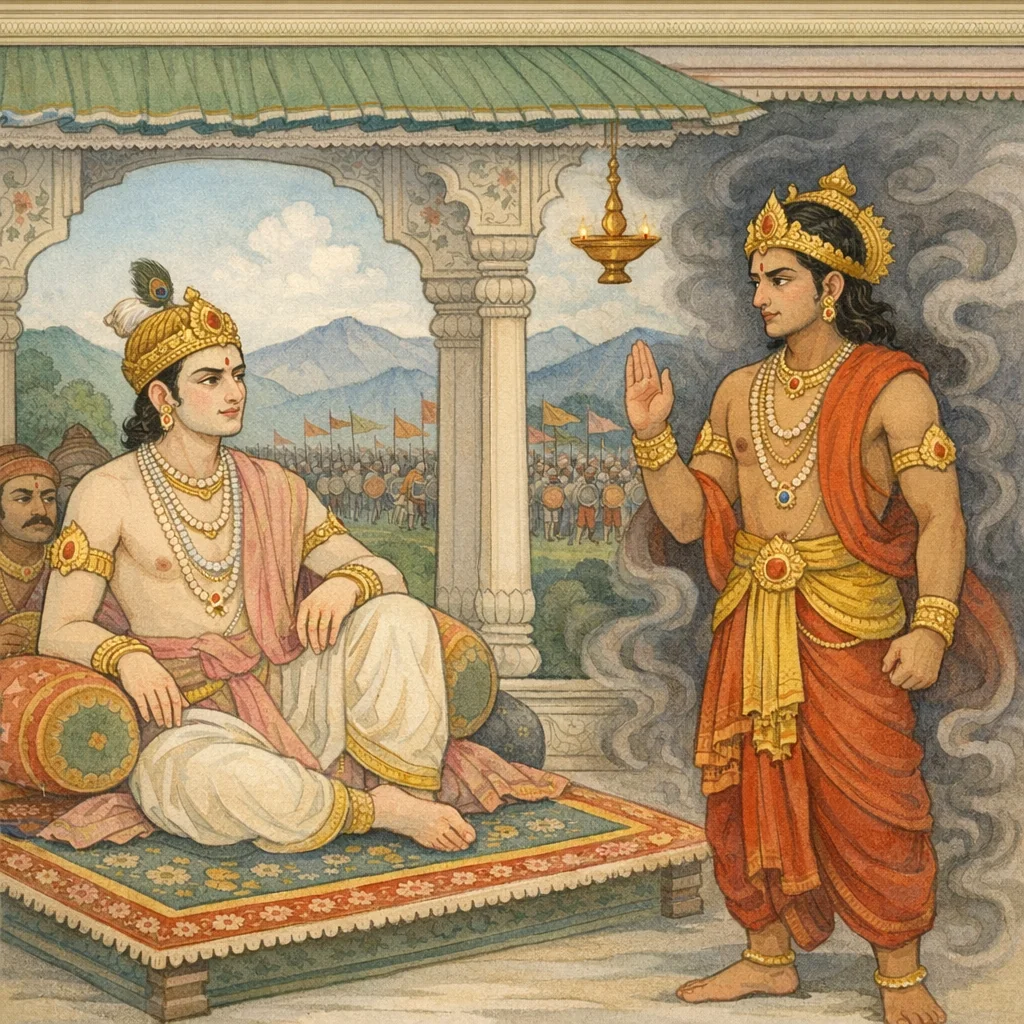
Adhyaya 253
Draupadī-apaharaṇa-saṃdeśaḥ (Report of Draupadī’s Abduction and the Pāṇḍavas’ Pursuit)
Upa-parva: Draupadī-haraṇa-anuyāna (Jayadratha Episode) — Kāmya-ka Forest Context
Vaiśaṃpāyana describes the Pāṇḍavas moving through the forest after hunting, hearing unsettling animal cries and interpreting them as signs of disorder. They turn toward the hermitage area with urgency. A jackal’s call on the left is treated as an inauspicious omen; Yudhiṣṭhira interprets it as indicating hostile action by the Kurus. The party enters the woods and finds a weeping girl—identified as Dhātreyikā, an attendant connected to Draupadī—who is questioned by Indrasena about the cause of distress and the safety of Draupadī. The attendant reports that Jayadratha has forcibly taken Draupadī, disregarding the Pāṇḍavas’ status. She points to fresh tracks and broken vegetation, urging immediate pursuit and arming. The attendant’s lament uses stark ritual and social inversions to communicate the severity of the transgression. Yudhiṣṭhira instructs her to restrain harsh speech even while acknowledging that rulers can act deceptively when intoxicated by power. The Pāṇḍavas then pursue rapidly along the indicated path, with Dhaulmya visible amid infantry, and their anger intensifies as they sight the dust of Jayadratha’s moving force and glimpse Draupadī on his chariot, prompting shouted challenge by Bhīma, Arjuna, the twins, and Yudhiṣṭhira.
Chapter Arc: हस्तिनापुर की राजनीति में अचानक अंधकार उतरता है—दुर्योधन अपमान और भय से प्रायोपवेशन (अनशन) पर बैठ जाता है, और सभा में यह प्रश्न गूंजता है कि क्या कुरुवंश का युवराज स्वयं को ही नष्ट कर देगा। → दानव-प्रेरित सलाहकार दुर्योधन को ‘साहस’ कहकर डांटते हैं, पर उसी डांट के भीतर उसे और कठोर, पाप-प्रधान उपायों की ओर मोड़ते हैं—अर्जुन-भय को लक्ष्य बनाकर वध-योजना, संशप्तकों का उकसाया जाना, और कर्ण को प्रतिज्ञा-बंधन में कसना। साथ ही, रज-तम से आक्रान्त होकर योद्धाओं के चित्त पर राक्षसी प्रभाव फैलता है; यहां तक कि भीष्म, द्रोण, कृप भी पाण्डव-स्नेह से विचलित दिखाए जाते हैं। → कर्ण, आविष्ट-चित्त होकर, दुर्योधन के भय का उत्तर प्रतिज्ञा में देता है—‘सत्यं ते प्रतिजानामि वधिष्यामि रणेऽर्जुनम्’—और दुर्योधन अनशन त्यागकर हस्तिनापुर लौटने/प्रस्थान का निश्चय करता है; राक्षसी प्रेरणा अब व्यक्तिगत शोक नहीं, संगठित हिंसा का रूप ले लेती है। → दुर्योधन का प्रायोपवेशन टूटता है, पर शांति से नहीं—उसके स्थान पर अर्जुन-वध की योजनाबद्ध प्रतिज्ञा, संशप्तक-उत्साह, और कौरव-सेना का सुसज्जित, ध्वज-पताका-छत्रों से भरा प्रस्थान स्थापित होता है; संकट टलता नहीं, दिशा बदलता है। → रज-तम से आक्रान्त संशप्तक और कर्ण की प्रतिज्ञा के साथ कौरव-सेना आगे बढ़ती है—अब प्रश्न यह है कि यह ‘अर्जुन-वध’ का उन्माद किसे पहले निगलेगा: अर्जुन को, या स्वयं कुरुवंश की मर्यादा को?
Shlokas
Verse 1
हि मय ० (0) है 7 द्विपज्चाशर्दाधिकद्विशततमो< ध्याय: सर्नेपर दुर्योधन धनको समझाना और कर्णके अनुरोध करनेपर दुयोधनका अनशन त्याग करके हस्तिनापुरको प्रस्थान दानवा ऊचु: भो: सुयोधन राजेन्द्र भरतानां कुलोद्वह । शूरै: परिवृतो नित्यं तथैव च महात्मभि:,दानव बोले--भरतवंशका भार वहन करनेवाले महाराज सुयोधन! आप सदा शूरवीरों तथा महामना पुरुषोंसे घिरे रहते हैं, फिर आपने यह आमरण उपवास करनेका साहस क्यों किया है? आत्महत्या करनेवाला पुरुष तो अधोगतिको प्राप्त होता है और लोकमें उसकी निन््दा होती है, जो अयश फैलानेवाली है
Vaiśampāyana said: The Dānavas spoke—“O Suyodhana, king among rulers, upholder of the Bharata lineage! You are always surrounded by heroes and by great-souled men. Why, then, did you dare to undertake a fast unto death? A man who destroys himself falls to a lower state, and in the world he earns blame—spreading only ill-fame.”
Verse 2
अकार्षी: साहसमिदं कस्मात् प्रायोपवेशनम् । आत्मत्यागी ह्यथो याति वाच्यतां चायशस्करीम्,दानव बोले--भरतवंशका भार वहन करनेवाले महाराज सुयोधन! आप सदा शूरवीरों तथा महामना पुरुषोंसे घिरे रहते हैं, फिर आपने यह आमरण उपवास करनेका साहस क्यों किया है? आत्महत्या करनेवाला पुरुष तो अधोगतिको प्राप्त होता है और लोकमें उसकी निन््दा होती है, जो अयश फैलानेवाली है
Vaiśaṃpāyana said: “Why have you committed this rash act—this resolve to fast unto death? For one who abandons his own life falls into a lower state, and he also earns blame in the world—disgrace that spreads ill-fame.”
Verse 3
न हि कार्यविरुद्धेषु बहुपापेषु कर्मसु । मूलघातिषु सज्जन्ते बुद्धिमन्तो भवद्विधा:,जो अभीष्ट कार्योके विरुद्ध पड़ते हों, जिनमें बहुत पाप भरे हों तथा जो जड़मूलसहित अपना विनाश करनेवाले हों, ऐसे आत्महत्या आदि अशुभ कर्मोमें आप-जैसे बुद्धिमान् पुरुष नहीं प्रवृत्त होते
Verse 4
नियच्छैनां मतिं राजन् धर्मार्थसुखनाशिनीम् | यशःप्रतापवीर्यघ्नीं शत्रूणां हर्षवर्धनीम्,राजन्! आपका यह आत्महत्यासम्बन्धी विचार धर्म, अर्थ तथा सुख, यश, प्रताप और पराक्रमका नाश करनेवाला तथा शत्रुओंका हर्ष बढ़ानेवाला है, अतः इसे रोकिये
Vaiśampāyana said: “O King, restrain this intention of yours. It destroys dharma, material welfare, and happiness; it slays fame, majesty, and valor; and it only increases the joy of your enemies.”
Verse 5
श्रूयतां तु प्रभो तत्त्वं दिव्यतां चात्मनो नृप । निर्माणं च शरीरस्य ततो धैर्यमवाप्रुहि,प्रभो! एक रहस्यकी बात सुनिये। नरेश्वर! आपका स्वरूप दिव्य है तथा आपके शरीरका निर्माण भी अदभुत प्रकारसे हुआ है। यह हमलोगोंसे सुनकर धैर्य धारण कीजिये
Vaiśampāyana said: “Listen, O lord, to the true principle of your being—your own divine nature, and the wondrous fashion in which your body was formed. Having heard this from us, O king, take up steadiness and courage.”
Verse 6
पुरा त्वं तपसास्माभिललब्धो राजन महेश्वरात् । पूर्वकायश्च पूर्वस्ते निर्मितो वज्ञसंचयै:,राजन! पूर्वकालमें हमलोंगोंने तपस्याद्वारा भगवान् शंकरकी आराधना करके आपको प्राप्त किया था। आपके शरीरका पूर्वभाग--जो नाभिसे ऊपर है, वज़्समूहसे बना हुआ है
Vaiśampāyana said: “Formerly, O King, through our austerities we obtained you as a boon from Maheśvara (Śiva). And the forepart of your body—your earlier-formed upper portion—was fashioned from accumulations of vajra-like substance.”
Verse 7
अस्त्रैरभेद्य: शस्त्रैश्ञाप्पध: कायश्ष तेडनघ । कृत: पुष्पमयो देव्या रूपत: स्त्रीमनोहर:,वह किसी भी अस्त्र-शस्त्रसे विदीर्ण नहीं हो सकता। अनघ! उसी प्रकार आपका नाभिसे नीचेका शरीर पार्वतीदेवीने पुष्पमय बनाया है, जो अपने रूप-सौन्दर्यसे स्त्रियोंके मनको मोहनेवाला है
Verse 8
एवमीथ्चरसंयुक्तस्तव देहो नृपोत्तम । देव्या च राजशार्दूल दिव्यस्त्वं हि न मानुष:,नृपश्रेष्ठ! इस प्रकार आपका शरीर देवी पार्वतीके साथ साक्षात् भगवान् महेश्वरने संघटित किया है। अत: राजसिंह! आप मनुष्य नहीं, दिव्य पुरुष हैं
Vaiśampāyana said: “O best of kings, your very body has been fashioned and joined in this manner by Lord Maheśvara together with the Goddess (Pārvatī). Therefore, O tiger among rulers, you are not merely human—you are a divine being.”
Verse 9
क्षत्रियाश्व॒ महावीर्या भगदत्तपुरोगमा: । दिव्यास्त्रविदुष: शूरा: क्षपयिष्यन्ति ते रिपून्
Vaiśampāyana said: “Those mighty Kṣatriya warriors—led in the forefront by Bhagadatta—heroes skilled in the use of celestial weapons, will destroy your enemies.”
Verse 10
भगदत्त आदि महापराक्रमी क्षत्रिय दिव्यास्त्रोंके ज्ञाता तथा शौर्यसम्पन्न हैं। वे आपके शत्रुओंका संहार करेंगे ।। तदलं ते विषादेन भयं तव न विद्यते | साहाय्यार्थ च ते वीरा: सम्भूता भुवि दानवा:,अत: आपको शोक करनेकी आवश्यकता नहीं है। आपको कोई भय नहीं है। आपकी सहायताके लिये बहुत-से वीर दानव भूतलपर प्रकट हो चुके हैं
Vaiśampāyana said: “Warriors such as Bhagadatta—mighty Kṣatriyas, skilled in divine weapons and endowed with valor—will bring about the destruction of your enemies. Therefore, give up this dejection: there is no fear for you. For your support, many heroic Dānavas have manifested upon the earth. Hence you need not grieve; you are not to be afraid, for powerful allies have arisen to aid your cause.”
Verse 11
भीष्मद्रोणकृपादी श्र प्रवेक्ष्यन्त्यपरे5सुरा: । यैराविष्टा घृणां त्यक्त्वा योत्स्यन्ते तव वैरिभि:,दूसरे भी अनेक असुर भीष्म, द्रोणाचार्य और कृपाचार्य आदिके शरीरोंमें प्रवेश करेंगे, जिनसे आविष्ट होकर वे लोग दयाको त्यागकर आपके शत्रुओंके साथ युद्ध करेंगे
Verse 12
नैव पुत्रानु न च भ्रातृन् न पितृन् च बान्धवान् | नैव शिष्यान् न च ज्ञातीन् न बालात् स्थविरानू नच
Vaiśampāyana said: “He would not spare even sons, nor brothers, nor fathers, nor other kinsmen; nor would he spare disciples or relatives—neither the young nor the aged.”
Verse 13
युधि सम्प्रहरिष्यन्तो मोक्ष्यन्ति कुरुसत्तम | निः:स्नेहा दानवाविष्टा: समाक्रान्तेडन्तरात्मनि
Vaiśampāyana said: “O best of the Kurus, when they are about to clash in battle, they will let loose their weapons. Devoid of natural affection, possessed by demonic impulses, they press on even as the inner self is overrun—so the fight is driven not by discernment but by a hardening of the heart.”
Verse 14
कुरुश्रेष्ठ) दानवोंका आवेश होनेपर भीष्म, द्रोण आदिकी अन्तरात्मापर भी उन दानवोंका ही अधिकार हो जायगा। उस दशामें युद्धमें स्नेहरहित हो प्रहार करते हुए वे लोग पुत्रों, भाइयों, पितृजनों, बान्धवों, शिष्यों, कुटुम्बीजनों, बालकों तथा बूढ़ोंको भी नहीं छोड़ेंगे ।। प्रहरिष्यन्ति विवशा: स्नेहमुत्सृज्य दूरत: । हृष्टा: पुरुषशार्टूला: कलुषीकृतमानसा: । अविज्ञानविमूढाश्चव दैवाच्च विधिनिर्मितात्,वे पुरुषसिंह भीष्म आदि वीर (दानवोंके आवेशके कारण) विवश होकर अज्ञानसे मोहित हो जायँगे। उनके मनमें मलिनता आ जायगी और वे स्नेहको दूर छोड़कर प्रसन्नतापूर्वक अस्त्र-शस्त्रोंद्वारा प्रहार करेंगे। इसमें विधिनिर्मित होनहार ही कारण है
Vaiśampāyana said: Overpowered and compelled, those tiger-like men will cast affection far away and strike from a distance. Exultant yet inwardly defiled, deluded by ignorance, they will attack as though driven by fate itself—an outcome fashioned by destiny. In such a condition, even bonds of kinship and duty are eclipsed, and the warriors’ ethical restraint collapses under a dark, external compulsion.
Verse 15
व्याभाषमाणाश्षान्योन्यं न मे जीवन् विमोक्ष्यसे । सर्वे शस्त्रास्त्रमोक्षेण पौरुषे समवस्थिता:
As they shouted back and forth at one another, he declared, “You will not escape me alive.” With that vow, all of them stood firm in their manly resolve, ready to unleash weapons and missiles—speech giving way to the grim ethic of combat where pride and survival are staked on force.
Verse 16
तेडपि पञ्च महात्मान: प्रतियोत्स्यन्ति पाण्डवा:
Vaiśampāyana said: Even those five great-souled men, too, will be met in battle by the Pāṇḍavas—signaling the Pāṇḍavas’ readiness to confront formidable opponents in defense of their rightful cause and duty.
Verse 17
दैत्यरक्षोगणाश्वैव सम्भूता: क्षत्रयोनिषु,(प्रहरिष्यन्ति ते वीरास्तवारिषु महाबला: ।) राजन! दैत्यों तथा राक्षसोंके समुदाय क्षत्रिययोनिमें उत्पन्न हुए हैं, जो आपके शत्रुओंके साथ पराक्रमपूर्वक युद्ध करेंगे। वे महाबली वीर दैत्य आपके शत्रुओंपर गदा, मुसल, शूल तथा अन्य छोटे-बड़े अस्त्र-शस्त्रोंद्वारा प्रहार करेंगे
Vaiśampāyana said: “O King, hosts of Daityas and Rākṣasas have been born among the Kṣatriya lineages. Those mighty, heroic warriors will strike down your enemies with great force.” The statement frames the coming conflict as one in which formidable, non-human powers take human birth and enter the battlefield, intensifying the moral weight of war and the peril faced by the king’s foes.
Verse 18
योत्स्यन्ति युधि विक्रम्य शत्रुभिस्तव पार्थिव | गदाभिमरुसलै: शूलै: शस्त्रैरुच्चावचैस्तथा,(प्रहरिष्यन्ति ते वीरास्तवारिषु महाबला: ।) राजन! दैत्यों तथा राक्षसोंके समुदाय क्षत्रिययोनिमें उत्पन्न हुए हैं, जो आपके शत्रुओंके साथ पराक्रमपूर्वक युद्ध करेंगे। वे महाबली वीर दैत्य आपके शत्रुओंपर गदा, मुसल, शूल तथा अन्य छोटे-बड़े अस्त्र-शस्त्रोंद्वारा प्रहार करेंगे
Vaiśampāyana said: “O king, there are hosts of Daityas and Rākṣasas born into the Kṣatriya line; joining with your enemies, they will fight with bold prowess on the battlefield. Those mighty warriors will strike at your foes with clubs, maces, spears, and weapons of many kinds—great and small.”
Verse 19
यच्च ते<न्तर्गतं वीर भयमर्जुनसम्भवम् | तत्रापि विहितो<स्माभिववधोपायो<र्जुनस्य वै,वीर! आपके भीतर जो अर्जुनका भय समाया हुआ है, वह भी निकाल देना चाहिये; क्योंकि हमलोगोंने अर्जुनके वधका उपाय भी कर लिया है
Vaiśampāyana said: “O hero, the fear of Arjuna that has taken root within you should be cast out. For even with regard to him, we have already devised a means for Arjuna’s killing.”
Verse 20
हतस्य नरकस्यात्मा कर्णमूर्तिमुपाश्रित: । तद् वैरं संस्मरन् वीर योत्स्यते केशवार्जुनौ,श्रीकृष्णके हाथों जो नरकासुर मारा गया है, उसकी आत्मा कर्णके शरीरमें घुस गयी है। वीरवर! वह (नरकासुर) उस वैरको याद करके श्रीकृष्ण और अर्जुनसे युद्ध करेगा
Vaiśampāyana said: “The spirit of Naraka—slain by Śrī Kṛṣṇa—has taken refuge in the embodied form of Karṇa. Remembering that former enmity, that mighty one will seek battle with Keśava and Arjuna.” Ethically, the verse frames impending conflict as driven not merely by present politics but by the persistence of hostility and unresolved karmic antagonism, warning how remembered hatred can reappear through new instruments and intensify war.
Verse 21
स ते विक्रमशौटीरो रणे पार्थ विजेष्यति । कर्ण: प्रहरतां श्रेष्ठ: सर्वाश्षारीन् महारथ:,महारथी कर्ण योद्धाओं में श्रेष्ठ और अपने पराक्रमपर गर्व रखनेवाला है। वह रणभूमिमें अर्जुन तथा आपके अन्य सब शत्रुओंपर अवश्य विजयी होगा
Vaiśampāyana said: “That Karṇa—proud of his prowess and famed for his martial daring—will conquer Pārtha (Arjuna) in battle. The great chariot-warrior Karṇa, foremost among those who strike, will surely overcome all your enemies.”
Verse 22
ज्ञात्वैतच्छझना वज्ी रक्षार्थ सव्यसाचिन: । कुण्डले कवचं चैव कर्णस्यापहरिष्यति,इस बातको समझकर वज्धारी इन्द्र अर्जुनकी रक्षाके लिये छल करके कर्णके कुण्डल और कवचका अपहरण कर लेंगे
Vaiśampāyana said: Understanding this stratagem, Indra, the wielder of the thunderbolt, will—seeking to protect Arjuna—resort to deception and take away Karṇa’s earrings and his natural armor. The verse frames a morally charged act: divine intervention, motivated by partiality and protection, employs trickery to diminish a formidable warrior’s invulnerability before the coming conflict.
Verse 23
तस्मादस्माभिरप्यत्र दैत्या:शतसहस््रशः । नियुक्ता राक्षसाश्वैव ये ते संशप्तका इति,इसीलिये हमलोंगोंने भी एक लाख दैत्यों तथा राक्षसोंको इस काममें लगा रखा है, जो संशप्तक नामसे विख्यात हैं। वे वीर अर्जुनको मार डालेंगे। अत: आप शोक न करें। नरेश्वर! आपको इस पृथ्वीका निष्कंटक राज्य भोगना है
Vaiśampāyana said: “Therefore, we too have stationed here countless Daityas—by the hundred-thousands—and Rakṣasas for this very task; they are known as the Saṁśaptakas. They will strike down the hero Arjuna. So do not grieve. O king, you are destined to enjoy an untroubled sovereignty over this earth.”
Verse 24
प्रख्यातास्ते<र्जुनं वीरं हनिष्यन्ति च मा शुचः । असपत्ना त्वया हीयं भोक्तव्या वसुधा नूप,इसीलिये हमलोंगोंने भी एक लाख दैत्यों तथा राक्षसोंको इस काममें लगा रखा है, जो संशप्तक नामसे विख्यात हैं। वे वीर अर्जुनको मार डालेंगे। अत: आप शोक न करें। नरेश्वर! आपको इस पृथ्वीका निष्कंटक राज्य भोगना है
Vaiśampāyana said: “Those renowned warriors will surely slay the hero Arjuna—do not grieve. O king, this earth is to be enjoyed by you without a rival; you are destined to rule it unopposed.”
Verse 25
मा विषादं गमस्तस्मान्नैतत्त्वय्युपपद्यते । विनष्टे त्वयि चास्माकं पक्षो हीयेत कौरव,अतः कुरुनन्दन! आप विषाद न करें। यह आपको शोभा नहीं देता है। आपके नष्ट हो जानेपर तो हमारे पक्षका ही नाश हो जायगा
Vaiśampāyana said: “Do not fall into despair for this reason; such dejection does not befit you. If you were to be lost, O Kaurava, our own side would be diminished—indeed, it would suffer ruin.”
Verse 26
गच्छ वीर न ते बुद्धिरन्या कार्या कथठ्चन । त्वमस्माकं गतिर्नित्यं देवतानां च पाण्डवा:,वीरवर! जाइये। अब आपको किसी तरह भी अन्यथा विचार नहीं करना चाहिये। देखिये, देवताओंने पाण्डवोंका आश्रय ले रखा है; परंतु हमारी गति तो सदा आप ही हैं
Vaiśampāyana said: “Go forth, O hero. You must not entertain any other course of thought in any way. You are ever our refuge and final recourse—and the Pāṇḍavas are likewise the refuge of the gods.”
Verse 27
वैशम्पायन उवाच एवमुकक््त्वा परिष्वज्य दैत्यास्तं राजकुञ्जरम् । समाश्चास्य च दुर्धर्ष पुत्रवद् दानवर्षभा:,वैशम्पायनजी कहते हैं--राजन्! दुर्धर्ष वीर नृपशिरोमणि दुर्योधनसे ऐसा कहकर दैत्यों तथा दानवेश्वरोंने उसे पुत्रकी भाँति हृदयसे लगाया और आश्वासन देकर उसकी बुद्धिको स्थिर किया। भारत! तत्पश्चात् प्रिय वचन बोलकर उन्होंने दुर्योधनको जानेके लिये आज्ञा देते हुए कहा--'अब आप जाइये और शशत्रुओंपर विजय प्राप्त कीजिये"
Vaiśampāyana said: Having spoken thus, the Daityas embraced that ‘elephant among kings’ (Duryodhana). Those bull-like Danavas then reassured the formidable prince as though he were their own son, steadying his resolve. Thereafter, speaking pleasing words, they granted him leave to depart, urging him to go forth and win victory over his foes. The episode underscores how powerful allies can strengthen a ruler’s determination—yet such encouragement, when yoked to hostility, can intensify the momentum toward conflict rather than toward restraint and dharma.
Verse 28
स्थिरां कृत्वा बुद्धिमस्य प्रियाण्युक्त्वा च भारत | गम्यतामित्यनुज्ञाय जयमाप्रुहि चेत्यथ,वैशम्पायनजी कहते हैं--राजन्! दुर्धर्ष वीर नृपशिरोमणि दुर्योधनसे ऐसा कहकर दैत्यों तथा दानवेश्वरोंने उसे पुत्रकी भाँति हृदयसे लगाया और आश्वासन देकर उसकी बुद्धिको स्थिर किया। भारत! तत्पश्चात् प्रिय वचन बोलकर उन्होंने दुर्योधनको जानेके लिये आज्ञा देते हुए कहा--'अब आप जाइये और शशत्रुओंपर विजय प्राप्त कीजिये"
Vaiśampāyana said: “O Bhārata, having steadied his resolve and spoken words pleasing to him, they granted him leave, saying, ‘Now depart, and win victory.’” In context, the passage highlights how persuasive reassurance can harden a person’s intention—here, encouragement is used not to restrain wrongdoing but to propel Duryodhana toward conflict, showing how counsel becomes ethically charged depending on the aim it serves.
Verse 29
तैर्विसृष्टं महाबाहुं कृत्या सैवानयत् पुनः । तमेव देशं यत्रासौ तदा प्रायमुपाविशत्,दैत्योंक विदा करनेपर उसी कृत्याने महाबाहु दुर्योधनको पुनः उसी स्थानपर पहुँचा दिया, जहाँ वह पहले आमरण उपवासके लिये बैठा था
Released by them, the sorcerous creation (kṛtyā) brought the mighty-armed one back again—returning him to that very place where he had earlier sat down, resolved upon fasting unto death. The episode underscores how destructive rites and coercive forces can be used to thwart a chosen act of self-restraint, turning a moral resolve into a pawn of hostility.
Verse 30
प्रतिनिक्षिप्य तं वीर॑ कृत्या समभिपूज्य च । अनुज्ञाता च राज्ञा सा तथैवान्तरधीयत,वीर राजा दुर्योधनको वहाँ रखकर कृत्याने उसके प्रति सम्मान प्रदर्शित किया और उससे आज्ञा लेकर जैसे आयी थी, वैसे ही अदृश्य हो गयी
Having deposited that hero there, the Kṛtyā (the magically empowered female apparition) duly honored him. Then, having received the king’s permission, she vanished from sight—just as she had appeared—thus marking the completion of her commissioned act and the king’s complicity in it.
Verse 31
गतायामथ तस्यां तु राजा दुर्योधनस्तदा । स्वप्रभूतमिदं सर्वमचिन्तयत भारत
Vaiśampāyana said: When she had departed, King Duryodhana at that time reflected upon all this as a display of his own power—O descendant of Bharata—turning the moment into a calculation of dominance rather than a consideration of righteousness.
Verse 32
कर्ण संशप्तकांश्षैव पार्थस्यामित्रघातिन:
Vaiśampāyana said: Karṇa, along with the Saṁśaptakas, (set themselves) against Pārtha—Arjuna, the slayer of foes—(seeking to confront and restrain him in battle).
Verse 33
एवमाशा दृढा तस्य धार्त॑राष्ट्रस्थ दुर्मतेः
Vaiśampāyana said: Thus firm was the hope of that ill-minded man who had cast his lot with the Dhārtarāṣṭras—his expectation hardened into resolve, despite the moral peril of the path he had chosen.
Verse 34
कर्णो5प्याविष्ट चित्तात्मा नरकस्यान्तरात्मना
Vaiśampāyana said: Even Karṇa, his mind and inner self seized and overwhelmed by a hellish impulse from within, became inwardly possessed—driven by a dark, destructive resolve rather than clear discernment. The line underscores how inner corruption can overtake judgment and bend a person toward harmful choices.
Verse 35
संशप्तकाश्न ते वीरा राक्षसाविष्टचेतस:
Vaiśampāyana said: Those warriors—bound by their sworn vow—had their minds seized by a rākṣasa-like frenzy, as if possessed, and rushed on with reckless resolve. The passage highlights how a rigid oath, when joined to delusion and rage, can eclipse discernment and push valor into destructive excess.
Verse 36
भीष्मद्रोणकृपाद्याश्न दानवाक्रान्तचेतस:
Vaiśampāyana said: “Bhīṣma, Droṇa, Kṛpa, and the others—having their minds overrun and seized by demonic impulses—(acted under that darkened influence).”
Verse 37
(कृत्यया55नाय्यकथितं यत् तस्यां निशि दानवै: ।) न चाचचक्षे कस्मैचिदेतद् राजा सुयोधन:,दानवोंने रातमें कृत्याद्वारा अपने यहाँ बुलाकर जो बातें कही थीं, उन्हें राजा दुर्योधनने किसीपर भी प्रकट नहीं किया
Vaiśampāyana said: Whatever the Dānavas had conveyed to him that night—after summoning him through the agency of the kṛtyā—King Suyodhana did not disclose any of it to anyone. The episode underscores how secret counsel and occult means are kept hidden, suggesting a deliberate concealment that distances the king from transparent, dharmic conduct.
Verse 38
दुर्योधनं निशान्ते च कर्णो वैकर्तनो<ब्रवीत् । स्मयन्निवाञ्जलिं कृत्वा पार्थिव हेतुमद् वच:,वह रात बीतनेपर सूर्यपुत्र कर्णने आकर राजा दुर्योधनसे हाथ जोड़ मुसकराते हुए यह युक्तियुक्त वचन कहा--
Vaiśampāyana said: At daybreak, Karṇa, the son of the charioteer (Vaikartana), addressed King Duryodhana. Smiling, and with palms joined in respectful salutation, he spoke words that were reasoned and purposeful—signaling counsel offered with outward courtesy, yet aimed at advancing their cause.
Verse 39
न मृतो जयते शत्रूञज्जीवन् भद्राणि पश्यति । मृतस्य भद्राणि कुतः कौरवेय कुतो जय:,“कुरुनन्दन! मरा हुआ मनुष्य कभी शत्रुओंपर विजय नहीं पाता। जो जीवित रहता है वह कभी सुखके दिन भी देखता है। मरे हुए को कहाँ सुख और कहाँ विजय?
Vaiśampāyana said: “A dead man does not conquer his enemies. Only one who remains alive may yet behold auspicious days. For the dead, where is well-being—and where, O son of the Kuru line, is victory?”
Verse 40
न कालोउद्य विषादस्य भयस्य मरणस्य वा | परिष्वज्याब्रवीच्चैनं भुजाभ्यां स महाभुज:,“यह समय शोक मनाने, भयभीत होने अथवा मरनेका नहीं है", यह कहकर महाबाहु कर्णने दोनों भुजाओंसे खींचकर दुर्योधनको हृदयसे लगा लिया और कहा--
Vaiśampāyana said: “This is not the time for grief, for fear, or for death.” Saying so, the mighty-armed Karṇa drew Duryodhana close with both arms, embraced him to his heart, and spoke—thus steadying his resolve and urging courage in the face of crisis.
Verse 41
उत्तिष्ठ राजन् कि शेषे कस्माच्छोचसि शत्रुहन् शत्रून् प्रताप्य वीर्येण स कथं मृत्युमिच्छसि,'शत्रुघाती नरेश! उठो, क्यों सो रहे हो? किसलिये शोक करते हो? अपने पराक्रमसे शत्रुओंको संतप्त करके अब मृत्युकी इच्छा क्यों करते हो?
Vaiśampāyana said: “Rise, O king. Why do you lie thus? Why do you grieve, O slayer of foes? Having scorched your enemies by your valor, how is it that you now desire death?”
Verse 42
अथवा ते भयं जात॑ दृष्टवार्जुनपराक्रमम् । सत्यं ते प्रतिजानामि वधिष्यामि रणे<र्जुनम्,“अथवा यदि तुम्हें अर्जुनका पराक्रम देखकर भय हो गया हो तो मैं तुमसे सच्ची प्रतिज्ञा करके कहता हूँ कि मैं युद्धमें अर्जुनको अवश्य मार डालूँगा
Or, if fear has arisen in you upon witnessing Arjuna’s prowess, then I make you a truthful vow: in battle I shall surely slay Arjuna. The speaker frames the promise as a reassurance meant to dispel anxiety, invoking the ethical weight of a solemn pledge even amid the harsh necessities of war.
Verse 43
गते त्रयोदशे वर्षे सत्येनायुधमालभे । आनयिष्याम्यहं पार्थान् वशं तव जनाधिप,“महाराज! मैं धनुष छूकर सचाईके साथ यह शपथ ग्रहण करता हूँ कि तेरहवाँ वर्ष व्यतीत होते ही पाण्डवोंको तुम्हारे वशमें ला दूँगा"
Vaiśaṃpāyana said: “When the thirteenth year has passed, I touch my weapon and swear by truth: I will bring the Pārthas (the Pāṇḍavas) under your control, O lord of men.” The statement frames a political vow as a moral act, invoking satya (truth) as the guarantor of one’s word and linking personal integrity to the ethics of power and conflict.
Verse 44
एवमुक्तस्तु कर्णेन दैत्यानां वचनात् तथा । प्रणिपातेन चाप्येषामुदतिष्ठत् सुयोधन:,कर्णके ऐसा कहनेपर और इन दुःशासन आदि भाइयोंके प्रणामपूर्वक अनुनय-विनय करनेपर दैत्योंके वचनोंका स्मरण करके दुर्योधन अपने आसनसे उठ खड़ा हुआ
Thus addressed by Karṇa, and also moved by the respectful prostrations and pleading of these (brothers such as Duḥśāsana), Suyodhana (Duryodhana)—remembering the words spoken by the Daityas—rose up from his seat. The verse highlights how counsel, memory of prior admonitions, and the humility shown by close kin can momentarily restrain pride and prompt a change in outward conduct, even in a mind otherwise driven by obstinacy.
Verse 45
दैत्यानां तद् वच: श्रुत्वा हृदि कृत्वा स्थिरां मतिम् ततो मनुजशार्दूलो योजयामास वाहिनीम्,दैत्योंके पूर्वोिक्त कथनको याद करके नरश्रेष्ठ दुर्योधनने पाण्डवोंसे युद्ध करनेका पक्का विचार कर लिया और फिर हस्तिनापुर जानेके लिये रथ, हाथी, घोड़े और पैदल सैनिकोंसे युक्त अपनी चतुरंगिणी सेनाको तैयार होनेकी आज्ञा दी। राजन्! वह विशाल वाहिनी गंगाके प्रवाहके समान चलने लगी
Vaiśampāyana said: Hearing the Daityas’ words and fixing a firm resolve in his heart, the tiger among men set about organizing his army. Recalling what had been said earlier, Duryodhana made a determined decision to wage war against the Pāṇḍavas and ordered his fourfold host—chariots, elephants, horses, and infantry—to be made ready for the march toward Hastināpura. O King, that vast force began to move like the flowing current of the Gaṅgā—unstoppable and swelling with intent. Ethically, the verse highlights how counsel, once internalized as “firm resolve,” can harden into a chosen course of action, for good or ill, and how determination becomes the engine that turns intention into collective violence.
Verse 46
रथनागाश्वकलिलां पदातिजनसंकुलाम् | गज्जौघप्रतिमा राजन् सा प्रयाता महाचमू:,दैत्योंके पूर्वोिक्त कथनको याद करके नरश्रेष्ठ दुर्योधनने पाण्डवोंसे युद्ध करनेका पक्का विचार कर लिया और फिर हस्तिनापुर जानेके लिये रथ, हाथी, घोड़े और पैदल सैनिकोंसे युक्त अपनी चतुरंगिणी सेनाको तैयार होनेकी आज्ञा दी। राजन्! वह विशाल वाहिनी गंगाके प्रवाहके समान चलने लगी
Vaiśampāyana said: “O King, that great army—thick with chariots, elephants, and horses, and crowded with masses of foot-soldiers—advanced, resembling a vast herd of elephants.” In context, the verse underscores how a hardened resolve for war quickly takes concrete form as organized force; once the will turns toward conflict, the machinery of violence gathers momentum and begins to move like an unstoppable current.
Verse 47
श्वेतच्छत्रै: पताकाभि ्षामरैश्न सुपाण्डुरै: । रथैनगि: पदातैश्न शुशुभेडतीव संकुला
Vaiśampāyana said: Adorned with white parasols, banners, and very pale fly-whisks, and crowded with chariots, elephants, and foot-soldiers, the scene shone brilliantly—its splendor heightened by the very press of the assembled host.
Verse 48
जयाशीर्भिड्विजेन्द्रे: स स्तूयमानो5घिराजवत्,धृतराष्ट्रपुत्र राजा दुर्योधन सम्राट्की भाँति श्रेष्ठ ब्राह्मणोंक मुखसे विजयसूचक आशीर्वादोंके साथ अपनी स्तुति सुनता तथा लोगोंकी प्रणामाञ्जलियोंको ग्रहण करता हुआ उत्कृष्ट शोभासे प्रकाशित हो आगे-आगे चला
Verse 49
गृह्नन्नज्जलिमालाश्र धार्तराष्ट्री जनाधिप: । सुयोधनो ययावग्रे श्रिया परमया ज्वलन्,धृतराष्ट्रपुत्र राजा दुर्योधन सम्राट्की भाँति श्रेष्ठ ब्राह्मणोंक मुखसे विजयसूचक आशीर्वादोंके साथ अपनी स्तुति सुनता तथा लोगोंकी प्रणामाञ्जलियोंको ग्रहण करता हुआ उत्कृष्ट शोभासे प्रकाशित हो आगे-आगे चला
Vaiśampāyana said: Accepting the reverent folded-hand salutations and listening to the laudatory blessings offered by the foremost brāhmaṇas, the Dhārtarāṣṭra king Suyodhana (Duryodhana) proceeded at the front, blazing with supreme splendor. The scene underscores how royal pride and public acclaim can magnify a ruler’s self-image, even when ethical discernment is needed.
Verse 50
कर्णेन सार्ध राजेन्द्र सौबलेन च देविना । दुःशासनादयश्चास्य भ्रातर: सर्व एव ते,राजेन्द्र! कर्ण तथा द्यूतकृशल शकुनिके साथ दुःशासन आदि सब भाई, भूरिश्रवा, सोमदत्त तथा महाराज बाह्नीक--ये सभी कुरुकुलरत्न नाना प्रकारके रथों, गजराजों तथा घोड़ोंपर बैठकर राजसिंह दुर्योधनके पीछे-पीछे चल रहे थे। जनमेजय! थोड़े समयमें उन सबने अपनी राजधानी हस्तिनापुरमें प्रवेश किया
Vaiśampāyana said: O king, together with Karṇa and with the Saubala (Śakuni), and with the rest of his brothers beginning with Duḥśāsana—all of them—(they followed him). The verse situates Duryodhana’s party as a unified retinue, emphasizing the consolidation of power through kinship and alliance, a cohesion that will later intensify adharma-driven decisions and their consequences.
Verse 51
भूरिश्रवा: सोमदत्तो महाराजश्न बाह्विक: । रथै्नानाविधाकारैहयैर्गजवरैस्तथा,राजेन्द्र! कर्ण तथा द्यूतकृशल शकुनिके साथ दुःशासन आदि सब भाई, भूरिश्रवा, सोमदत्त तथा महाराज बाह्नीक--ये सभी कुरुकुलरत्न नाना प्रकारके रथों, गजराजों तथा घोड़ोंपर बैठकर राजसिंह दुर्योधनके पीछे-पीछे चल रहे थे। जनमेजय! थोड़े समयमें उन सबने अपनी राजधानी हस्तिनापुरमें प्रवेश किया
Vaiśampāyana said: Bhūriśravas, Somadatta, and the aged king Bāhlīka—along with Karṇa, Śakuni the gambler, and Duḥśāsana and the rest of the brothers—those jewels of the Kuru line, mounted on chariots of many kinds, on fine horses, and on lordly elephants, proceeded behind Duryodhana. O Janamejaya, in a short time they all entered their capital, Hastināpura. The passage underscores how a powerful retinue and royal splendor can accompany a morally compromised leadership, foreshadowing the ethical consequences that follow the Kauravas’ choices.
Verse 52
प्रयान्तं नृपसिंहं तमनुजग्मु: कुरूद्वहा: । कालेनाल्पेन राजेन्द्र स्वपुरं विविशुस्तदा,राजेन्द्र! कर्ण तथा द्यूतकृशल शकुनिके साथ दुःशासन आदि सब भाई, भूरिश्रवा, सोमदत्त तथा महाराज बाह्नीक--ये सभी कुरुकुलरत्न नाना प्रकारके रथों, गजराजों तथा घोड़ोंपर बैठकर राजसिंह दुर्योधनके पीछे-पीछे चल रहे थे। जनमेजय! थोड़े समयमें उन सबने अपनी राजधानी हस्तिनापुरमें प्रवेश किया
Vaiśampāyana said: As that lion among kings set out, the foremost of the Kurus followed after him. Before long, O king, they entered their own city. The verse underscores the cohesion of the Kuru faction around Duryodhana—an outward show of loyalty and power—while the larger ethical tension of the Vana Parva continues to build beneath this political solidarity.
Verse 153
श्लाघमाना: कुरुश्रेष्ठ करिष्यन्ति जनक्षयम् । एक-दूसरेके विरुद्ध भाषण करते हुए वे सब योद्धा कहेंगे--“आज तू मेरे हाथोंसे जीवित नहीं बच सकता।' कुरुश्रेष्ठी! इस प्रकार सभी अस्त्र-शस्त्रोंकी वर्षा करते हुए पराक्रमपर डटे रहेंगे और परस्पर होड़ लगाकर जनसंहार करेंगे
Verse 166
वधं चैषां करिष्यन्ति दैवयुक्ता महाबला: । वे दैवप्रेरित महाबली महात्मा पाँचों पाण्डव भी इन भीष्म आदिका सामना करते हुए इनका वध करेंगे
Vaiśaṃpāyana said: Empowered by destiny and endowed with great strength, they will bring about the slaying of these men. The sense is that the mighty Pāṇḍavas—moved by a higher dispensation—will confront even formidable elders like Bhīṣma and, in the course of the righteous war, cause their downfall.
Verse 251
इस प्रकार श्रीमह्याभारत वनपर्वके अन्तर्गत घोषयात्रापर्वमें दुर्योधनप्रायोपवेशनविषयक दो सौ इक्यावनवाँ अध्याय पूरा हुआ
Thus ends the two-hundred and fifty-first chapter of the Ghoṣayātrā sub-episode within the Vana Parva of the sacred Mahābhārata, dealing with Duryodhana’s resolve to undertake prāyopaveśa (fasting unto death). The closing note signals a moral crisis: when pride and humiliation harden into self-destructive resolve, counsel and dharma become the decisive tests for kingship and character.
Verse 252
इति श्रीमहाभारते वनपर्वणि घोषयात्रापर्वणि दुर्योधनपुरप्रवेशे द्विपज्चाशदधिकद्धिशततमो<5ध्याय:
Thus ends, in the Śrī Mahābhārata, within the Vana Parva, the section known as the Ghoṣa-yātrā Parva, the chapter describing Duryodhana’s entry into the city—being the two-hundred-and-fifty-second chapter (with an additional fifty, i.e., 252).
Verse 313
(सम्मृश्य तानि वाक्यानि दानवोक्तानि दुर्मति: ।) विजेष्यामि रणे पाण्डूनिति चास्याभवन्मति: । भारत! कृत्याके चले जानेपर राजा दुर्योधनने इन सारी बातोंको स्वप्न समझा। दैत्योंके कहे हुए वचनोंपर विचार करके दुर्बुद्धि दुर्योधनके मनमें यह संकल्प उदित हुआ कि -मैं युद्धमें पाण्डवोंको जीत लूँगा'
Vaiśampāyana said: Reflecting on those words spoken by the Dānavas, the ill-minded Duryodhana’s resolve arose: “I shall defeat the Pāṇḍavas in battle.” The passage highlights how pride and delusion can turn ominous counsel into a hardened intention toward war, eclipsing prudence and dharma.
Verse 326
अमन्यत वधे युक्तान् समर्थाश्व सुयोधन: । दुर्योधनने यह मान लिया कि संशप्तकगण तथा कर्ण ये शत्रुधाती अर्जुनके वधमें लगे हुए हैं और इसके लिये वे समर्थ हैं
Vaiśampāyana said: Suyodhana (Duryodhana) concluded that those engaged in the task of killing were capable—believing that the Saṁśaptakas, along with Karṇa, were fully committed to Arjuna’s destruction. The verse highlights how confidence in force and alliances can harden into moral certainty, even when the aim is the slaying of a righteous opponent.
Verse 336
विनिर्जये पाण्डवानाम भवद् भरतर्षभ । जनमेजय! इस प्रकार उस खोटी बुद्धिवाले धृतराष्ट्रपुत्रके मनमें पाण्डवोंपर विजय पानेकी दृढ़ आशा हो गयी
Vaiśampāyana said: “O bull among the Bharatas, O Janamejaya—thus, when the Pāṇḍavas were thought to be defeated, a firm and stubborn hope of gaining victory over them arose in the mind of that wrong‑minded son of Dhṛtarāṣṭra.”
Verse 343
अर्जुनस्य वधे क्रूरां करोति सम तदा मतिम् । इधर कर्ण भी नरकासुरकी अन्तरात्मासे आविष्टचित्त होनेके कारण अर्जुनका वध करनेके लिये क्रूरतापूर्ण संकल्प करने लगा
Vaiśampāyana said: At that time he formed a harsh and ruthless resolve to bring about Arjuna’s death. Overpowered inwardly—his mind seized by the influence associated with Narakāsura—Karna turned toward a cruel determination to kill Arjuna, showing how inner possession and unchecked hostility can distort judgment and drive one toward adharma.
Verse 356
रजस्तमो भ्यामाक्रान्ता: फाल्गुनस्य वधैषिण: । इसी प्रकार राक्षसोंसे आविष्टचित्त होकर वे संशप्तक वीर भी रजोगुण और तमोगुणसे आक्रान्त हो अर्जुनको मार डालनेकी इच्छा रखने लगे
Vaiśampāyana said: Overpowered by passion and darkness (rajas and tamas), they became intent on the slaying of Phālguna (Arjuna). Thus, with minds seized by rākṣasa-like fury, those Saṁsaptaka warriors too—overwhelmed by these lower impulses—fixed their will on killing Arjuna.
Verse 366
न तथा पाण्डुपुत्राणां स्नेहवन्तो विशाम्पते । राजन! भीष्म, द्रोण और कृपाचार्य आदिके मनपर भी दानवोंने अधिकार कर लिया था। अतः पाण्डवोंके प्रति उनका भी वैसा स्नेह नहीं रह गया
Vaiśampāyana said: “O lord of the people, it was not the same affection toward the sons of Pāṇḍu. O King, even the minds of Bhīṣma, Droṇa, and Kṛpa and the other elders had been brought under the sway of demonic influences; therefore, even their former tenderness toward the Pāṇḍavas did not remain as it once was.”
Verse 473
व्यपेता भ्रघने काले द्यौरिवाव्यक्तशारदी । शत छत्र, पताका, शुभ चँवर, रथ, हाथी और पैदल योद्धाओंसे भरी हुई वह कौरव- सेना शरत्कालमें कुछ-कुछ व्यक्त शारदीय सुषमासे सुशोभित आकाशकी भाँति शोभा पा रही थी
Vaiśampāyana said: When the dense gloom of the season had passed, the Kaurava host—filled with hundreds of parasols, banners, auspicious yak-tail fans, chariots, elephants, and foot-soldiers—appeared splendid. Like the autumn sky that becomes gradually clear and beautiful, that army too, in the season of autumn, shone with a distinct and ordered radiance, suggesting the calm that can precede the violence of war.
Frequently Asked Questions
The chapter frames a dharma-saṅkaṭa between urgent protective retaliation (to recover Draupadī and restore violated order) and the need for disciplined conduct—especially regulating speech and action so that response remains lawful and purposeful rather than purely reactive.
Leadership is measured by containment: even when provoked by severe wrongdoing, a ruler must convert grief and anger into coordinated action, maintaining ethical speech and clarity of judgment while fulfilling protective duty.
No explicit phalaśruti is presented here; the meta-level function is narrative-ethical—using omens, messenger testimony, and Yudhiṣṭhira’s corrective speech as an interpretive guide to how dharma is enacted under crisis.