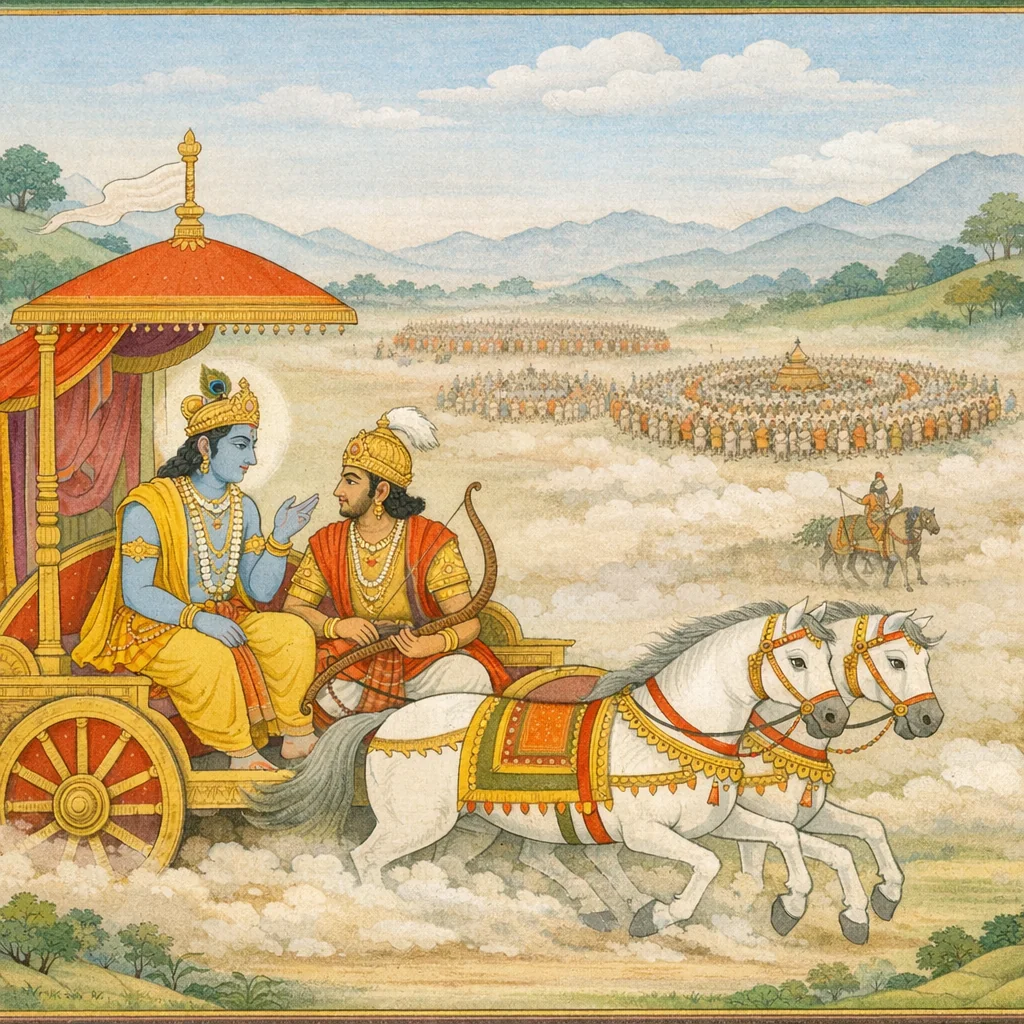
Adhyaya 76
द्रोणानीक-व्यतिक्रमः — Kṛṣṇa–Arjuna Break Through Droṇa’s Array
Upa-parva: Jayadratha-vadha Upākhyāna (Droṇa-parva war episode)
Saṃjaya reports that fear spreads among the Kauravas as Vāsudeva and Dhanaṃjaya appear to have crossed beyond the dense, difficult-to-penetrate Droṇa-array. Warriors rally with renewed steadiness, yet many do not return, likened to rivers not turning back from the ocean; those who withdraw are described through a moralizing contrast, accruing ‘kilbiṣa’ (fault) as they turn away. The two heroes are repeatedly compared to cosmic and natural forces—sun and fire freed from eclipse, fish tearing through a net—signaling both tactical release from weapon-congestion and a surge in offensive tempo that agitates the army like sea-creatures stirring an ocean. Kaurava estimations shift: Jayadratha’s survival is doubted, while hope persists that Droṇa and Kṛtavarman might still contain Kṛṣṇa and Arjuna. The pair confer explicitly on Jayadratha’s impending death, asserting resolve even against divine protection. Nearing Jayadratha, their posture becomes predatory and time-focused. Duryodhana, armored by Droṇa and advancing swiftly, interposes in front of them; the armies respond with instruments and roars, and Kṛṣṇa addresses Arjuna with timely counsel as the confrontation tightens.
Chapter Arc: संजय धृतराष्ट्र से कहता है कि अर्जुन ने जयद्रथ-वध की प्रतिज्ञा कर ली है—और उसी क्षण श्रीकृष्ण, सारथी होकर भी, नीति और यथार्थ का कठोर दर्पण अर्जुन के सामने रख देते हैं। → कृष्ण अर्जुन को टोकते हैं कि भाइयों की सम्मति जाने बिना इतना भारी वचन दे देना साहस है; अब यह प्रतिज्ञा केवल व्यक्तिगत नहीं रही—समस्त पाण्डव-सेना की प्रतिष्ठा और हँसी-उड़ाए जाने का भय इससे जुड़ गया है। उधर कौरव-पक्ष जयद्रथ की रक्षा हेतु द्रोण से विशेष व्यूह-रचना और सुरक्षा-व्यवस्था का आग्रह करता है; जयद्रथ को ‘वीरों द्वारा रक्षित’ रखने का संकल्प उभरता है। → कृष्ण का निर्णायक आश्वासन—वासुदेव के साथ संयुक्त कौन्तेय तीनों लोकों तक को जीत/वध करने में समर्थ है—अर्जुन के भीतर संकल्प को लौह-सा कठोर कर देता है; साथ ही कौरव-नीति का प्रतिउत्तर भी स्पष्ट हो जाता है: द्रोणाचार्य द्वारा जयद्रथ-रक्षा हेतु विशेष व्यूह (अग्रभाग शकटाकार, पश्चभाग कमलाकार) की स्थापना। → अध्याय का अंत ‘रणनीति-निर्धारण’ पर टिकता है—कृष्ण अर्जुन को प्रतिज्ञा की कीमत, लोक-लज्जा और विजय-उपाय समझाते हैं; कौरव-पक्ष द्रोण के नेतृत्व में जयद्रथ-रक्षा की तैयारी पक्की करता है। प्रतिज्ञा अब युद्ध के अगले दिन का केंद्रीय ध्रुव बन जाती है। → जयद्रथ को अभेद्य व्यूह में छिपाकर रखा जाएगा—तो क्या अर्जुन सूर्यास्त से पहले उसे भेदकर वध कर पाएगा, या प्रतिज्ञा पाण्डवों पर विपत्ति बनकर टूटेगी?
Shlokas
Verse 1
संजय कहते हैं--राजन्! जब अर्जुनने सिंधुराज जयद्रथके वधकी प्रतिज्ञा कर ली, उस समय महाबाहु भगवान् श्रीकृष्णने अर्जुनसे कहा--
Sanjaya said: O King! When Arjuna had taken a solemn vow to slay Jayadratha, the ruler of Sindhu, then the mighty-armed Lord Śrī Kṛṣṇa spoke to Arjuna—setting the stage for counsel that binds personal resolve to righteous purpose amid the pressures of war.
Verse 2
भ्रातृणां मतमज्ञाय त्वया वाचा प्रतिश्रुतम् । सैन्धवं चास्मि हन्तेति तत्साहसमिदं कृतम्,“धनंजय! तुमने अपने भाइयोंका मत जाने बिना ही जो वाणीद्वारा यह प्रतिज्ञा कर ली कि मैं सिंधुराज जयद्रथको मार डालूगा, यह तुमने दुःसाहसपूर्ण कार्य किया है
Sañjaya said: “Without first ascertaining the counsel of your brothers, you have given your word—declaring, ‘I will slay the Saindhava (Jayadratha).’ This is a rash and perilous act you have undertaken.”
Verse 3
असम्मन्त्रय मया सार्धमतिभारो<यमुद्यत: । कथं तु सर्वलोकस्य नावहास्या भवेमहि,“मेरे साथ सलाह किये बिना ही तुमने यह बड़ा भारी भार उठा लिया। ऐसी दशामें हम सम्पूर्ण लोकोंके उपहासपात्र कैसे नहीं बनेंगे?
Sañjaya said: “Without taking counsel with me, you have undertaken this exceedingly weighty burden. In such a situation, how could we fail to become a laughingstock before all the world?”
Verse 4
धार्तराष्ट्रस्य शिबिरे मया प्रणिहिताश्षरा: । त इमे शीघ्रमागम्य प्रवृत्ति वेदयन्ति नः,“मैंने दुर्योधनके शिविरमें अपने गुप्तचर भेजे थे। वे शीघ्र ही वहाँसे लौटकर अभी-अभी वहाँका समाचार मुझे बता गये हैं
Sañjaya said: “I had dispatched my secret agents into the camp of Dhṛtarāṣṭra’s son. They have returned swiftly and are now reporting to us the latest developments there.”
Verse 5
त्वया वै सम्प्रतिज्ञाते सिन्धुराजवधे प्रभो । सिंहनाद: सवादित्र: सुमहानिह तै: श्रुतः,“शक्तिशाली अर्जुन! जब तुमने सिंधुराजके वधकी प्रतिज्ञा की थी, उस समय यहाँ रणवाद्योंके साथ-साथ महान् सिंहनाद किया गया था, जिसे कौरवोंने सुना था
Sanjaya said: O lord, when you made the solemn vow to slay the king of Sindhu, a mighty lion-roar—accompanied by the blare of war-instruments—was raised here, and it was heard by those warriors (the Kauravas). The scene recalls the moral weight of a warrior’s public pledge: once proclaimed before both armies, it becomes a binding test of resolve, honor, and responsibility amid the chaos of war.
Verse 6
तेन शब्देन वित्रस्ता धार्तराष्ट्रा: ससैन्धवा: । नाकस्मात् सिंहनादो5यमिति मत्वा व्यवस्थिता:,“उस शब्दसे जयद्रथसहित सभी धूृतराष्ट्रपुत्र संत्रस्त हो उठे। वे यह सोचकर कि यह सिंहनाद अकारण नहीं हुआ है, सावधान हो गये
Sañjaya said: Startled by that sound, the sons of Dhṛtarāṣṭra—together with Jayadratha—were thrown into alarm. Concluding that such a lion-roar could not have arisen without cause, they became alert and took up their positions with caution.
Verse 7
सुमहान् शब्दसम्पात: कौरवाणां महाभुज । आसीज्नागाश्रपत्तीनां रथघोषश्ष भैरव:,“महाबाहो! फिर तो कौरवोंके दलमें भी बड़े जोरका कोलाहल मच गया। हाथी, घोड़े, पैदल तथा रथ-सेनाओंका भयंकर घोष सब ओर गूँजने लगा
Sañjaya said: “O mighty-armed one, then a tremendous uproar arose within the Kaurava host. From elephants, horses, infantry, and chariots there resounded a dreadful din of movement and war-cries, echoing in every direction.”
Verse 8
अभिमन्योर्व॑धं श्रुत्वा ध्रुवमार्तों धनंजय: । रात्रौ निर्यास्यति क्रोधादिति मत्वा व्यवस्थिता:,“वे यह समझकर युद्धके लिये उद्यत हो गये कि अभिमन्युके वधका वृत्तान्त सुनकर अर्जुनको अवश्य ही महान् कष्ट हुआ होगा; अतः वे क्रोध करके रातमें ही युद्धके लिये निकल पड़ेंगे
Verse 9
तैर्यतद्धिरियं सत्या श्रुता सत्यवतस्तव । प्रतिज्ञा सिन्धुराजस्य वधे राजीवलोचन,“कमलनयन! युद्धके लिये तैयार होते-होते उन कौरवोंने सदा सत्य बोलनेवाले तुम्हारी जयद्रथ-वधविषयक वह सच्ची प्रतिज्ञा सुनी
Sañjaya said: O lotus-eyed one, while those men were making ready, they heard your truthful vow—true to your nature—concerning the slaying of the king of Sindhu (Jayadratha). The verse underscores the ethical weight of a warrior’s pledged word: a vow grounded in truth becomes a binding force within the moral economy of war.
Verse 10
ततो विमनस: सर्वे त्रस्ता: क्षुद्रमृगा इव । आसन् सुयोधनामात्या: स च राजा जयद्रथ:,'फिर तो दुर्योधनके मन्त्री और स्वयं राजा जयद्रथ--से सब-के-सब (सिंहसे डरे हुए) क्षुद्र मुगोंके समान भयभीत और उदास हो गये
Sañjaya said: Then all of them became downcast and frightened—like timid little deer. Duryodhana’s ministers, and King Jayadratha as well, were seized by fear and dejection, their confidence shaken amid the pressure of the battle.
Verse 11
अथोत्थाय सहामात्यैर्दीन: शिबिरमात्मन: । आयात् सौवीरसिन्धूनामी श्वरो भूशदु:खित:,“तदनन्तर सिंधुसौवीरदेशका स्वामी जयद्रथ अत्यन्त दुःखी और दीन हो मन्त्रियोंसहित उठकर अपने शिविरमें आया
Sañjaya said: Then Jayadratha, the ruler of the Sauvīras and Sindhus, rose up in deep distress. Wretched and grief-stricken, he returned to his own camp together with his ministers—his outward authority now overshadowed by the moral and emotional weight of the war’s consequences.
Verse 12
स मन्त्रकाले सम्मन्त्रय सर्वा नैःश्रेयसीं क्रियाम् | सुयोधनमिदं वाक्यमब्रवीद् राजसंसदि,“उसने मन्त्रणाके समय अपने लिये श्रेयस्कर सिद्ध होनेवाले समस्त कार्योके सम्बन्धमें मन्त्रियोंसे परामर्श करके राजसभामें आकर दुर्योधनसे इस प्रकार कहा--
Sañjaya said: At the appointed time for counsel, having consulted the ministers about every course of action that could lead to the highest welfare, he came into the royal assembly and addressed Duryodhana with these words. The verse frames the coming speech as the outcome of deliberation aimed at what is truly beneficial, setting an ethical contrast between prudent counsel and the destructive momentum of war.
Verse 13
मामसौ पुत्रहन्तेति श्वोडईभियाता धनंजय: । प्रतिज्ञातो हि सेनाया मध्ये तेन वधो मम,“राजन! मुझे अपने पुत्रका घातक समझकर अर्जुन कल सबेरे मुझपर आक्रमण करनेवाला है; क्योंकि उसने अपनी सेनाके बीचमें मेरे वधकी प्रतिज्ञा की है
Sañjaya said: “O King, thinking of me as the slayer of his son, Dhanañjaya (Arjuna) will come against me tomorrow at dawn. For, in the midst of his army, he has vowed to bring about my death.”
Verse 14
तां न देवा न गन्धर्वा नासुरोरगराक्षसा: । उत्सहन्तेडन्यथा कर्तु प्रतिज्ञां सव्यसाचिन:,'सव्यसाची अर्जुनकी उस प्रतिज्ञाको देवता, गन्धर्व, असुर, नाग और राक्षस भी अन्यथा नहीं कर सकते
Sanjaya said: Even the gods, the Gandharvas, the Asuras, the Nāgas, and the Rākṣasas are not capable of making Arjuna’s vow turn out otherwise. Such is the unshakable force of the pledge of the ambidextrous archer—once he has resolved upon a righteous aim in battle, no power can divert it.
Verse 15
ते मां रक्षत संग्रामे मा वो मूर्ध्नि धनंजय: । पदं कृत्वा55प्रुयाल्लक्ष्यं तस्मादत्र विधीयताम्,“अतः आपलोग संग्राममें मेरी रक्षा करें। कहीं ऐसा न हो कि अर्जुन आपलोगोंके सिरपर पैर रखकर अपने लक्ष्यतक पहुँच जाय; अत: इसके लिये आप आवश्यक व्यवस्था करें
Sañjaya said: “Protect me in this battle. Let it not happen that Dhanañjaya (Arjuna), stepping upon your very heads, breaks through and reaches his target. Therefore, make the necessary arrangements here.”
Verse 16
अथ रक्षा न मे संख्ये क्रियते कुरुनन्दन । अनुजानीहि मां राजन् गमिष्यामि गृहान् प्रति,“कुरुनन्दन! यदि आप युद्धमें मेरी रक्षा न कर सकें तो मुझे आज्ञा दें; राजन! मैं अपने घर चला जाऊँगा
Sañjaya said: “O joy of the Kurus, if in this battle you cannot ensure my protection, then grant me leave, O king; I shall depart for my home.” In the ethical atmosphere of the war, the line underscores the tension between duty to remain with one’s lord and the basic human demand for safety when protection and order collapse.
Verse 17
एवमुक्तस्त्ववाक्ृशीर्षो विमना: स सुयोधन: । श्रुत्वा तं समय॑ तस्य ध्यानमेवान्वपद्यत,“जयद्रथके ऐसा कहनेपर दुर्योधन अपना सिर नीचे किये मन-ही-मन बहुत दुःखी हो गया और तुम्हारी उस प्रतिज्ञाको सुनकर उसे बड़ी भारी चिन्ता हो गयी
Sañjaya said: Thus addressed, Suyodhana (Duryodhana), with his head bowed and his mind cast down, became despondent. Hearing that pledge, he fell into deep anxious reflection—troubled by the moral and strategic weight of the vow now set in motion.
Verse 18
तमार्तमभिसंप्रेक्ष्य राजा किल स सैन्धव: । मृदु चात्महितं चैव साक्षेपमिदमुक्तवान्,“दुर्योधनको उद्विग्नचित्त देखकर सिन्धुराज जयद्रथने व्यंग्य करते हुए कोमल वाणीमें अपने हितकी बात इस प्रकार कही--
Sañjaya said: Seeing him distressed, the king—Jayadratha of Sindhu—spoke in a gentle tone, yet with pointed insinuation, uttering words calculated for his own advantage.
Verse 19
नेह पश्यामि भवतां तथावीर्य धनुर्धरम् । योअर्जुनस्यास्त्रमस्त्रेण प्रतिहन्यान्महाहवे,“राजन! आपकी सेनामें किसी भी ऐसे पराक्रमी धनुर्धरको नहीं देखता, जो उस महायुद्धमें अपने अस्त्रद्वारा अर्जुनके अस्त्रका निवारण कर सके
Sañjaya said: “O King, I do not see here, within your forces, any bowman of such prowess who, in this great battle, could counter Arjuna’s weapon with a weapon of his own.”
Verse 20
वासुदेवसहायस्य गाण्डीवं धुन्वतो धनु: । कोडर्जुनस्थाग्रतस्तिछेत् साक्षादपि शतक्रतु:,'श्रीकृष्णके साथ आकर गाण्डीव धनुषका संचालन करते हुए अर्जुनके सामने कौन खड़ा हो सकता है? साक्षात् इन्द्र भी तो उसका सामना नहीं कर सकते
Sañjaya said: “When Arjuna, aided by Vāsudeva, is brandishing the Gāṇḍīva bow, who could possibly stand before him? Not even Śatakratu (Indra) himself could truly face him.” The verse underscores how righteous strength, when joined with divine guidance and steadfast purpose, becomes irresistible on the battlefield.
Verse 21
महेश्वरो5पि पार्थेन श्रूयते योधित: पुरा । पदातिना महावीर्यों गिरौ हिमवति प्रभु:,“मैंने सुना है कि पूर्वकालमें हिमालयपर्वतपर पैदल अर्जुनने महापराक्रमी भगवान् महेश्वरके साथ भी युद्ध किया था
Sañjaya said: “It is heard that in former times even Maheśvara—the mighty Lord—was fought by Pārtha (Arjuna) on foot upon the Himavat mountain. This recalls Arjuna’s extraordinary prowess and the awe-inspiring stature of the divine, suggesting that human valor, when disciplined and purpose-bound, can be tested even against the highest powers—yet such encounters ultimately point to reverence and the limits of mere force.”
Verse 22
दानवानां सहस्राणि हिरण्यपुरवासिनाम् | जघानैकरथेनैव देवराजप्रचोदित:,“देवराज इन्द्रकी आज्ञा पाकर उसने एकमात्र रथकी सहायतासे हिरण्यपुरवासी सहस्रों दानवोंका संहार कर डाला था
Sañjaya said: Urged on by the Lord of the gods, Indra, he slew thousands of Dānavas who dwelt in Hiraṇyapura—accomplishing the slaughter with a single chariot alone. The verse underscores a divinely sanctioned feat of arms, where extraordinary violence is framed as the execution of a higher command rather than personal cruelty.
Verse 23
समायुक्तो हि कौन्तेयो वासुदेवेन धीमता । सामरानपि लोकांस्त्रीन् हन्यादिति मतिर्मम,“मेरा तो ऐसा विश्वास है कि परम बुद्धिमान् वसुदेवनन्दन श्रीकृष्णके साथ रहकर कुन्तीकुमार अर्जुन देवताओंसहित तीनों लोकोंको नष्ट कर सकता है
Sañjaya said: “My conviction is this: if Kuntī’s son Arjuna is united with the supremely wise Vāsudeva (Śrī Kṛṣṇa), he could even destroy the three worlds together with their gods.” In the ethical frame of the epic, the verse underscores how righteous strength becomes overwhelming when guided by divine wisdom—power is not praised as mere violence, but as potency disciplined by higher counsel in a war fought for dharma.
Verse 24
सो5हमिच्छाम्यनुज्ञातं रक्षितुं वा महात्मना । द्रोणेन सहपुत्रेण वीरेण यदि मन्यसे,“इसलिये मैं यहाँसे चले जानेकी अनुमति चाहता हूँ। अथवा यदि आप ठीक समझें तो पुत्रसहित वीर महामना द्रोणाचार्यके द्वारा मैं अपनी रक्षाका आश्वासन चाहता हूँ”
Sañjaya said: “Therefore I seek your permission to depart from here. Or, if you deem it proper, let my safety be assured by the great-souled, heroic Droṇa—together with his son.”
Verse 25
स राज्ञा स्वयमाचार्यो भृशमत्रार्थितो<र्जुन । संविधान च विहित॑ं रथाश्च॒ किल सज्जिता:,“अर्जुन! तब राजा दुर्योधनने स्वयं ही आचार्य द्रोणसे जयद्रथकी रक्षाके लिये बड़ी प्रार्थना की है। अतः उसकी रक्षाका पूरा प्रबन्ध कर लिया गया है तथा रथ भी सजा दिये गये हैं
Sañjaya said: “O Arjuna, the king (Duryodhana) has earnestly entreated the preceptor himself (Droṇa) in this matter. Accordingly, the full protective arrangement has been put in place, and the chariots too have been made ready.”
Verse 26
कर्णो भूरिश्रवा द्रौणिर्वषसेनश्व दुर्जय: । कृपश्च मद्रराजश्न षडेते5स्य पुरोगमा:,“कलके युद्धमें कर्ण, भूरिश्रवा, अश्वत्थामा, दुर्जय वीर वृषसेन, कृपाचार्य और मद्रराज शल्य--ये छः महारथी उसके आगे रहेंगे”
Sañjaya said: Karṇa, Bhūriśravā, Droṇa’s son Aśvatthāmā, the hard-to-conquer hero Vṛṣasena, Kṛpācārya, and the king of Madra, Śalya—these six great warriors will stand at his front in the battle. The verse underscores how the war is shaped not only by individual prowess but by deliberate formations and loyalties, where renowned fighters place themselves forward to shield and advance their leader’s cause.
Verse 27
शकट: पद्मकश्चार्धो व्यूहो द्रोणेन निर्मित: । पद्मकर्णिकमध्यस्थ: सूचीपाश्चे जयद्रथ:
Sañjaya said: Droṇa arranged a battle-formation consisting of the Śakaṭa and the Padmaka, along with a half-formation besides. In the very center—at the lotus’s pericarp—stood Jayadratha, with the needle-like (penetrating) troops positioned behind him. The design reveals a deliberate ethical inversion of war: strategy is used not merely for defense but to shield a single man whose protection serves a larger vow-driven objective, turning the battlefield into a test of resolve, restraint, and the limits of righteous means.
Verse 28
धनुष्यस्त्रे च वीर्ये च प्राणे चैव तथौरसे,'पार्थ! ये पूर्व निश्चित छः महारथी धनुष, बाण, पराक्रम, प्राणशक्ति तथा मनोबलमें अत्यन्त असहा माने गये हैं। इन छः महारथियोंको जीते बिना जयद्रथको प्राप्त करना असम्भव है
Sanjaya said: “O Partha, those six great chariot-warriors who have been previously marked out are deemed utterly unconquerable—by their mastery of bow and weapons, by valor, by life-breath itself, and by the strength of their chest and resolve. Unless these six are overcome, it is impossible to reach Jayadratha.”
Verse 29
अविषद्वुतमा होते निश्चिता: पार्थ षड् रथा: । एतानजित्वा षड् रथान् नैव प्राप्यो जयद्रथ:,'पार्थ! ये पूर्व निश्चित छः महारथी धनुष, बाण, पराक्रम, प्राणशक्ति तथा मनोबलमें अत्यन्त असहा माने गये हैं। इन छः महारथियोंको जीते बिना जयद्रथको प्राप्त करना असम्भव है
Sañjaya said: “O Partha, six chariot-warriors have been firmly appointed (to guard him)—fighters deemed utterly unyielding in battle. Unless these six are first overcome, Jayadratha cannot be reached at all.”
Verse 30
तेषामेकैकशो वीर्य षण्णां त्वमनुचिन्तय । सहिता हि नरव्यापत्र न शक््या जेतुमज्जसा,'पुरुषसिंह! पहले तुम इन छ: महारथियोंमें एक-एकके बल-पराक्रमका विचार करो। फिर जब ये छ: एक साथ होंगे, उस समय इन्हें सुगमतासे नहीं जीता जा सकता
Sañjaya said: “O tiger among men, first reflect carefully on the strength and prowess of each of those six heroes, one by one. For when those six stand united, they cannot be overcome with ease.”
Verse 31
भूयस्तु मन्त्रयिष्यामि नीतिमात्महिताय वै । मन्त्रज्जै: सचिवै: सार्ध सुहृद्धि: कार्यसिद्धये,“अब मैं पुनः अपने हितका ध्यान रखते हुए कार्यकी सिद्धिके लिये मन्त्रज्ञ मन्त्रियों और हितैषी सुहृदोंके साथ सलाह करूँगा”
Sañjaya said: “Once again I shall take counsel—keeping my own welfare in view—so that the undertaking may succeed, together with ministers skilled in counsel and with well-wishing friends.”
Verse 75
इति श्रीमहाभारते द्रोणपर्वणि प्रतिज्ञापर्वणि श्रीकृष्णवाक्ये पजचसप्ततितमो< ध्याय:,इस प्रकार श्रीमह्ाभारत द्रोणपर्वके अन्तर्गत प्रतिज्ञापर्वमें श्रीकृष्णवाक्यविषयक पचहत्तरवाँ अध्याय पूरा हुआ
Sanjaya said: “Thus, in the Śrī Mahābhārata, within the Droṇa Parva—specifically in the Pratijñā Parva—concerning the discourse/words of Śrī Kṛṣṇa, the seventy-fifth chapter comes to an end.” This closing colophon frames Kṛṣṇa’s counsel as a decisive moral and strategic intervention amid the escalating duties and vows of war.
Verse 276
स्थास्यते रक्षितो वीरै: सिंधुराट् स सुदुर्मद: । “ट्रोणाचार्यने ऐसा व्यूह बनाया है, जिसका अगला आधा भाग शकटके आकारका है और पिछला कमलके समान। कमलव्यूहके मध्यकी कर्णिकाके बीच सूचीव्यूहके पार्श्व भागमें युद्धदुर्मद सिन्धुराज जयद्रथ खड़ा होगा और अन्यान्य वीर उसकी रक्षा करते रहेंगे
Sañjaya said: The Sindhu king Jayadratha, swollen with pride, will take his stand there, guarded on all sides by warriors. In the unfolding stratagem of war, his protection is made a deliberate moral and tactical choice—placing a single man at the heart of a formation so that duty, loyalty, and the costs of violence converge upon him.
Frequently Asked Questions
The chapter contrasts steadfast engagement with withdrawal, framing retreat as ethically compromising in this context (kilbiṣa language), while also exposing how battlefield necessity can drive moral judgments that are contingent on role-duty and perceived stakes.
Sustained focus on a clearly defined objective—supported by coordination between leader (Kṛṣṇa) and executor (Arjuna)—can overcome layered constraints, but it also amplifies responsibility for the means used and the moral narratives imposed on others’ choices.
No explicit phalaśruti appears in the supplied passage; the meta-commentary is implicit through similes and evaluative diction (fear, resolve, kilbiṣa), guiding interpretation of conduct within the epic’s broader dharma discourse.