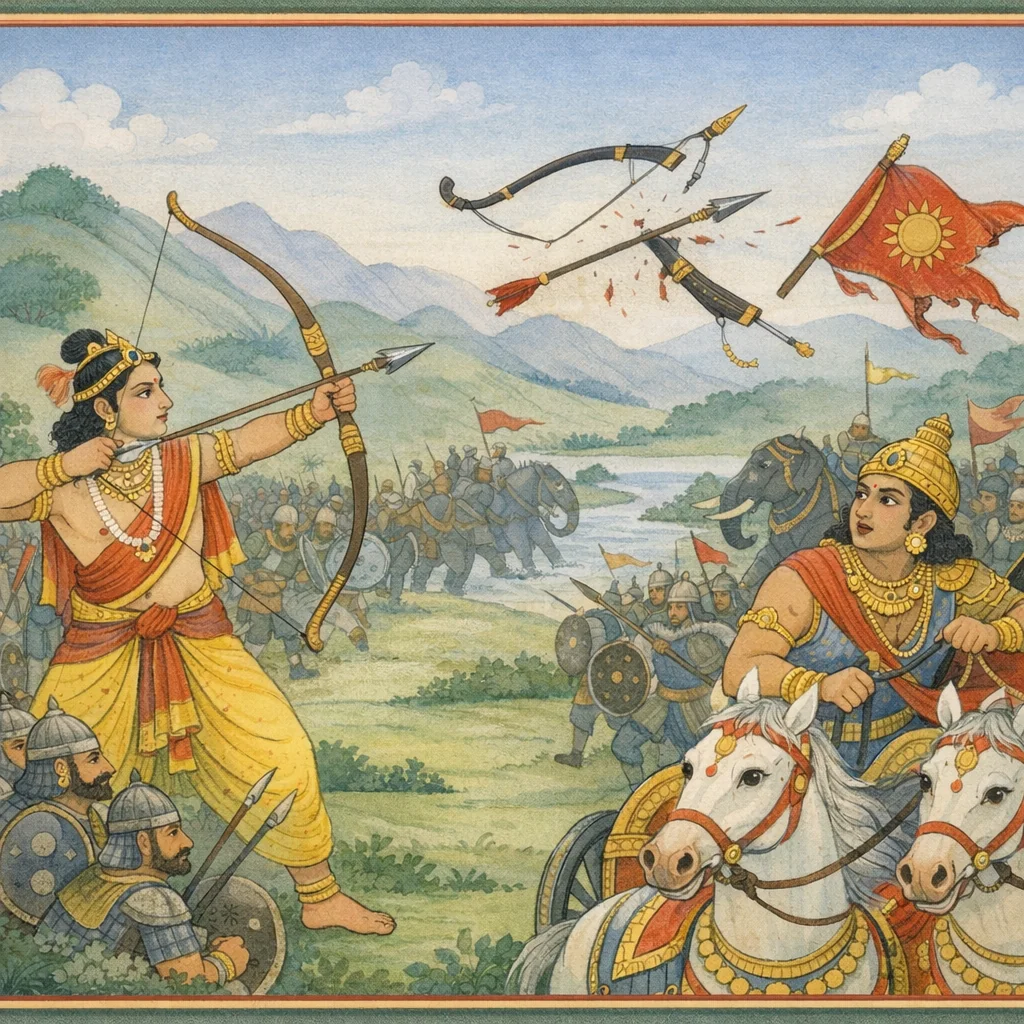
Adhyaya 40
Adhyāya 40 (Book 7, Droṇa-parva): Abhimanyu’s Rapid Advance and Battlefield Disruption
Upa-parva: Abhimanyu’s Assault on the Kaurava Host (Tactical Breakthrough Episode)
Saṃjaya reports a fast-paced exchange centered on Abhimanyu’s forward drive. A bow-armed opponent closes chariot distance and strikes Abhimanyu with multiple arrows, targeting visible chariot components (standard, parasol, driver, and horses). Observers aligned with Dhṛtarāṣṭra’s side react with approval on seeing Abhimanyu momentarily afflicted. Abhimanyu responds with a precise counter-shot that dislodges the attacker’s head/helmet region, causing a fall from the chariot. Karṇa, witnessing a brother’s fall, experiences distress; Abhimanyu then turns Karṇa away with repeated, sharp volleys and charges other principal archers. The narrative expands from duel to field-scale effect: Abhimanyu tears through a mixed host of elephants, horses, chariots, and infantry, producing heavy casualties and material wreckage (broken chariots, fallen banners, scattered weapons and bodies). Dust and arrow-saturation obscure recognition, yet Abhimanyu repeatedly reappears ‘like the midday sun,’ emphasizing both tactical dominance and the perceptual instability of mass combat.
Chapter Arc: संजय धृतराष्ट्र को सुनाते हैं कि रणभूमि में सौभद्र अभिमन्यु और कौरव-पक्ष के महाबली योद्धाओं के बीच घोर संग्राम छिड़ गया—युवक वीर अपने अपमानों का हिसाब युद्ध में चुकाने को सामने आता है। → दुःशासन गर्वोक्ति और कटु स्मरण दिलाता है—सभा में युधिष्ठिर का अपमान, पाण्डवों की ‘धर्म’ की मर्यादा, और अब उसी का प्रतिशोध। अभिमन्यु निर्भीक होकर द्रोण-सेना में घुसता है, तीव्र बाण-वर्षा से रथ, ध्वज, छत्र और सारथि तक को लक्ष्य बनाता है; कौरव-वीर उसे रोकने को एक-एक कर भिड़ते हैं। → अभिमन्यु का निर्णायक प्रहार: वह कर्ण (राधेय) पर शिलीमुखों की वर्षा करता है, उसकी रक्षा-व्यवस्था को तोड़ता है और अंततः ध्वज सहित कर्ण का धनुष काटकर पृथ्वी पर गिरा देता है—युद्ध-गर्व का शिखर क्षण भर में धूल में मिल जाता है। → कर्ण और दुःशासन दोनों अभिमन्यु के पराक्रम से दबते हैं; कौरव-पक्ष की पंक्तियाँ क्षणिक रूप से विचलित होती हैं और पाण्डव-पक्ष में उत्साह की लहर उठती है। अभिमन्यु की कीर्ति द्रोणानीक के बीच चमकती है, मानो अकेला दीपक आँधी में भी स्थिर हो। → परन्तु यही विजय कौरवों के भीतर प्रतिशोध की आग और तीव्र कर देती है—अगले क्षण वे और अधिक संख्या व छल-नीति से उसे घेरने की तैयारी करते हैं।
Shlokas
Verse 1
अत---#क+ चत्वारिशो<5 ध्याय: अभिमन्युके द्वारा द:ःशासन और कर्णकी पराजय संजय उवाच (तत: समभवद् युद्ध तयो: पुरुषसिंहयो: । तस्मिन् काले महाबाहु: सौभद्र: परवीरहा ।। सशरं कार्मुकं छित्त्वा लाघवेन व्यपातयत् । दुःशासनं शरैघोरै: संततक्ष समन्तत: ।।) संजय कहते हैं--राजन्! तदनन्तर उन दोनों पुरुषसिंहोंमें घोर युद्ध होने लगा। उस समय शत्रुवीरोंका संहार करनेवाले महाबाहु सुभद्राकुमारने बड़ी फुर्तीके साथ दुःशासनके बाणसहित धनुषको काट गिराया और उसे अपने भयंकर बाणोंद्वारा सब ओरसे क्षत-विक्षत कर दिया ।। शरविक्षतगात्र तु प्रत्यमित्रमवस्थितम् । अभिमन्यु: स्मयन् धीमान् दुःशासनमथाब्रवीत्,इसके बाद बुद्धिमान् अभिमन्यु किंचित् मुसकराकर सामने विपक्षमें खड़े हुए दुःशासनसे, जिसका शरीर बाणोंसे अत्यन्त घायल हो गया था, इस प्रकार कहा--
Sañjaya said: Then a fierce battle arose between those two lion-like warriors. At that time the mighty-armed son of Subhadrā—slayer of enemy heroes—swiftly cut down Duḥśāsana’s bow along with its arrows and cast it away. With dreadful shafts he struck Duḥśāsana from every side, mangling his limbs. Seeing his opponent standing before him, his body torn by arrows, the wise Abhimanyu smiled slightly and then addressed Duḥśāsana. The passage highlights the warrior’s discipline and skill in combat, while also hinting at the ethical tension of war: prowess and restraint coexist with the grim reality of wounding an enemy.
Verse 2
दिष्ट्या पश्यामि संग्रामे मानिनं शूरमागतम् । निष्ठर॑ त्यक्तर्थर्माणमाक्रोशनपरायणम्,“बड़े सौभाग्यकी बात है कि आज मैं युद्धमें सामने आये हुए और अपनेको शूरवीर माननेवाले तुझ अभिमानी, निष्ठुर, धर्मत्यागी और दूसरोंकी निन्दामें तत्पर रहनेवाले शत्रुको प्रत्यक्ष देख रहा हूँ
Sañjaya said: “By good fortune, here in the midst of battle I behold, face to face, the enemy who has come forth—one who prides himself on being a hero, yet is arrogant, ruthless, a forsaker of dharma, and devoted to abuse and denunciation.”
Verse 3
यत् सभायां त्वया राज्ञो धृतराष्ट्रस्य शृण्वत: । कोपित: परुषैर्वाक्यैर्थर्मराजो युधिछ्िर:
Sañjaya said: “That very incident—when, in the royal assembly, with King Dhṛtarāṣṭra listening, you provoked Dharmarāja Yudhiṣṭhira with harsh words—(is now bearing its consequences).”
Verse 4
जयोन्मत्तेन भीमश्न बह्चबद्धं प्रभाषित: । अक्षकूटं समाश्रित्य सौबलस्यात्मनो बलम्
Sañjaya said: In a frenzy of triumph, Bhīma spoke in a harsh, tightly bound (taunting) manner, relying on the ‘dice-heap’—the emblem of deceitful gambling—and on the strength of Śakuni, the son of Subala, as well as on his own power. The line evokes the moral stain of the dice-game as a continuing cause of the war’s violence, where pride and remembered injustice sharpen speech into cruelty.
Verse 5
तत् त्वयेदमनुप्राप्तं तस्य कोपान्महात्मन: । 'ओ मूर्ख! तूने द्यूतक्रीडामें विजय पानेसे उन््मत्त होकर सभामें राजा धृतराष्ट्रके सुनते हुए जो अपने निष्ठुर वचनोंद्वारा धर्मराज युधिष्ठिरको कुपित किया था और शकुनिके आत्मबल--जूएमें छल-कपटका आश्रय लेकर जो भीमसेनके प्रति बहुत-सी अंट-संट बातें कही थीं, इससे उन महात्मा धर्मराजको जो क्रोध हुआ, उसीका यह फल है कि तुझे आज यह दुर्दिन प्राप्त हुआ है ।। ३-४ ई ।। परवित्तापहारस्य क्रोधस्याप्रशमस्य च,तत् त्वयेदमनुप्राप्तं प्रकोपाद् वै महात्मनाम् । “दूसरोंके धनका अपहरण, क्रोध, अशान्ति, लोभ, ज्ञानलोप, द्रोह, दुःसाहसपूर्ण बर्ताव तथा मेरे उग्र धनुर्धर पितरोंके राज्यका अपहरण--इन सभी बुराइयोंके फलस्वरूप उन महात्मा पाण्डवोंके क्रोधसे तुझे आज यह बुरा दिन प्राप्त हुआ है
Sañjaya said: “This calamity has come upon you because you provoked the wrath of that great-souled one. By seizing what belongs to others, by unrestrained anger and the refusal to be pacified, you have brought this fate upon yourself—indeed, it is the consequence of the righteous indignation of the great-souled ones whom you wronged.”
Verse 6
लोभस्य ज्ञाननाशस्य द्रोहस्यात्याहितस्थ च । पितृणां मम राज्यस्य हरणस्योग्रधन्विनाम्
Sañjaya said: “(I speak) of greed, of the ruin of discernment, of treachery, and of grievous wrongdoing; and of the seizure of my fathers’ kingdom by the fierce bowmen.”
Verse 7
स तस्योग्रमधर्मस्य फल प्राप्रुहि दुर्मते,“दुर्मते! तू अपने उस अधर्मका भयंकर फल प्राप्त कर। आज मैं सारी सेनाओंके देखते-देखते अपने बाणोंद्वारा तुझे दण्ड दूँगा। आज मैं युद्धमें उन महात्मा पितरोंके उस क्रोधका बदला चुकाकर उऋण हो जाऊँगा
Sanjaya said: “Reap now the dreadful fruit of that fierce unrighteousness of yours, O wicked-minded one. Before the eyes of all the armies, today I shall punish you with my arrows. Today, in battle, I shall repay the wrath of those great-souled forefathers and become free of that debt.”
Verse 8
शासितास्म्यद्य ते बाणै: सर्वसैन्यस्य पश्यत: । अद्याहमनृणस्तस्य कोपस्य भविता रणे,“दुर्मते! तू अपने उस अधर्मका भयंकर फल प्राप्त कर। आज मैं सारी सेनाओंके देखते-देखते अपने बाणोंद्वारा तुझे दण्ड दूँगा। आज मैं युद्धमें उन महात्मा पितरोंके उस क्रोधका बदला चुकाकर उऋण हो जाऊँगा
Sañjaya said: “Today, before the eyes of the entire army, I shall punish you with my arrows. Today, in battle, I shall become free of the debt of that wrath—discharging the long-standing anger (of the revered elders/forefathers) by exacting its due.”
Verse 9
अमर्षिताया: कृष्णाया: काड्क्षितस्य च मे पितु: । अद्य कौरव्य भीमस्य भवितास्म्यनृणो युधि,“कुरुकुलकलंक! आज रोषमें भरी हुई माता कृष्णा तथा पितृतुल्य (ताऊ) भीमसेनका अभीष्ट मनोरथ पूर्ण करके इस युद्धमें उनके ऋणसे उऋण हो जाऊँगा
Sañjaya said: “Today, in this battle, I shall repay my debt by fulfilling the longed-for desire of the wrath-filled Kṛṣṇā (Draupadī) and of my fatherlike elder, Bhīmasena of the Kaurava line.”
Verse 10
न हि मे मोक्ष्यसे जीवन् यदि नोत्सृजसे रणम् | एवमुकक््त्वा महाबाहुर्बाणं दुःशासनान्तकम्
Sañjaya said: “You will not escape me alive, unless you abandon the battlefield.” Having spoken thus, the mighty-armed warrior then discharged an arrow destined to bring about Duḥśāsana’s end—an utterance and act that reveal the war’s grim ethic: survival is made conditional upon withdrawal, and speech becomes a prelude to lethal resolve.
Verse 11
तस्योरस्तूर्णमासाद्य जन्रुदेशे विभिद्य तम्,वह बाण तुरंत ही उसके वक्ष:स्थलपर पहुँचकर उसके गलेकी हँसलीको विदीर्ण करता हुआ पंखसहित भीतर घुस गया, मानो कोई सर्प बाँबीमें समा गया हो। तत्पश्चात् अभिमन्युने दुःशासनको पचीस बाण और मारे
Sanjaya said: The arrow swiftly struck his chest and, piercing the region of the collarbone at the throat, entered inside with its feathers, like a serpent slipping into an anthill. After that, Abhimanyu again shot Duhshasana with twenty-five arrows—pressing the battle forward with relentless force amid the harsh ethics of war.
Verse 12
जगाम सह पुड्खेन वल्मीकमिव पन्नग: । अथैनं पज्चविंशत्या पुनरेव समार्पयत्,वह बाण तुरंत ही उसके वक्ष:स्थलपर पहुँचकर उसके गलेकी हँसलीको विदीर्ण करता हुआ पंखसहित भीतर घुस गया, मानो कोई सर्प बाँबीमें समा गया हो। तत्पश्चात् अभिमन्युने दुःशासनको पचीस बाण और मारे
Verse 13
शरैरग्निसमस्पर्शैराकर्णसमचोदितै: । स गाढविद्धो व्यथितो रथोपस्थ उपाविशत्
Sañjaya said: Struck hard by arrows whose touch was like fire and which had been drawn and released to the ear with full force, he—deeply pierced and in pain—sank down and sat upon the floor of his chariot. The verse underscores the brutal immediacy of battle: skill and power, when yoked to wrath, turn into searing instruments that overwhelm even a warrior’s composure.
Verse 14
सारथिस्त्वरमाणस्तु दःशासनमचेतनम्
Sañjaya said: The charioteer, acting in haste, attended to Duḥśāsana, who had fallen unconscious—an image of how the frenzy of battle reduces even the mighty to helplessness and forces urgent, practical choices amid the collapse of strength and pride.
Verse 15
पाण्डवा द्रौपदेयाश्न विराटश्न॒ समीक्ष्य तम्
Sañjaya said: The Pāṇḍavas, along with Draupadī’s sons and King Virāṭa, having carefully observed him, assessed the situation before them—an act of prudent discernment amid the pressures of war.
Verse 16
वादित्राणि च सर्वाणि नानालिड्रानि सर्वश:,पाण्डवोंके सैनिक वहाँ हर्षमें भरकर नाना प्रकारके सभी रणवाद्य बजाने लगे और मुसकराते हुए वे सुभद्राकुमारका पराक्रम देखने लगे
Sañjaya said: Then the soldiers of the Pāṇḍavas, filled with joy on every side, began to sound all kinds of war-instruments. Smiling, they fixed their attention on the prowess of Subhadrā’s son, eager to witness his valor. In the midst of battle’s harshness, their exultation signals confidence in righteous courage and the morale that sustains a just cause.
Verse 17
प्रावादयन्त संहृष्टा: पाण्डूनां तत्र सैनिका: | अपश्यन् स्मयमानाश्न सौभद्रस्य विचेष्टितम्,पाण्डवोंके सैनिक वहाँ हर्षमें भरकर नाना प्रकारके सभी रणवाद्य बजाने लगे और मुसकराते हुए वे सुभद्राकुमारका पराक्रम देखने लगे
Sañjaya said: Thereupon the soldiers of the Pāṇḍavas, filled with exhilaration, began to sound their various war-instruments. Smiling, they watched the deeds and martial prowess of Saubhadra (Abhimanyu), taking heart from his valor amid the grim demands of battle.
Verse 18
अत्यन्तवैरिणं दृप्तं दृष्टवा शत्रुं पपाजितम् । धर्ममारुतशक्राणामश्रिनो: प्रतिमास्तथा,अभ्यद्रवन्त त्वरिता द्रोणानीकं॑ बिभित्सव: । घमंडमें भरे हुए अपने कट्टर शत्रुको पराजित हुआ देख अपनी ध्वजाओंके अग्रभागमें धर्म, वायु, इन्द्र और अश्विनीकुमारोंकी प्रतिमा धारण करनेवाले महारथी द्रौपदीकुमार, सात्यकि, चेकितान, धृष्टद्युम्मन, शिखण्डी, केकय-राजकुमार, धृष्टकेतु, मत्स्य, पांचाल, सूंजय तथा युधिष्ठिर आदि पाण्डव बड़े हर्षके साथ उतावले होकर द्रोणाचार्यके व्यूहका भेदन करनेकी इच्छासे उसपर टूट पड़े
Sañjaya said: Seeing their utterly hostile and arrogant enemy brought low, the warriors who bore on the foreparts of their standards the emblems of Dharma, Vāyu, Indra, and the Aśvin twins rushed forward in haste, eager to break through Droṇa’s battle-array. Their surge is driven not merely by triumph, but by the conviction that the enemy’s pride has been checked and that the moment has come to pierce the formidable formation guarding Droṇa.
Verse 19
धारयन्तो ध्वजाग्रेषु द्रौपदेया महारथा: । सात्यकिश्रेकितानश्च धृष्टद्ुम्नशिखण्डिनौ
Sanjaya said: The mighty chariot-warriors—the sons of Draupadī—were holding their standards aloft; and so too were Sātyaki and Śrekitān, along with Dhṛṣṭadyumna and Śikhaṇḍin. In the charged moral atmosphere of battle, the raised banners signify resolve, leadership, and the public affirmation of one’s chosen cause and comrades.
Verse 20
केकया धृष्टकेतुश्व मत्स्या: पज्चालसृज्जया: । पाण्डवाश्च मुदा युक्ता युधिष्ठिरपुरोगमा:
Sañjaya said: The Kekayas, Dhṛṣṭaketu, the Matsyas, and the Pañcālas and Sṛñjayas—together with the Pāṇḍavas led by Yudhiṣṭhira—were filled with joy and high resolve. In the midst of war, their gladness signals renewed confidence and unity of purpose around righteous leadership.
Verse 21
ततो5भवन्महायुद्ध॑ त्वदीयानां परै: सह
Then a great battle arose between your own forces and the enemy, as the conflict intensified into a full-scale war—signaling the grave moral and human cost that follows when kin and rivals alike are driven into relentless violence.
Verse 22
तथा तु वर्तमाने वै संग्रामेडतिभयंकरे
Sañjaya said: And so, while that exceedingly dreadful battle was in progress, events continued to unfold amid terror and turmoil—signaling the relentless momentum of war and the grave moral weight borne by those engaged in it.
Verse 23
पश्य दुःशासनं वीरमभिमन्युवशं गतम्
Sañjaya said: “Behold the warrior Duḥśāsana—he has fallen under Abhimanyu’s power, brought into his control.” The line underscores the shifting fortunes of battle and the moral tension of a war where prowess can momentarily subdue even the fierce, yet the larger conflict remains driven by adharma and vengeance.
Verse 24
प्रतपन्तमिवादित्यं निध्नन्तं शात्रवान् रणे । “कर्ण! देखो, वीर दु:ःशासन सूर्यके समान शत्रु-सैनिकोंको संतप्त करता हुआ युद्धमें उन्हें मार रहा था, इसी अवस्थामें वह अभिमन्युके वशमें पड़ गया है ।। अथ चैते सुसंरब्धा: सिंहा इव बलोत्कटा:
Sanjaya said: “O Karna, look! The hero Duḥśāsana—like the sun in his blazing power—was scorching the enemy’s troops and striking down foes in the thick of battle. Yet even in that very condition, he has fallen under Abhimanyu’s control.” And then those warriors, fiercely enraged and mighty as lions, (advanced further).
Verse 25
ततः कर्ण: शरैस्तीक्ष्णैरभिमन्युं दुरासदम्
Sañjaya said: Then Karṇa, with his sharp arrows, assailed Abhimanyu—one who was exceedingly hard to approach or overcome—pressing the battle forward with relentless force.
Verse 26
तस्य चानुचरांस्ती&णैर्विव्याध परमेषुभि:
Verse 27
अभिमन्युस्तु राधेयं त्रिसप्तत्या शिलीमुखै:
Sañjaya said: Abhimanyu, for his part, struck Rādheya (Karna) with seventy-one sharp arrows. The scene underscores the fierce reciprocity of battle—youthful valor meeting seasoned might—where courage is measured not by age but by steadfast resolve amid dharma’s grim demands in war.
Verse 28
तं तथा नाशकत् वक्िद् द्रोणाद् वारयितुं रथी
Sañjaya said: In that situation, the chariot-warrior was unable to restrain him from Droṇa—so overpowering was Droṇa’s force on the battlefield, and so futile were attempts to check his advance.
Verse 29
तत: कर्णो जयप्रेप्सुर्मानी सर्वधनुष्मताम्,समरे शत्रुदुर्थर्षमभिमन्युमपीडयत् । विजय पानेकी इच्छा रखनेवाला, सम्पूर्ण धनुर्धरोंमें मानी, अस्त्रवेत्ताओंमें श्रेष्ठ, परशुरामजीके शिष्य और प्रतापी वीर कर्णने अपने उत्तम अस्त्रोंका प्रदर्शन करते हुए सैकड़ों बाणोंद्वारा शत्रुदुर्जय सुभद्राकुमार अभिमन्युको बींध डाला और समरांगणमें उसे पीड़ा देना आरम्भ किया
Sañjaya said: Then Karṇa—eager for victory and proud among all master-archers—pressed hard Abhimanyu in battle, that foe so difficult for enemies to withstand. Displaying his finest missiles, Karṇa pierced him with hundreds of arrows and began to torment him on the field. The verse underscores how the pursuit of triumph and reputation in war can intensify cruelty, even against a heroic opponent, raising the ethical tension between martial prowess and restraint.
Verse 30
सौभद्रंं शतशो<विध्यदुत्तमास्त्राणि दर्शयन् । सोस्स्त्रैरस्त्रविदां श्रेष्ठोी रामशिष्य: प्रतापवान्,समरे शत्रुदुर्थर्षमभिमन्युमपीडयत् । विजय पानेकी इच्छा रखनेवाला, सम्पूर्ण धनुर्धरोंमें मानी, अस्त्रवेत्ताओंमें श्रेष्ठ, परशुरामजीके शिष्य और प्रतापी वीर कर्णने अपने उत्तम अस्त्रोंका प्रदर्शन करते हुए सैकड़ों बाणोंद्वारा शत्रुदुर्जय सुभद्राकुमार अभिमन्युको बींध डाला और समरांगणमें उसे पीड़ा देना आरम्भ किया
Sañjaya said: Displaying his finest missiles, the mighty Karṇa—eager for victory, famed among all bowmen, and foremost among masters of weapons, a disciple of Rāma (Paraśurāma)—pierced Saubhadra Abhimanyu again and again with hundreds of arrows. In the thick of battle he began to press and torment Abhimanyu, that foe whom enemies found hard to withstand—an image of how prowess and ambition, when unrestrained by compassion, intensify the cruelty of war.
Verse 31
स तथा पीड्यमानस्तु राधेयेनास्त्रवृष्टिभि:
Sañjaya said: Thus, being sorely pressed by Rādheya’s showers of weapons, he endured the onslaught—an image of how, in the fury of war, even the steadfast are tested by relentless force and must meet violence with resolve and discipline rather than panic.
Verse 32
ततः शिलाशितैस्ती&णैर्भल्लैरानतपर्वभि:
Sañjaya said: Then, with arrows sharpened on stone—broad-headed shafts whose joints were bent downward—he pressed the attack, intensifying the violence of the encounter in the midst of the war’s relentless momentum.
Verse 33
धनुर्मण्डलनिर्मुक्ते: शरैराशीविषोपमै:
Sañjaya said: “From the circle of the bow, arrows were released—like venomous serpents—swift and deadly, intensifying the terror and moral weight of the battlefield.”
Verse 34
कर्णोडपि चास्य चिक्षेप बाणान् संनतपर्वण:
Sañjaya said: Karṇa too shot arrows at him—arrows whose joints were well-bent and firmly set—intensifying the assault in the midst of the righteous yet devastating conflict.
Verse 35
ततो मुहूर्तात् कर्णस्य बाणेनैकेन वीर्यवान्
Sañjaya said: Then, within a brief moment, the valiant one was struck down by a single arrow of Karṇa—an image of how, in the brutal economy of war, prowess and fate can turn on an instant, and a lone missile can decide what armies could not.
Verse 36
ततः कृच्छूगतं कर्ण दृष्टवा कर्णादनन्तर:,कर्णको संकटमें पड़ा देख उसका छोटा भाई सुदृढ़ धनुष हाथमें लेकर तुरंत ही सुभद्राकुमारका सामना करनेके लिये आ पहुँचा। उस समय कुन्तीके सभी पुत्र और उनके अनुगामी सैनिक जोर-जोरसे गरजने, बाजे बजाने और अभिमन्युकी भूरि-भूरि प्रशंसा करने लगे
Sañjaya said: Then, seeing Karṇa fallen into dire straits, Karṇa’s younger brother immediately came forward to confront Subhadrā’s son, bow in hand. At that moment all of Kuntī’s sons and their supporting troops roared aloud, sounded their instruments, and praised Abhimanyu again and again—exalting valor and resolve amid the harsh demands of war.
Verse 37
सौभद्रम भ्ययात् तूर्ण दृढमुद्यम्य कार्मुकम् । तत उच्चुक्रुशु: पार्थास्तिषां चानुचरा जना: । वादित्राणि च संजघ्नु: सौभद्रे चापि तुष्ठवु:,कर्णको संकटमें पड़ा देख उसका छोटा भाई सुदृढ़ धनुष हाथमें लेकर तुरंत ही सुभद्राकुमारका सामना करनेके लिये आ पहुँचा। उस समय कुन्तीके सभी पुत्र और उनके अनुगामी सैनिक जोर-जोरसे गरजने, बाजे बजाने और अभिमन्युकी भूरि-भूरि प्रशंसा करने लगे
Sañjaya said: Raising his bow firmly, he rushed swiftly to confront Saubhadra (Abhimanyu). Then the sons of Pṛthā (the Pāṇḍavas) and their attendant troops cried out loudly; they struck up their instruments and, delighted, praised Saubhadra—affirming courage and loyalty amid the harsh demands of war.
Verse 39
इस प्रकार श्रीमहाभारत द्रोणपर्वके अन्तर्गत अभिमन्युवधपर्वमें दुःशासनयुद्धाविषयक उनतालीसवाँ अध्याय पूरा हुआ
Sanjaya said: Thus ends the thirty-ninth chapter, concerning the battle involving Duḥśāsana, within the Abhimanyu-slaying section of the Droṇa Parva of the Śrī Mahābhārata. The closing formula underscores the epic’s careful framing of events: each violent episode is recorded as part of a larger moral and historical account, inviting reflection on responsibility and the cascading consequences of war.
Verse 40
इति श्रीमहाभारते द्रोणपर्वणि अभिमन्युवधपर्वणि कर्णदुःशासनपरा भवे चत्वारिंशो5ध्याय:
Thus ends the fortieth chapter in the Droṇa Parva of the Śrī Mahābhārata, within the section on the slaying of Abhimanyu, describing the defeat of Karṇa and Duḥśāsana. The colophon marks a narrative closure, reminding the listener that the war’s momentum is driven not only by prowess but also by moral consequence—where arrogance, cruelty, and adharma invite reversal even amid battlefield success.
Verse 66
तत् त्वयेदमनुप्राप्तं प्रकोपाद् वै महात्मनाम् । “दूसरोंके धनका अपहरण, क्रोध, अशान्ति, लोभ, ज्ञानलोप, द्रोह, दुःसाहसपूर्ण बर्ताव तथा मेरे उग्र धनुर्धर पितरोंके राज्यका अपहरण--इन सभी बुराइयोंके फलस्वरूप उन महात्मा पाण्डवोंके क्रोधसे तुझे आज यह बुरा दिन प्राप्त हुआ है
Verse 103
संदधे परवीरघ्न: कालाग्न्यनिलवर्चसम् | 'यदि तू युद्ध छोड़कर भाग नहीं जायगा तो आज मेरे हाथसे जीवित नहीं छूट सकेगा।” ऐसा कहकर शत्रुवीरोंका नाश करनेवाले महाबाहु अभिमन्युने काल, अग्नि और वायुके समान तेजस्वी बाणका संधान किया, जो दुःशासनके प्राण लेनेमें समर्थ था
Sañjaya said: Declaring, “If you do not abandon the fight and flee, you will not escape alive from my hands today,” Abhimanyu—mighty-armed and a slayer of enemy champions—set an arrow to his bow, blazing like Time, fire, and wind, an arrow capable of taking Duḥśāsana’s life. The moment frames the grim ethics of battlefield resolve: a vow-like warning, followed by decisive action aimed at ending a dangerous foe.
Verse 133
दुःशासनो महाराज कश्मलं चाविशन्महत् | धनुषको कानतक खींचकर चलाये हुए उन बाणोंद्वारा, जिनका स्पर्श अग्निके समान दाहक था, गहरी चोट खाकर दु:ःशासन व्यथित हो रथकी बैठकमें बैठ गया। महाराज! उस समय उसे भारी मूर्च्छा आ गयी
Sanjaya said: O King, a great faintness and distress seized Duhshasana. Struck deeply by the arrows that were drawn and released from the bow—burning to the touch like fire—he became overwhelmed with pain, sank down upon the seat of his chariot, and at that moment fell into a heavy swoon.
Verse 143
रणमध्यादपोवाह सौभद्रशरपीडितम् | तब अभिमन्युके बाणोंसे पीड़ित एवं अचेत हुए दुःशासनको सारथि बड़ी उतावलीके साथ युद्धस्थलसे बाहर हटा ले गया
Sañjaya said: From the very midst of the battle, the charioteer hurriedly carried away Duḥśāsana, who had been tormented by the arrows of Saubhadra (Abhimanyu). Struck by Abhimanyu’s shafts, Duḥśāsana had become senseless; therefore his driver, in anxious haste, withdrew him from the field—an act that underscores how even fierce warriors are bound by the immediate duty to preserve life when a combatant is incapacitated.
Verse 156
पज्चाला: केकयाश्रैव सिंहनादमथानदन् । उस समय पाण्डव, पाँचों द्रौपदीकुमार, राजा विराट, पांचाल और केकय दुःशासनको पराजित हुआ देख जोर-जोरसे सिंहनाद करने लगे
Sañjaya said: Then the Pañcālas and the Kekayas raised a loud lion-roar. Seeing Duḥśāsana overcome, the Pāṇḍavas—along with the five sons of Draupadī and King Virāṭa—exulted, proclaiming their renewed courage and the moral momentum of their cause amid the chaos of war.
Verse 203
अभ्यद्रवन्त त्वरिता द्रोणानीकं॑ बिभित्सव: । घमंडमें भरे हुए अपने कट्टर शत्रुको पराजित हुआ देख अपनी ध्वजाओंके अग्रभागमें धर्म, वायु, इन्द्र और अश्विनीकुमारोंकी प्रतिमा धारण करनेवाले महारथी द्रौपदीकुमार, सात्यकि, चेकितान, धृष्टद्युम्मन, शिखण्डी, केकय-राजकुमार, धृष्टकेतु, मत्स्य, पांचाल, सूंजय तथा युधिष्ठिर आदि पाण्डव बड़े हर्षके साथ उतावले होकर द्रोणाचार्यके व्यूहका भेदन करनेकी इच्छासे उसपर टूट पड़े
Sañjaya said: Eager to break through Droṇa’s battle-array, they rushed swiftly upon Droṇa’s army, intent on shattering it. Seeing their fierce enemy pressed and overcome, the great chariot-warriors—bearing on the foreparts of their standards the emblems of Dharma, Vāyu, Indra, and the Aśvin twins—Draupadī’s sons, Sātyaki, Cekitāna, Dhṛṣṭadyumna, Śikhaṇḍin, the Kekaya princes, Dhṛṣṭaketu, and the forces of the Matsyas, the Pāñcālas, the Sṛñjayas, and Yudhiṣṭhira and the other Pāṇḍavas, surged forward with joy and urgency to pierce Droṇācārya’s formation.
Verse 213
जयमाकाड्क्षमाणानां शूराणामनिवर्तिनाम् | तदनन्तर विजयकी अभिलाषा रखकर युद्धमें कभी पीठ न दिखानेवाले आपके शूरवीर सैनिकोंका शत्रुओंके साथ महान् युद्ध होने लगा
Sañjaya said: “Thereafter, a great battle arose between your heroic soldiers—men who longed for victory and never turned back—and their enemies. Driven by the desire to win and bound by the warrior’s resolve, they faced the foe without retreat.”
Verse 226
दुर्योधनो महाराज राधेयमिदमब्रवीत् । महाराज! जब इस प्रकार अत्यन्त भयंकर संग्राम हो रहा था, उस समय दुर्योधनने राधापुत्र कर्णसे यों कहा--
Sañjaya said: “O King, Duryodhana spoke these words to Rādhā’s son (Karna). O great king, while such an exceedingly dreadful battle was raging, Duryodhana addressed Karna in this manner.”
Verse 246
सौभद्रमुद्यतास्त्रातुम भ्यधावन्त पाण्डवा: । “इधर ये क्रोधमें भरे हुए पाण्डव सुभद्राकुमारकी रक्षा करनेके लिये उद्यत हो प्रचण्ड बलशाली सिंहोंके समान धावा कर चुके हैं"
Sañjaya said: The Pāṇḍavas, intent on protecting Saubhadra (Abhimanyu) from the raised weapons of his foes, rushed forward. Inflamed with righteous anger and driven by their duty to defend their own, they charged like mighty lions—an image of protective valor amid the moral chaos of war.
Verse 253
अभ्यवर्षत संक्रुद्धः पुत्रस्य हितकृत् तव । यह सुनकर आपके पुत्रका हित करनेवाला कर्ण अत्यन्त क्रोधमें भरकर दुर्द्धर्ष वीर अभिमन्युपर तीखे बाणोंकी वर्षा करने लगा
Sañjaya said: Hearing this, Karṇa—intent on securing the welfare of your son—became inflamed with anger and began to shower Abhimanyu with a fierce rain of sharp arrows. The scene underscores how loyalty to one’s chosen side, when fused with wrath, intensifies the violence of war and narrows the space for restraint.
Verse 263
अवज्ञापूर्वकं शूर: सौभद्रस्य रणाजिरे । शूरवीर कर्णने समरांगणमें सुभद्राकुमारके सेवकोंको भी तीखे एवं उत्तम बाणोंद्वारा अवहेलनापूर्वक बींध डाला
Sañjaya said: In the thick of battle, the valiant Karṇa—acting with contempt—pierced even the attendants and followers of Abhimanyu (Saubhadra), Subhadrā’s son, with sharp and excellent arrows, cutting them down as though they were beneath his notice. The episode underscores how disdain in war can harden into cruelty, where prowess is displayed not only against equals but also against those of lesser standing.
Verse 273
अविध्यत् त्वरितो राजन द्रोणं प्रेप्सुमहामना: । राजन्! उस समय महामनस्वी अभिमन्युने द्रोणाचार्यके समीप पहुँचनेकी इच्छा रखकर तुरंत ही तिहत्तर बाणोंद्वारा कर्णको घायल कर दिया
Sañjaya said: “O King, acting with swift resolve, the high-souled warrior—intent on reaching Droṇa—struck Karṇa at once with seventy-three arrows.” The verse highlights Abhimanyu’s focused purpose in battle: he does not attack for cruelty, but as a tactical and duty-bound step toward confronting the commander, even amid the moral strain of fratricidal war.
Verse 286
आरुजन्तं रथव्रातान् वजहस्तात्मजात्मजम् | कोई भी रथी रथसमूहोंको नष्ट-भ्रष्ट करते हुए इन्द्रकुमार अर्जुनके उस पुत्रको द्रोणाचार्यकी ओर जानेसे रोक न सका
Sañjaya said: As that grandson of Arjuna—bearing the thunderbolt-like might in his hands—went on shattering entire masses of chariots, no warrior was able to stop him from advancing toward Droṇācārya. The scene underscores how, in the fury of battle, even seasoned fighters can be overwhelmed when a divinely favored hero presses forward with unwavering purpose.
Verse 316
समरे5मरसंकाश: सौभद्रो न व्यशीर्यत । कर्णके द्वारा उसकी अस्त्रवर्षसे पीड़ित होनेपर भी देवतुल्य अभिमन्यु समरभूमिमें शिथिल नहीं हुआ
Sañjaya said: In the thick of battle, the son of Subhadrā—radiant like an immortal—did not falter. Though tormented by the rain of missiles unleashed by Karṇa, Abhimanyu, godlike in valor, did not slacken on the battlefield. The verse highlights steadfast courage under overwhelming force, presenting endurance and resolve as a warrior’s ethical ideal amid the chaos of war.
Verse 326
छित्त्वा धनूंषि शूराणामार्जुनि: कर्णमार्दयत् । तत्पश्चात् अर्जुनकुमारने सानपर चढ़ाकर तेज किये हुए झुकी हुई गाँठवाले तीखे भल्लोंद्वारा शूरवीरोंके धनुष काटकर कर्णको सब ओरसे पीड़ा दी
Sañjaya said: Having cut the bows of the valiant warriors, Arjuna’s son pressed Karṇa hard. Thereafter, with sharpened, keen, knot-jointed arrows set upon the bowstring, he repeatedly severed the heroes’ bows and tormented Karṇa from every side—an image of relentless martial skill where prowess, not mercy, governs the moment on the battlefield.
Verse 333
सच्छत्रध्वजयन्तारं साश्वमाशु स्मयन्निव । उसने मुसकराते हुए-से अपने मण्डलाकार धनुषसे छूटे हुए विषधर सर्पोके समान भयानक बाणोंद्वारा छत्र, ध्वज, सारथि और घोड़ोंसहित कर्णको शीघ्र ही घायल कर दिया
Sanjaya said: As though smiling, he swiftly struck Karna—together with his parasol, banner, charioteer, and horses—using terrifying arrows released from his circular bow, like venomous serpents. The scene underscores how, in the fury of war, even the emblems of honor and protection are shattered, and prowess is measured by the capacity to disable an opponent’s entire war-machine, not merely the warrior.
Verse 343
असम्भ्रान्तश्न तान् सर्वानिगृह्नात् फाल्गुनात्मज: । कर्णने भी उसके ऊपर झुकी हुई गाँठवाले बहुत-से बाण चलाये; परंतु अर्जुनकुमारने उन सबको बिना किसी घबराहटके सह लिया
Sañjaya said: Unshaken and self-possessed, the son of Phalguna (Arjuna’s son) checked and endured all those assaults. Though Karṇa discharged many arrows—hard, knotty, and forceful—aimed to break his resolve, the young warrior bore them without panic, showing steadiness of mind amid the chaos of battle.
Verse 356
सध्वजं कार्मुकं वीरश्छित्त्वा भूमावपातयत् । तदनन्तर दो ही घड़ीमें पराक्रमी वीर अभिमन्युने एक बाण मारकर कर्णके ध्वजसहित धनुषको पृथ्वीपर काट गिराया
Sanjaya said: The heroic warrior cut down the bow together with its banner and made it fall to the ground. In the flow of battle, this act signals not only physical prowess but also the tactical and moral aim of disabling an opponent’s capacity to fight by stripping away his weapon and emblem of martial pride.
Frequently Asked Questions
The chapter frames a tension between valorous penetration of enemy lines (as kṣatriya excellence) and the escalating, impersonal harm of mass engagement, where individual duels rapidly become collective destruction.
The text underscores how quickly tactical success can alter the whole field: localized decisions (counter-shot, turning a senior opponent, rapid advance) propagate systemic effects—fear, flight, and loss of visibility—changing outcomes beyond the initial duel.
No explicit phalaśruti appears in the provided passage; the meta-level emphasis is conveyed indirectly through similes (fire in dry grass, midday sun) that interpret the episode’s scale and moral weight within the war narrative.