Adhyaya 9
शिशुमार-रूपं, ध्रुवबन्धनम्, वृष्टिचक्र-पालनम्, नारायणाधारत्वम्
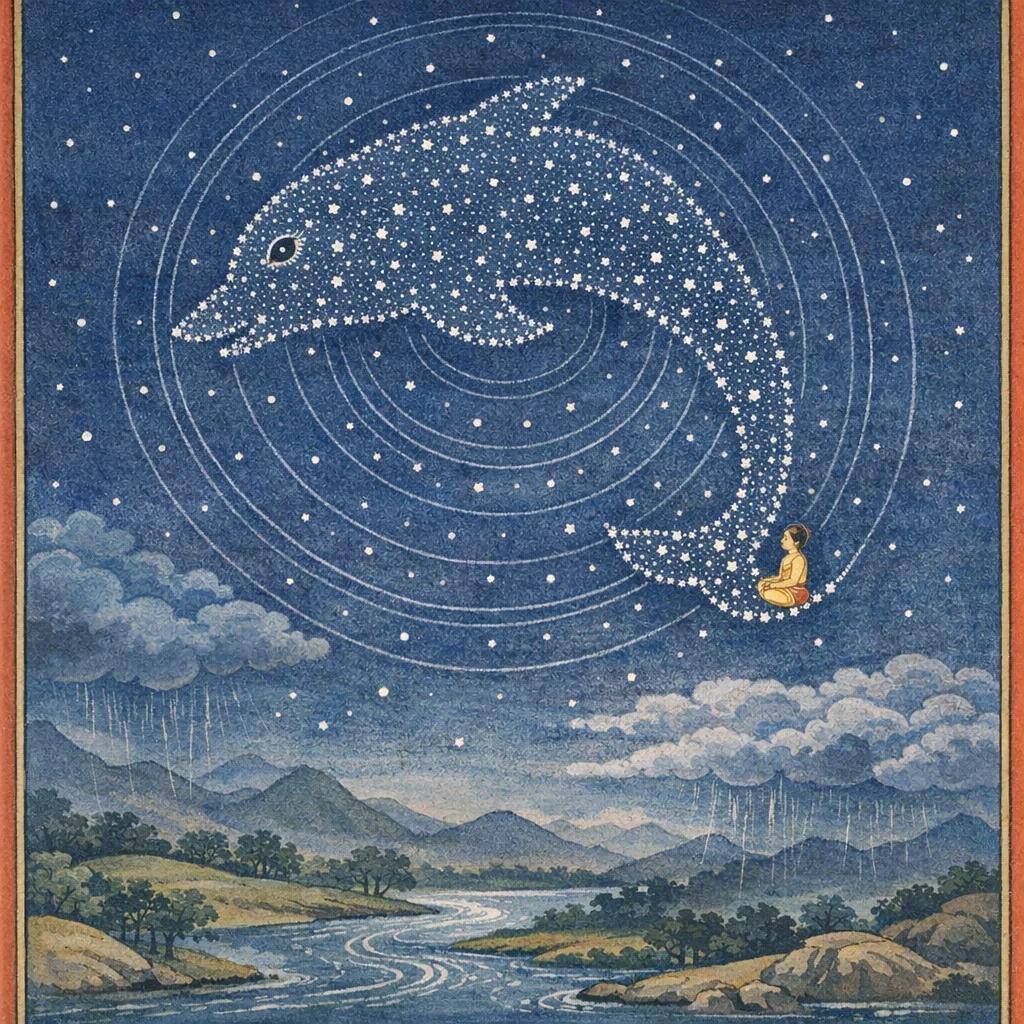
Parāśara describes Hari’s celestial arrangement as the star-formed Śiśumāra (cosmic dolphin), with Dhruva fixed at the tip of its tail. Dhruva’s circling regulates the revolutions of the Sun, Moon, planets, and constellations, said to be bound to him by the unseen “wind-host” bonds that uphold cosmic order. Dhruva, son of Uttānapāda, attained this station through devoted worship of the Lord. Parāśara then clarifies the chain of support: Janārdana upholds the Śiśumāra; the Śiśumāra rests on Dhruva; and the Sun’s station is established upon Dhruva—yet in the end all rests upon Nārāyaṇa. The chapter also explains the rainfall cycle that sustains life: the Sun draws up waters for eight months and releases them as rain, producing food and nourishing beings; waters are conveyed through Soma (the Moon) and spread into clouds by wind-channels. It distinguishes cloud-rain from the purifying ‘ākāśa-gaṅgā’ waters that fall without clouds. The cycle culminates in dharma: rain enables food, sacrifice, Veda-ordered life, and the nourishment of the devas, showing cosmic processes and ritual economy integrated under Nārāyaṇa enthroned at the heart of the Śiśumāra.
Shlokas
Verse 1
तारामयं भगवतः शिशुमाराकृति प्रभोः दिवि रूपं हरेर् यत् तु तस्य पुच्छे स्थितो ध्रुवः
In heaven shines the Lord Hari’s star-woven form, shaped as the Śiśumāra; upon the tip of its tail stands Dhruva, fixed and unmoving.
Verse 2
एष भ्रमन् भ्रामयति चन्द्रादित्यादिकान् ग्रहान् भ्रमन्तम् अनु तं यान्ति नक्षत्राणि च चक्रवत्
Circling in his own station, he sets the Moon, the Sun, and the other planets in motion; and the constellations follow him like a turning wheel.
Verse 3
सूर्याचन्द्रमसौ तारा नक्षत्राणि ग्रहैः सह वातानीकमयैर् बन्धैर् ध्रुवे बद्धानि तानि वै
The Sun and Moon, the stars, the constellations, and the planets are bound to Dhruva by bonds formed of the hosts of winds, and thus kept in their ordained courses.
Verse 5
उत्तानपादपुत्रस् तु तम् आराध्य जगत्पतिम् सताराशिशुमारस्य ध्रुवः पुच्छे व्यवस्थितः
Uttānapāda’s son, having worshipped the Lord of the universe, became Dhruva—fixed in the heavens at the tail of the starry Śiśumāra.
Verse 6
आधारः शिशुमारस्य सर्वाध्यक्षो जनार्दनः ध्रुवस्य शिशुमारश् च ध्रुवे भानुर् व्यवस्थितः
Janārdana, the all-overseeing Lord, is the very support of the Śiśumāra. The Śiśumāra depends upon Dhruva, and upon Dhruva the radiant Bhānu—the Sun—is established in his ordained station.
Verse 7
तदाधारं जगच् चेदं सदेवासुरमानुषम्
Upon Him this entire universe is upheld—together with the gods, the asuras, and humankind—for all beings rest in Him as their very support.
Verse 8
येन विप्र विधानेन तन् ममैकमनाः शृणु विवस्वान् अष्टभिर् मासैर् आदायापो रसान्विताः वर्षत्य् अम्बु ततश् चान्नम् अन्नाद् अप्य् अखिलं जगत्
Hear with single-pointed mind, O brāhmaṇa, the ordinance by which this is done. Vivasvān, the Sun, for eight months draws up the waters with their sap and essence, then releases them as rain. From rain comes food, and from food the whole world is sustained.
Verse 9
विवस्वान् अंशुभिस् तीक्ष्णैर् आदाय जगतो जलम् सोमे मुञ्चत्य् अथेन्दुश् च वायुनाडीमयैर् दिवि नालैर् विक्षिपते ऽभ्रेषु धूमाग्न्यनिलमूर्तिषु
Vivasvān, the Sun, with his piercing rays draws up the waters of the world and releases them into Soma, the Moon. Thereafter Indu, the Moon, through heavenly channels formed of wind-currents, disperses that water into the clouds—taking forms of smoke, fire, and moving air—so it may be spread above.
Verse 10
न भ्रश्यन्ति यतस् तेभ्यो जलान्य् अभ्राणि तान्य् अतः अभ्रस्थाः प्रपतन्त्य् आपो वायुना समुदीरिताः संस्कारं कालजनितं मैत्रेयासाद्य निर्मलाः
Because the waters do not slip away from those clouds, they are therefore called “abhras” (clouds). From the clouds the waters fall, driven onward by the winds; and, O Maitreya, having attained the purification born of time, they become clear and pure.
Verse 11
सरित्समुद्रभौमास् तु तथापः प्राणिसंभवाः चतुष्प्रकारा भगवान् आदत्ते सविता मुने
O sage, the Blessed Sun, Savitā, by his sovereign ordinance draws up the waters in four modes: those of rivers, those of the ocean, those that arise from the earth, and those born from living beings.
Verse 12
आकाशगङ्गासलिलं तथादाय गभस्तिमान् अनभ्रगतम् एवोर्व्यां सद्यः क्षिपति रश्मिभिः
Thus the radiant Sun, drawing up the waters of the celestial Gaṅgā, immediately casts them down upon the earth by his rays—sending them straightway, even without the intervention of clouds.
Verse 13
तस्य संस्पर्शनिर्धूतपापपङ्को द्विजोत्तम न याति नरकं मर्त्यो दिव्यं स्नानं हि तत् स्मृतम्
O best of twice-born ones, the mortal whose mire of sin is washed away merely by its touch does not go to hell; for that is remembered in the tradition as a truly divine bath.
Verse 14
दृष्टसूर्यं हि यद् वारि पतत्य् अभ्रैर् विना दिवः आकाशगङ्गासलिलं तद् गोभिः क्षिप्यते रवेः
That water which is seen to fall from the sky even when the sun is visible and no clouds are present is the water of the heavenly Gaṅgā; it is cast down by Ravi through his “cows”—that is, his rays.
Verse 15
कृत्तिकादिषु ऋक्षेषु विषमेष्व् अम्बु यद् दिवः दृष्टार्कं पतितं ज्ञेयं तद् गाङ्गं दिग्गजोज्झितम्
Among the lunar mansions beginning with Kṛttikā, especially in the inauspicious uneven divisions, when water is seen to fall from the sky while the Sun is still visible, know that rain to be the ‘Gaṅgā’: a heaven-sent outpouring, as though released from the quarters when the cosmic elephants that uphold the directions have withdrawn.
Verse 16
युग्मर्क्षेषु तु यत् तोयं पतत्य् अर्कोज्झितं दिवः तत् सूर्यरश्मिभिः सद्यः समादाय निरस्यते
But the water that, in the region of the paired lunar mansions, falls down from the sky after being released by the Sun—this is immediately gathered up again by the Sun’s rays and driven onward.
Verse 17
उभयं पुण्यम् अत्यर्थं नृणां पापहरं द्विज आकाशगङ्गासलिलं दिव्यं स्नानं महामुने
O twice-born one, both are supremely meritorious and remove the sins of human beings: the sacred water of the heavenly Gaṅgā, and the divine act of bathing therein, O great sage.
Verse 18
यत् तु मेघैः समुत्सृष्टं वारि तत् प्राणिनां द्विज पुष्णात्य् ओषधयः सर्वा जीवनायामृतं हि तत्
But the water released by the clouds—O twice-born one—nourishes all living beings. From it all herbs and plants are sustained; indeed, for the sake of life it is as nectar itself.
Verse 19
तेन वृद्धिं परां नीतः सलिलेनौषधीगणः साधकः फलपाकान्तः प्रजानां द्विज जायते
By that life-giving water, the multitude of herbs and plants is led to supreme increase; ripening into fruit at the proper time, it becomes the true accomplisher of the peoples’ welfare—so that it is rightly spoken of as ‘twice-born’.
Verse 20
तेन यज्ञान् यथाप्रोक्तान् मानवाः शास्त्रचक्षुषः कुर्वन्त्य् अहरहस् तैश् च देवान् आप्याययन्ति ते
Therefore, humans—seeing with the eye of scripture—perform, day after day, the sacrifices exactly as enjoined; and by those rites they nourish and strengthen the devas, sustaining the ordained harmony between the human and the divine.
Verse 21
एवं यज्ञाश् च वेदाश् च वर्णाश् च द्विजपूर्वकाः सर्वे देवनिकायाश् च पशुभूतगणाश् च ये
Thus, the sacrifices and the Vedas, the social orders beginning with the twice-born, and indeed all the companies of the gods—together with the multitudes of animals and living beings—arise and are upheld within the ordained cosmic order.
Verse 22
वृष्ट्या धृतम् इदं सर्वम् अन्नं निष्पाद्यते यया सापि निष्पाद्यते वृष्टिः सवित्रा मुनिसत्तम
By rain, indeed, this entire world is upheld; by it, food is brought forth. And that very rain, O best of sages, is itself brought into being by Savitṛ—the Sun—who governs the ordered flow of nourishment.
Verse 23
आधारभूतः सवितुर् ध्रुवो मुनिवरोत्तम ध्रुवस्य शिशुमारो ऽसौ सो ऽपि नारायणाश्रयः
O best of sages, Dhruva—the Pole Star—stands as the supporting foundation even for the Sun’s course; and that Śiśumāra-constellation, belonging to Dhruva, rests likewise upon Nārāyaṇa as its ultimate refuge and ground.
Verse 24
हृदि नारायणस् तस्य शिशुमारस्य संस्थितः बिभर्ता सर्वभूतानाम् आदिभूतः सनातनः
In the very heart of that Śiśumāra is Nārāyaṇa enthroned—the eternal, primeval source, who upholds all beings and bears the universe within His sovereign order.
Frequently Asked Questions
It is a star-constituted heavenly form of Hari described as dolphin-shaped, a cosmic configuration through which the ordered motion of luminaries is contemplated, with Dhruva fixed at its tail-tip.
The Sun draws up waters for eight months, releases them as rain (often via the Moon and cloud-formation through wind-conduits), producing food; food sustains beings and enables yajña, by which devas are nourished—forming a closed cycle of cosmic maintenance.
It asserts theological primacy: even the cosmic mapping of stars and the pivot of Dhruva ultimately rest on Nārāyaṇa as the eternal ādhāra, integrating cosmology into devotion and metaphysics.