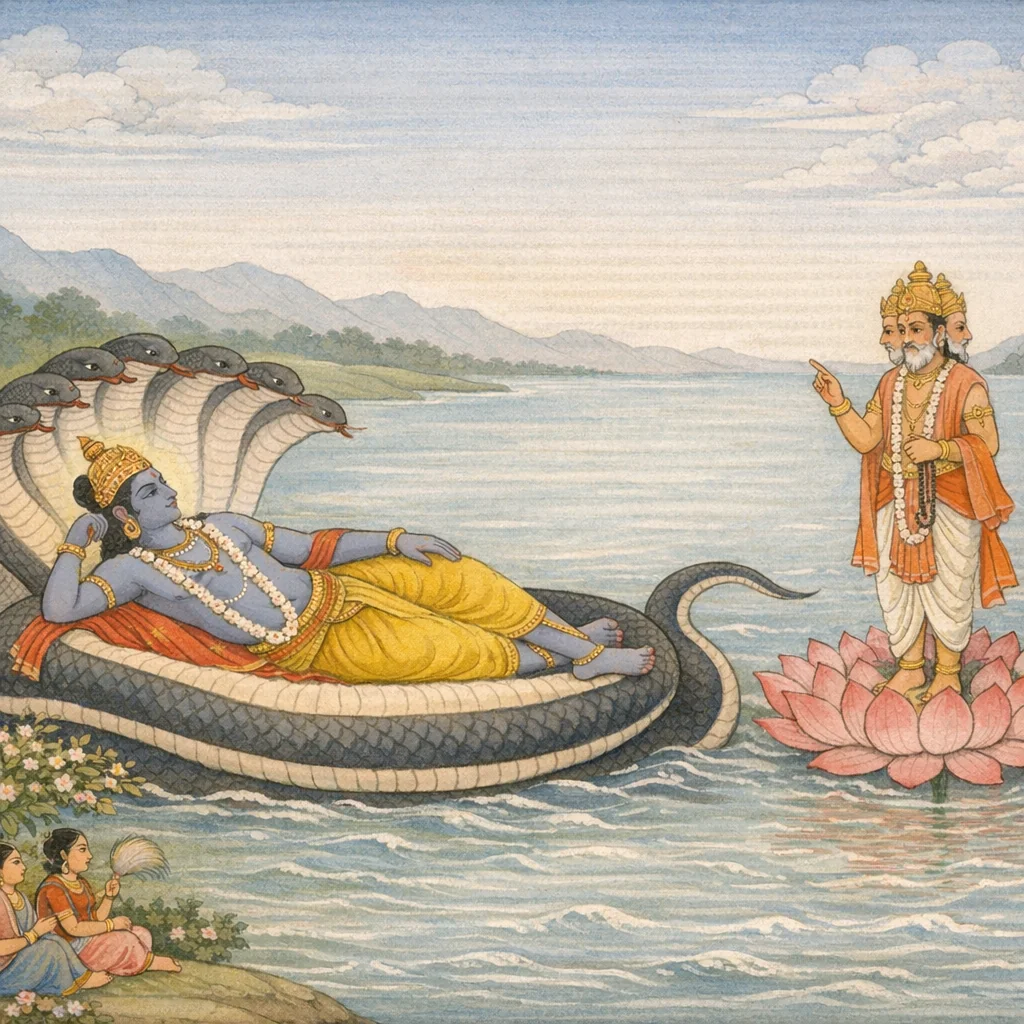
Brahmā–Viṣṇu Garva-vādaḥ (The Dispute of Pride Between Brahmā and Viṣṇu)
This chapter, introduced by Nandikeśvara, narrates an episode in which Viṣṇu rests upon the serpent couch of Śeṣa, attended by his retinue, when Brahmā arrives unexpectedly and challenges what he sees. Speaking with the pride of superiority, Brahmā commands Viṣṇu to rise and acknowledge him, invoking a guru-like authority and rebuking any display of pride before an arriving “higher” one. Viṣṇu answers with counter-claims of primacy: Brahmā is born from the lotus at Viṣṇu’s navel, and the world abides within Viṣṇu; he even brands Brahmā’s approach as presumptuous, almost “thief-like.” The exchange escalates into mutual self-assertion—“I alone am supreme”—and the beginning of conflict. The adhyāya’s inner teaching is an anatomy of garva (pride): even the highest cosmic deities, when identified with ego, fall into delusion and rivalry, thereby preparing the theological necessity of Śiva as the transcendent arbiter and ultimate ground beyond all contention.
Shlokas
Verse 1
नंदिकेश्वर उवाच । पुरा कदाचिद्योगींद्र विष्णुर्विषधरासनः । सुष्वाप परया भूत्या स्वानुगैरपि संवृतः
Nandikeśvara said: Long ago, at a certain time, Viṣṇu—the lord among yogins, seated upon the serpent (Śeṣa)—fell into deep sleep, endowed with supreme majesty, and surrounded by his own attendants.
Verse 2
यदृच्छया गतस्तत्र ब्रह्मा ब्रह्मविदांवरः । अपृच्छत्पुंडरीकाक्षं शयनं सर्वसुन्दरम्
By chance, Brahmā—the foremost among the knowers of Brahman—went there. He then questioned the lotus‑eyed Lord (Viṣṇu), who was reclining upon that most beautiful couch.
Verse 3
कस्त्वं पुरुषवच्छेषे दृष्ट्वा मामपि दृप्तवत् । उत्तिष्ठ वत्स मां पश्य तव नाथमिहागतम्
“Who are you, lingering here like a mere man, and even looking upon me with arrogance? Rise up, dear child—look at me. Your Lord has come here.”
Verse 4
आगतं गुरुमाराध्यं दृष्ट्वा यो दृप्तवच्चरेत् । द्रो हिणस्तस्य मूढस्य प्रायश्चित्तं विधीयते
If, on seeing the revered Guru arrive, a person behaves with arrogance, then for that deluded offender—one who bears malice toward the Guru—an expiatory rite (prāyaścitta) is prescribed.
Verse 5
इति श्रुत्वा वचः क्रुद्धो बहिः शांतवदाचरत् । स्वस्ति ते स्वागतं वत्स तिष्ठ पीठमितो विश
Hearing those words, though angered within, he behaved outwardly as if calm. “May auspiciousness be yours. Welcome, dear child. Sit on this seat—come in.”
Verse 6
इति श्रीशिवमहापुराणे विद्येश्वरसंहितायां षष्ठोऽध्यायः
Thus ends the sixth chapter in the Vidyeśvara-saṃhitā of the revered Śiva Mahāpurāṇa.
Verse 7
पितामहश्च जगतः पाता च तव वत्सक । विष्णुरुवाच । मत्स्थं जगदिदं वत्स मनुषे त्वं हि चोरवत्
“You are the grandsire of the world, and also its protector, dear child.” Viṣṇu said: “This entire universe abides in Me, my son; yet you speak of it as if it were your own—like a thief.”
Verse 8
मन्नाभिकमलाज्जातः पुत्रस्त्वं भाषसे वृथा । नंदिकेश्वर उवाच । एवं हि वदतोस्तत्र मुग्धयोरजयोस्तदा
“Born from the lotus of my navel, you are my son—yet you speak in vain.” Nandikeśvara said: Thus, at that time and in that place, those two—both deluded and unconquered—were speaking on…
Verse 9
अहमेव बरो न त्वमहं प्रभुरहं प्रभुः । परस्परं हंतुकामौ चक्रतुः समरोद्यमम्
“I alone am the superior—certainly not you. I am the Lord; I am the Lord.” Thus, desiring to slay one another, the two set about preparing for battle.
Verse 10
युयुधातेऽमरौ वीरौ हंसपक्षींद्र वाहनौ । वैरंच्या वैष्णवाश्चैवं मिथो युयुधिरे तदा
Then those two heroic Devas—mounted on the lordly swan and the king of birds—fought one another; the forces of Brahmā and the forces of Viṣṇu thus engaged in mutual combat at that time.
Verse 11
तावद्विमानगतयः सर्वा वै देवजातयः । दिदृक्षवः समाजग्मुः समरं तं महाद्भुतम्
Then all the orders of the gods, mounted upon their celestial chariots, assembled together—eager to behold that exceedingly wondrous battle.
Verse 12
क्षिपंतः पुष्पवर्षाणि पश्यंतः स्वैरमंबरे । सुपर्णवाहनस्तत्र क्रुद्धो वै ब्रह्मवक्षसि
As they scattered showers of flowers and gazed freely about the sky, there the Lord who rides Garuḍa grew wrathful at Brahmā’s presumption.
Verse 13
मुमोच बाणानसहानस्त्रांश्च विविधान्बहून् । मुमोचाऽथ विधिः क्रुद्धो विष्णोरुरसि दुःसहान्
He loosed many kinds of weapons and unbearable arrows. Then Vidhi (Brahmā), enraged, discharged upon Viṣṇu’s chest missiles hard to endure.
Verse 14
बाणाननलसंकाशानस्त्रांश्च बहुशस्तदा । तदाश्चर्यमिति स्पष्टं तयोः समरगोचरम्
Then, in that battle, many missiles and weapons—arrows blazing like fire—were loosed again and again. Their encounter upon the field of war was plainly astonishing to behold.
Verse 15
समीक्ष्य दैवतगणाः शशंसुर्भृशमाकुलाः । ततो विष्णुः सुसंक्रुद्धः श्वसन्व्यसनकर्शितः
Seeing this, the hosts of gods, greatly agitated, cried out in alarm. Thereupon Viṣṇu—deeply enraged, breathing hard and worn down by distress—responded at once.
Verse 16
माहेश्वरास्त्रं मतिमान् संदधे ब्रह्मणोपरि । ततो ब्रह्मा भृशं क्रुद्धः कंपयन्विश्वमेव हि
Then the wise one deployed the Maheśvara weapon against Brahmā. Thereupon Brahmā became exceedingly enraged, indeed causing the entire universe to tremble.
Verse 17
अस्त्रं पाशुपतं घोरं संदधे विष्णुवक्षसि । ततस्तदुत्थितं व्योम्नि तपनायुतसन्निभम्
He fixed the dreadful Pāśupata weapon upon Viṣṇu’s chest. Then that weapon rose up into the sky, blazing like ten thousand suns.
Verse 18
सहस्रमुखमत्युग्रं चंडवातभयंकरम् । अस्त्रद्वयमिदं तत्र ब्रह्मविष्ण्वोर्भयंकरम्
There appeared a pair of weapons—thousand-faced and exceedingly fierce, terrifying like a storm-wind; there, they became a cause of dread even to Brahmā and Viṣṇu.
Verse 19
इत्थं बभूव समरो ब्रह्मविष्ण्वोः परस्परम् । ततो देवगणाः सर्वे विषण्णा भृशमाकुलाः । ऊचुः परस्परं तात राजक्षोभे यथा द्विजाः
Thus the battle between Brahmā and Viṣṇu raged against each other. Then all the hosts of gods, deeply despondent and greatly agitated, spoke among themselves—like learned brāhmaṇas conferring when a kingdom is thrown into turmoil.
Verse 20
सृष्टिः स्थितिश्च संहारस्तिरो भावोप्यनुग्रहः । यस्मात्प्रवर्तते तस्मै ब्रह्मणे च त्रिशूलिने
Creation, preservation, dissolution, veiling (tirōbhāva), and also grace (anugraha)—all these proceed from Him. Salutations to that Supreme Reality, to the Trident-bearing Lord, Śiva.
Verse 22
अशक्यमन्यैर्यदनुग्रहं विना तृणक्षयोप्यत्र यदृच्छया क्वचित् । इति देवाभयं कृत्वा विचिन्वंतः शिवक्षयम् । जग्मुः कैलासशिखरं यत्रास्ते चंद्र शेखरः
“Without His grace, it is impossible for others to accomplish it; even the destruction of a single blade of grass here occurs only by chance.” Thinking thus, the gods made themselves fearless, sought the ‘end/limit’ of Śiva, and went to the summit of Kailāsa, where Candraśekhara, the Moon-crested Lord, abides.
Verse 23
दृष्ट्वैवममरा हृष्टाः पदंतत्पारमेश्वरम् । प्रणेमुः प्रणवाकारं प्रविष्टास्तत्र सद्मनि
Beholding thus the supreme abode of Parameśvara, the devas rejoiced. They bowed down to the Lord whose very form is the sacred syllable Oṁ, and then entered that divine mansion.
Verse 24
तेपि तत्र सभामध्ये मंडपे मणिविष्टरे । विराजमानमुमया ददृशुर्देवपुंगवम्
There, in the midst of the assembly hall, within the pavilion upon a jeweled dais, they beheld the foremost of the gods—Lord Śiva—radiant and resplendent together with Umā.
Verse 25
सव्योत्तरेतरपदं तदर्हितकरां बुजम् । स्वगणैः सर्वतो जुष्टं सर्वलक्षणलक्षितम्
His left and right feet were set in perfect poise; His lotus-like hands were held in fitting and worthy mudrās. Surrounded on every side by His own gaṇas, He bore all auspicious marks, fully endowed with every divine characteristic.
Verse 26
वीज्यमानं विशेषजैः स्त्रीजनैस्तीव्रभावनैः । शस्यमानं सदावेदैरनुगृह्णंतमीश्वरम्
He—the Lord, Īśvara—was being fanned by devoted women of excellent conduct, their hearts intensely absorbed in reverence; and the Vedas continually hymned Him, while He, the Supreme Īśvara, bestowed grace upon all.
Verse 27
दृष्ट्वैवमीशममराः संतोषसलिलेक्षणाः । दंडवद्दूरतो वत्स नमश्चक्रुर्महागणाः
Seeing the Lord thus, the gods—whose eyes were filled with tears born of joy—bowed from afar, prostrating like a staff, and the great hosts offered their reverent salutations.
Verse 28
तानवेक्ष्य पतिर्देवान्समीपे चाह्वयद्गणैः । अथ संह्लादयन्देवान्देवो देवशिखामणिः । अवोचदर्थगंभीरं वचनं मधुमंगलम्
Seeing those gods, the Lord—Pati, sovereign of all—summoned them near with his gaṇas. Then, delighting the devas, that God, the crest-jewel among the gods, spoke words profound in meaning, sweet, and auspicious.
Frequently Asked Questions
A confrontational dialogue where Brahmā challenges reclining Viṣṇu and Viṣṇu counters with claims of cosmic priority; the episode functions as a theological argument that divine offices without humility devolve into rivalry, anticipating Śiva’s role as the ultimate resolution to competing claims.
Viṣṇu’s serpent couch and the navel-lotus motif encode cosmological dependence and delegated creation: they symbolize how manifest authority (creation, preservation) is mediated through forms and functions, whereas the chapter’s deeper lesson critiques identification with those functions as the root of delusion.
No explicit Śiva/Gaurī manifestation is foregrounded in the sampled verses; instead, the chapter operates as a prelude—by exposing Brahmā–Viṣṇu rivalry, it implicitly elevates Śiva as the transcendent principle required to adjudicate and stabilize the cosmic hierarchy.