Sarga 24
गङ्गा–सरयू-सङ्गमः, मलद–करूश-देशकथा, ताटकावनप्रवेशोपदेशः (The Confluence of Gaṅgā and Sarayū; the Tale of Malada–Karūśa; Counsel on Tātakā’s Forest)
बालकाण्ड
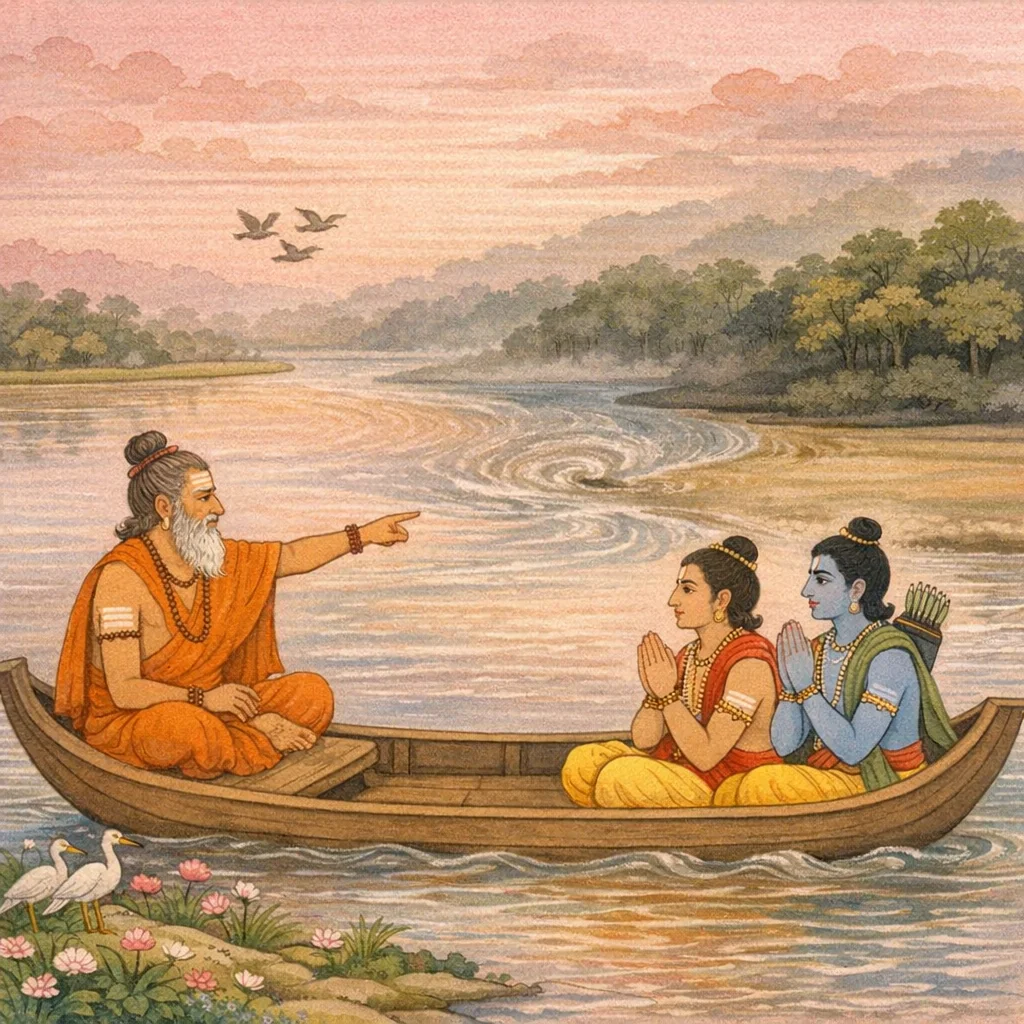
At a bright dawn, Rāma and Lakṣmaṇa complete their morning rites and go with Viśvāmitra to the riverbank. Ascetics provide an auspicious boat, and the party crosses the sacred Gaṅgā. Midstream, Rāma hears a great roar; Viśvāmitra explains it as the tumult at the confluence where Gaṅgā draws near to Sarayū, and instructs him to offer focused salutations. The brothers bow reverently to both rivers and reach the southern bank. There they behold an untrodden, dreadful forest, dense with trees and filled with ominous cries of beasts and birds. When Rāma asks, Viśvāmitra recounts the land’s former prosperity—Malada and Karūśa—said to have been fashioned by celestial architects. He also tells of Indra’s purification after the Vṛtra episode, by which the country received a boon and its names. In time, the yakṣī Tātakā—fearsome, shape-shifting, and mother of Mārīca—seizes the region, terrorizes its people, and blocks the route. Viśvāmitra commands Rāma to rely on his own strength to remove this “thorn” and restore the land’s safety, presenting it as a dharmic duty undertaken with ascetic authorization.
Shlokas
Verse 1
तत: प्रभाते विमले कृताह्निकमरिन्दमौ।विश्वामित्रं पुरस्कृत्य नद्यास्तीरमुपागतौ।।1.24.1।।
Then, at the clear and bright dawn, the two foe-subduers—having performed their morning rites—reached the riverbank with Viśvāmitra going before them.
Verse 2
ते च सर्वे महात्मानो मुनयस्संश्रितव्रता:।उपस्थाप्य शुभां नावं विश्वामित्रमथाब्रुवन्।।1.24.2।।
Then all those great-souled ascetics, steadfast in their vows, had an auspicious boat made ready and addressed Viśvāmitra, saying:
Verse 3
आरोहतु भवान्नावं राजपुत्रपुरस्कृत:।अरिष्टं गच्छ पन्थानं मा भूत्कालविपर्यय:।।1.24.3।।
“Revered sir, with the princes leading the way, please board the boat. Proceed along a path free from danger; let there be no delay of time.”
Verse 4
विश्वामित्रस्तथेत्युक्तवा तानृषीनभिपूज्य च।ततार सहितस्ताभ्यां सरितं सागरङ्गमाम्।।1.24.4।।
Viśvāmitra, saying “So be it,” honored those sages; then, accompanied by the two princes, he crossed the river that flows toward the ocean.
Verse 5
ततश्शुश्राव वै शब्दमतिसंरम्भवर्धितम्।मध्यमागम्य तोयस्य सह राम:कनीयसा।।1.24.5।।
Then, as they reached midstream, Rāma—together with his younger brother—heard a roaring sound, intensified by the river’s violent rush.
Verse 6
अथ रामस्सरिन्मध्ये पप्रच्छ मुनिपुङ्गवम्।वारिणो भिद्यमानस्य किमयं तुमुलो ध्वनि:।।1.24.6।।
Then, in the middle of the river, Rāma asked the best of sages: “What is this tumultuous sound, as though the waters are splitting apart?”
Verse 7
राघवस्य वचश्श्रुत्वा कौतूहलसमन्वित:।कथयामास धर्मात्मा तस्य शब्दस्य निश्चयम्।।1.24.7।।
Hearing Rāghava’s words, spoken in eager curiosity, the righteous-souled Viśvāmitra explained to him the true source and meaning of that sound.
Verse 8
कैलासपर्वते राम मनसा निर्मितं सर:।ब्रह्मणा नरशार्दूल तेनेदं मानसं सर:।।1.24.8।।
“O Rāma, tiger among men: on Mount Kailāsa, Brahmā created a lake by the power of his mind; therefore this lake is known as Mānasā (Manasa) Lake.”
Verse 9
तस्मात्सुस्राव सरसस्सायोध्यामुपगूहते ।सर प्रवृत्ता सरयू: पुण्या ब्रह्मसरश्च्युता।।1.24.9।।
“From that lake a river flowed forth—this sacred stream that embraces Ayodhyā. Since it issues from the lake, it is called Sarayū, and it is holy as it springs from Brahmā’s lake.”
Verse 10
तस्यायमतुलश्शब्दो जाह्नवीमभिवर्तते।वारिसङ्क्षोभजो राम प्रणामं नियत:कुरु।।1.24.10।।
As the Jāhnavī (Gaṅgā) draws near, this incomparable roar arises from the churning clash of waters. Rāma, with a composed mind, offer your reverent salutation.
Verse 11
ताभ्यां तु तावुभौ कृत्वा प्रणाममतिधार्मिकौ।तीरं दक्षिणमासाद्य जग्मतुर्लघुविक्रमौ।।1.24.11।।
Those two, supremely righteous, having bowed in reverence to both rivers, reached the southern bank and went on swiftly.
Verse 12
स वनं घोरसङ्काशं दृष्ट्वा नृपवरात्मज:।अविप्रहतमैक्ष्वाक: पप्रच्छ मुनिपुङ्गवम्।।1.24.12।।
Seeing that forest, grim in appearance and seemingly untrodden, the Ikṣvāku prince—the son of the best of kings—questioned the foremost of sages.
Verse 13
अहो वनमिदं दुर्गं झिल्लिकागणनादितम्।भैरवैश्शपदै: पूर्णं शकुन्तैर्दारुणारुतै:।।1.24.13।।
“Ah! This forest is truly hard to pass—ringing with the incessant chorus of crickets, filled with fearsome beasts, and with birds that cry out harshly.”
Verse 14
नानाप्रकारैश्शकुनै र्वाश्यद्भिर्भैरवस्वनै:।सिंहव्याघ्रवराहैश्च वारणैश्चोपशोभितम्।।1.24.14।।
“It resounds with the frightful cries of birds of many kinds, and it is populated—indeed made formidable—by lions, tigers, boars, and elephants.”
Verse 15
धवाश्वकर्णककुभैर्बिल्वतिन्दुकपाटलै:। सङ्कीर्णं बदरीभिश्च किन्न्वेतद्दारुणं वनम्।।1.24.15।।
“Thick with dhava, aśvakarṇa, kakubha, bilva, tinduka, and pāṭala trees, and crowded with badarī as well—what, indeed, is this dreadful forest?”
Verse 16
तमुवाच महातेजा विश्वामित्रो महामुनि:।श्रूयतां वत्स काकुत्स्थ यस्यैतद्दारुणं वनम्।।1.24.16।।
Then the mighty, radiant sage Viśvāmitra said to him: “Listen, dear child of the Kakutstha line; I shall tell you to whom this dreadful forest belongs.”
Verse 17
एतौ जनपदौ स्फीतौ पूर्वमास्तां नरोत्तम।मलदाश्च करूशाश्च देवनिर्माणनिर्मितौ।।1.24.17।।
“O best of men, in former times there stood here two flourishing realms—Maladā and Karūśā—fashioned by celestial builders.”
Verse 18
पुरा वृत्रवधे राम मलेन समभिप्लुतम्।क्षुधा चैव सहस्राक्षं ब्रह्महत्या समाविशत्।।1.24.18।।
“In ancient times, O Rāma, after the slaying of Vṛtra, the thousand-eyed Indra was seized by brahmahatyā—the sin of brahmin-slaying—and he was overwhelmed by impurity and hunger as well.”
Verse 19
तमिन्द्रं स्नापयन् देवा ऋषयश्च तपोधना:।कलशैस्स्नापयामासुर्मलं चास्य प्रमोचयन्।।1.24.19।।
The gods and the seers—whose wealth was austerity—bathed Indra with water-pitchers, and thereby freed him from his bodily taint.
Verse 20
इह भूम्यां मलं दत्वा दत्वा कारूशमेव च।शरीरजं महेन्द्रस्य ततो हर्षं प्रपेदिरे।।1.24.20।।
Having left here upon this ground the bodily impurity of Mahendra—and his hunger as well—the gods thereafter attained great joy.
Verse 21
निर्मलो निष्करूशश्च शुचिरिंन्द्रो यदाभवत्।ददौ देशस्य सुप्रीतो वरं प्रभुरनुत्तमम्।।1.24.21।।
When Indra became pure—free from taint and free from hunger—the mighty lord, greatly pleased, granted that region an unsurpassed boon.
Verse 22
इमौ जनपदौ स्फीतौ ख्यातिं लोके गमिष्यत:।मलदाश्च करूशाश्च ममाङ्गमलधारिणौ।।1.24.22।।
Let these two provinces, bearing the impurities from my own body, become flourishing and attain fame in the world—as Maladā and Karūṣa.
Verse 23
साधु साध्विति तं देवा: पाकशासनमब्रुवन्।देशस्य पूजां तां दृष्ट्वा कृतां शक्रेण धीमता।।1.24.23।।
Seeing that honor bestowed upon the land by wise Śakra, the gods said to Pākaśāsana (Indra), “Well done! Well done!”
Verse 24
एतौ जनपदौ स्फीतौ दीर्घकालमरिन्दम।मलदाश्च करूशाश्च मुदितौ धनधान्यत:।।1.24.24।।
O subduer of enemies, these two flourishing provinces—Maladā and Karūṣa—remained for a long time joyful, rich in wealth and grain.
Verse 25
कस्यचित्त्वथ कालस्य यक्षी वै कामरूपिणी।बलं नागसहस्रस्य धारयन्ती तदा ह्यभूत्।।1.24.25।। ताटका नाम भद्रं ते भार्या सुन्दस्य धीमत:। 2मारीचो राक्षस: पुत्रो यस्याश्शक्रपराक्रम:।।1.24.26।।
After some time, there arose a yakṣī who could assume forms at will, bearing the strength of a thousand elephants. She was named Tāṭakā—may auspiciousness be yours—the wife of the wise Sunda, and the mother of the rākṣasa Mārīca, whose prowess was like that of Śakra.
Verse 26
कस्यचित्त्वथ कालस्य यक्षी वै कामरूपिणी।बलं नागसहस्रस्य धारयन्ती तदा ह्यभूत्।।1.24.25।। ताटका नाम भद्रं ते भार्या सुन्दस्य धीमत:। 2मारीचो राक्षस: पुत्रो यस्याश्शक्रपराक्रम:।।1.24.26।।
After some time, there arose a yakṣī who could assume forms at will, bearing the strength of a thousand elephants. She was named Tāṭakā—may auspiciousness be yours—the wife of the wise Sunda, and the mother of the rākṣasa Mārīca, whose prowess was like that of Śakra.
Verse 27
वृत्तबाहुर्महावीर्यो विपुलास्य तनुर्महान्।राक्षसो भैरवाकारो नित्यं त्रासयते प्रजा:।।1.24.27।।
A rākṣasa with rounded, powerful arms—great in energy, broad-faced and huge-bodied—terrifying in form, continually tormented the people.
Verse 28
इमौ जनपदौ नित्यं विनाशयति राघव।मलदांश्च करूशांश्च ताटका दुष्टचारिणी।।1.24.28।।
“O Rāghava, that wicked-doing Tāṭakā continually devastates these two regions—Malada and Karūśa.”
Verse 29
सेयं पन्थानमावृत्य वसत्यध्यर्धयोजने।अत एव न गन्तव्यं ताटकाया वनं यत:।।1.24.29।।
“She blocks the roadway and dwells about a yojana and a half from here. For this very reason, people do not pass through—since it is Tāṭakā’s forest.”
Verse 30
स्वबाहुबलमाश्रित्य जहीमां दुष्टचारिणीम्।मन्नियोगादिमं देशं कुरु निष्कण्टकं पुन:।।1.24.30।।
“Relying on the strength of your own arms, slay this wicked-doer. By my command, make this land once more free of thorns—safe and unhindered.”
Verse 31
न हि कश्चिदिमं देशं शक्नोत्यागन्तुमीदृशम्।यक्षिण्या घोरया राम उत्सादितमसह्यया।।1.24.31।।
“O Rāma, no one is able to come into this land in such a state—laid waste by that dreadful, unbearable yakṣiṇī.”
Verse 32
एतत्ते सर्वमाख्यातं यथैतद्दारुणं वनम्।यक्ष्या चोत्सादितं सर्वमद्यापि न निवर्तते।।1.24.32।।
All this has been told to you—how this forest became so dreadful, and how that yakṣī laid everything waste; even now she has not withdrawn.
Verse 33
“Relying on the strength of your own arms, slay this wicked-doer. By my command, make this land once more free of thorns—safe and unhindered.”
Frequently Asked Questions
The pivotal action is Viśvāmitra’s injunction that Rāma neutralize Tātakā, who persistently devastates Malada–Karūśa and obstructs passage. The episode frames force as ethically bounded: a protective act undertaken under sage-guidance to restore public safety and lawful movement.
The chapter teaches that dharma is not only personal piety (morning rites, salutations to rivers) but also restorative responsibility: when a region is rendered uninhabitable by recurring harm, a qualified agent must act to remove the cause, guided by legitimate authority and disciplined intention.
Key landmarks include Gaṅgā (Jāhnavī), Sarayū and their confluence (marked by the ‘clash of waters’ sound), Manasa Sarovara on Kailāsa as Sarayū’s source, Ayodhyā as Sarayū’s embraced city, and the Malada–Karūśa region culminating in the feared Tātakā forest.