Sarga 54
भरद्वाजाश्रमप्राप्तिः — Arrival at Bharadvāja’s Hermitage and Counsel toward Citrakūṭa
अयोध्याकाण्ड
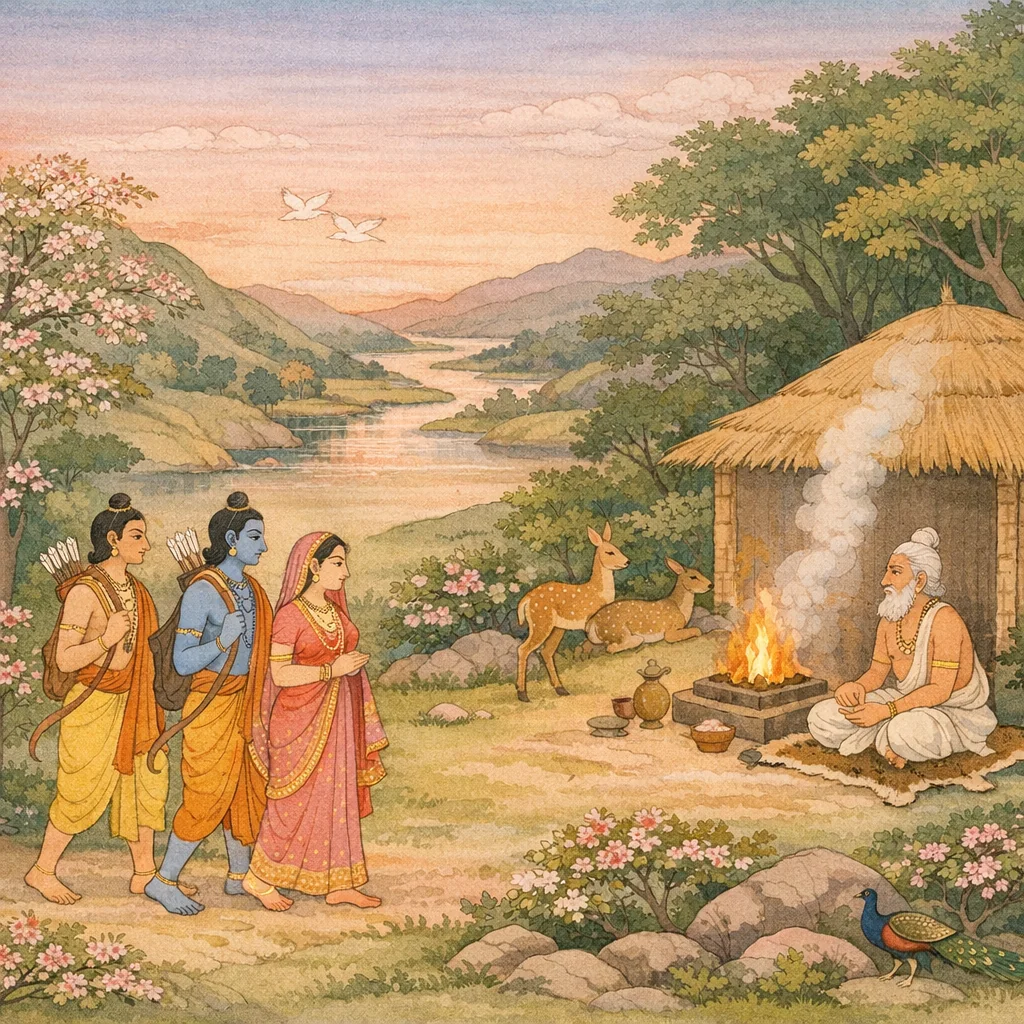
Sarga 54 shifts from travel to sacred discourse at Prayāga, the confluence of the Gaṅgā and Yamunā. After an auspicious night beneath a great tree, Rāma, Sītā, and Lakṣmaṇa cross a vast forest toward the sangam, marveling at unfamiliar and enchanting landscapes. Seeing sacrificial smoke, they infer a nearby ascetic settlement and by evening reach the āśrama of the sage Bharadvāja. They wait respectfully at a distance, then enter and bow to the ṛṣi, portrayed as disciplined, devoted to fire-rites, and spiritually discerning. Rāma formally introduces himself, Sītā, and Lakṣmaṇa, explains the exile, and declares their intent to live on roots and fruits in accordance with dharma. Bharadvāja offers full guest-hospitality—arghya, water, provisions, and lodging—welcoming them among disciples, hermits, and the forest’s creatures. Bharadvāja suggests they dwell comfortably near the holy confluence, but Rāma declines, anticipating frequent visits from nearby settlements and seeking a more secluded place suitable for Sītā’s comfort. The sage recommends the renowned mountain Citrakūṭa, ten krośas away, praising its sanctity, natural abundance, and uplifting sight. He permits them to depart at dawn and reaffirms Citrakūṭa as a fitting forest abode.
Shlokas
Verse 1
ते तु तस्मिन्महावृक्षे उषित्वा रजनीं शिवाम्।विमलेऽभ्युदिते सूर्ये तस्माद्देशात्प्रतस्थिरे।।।।
They spent that auspicious night beneath that great tree, and when the spotless sun had risen, they set out from that place.
Verse 2
यत्र भागीरथीं गङ्गां यमुनाभिप्रवर्तते।जग्मुस्तं देशमुद्दिश्य विगाह्य सुमहद्वनम्।।।।ते भूमिभागान्विविधान् देशांश्चापि मनोरमान्।अदृष्टपूर्वान् पश्यन्तस्तत्र तत्र यशश्विनः।।।।
Rama, Sita, and Lakshmana—illustrious in fame—entered the vast forest, journeying toward the place where the Yamuna meets the Bhagirathi Ganga, and along the way beheld many varied tracts of land and delightful regions they had never seen before.
Verse 3
यत्र भागीरथीं गङ्गां यमुनाभिप्रवर्तते।जग्मुस्तं देशमुद्दिश्य विगाह्य सुमहद्वनम्।।2.54.2।।ते भूमिभागान्विविधान् देशांश्चापि मनोरमान्।अदृष्टपूर्वान् पश्यन्तस्तत्र तत्र यशश्विनः।।2.54.3।।
Those illustrious ones, looking about here and there, beheld diverse tracts of land and many enchanting regions—places they had never seen before.
Verse 4
यथा क्षेमेण गच्छन् स पश्यंश्च विविधान् द्रुमान्।निवृत्तमात्रे दिवसे रामः सौमित्रिमब्रवीत्।।।।
Proceeding safely along the way and observing many kinds of trees, as the day drew to its close, Rāma spoke to Saumitrī (Lakṣmaṇa).
Verse 5
प्रयागमभितः पश्य सौमित्रे धूममुन्नतम्।अग्नेर्भगवतः केतुं मन्ये सन्निहितो मुनिः।।।।
“Look, Saumitrī—near Prayāga a tall column of smoke rises, like the banner of the revered Fire-god Agni. I think a sage’s dwelling is close by.”
Verse 6
नूनं प्राप्ताः स्म सम्भेदं गङ्गायमुनयोर्वयम्।तथा हि श्रूयते शब्दो वारिणो वारिघट्टितः।।।।
Surely we have reached the confluence of the Gaṅgā and the Yamunā, for the sound of waters striking against waters is clearly heard.
Verse 7
दारूणि परिभिन्नानि वनजैरुपजीविभिः।भरद्वाजाश्रमे चैते दृश्यन्ते विविधा द्रुमाः।।।।
Here, near Bharadvāja’s hermitage, are logs split by forest-dwellers who live by forest produce; and many different trees are seen as well.
Verse 8
धन्विनौ तौ सुखं गत्वा लम्बमाने दिवाकरे।गङ्गायमुनयोस्सन्धौ प्रापतुर्निलयं मुनेः।।।।
As the sun was declining, the two bowmen went on at ease and reached the sage’s dwelling at the confluence of the Gaṅgā and Yamunā.
Verse 9
रामस्त्वाश्रममासाद्य त्रासयन्मृगपक्षिणः।गत्वा मुहूर्तमध्वानं भरद्वाजमुपागमत्।।।।
Rāma approached the hermitage, startling the deer and birds; after going a short distance along the path, he reached Bharadvāja.
Verse 10
ततस्त्वाश्रमासाद्य मुनेर्दर्शनकाङ्क्षिणौ।सीतयानुगतौ वीरौ दूरादेवावतस्थतुः।।।।
Then, having reached the sage’s hermitage, the two heroes—followed by Sītā—stood at a distance, wishing for the seer’s audience.
Verse 11
स प्रविश्य महात्मानमृषिं शिष्यगणैर्वृतम्।संशितव्रतमेकाग्रं तपसा लब्धचक्षुषम्।।।।हुताग्निहोत्रं दृष्ट्वैव महाभागं कृताञ्जलिः।रामः सौमित्रिणा सार्धं सीतया चाभ्यवादयत्।।।।
Entering the hermitage, Rama beheld the great-souled rishi, surrounded by disciples—steadfast in vows, single-minded, and endowed with inner vision won through tapas. Seeing that eminent keeper of the sacred fires, Rama, with Lakshmana and Sita, joined his palms and paid reverent homage.
Verse 12
स प्रविश्य महात्मानमृषिं शिष्यगणैर्वृतम्।संशितव्रतमेकाग्रं तपसा लब्धचक्षुषम्।।2.54.11।।हुताग्निहोत्रं दृष्ट्वैव महाभागं कृताञ्जलिः।रामः सौमित्रिणा सार्धं सीतया चाभ्यवादयत्।।2.54.12।।
Entering the hermitage, Rama beheld the great sage surrounded by disciples—steadfast in vows, single-pointed in mind, and endowed with inner sight won through austerity. Seeing that noble keeper of the sacred agnihotra fires, Rama, with palms joined, saluted him together with Lakshmana and Sita.
Verse 13
न्यवेदयत चात्मानं तस्मै लक्ष्मणपूर्वजः।पुत्रौ दशरथस्यावां भगवन् रामलक्ष्मणौ।।।।
Then Rama, Lakshmana’s elder brother, introduced himself to the sage: “O venerable one, we are the two sons of Dasharatha—Rama and Lakshmana.”
Verse 14
भार्या ममेयं वैदेही कल्याणी जनकात्मजा।मां चानुयाता विजनं तपोवनमनिन्दिता।।।।
“This is my wife, Vaidehi—Sita, the blessed daughter of Janaka. Blameless as she is, she has followed me even into this lonely forest of ascetic life.”
Verse 15
पित्रा प्रव्राज्यमानं मां सौमित्रिरनुज प्रियः।अयमन्वगमद्भ्राता वनमेव दृढव्रतः।।।।
“When my father sent me into exile, this dear younger brother of mine—Saumitra—firm in his resolve, followed me into the forest.”
Verse 16
पित्रा नियुक्ता भगवन् प्रवेक्ष्यामस्तपोवनम्।धर्ममेव चरिष्याम स्तत्र मूलफलाशनाः।।।।
“O venerable one, commanded by my father, we shall enter this forest-grove of ascetic life. There, living on roots and fruits, we will practice dharma alone.”
Verse 17
तस्य तद्वचनं श्रुत्वा राजपुत्रस्य धीमतः।उपानयत धर्मात्मा गामर्घ्यमुदकं ततः।।।।
Hearing those words of the wise prince, the righteous-souled sage then brought a cow, water, and arghya—honor-offerings due to a guest.
Verse 18
नानाविधानन्नरसान् वन्यमूलफलाश्रयान्।तेभ्यो ददौ तप्ततपा वासं चैवाभ्यकल्पयत्।।।।
The sage of intense austerities gave them various foods and drinks prepared from forest roots and fruits, and he also arranged a place for them to rest.
Verse 19
मृगपक्षिभिरासीनो मुनिभिश्च समन्ततः।राममागतमभ्यर्च्य स्वागतेनाहतं मुनिः।।।।
Seated amid hermits on every side—and with animals and birds nearby—the sage, having honored Rama on his arrival with words of welcome, then spoke.
Verse 20
प्रतिगृह्य च तामर्चामुपविष्टं स राघवम्।भरद्वाजोऽब्रवीद्वाक्यं धर्मयुक्तमिदं तदा।।।।
After accepting that hospitality and sitting down, Rāghava was then addressed by Bharadvāja in words aligned with dharma.
Verse 21
चिरस्य खलु काकुत्स्थ पश्यामि त्वामिहागतम्।श्रुतं तव मया चेदं विवासनमकारणम्।।।।
O Kakutstha, after a long time I see you arrived here; and I have also heard of this banishment of yours, done without just cause.
Verse 22
अवकाशो विविक्तोऽयं महानद्योस्समागमे।पुण्यश्च रमणीयश्च वसत्विह भवान् सुखम्।।।।
This place is spacious and secluded, at the meeting of two great rivers; it is sacred and delightful—may you dwell here in comfort.
Verse 23
एवमुक्तस्तु वचनं भरद्वाजेन राघवः।प्रत्युवाच शुभं वाक्यं रामः सर्वहिते रतः।।।।
Thus addressed by Bharadvāja, Rāma—ever devoted to the welfare of all—replied with auspicious words.
Verse 24
भगवन्नित आसन्नः पौरजानपदो जनः।सुदर्शमिह मां प्रेक्ष्य मन्येऽहमिममाश्रमम्।।।।आगमिष्यति वैदेहीं मां चापि प्रेक्षको जनः।अनेन कारणेनाहमिह वासं न रोचये।।।।
Venerable sir, I think the nearby townsfolk and villagers, seeing that I am easily visible here, will often come to this hermitage to behold Vaidehī (Sītā) and me as well. For this reason I do not wish to stay here.
Verse 25
भगवन्नित आसन्नः पौरजानपदो जनः।सुदर्शमिह मां प्रेक्ष्य मन्येऽहमिममाश्रमम्।।2.54.24।।आगमिष्यति वैदेहीं मां चापि प्रेक्षको जनः।अनेन कारणेनाहमिह वासं न रोचये।।2.54.25।।
Venerable sir, I think the nearby townspeople and villagers, seeing that I am easily visible here, will keep coming to this hermitage to look upon Vaidehī (Sītā) and me. Therefore I do not wish to reside here.
Verse 26
एकान्ते पश्य भगवन्नाश्रमस्थानमुत्तमम्।रमेत यत्र वैदेही सुखार्हा जनकात्मजा।।।।
Venerable sir, please point out an excellent hermitage-site in a secluded place, where Vaidehī—Janaka’s daughter, worthy of comfort—may live contentedly.
Verse 27
एतछ्रुत्वा शुभं वाक्यं भरद्वाजो महामुनिः।राघवस्य ततो वाक्यमर्थग्राहकमब्रवीत्।।।।
Having heard Rāghava’s auspicious words and understood his intent, the great sage Bharadvāja then spoke in reply, grasping their true meaning.
Verse 28
दशक्रोश इतस्तात गिरिर्यत्रनिवत्स्यसि।महर्षिसेवितः पुण्यः सर्वतः सुखदर्शनः।।।।गोलाङ्गूलानुचरितो वानरर्क्षनिषेवितः।चित्रकूट इति ख्यातो गन्धमादनसन्निभः।।।।
Dear child, ten krośas from here is the mountain where you may dwell—holy, frequented by great rishis, and pleasing to behold on every side. Long-tailed apes roam there, and monkeys and bears make it their home; it is famed as Citrakūṭa, resembling Mount Gandhamādana.
Verse 29
दशक्रोश इतस्तात गिरिर्यत्रनिवत्स्यसि।महर्षिसेवितः पुण्यः सर्वतः सुखदर्शनः।।2.54.28।।गोलाङ्गूलानुचरितो वानरर्क्षनिषेवितः।चित्रकूट इति ख्यातो गन्धमादनसन्निभः।।2.54.29।।
Dear child, ten krośas from here lies the mountain fit for your dwelling—holy, visited by great rishis, delightful to see from every side, and known as Citrakūṭa, like Gandhamādana, with apes, monkeys, and bears moving about it.
Verse 30
यावता चित्रकूटस्य नरशृङ्गान्यवेक्षते।कल्याणानि समाधत्ते न पापे कुरुते मनः।।।।
So long as a person beholds the human-like peaks of Citrakūṭa, he is disposed toward auspicious deeds, and his mind does not turn to sin.
Verse 31
ऋषयस्तत्र बहवो विहृत्य शरदां शतम्।तपसा दिवमारूढाः कपालशिरसा सह।।।।
There many sages lived and wandered for a hundred autumns; by the power of austerity they ascended to heaven—so wasted away that they seemed nothing but skull-headed.
Verse 32
प्रविविक्तमहं मन्ये तं वासं भवतस्सुखम्।इह वा वनवासाय वस राम मया सह।।।।
I think that solitary, secluded dwelling will be pleasant for you; or else, Rāma, stay here with me for the time of your forest-exile.
Verse 33
स रामं सर्वकामैस्तं भरद्वाजः प्रियातिथिम्।सभार्यं सह च भ्रात्रा प्रतिजग्राह धर्मवित्।।।।
Bharadvāja, knower of dharma, received his beloved guest Rāma—together with his wife and his brother—honouring him with every kind of hospitality.
Verse 34
तस्य प्रयागे रामस्य तं महर्षिमुपेयुषः।प्रपन्ना रजनी पुण्याः चित्राः कथयतः कथाः।।।।
At Prayāga, as Rāma sat near that great sage and listened to varied and uplifting accounts, the holy night descended.
Verse 35
सीतातृतीयः काकुत्स्थः परिश्रान्तः सुखोचितः।भरद्वाजाश्रमे रम्ये तां रात्रिमवसत्सुखम्।।।।
Rāma of the Kakutsthas—Sītā as the third, with him and Lakṣmaṇa—though exhausted and accustomed to comfort, spent that night happily in Bharadvāja’s lovely hermitage.
Verse 36
प्रभातायां रजन्यां तु भरद्वाजमुपागमत्।उवाच नरशार्दूलो मुनिं ज्वलिततेजसम्।।।।
When the night brightened into dawn, Rāma—the tiger among men—approached the radiant sage Bharadvāja and spoke.
Verse 37
शर्वरीं भगवन्नद्य सत्यशील तवाश्रमे।उषिताः स्मेह वसतिमनुजानातु नो भवान्।।।।
O Blessed One, O sage steadfast in truth: we have spent the night here in your hermitage. Please grant us leave to depart for the dwelling-place you have indicated.
Verse 38
रात्र्यां तु तस्यां व्युष्टायां भरद्वाजोऽब्रवीदिदम्।मधुमूलफलोपेतं चित्रकूटं व्रजेति ह।।।।
When that night had ended, Bharadvāja said: “Go to Citrakūṭa, rich in honey, roots, and fruits.”
Verse 39
वासमौपयिकं मन्ये तव राम महाबलनानानगगणोपेतः किन्नरोरगसेवितः।मयूरनादाभिरुतो गजराजनिषेवितः।।।।गम्यतां भवता शैल श्चित्रकूटः स विश्रुतः।पुण्यश्च रमणीयश्च बहुमूलफलायुतः।।।।
O mighty Rāma, I deem this a fitting place for you to dwell: the famed mountain Citrakūṭa. It is filled with many kinds of trees, frequented by kinnaras and serpents, resonant with peacocks’ calls, and visited by lordly elephants. Abounding in roots and fruits, it is both sacred and delightful—go there.
Verse 40
वासमौपयिकं मन्ये तव राम महाबलनानानगगणोपेतः किन्नरोरगसेवितः।मयूरनादाभिरुतो गजराजनिषेवितः।।2.54.39।।गम्यतां भवता शैल श्चित्रकूटः स विश्रुतः।पुण्यश्च रमणीयश्च बहुमूलफलायुतः।।2.54.40।।
O mighty Rāma, I deem this a fitting place for you to dwell: the famed mountain Citrakūṭa. It is filled with many kinds of trees, frequented by kinnaras and serpents, resonant with peacocks’ calls, and visited by lordly elephants. Abounding in roots and fruits, it is both sacred and delightful—go there.
Verse 41
तत्र कुञ्जरयूथानि मृगयूथानि चाभितः।विचरन्ति वनान्तेस्मिन् तानि द्रक्ष्यसि राघव।।।।
There, throughout that forest-region, herds of elephants and herds of deer roam about—you will see them, O Rāghava.
Verse 42
सरित्प्रस्रवणप्रस्थान् दरीकन्दरनिर्झरान्।चरतः सीतया सार्धं नन्दिष्यति मनस्तव।।।।
As you wander together with Sītā—beholding rivers, waterfalls, plateaus, caves, ravines, and mountain-streams—your mind will be filled with joy.
Verse 43
प्रहृष्टकोयष्टिककोकिलस्वनैर्विनादितं तं वसुधाधरं शिवम्।मृगैश्च मत्तैर्बहुभिश्च कुञ्जरैः सुरम्यमासाद्य समावसाश्रमम्।।।।
That auspicious mountain, bearer of the earth, resounds with the joyous calls of lapwings and cuckoos. Visited by many deer and by numerous rutting elephants, it is exceedingly lovely. Having reached it, dwell there in a hermitage.
Frequently Asked Questions
Rama faces a practical dharma-choice: whether to accept Bharadvaja’s offer to stay at the sacred confluence (comfortable and accessible) or to seek seclusion. He declines the convenient option because visibility would draw townspeople and disrupt the ascetic aims of exile, and he prioritizes Sita’s wellbeing by requesting a solitary, suitable hermitage site.
The chapter frames dharma as context-sensitive discipline: hospitality is honored through proper reception and reverence, yet residence is chosen by weighing social consequences, safety, and the purpose of vanavāsa. Bharadvaja’s praise of Citrakuta also conveys a moral ecology theme—sacred landscapes can orient the mind toward auspicious action and away from harmful impulses.
Key landmarks include Prayaga at the Gaṅgā–Yamunā confluence, Bharadvaja’s hermitage as a ritual center marked by agnihotra smoke, and the mountain Citrakūṭa (ten krośas away), described as abundant in roots, fruits, and honey and frequented by sages and forest beings—functioning as an ideal exile-dwelling landscape.