Sarga 69
अयोमुखी-दर्शनम् तथा कबन्ध-प्रवेशः (Ayomukhi Encounter and the ظهور of Kabandha)
अरण्यकाण्ड
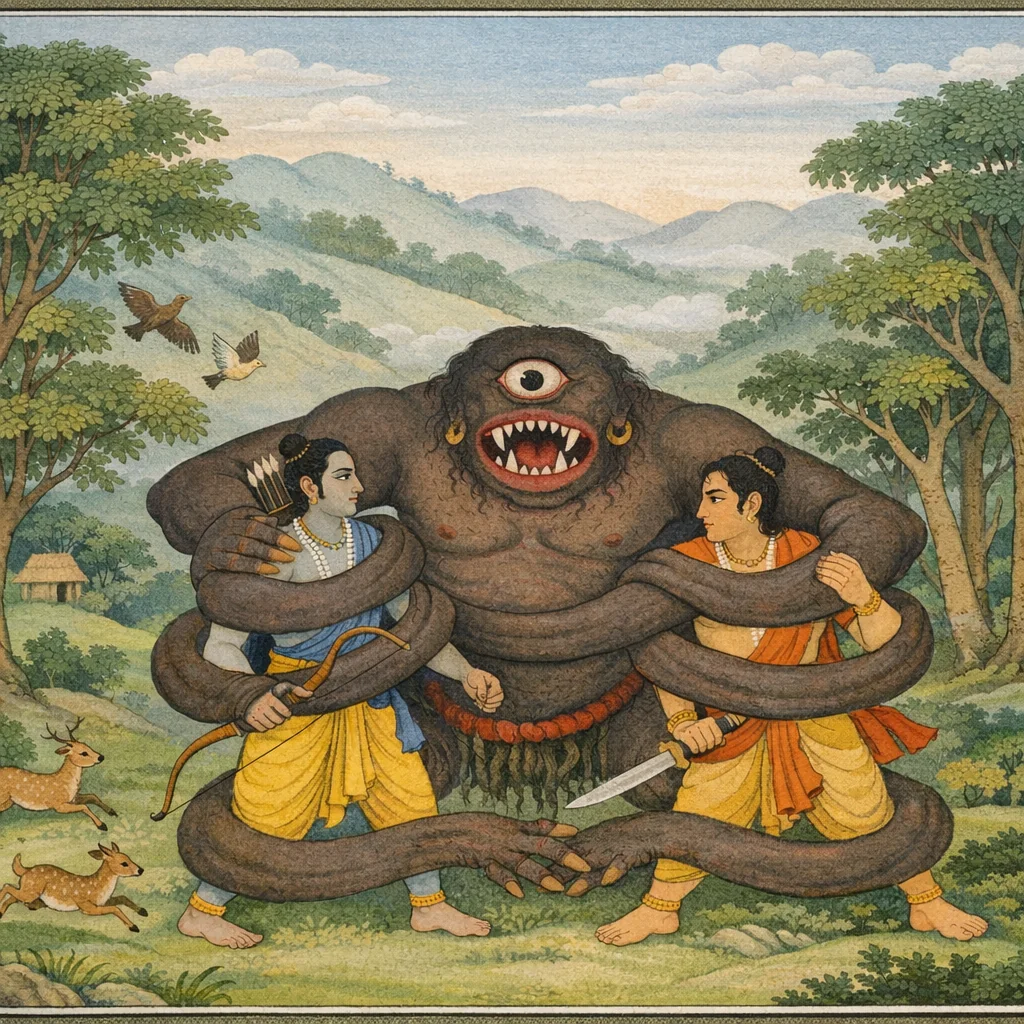
Having performed the sacred funerary libations for Jaṭāyu, Rāma and Lakṣmaṇa press forward in their search for Sītā, traversing the dense and ominous Krauñcāraṇya forest near Mataṅga’s hermitage. They encounter a cavern of netherworld-like darkness where the rākṣasī Ayomukhī accosts them, seizing Lakṣmaṇa and demanding a coerced union. Lakṣmaṇa responds with swift, righteous force, severing her nose, ears, and breasts, causing the demoness to flee in agony. As the brothers advance through untrodden tracts, Lakṣmaṇa senses inauspicious bodily portents but also notes a bird signaling eventual victory. Suddenly, a catastrophic roar fills the air, revealing the grotesque form of Kabandha—a headless colossus with a single fiery eye upon his chest and a gaping mouth in his abdomen. The monster physically seizes both princes. While Lakṣmaṇa momentarily despairs and offers himself as a sacrifice to save his brother, Rāma steadies him with a profound reflection on the irresistible power of Kāla (Time/Destiny), composing their minds before the monster addresses them.
Shlokas
Verse 1
कृत्वैवमुदकं तस्मै प्रस्थितौ रामलक्ष्मणौ।अवेक्षन्तौ वने सीतां पश्चिमां जग्मतुर्दिशम्।।।।
Having thus offered the udaka water-libation to him, Rāma and Lakṣmaṇa set out, scanning the forest for Sītā as they went toward the western direction.
Verse 2
तौ दिशं दक्षिणां गत्वा शरचापासिधारिणौ।अविप्रहतमैक्ष्वाकौ पन्थानं प्रतिपेदतुः।।।।
Bearing arrows, bows, and swords, the two princes of Ikṣvāku went south and entered an untrodden path.
Verse 3
गुल्मैर्वृक्षैश्च बहुभिर्लताभिश्च प्रवेष्टितम्।आवृतं सर्वतो दुर्गं गहनं घोरदर्शनम्।।।।
It was overgrown with many shrubs, trees, and creepers—covered on every side, hard to enter, dense and forbidding to behold.
Verse 4
व्यतिक्रम्य तु वेगेन व्यालसिंहनिषेवितम्।सुभीमं तन्महारण्यं व्यतियातौ महाबलौ।।।।
The two mighty brothers pressed on swiftly, forcing their way through that great forest—terrifying, and frequented by serpents and lions.
Verse 5
ततः परं जनस्थानातत्रिक्रोशं गम्य राघवौ।क्रौञ्चारण्यं विविशतुर्गहनं तौ महौजसौ।।।।
Then, moving on from Janasthāna and having gone three krośas, the two mighty scions of the Raghu line entered the dense Krauncha forest.
Verse 6
नानामेघघनप्रख्यं प्रहृष्टमिव सर्वतः।नानापक्षिगणैर्युक्तं नानाव्यालमृगैर्युतम्।।।।दिदृक्षमाणौ वैदेहीं तद्वनं तौ विचिक्यतुः।तत्र तत्रावतिष्ठन्तौ सीताहरणकर्शितौ।।।।
That forest, like dense masses of many clouds and seeming joyous on every side, was filled with flocks of varied birds and with many kinds of serpents and beasts. Longing to see Vaidehī, the two searched through it; tormented by Sītā’s abduction, they paused here and there.
Verse 7
नानामेघघनप्रख्यं प्रहृष्टमिव सर्वतः।नानापक्षिगणैर्युक्तं नानाव्यालमृगैर्युतम्।।3.69.6।।दिदृक्षमाणौ वैदेहीं तद्वनं तौ विचिक्यतुः।तत्र तत्रावतिष्ठन्तौ सीताहरणकर्शितौ।।3.69.7।।
The forest, cloud-dense in appearance and seemingly exultant on all sides, teemed with many kinds of birds, serpents, and beasts. Afflicted by Sītā’s abduction, the two brothers—longing to see Vaidehī—searched it thoroughly, halting again and again.
Verse 8
ततः पूर्वेण तौ गत्वा त्रिक्रोशं भ्रातरौ तदा।क्रौञ्चारण्यमतिक्रम्य मतङ्गाश्रममन्तरा।।।।दृष्ट्वा तु तद्वनं घोरं बहुभीममृगद्विजम्।ननासत्त्वसमाकीर्णं सर्वं गहनपादपम्।।।।ददृशाते तु तौ तत्र दरीं दशरथात्मजौ।पातालसमगम्भीरां तमसा नित्यसंवृताम्।।।।
Then the two brothers went eastward for three krośas; crossing the Krauñca forest near the āśrama of sage Mataṅga, they beheld a dreadful woodland—dense with deep trees, thronged with many kinds of beings, with fearsome beasts and birds. There the two sons of Daśaratha saw a cavern, ever veiled in darkness, deep as Pātāla.
Verse 9
ततः पूर्वेण तौ गत्वा त्रिक्रोशं भ्रातरौ तदा।क्रौञ्चारण्यमतिक्रम्य मतङ्गाश्रममन्तरा।।3.69.8।।दृष्ट्वा तु तद्वनं घोरं बहुभीममृगद्विजम्।ननासत्त्वसमाकीर्णं सर्वं गहनपादपम्।।3.69.9।।ददृशाते तु तौ तत्र दरीं दशरथात्मजौ।पातालसमगम्भीरां तमसा नित्यसंवृताम्।।3.69.10।।
In this combined numbering, the same scene is reiterated: traveling east for three krośas, the two brothers cross the Krauñca forest near Mataṅga’s āśrama, behold a dreadful woodland thick with creatures, and see a cave perpetually shrouded in darkness, deep like Pātāla.
Verse 10
ततः पूर्वेण तौ गत्वा त्रिक्रोशं भ्रातरौ तदा।क्रौञ्चारण्यमतिक्रम्य मतङ्गाश्रममन्तरा।।3.69.8।।दृष्ट्वा तु तद्वनं घोरं बहुभीममृगद्विजम्।ननासत्त्वसमाकीर्णं सर्वं गहनपादपम्।।3.69.9।।ददृशाते तु तौ तत्र दरीं दशरथात्मजौ।पातालसमगम्भीरां तमसा नित्यसंवृताम्।।3.69.10।।
Then the two brothers went three krośas eastward. Crossing the Krauñca forest near the āśrama of sage Mataṅga, they beheld a dreadful woodland—dense with tangled trees, thronged with many kinds of beings, and filled with fearsome beasts and birds. There the sons of Daśaratha saw a cave, ever shrouded in darkness, deep as Pātāla, the netherworld.
Verse 11
आसाद्य तौ नरव्याघ्रौ दर्यास्तस्याविदूरतः।ददृशाते महारूपां राक्षसीं विकृताननाम्।।।।
Reaching the cave, those two tiger-like men saw, not far from it, a rākṣasī of enormous size, her face grotesquely disfigured.
Verse 12
भयदामल्पसत्त्वानां बीभत्सां रौद्रदर्शनाम्।लम्बोदरीं तीक्ष्णदंष्ट्रां करालीं परुषत्वचम्।।।।भक्षयन्तीं मृगान्भीमान्विकटां मुक्तमूर्धजाम्।प्रैक्षेतां तौ ततस्तत्र भ्रातरौ रामलक्ष्मणौ।।।।
Then the two brothers, Rāma and Lakṣmaṇa, saw there a fearsome rākṣasī—terrifying to the faint-hearted, grotesque and dreadful to behold—big-bellied, rough-skinned, with sharp fangs, hair hanging loose, and devouring frightful wild beasts.
Verse 13
भयदामल्पसत्त्वानां बीभत्सां रौद्रदर्शनाम्।लम्बोदरीं तीक्ष्णदंष्ट्रां करालीं परुषत्वचम्।।3.69.12।।भक्षयन्तीं मृगान्भीमान्विकटां मुक्तमूर्धजाम्।प्रैक्षेतां तौ ततस्तत्र भ्रातरौ रामलक्ष्मणौ।।3.69.13।।
Then the two brothers, Rāma and Lakṣmaṇa, saw there a fearsome rākṣasī—terrifying to the faint-hearted, grotesque and dreadful to behold—big-bellied, rough-skinned, with sharp fangs, hair hanging loose, and devouring frightful wild beasts.
Verse 14
सा समासाद्य तौ वीरौ व्रजन्तं भ्रातुरग्रतः।एहि रंस्यावहेत्युक्त्वा समालम्बत लक्ष्मणम्।।।।
Approaching the two heroes, she seized Lakṣmaṇa as he walked ahead of his brother and said, “Come—let us sport together.”
Verse 15
उवाच चैनं वचनं सौमित्रिमुपगूह्य सा।अहं त्वयोमुखी नाम लब्धा ते त्वमसि प्रियः।।।।नाथ पर्वतकूटेषु नदीनां पुलिनेषु च।आयुश्शेषमिमं वीर त्वं मया सह रंस्यसे।।।।
Clasping Saumitri, she spoke to him: “I am named Ayomukhī; I have been won by you, and you are dear to me. O lord, O hero—on mountain peaks and on riverbanks, for the remainder of your life you will sport together with me.”
Verse 16
उवाच चैनं वचनं सौमित्रिमुपगूह्य सा।अहं त्वयोमुखी नाम लब्धा ते त्वमसि प्रियः।।3.69.15।।नाथ पर्वतकूटेषु नदीनां पुलिनेषु च।आयुश्शेषमिमं वीर त्वं मया सह रंस्यसे।।3.69.16।।
Thus addressed, Lakṣmaṇa—subduer of enemies—grew enraged, drew his sword, and cut off her ears, nose, and breasts.
Verse 17
एवमुक्तस्तु कुपितः खड्गमुद्धृत्य लक्ष्मणः।कर्णनासास्तनं तस्या निचकर्तारिसूदनः।।।।
Thus addressed, Lakṣmaṇa—subduer of enemies—grew enraged, drew his sword, and cut off her ears, nose, and breasts.
Verse 18
कर्णनासे निकृत्ते तु विस्वरं सा विनद्य च।यथागतं प्रदुद्राव राक्षसी भीमदर्शना।।।।
With her ears and nose cut off, the dreadful-looking rākṣasī cried out in a broken voice and fled back the way she had come.
Verse 19
तस्यां गतायां गहनं व्रजन्तौ वनमोजसा।आसेदतुरमित्रघ्नौ भ्रातरौ रामलक्ष्मणौ।।।।
After she had gone, the two enemy-slaying brothers, Rāma and Lakṣmaṇa, pressed on with vigor and reached deeper into the dense forest.
Verse 20
लक्ष्मणस्तु महातेजास्सत्त्ववान् शीलवान् शुचिः।अब्रवीत्प्राञ्जलिर्वाक्यं भ्रातरं दीप्ततेजसम्।।।।
Then Lakṣmaṇa—radiant, strong in spirit, well-conducted, and pure—spoke with folded hands to his brother of blazing splendor.
Verse 21
स्पन्दते च दृढं बाहुरुद्विग्नमिव मे मनः।प्रायशश्चाप्यनिष्टानि निमित्तान्युपलक्षये।।।।
My arm throbs hard, and my mind feels as though unsettled; again and again I perceive inauspicious omens, as if foretelling harm.
Verse 22
तस्मात्सज्जीभवार्य त्वं कुरुष्व वचनं हितम्।ममैव हि निमित्तानि सद्यश्शंसन्ति सम्भ्रमम्।।।।
Therefore, O noble one, be ready and act upon my wholesome counsel; for the omens I perceive even now proclaim alarm and peril.
Verse 23
एष वञ्चुलको नाम पक्षी परमदारुणः।आवयोर्विजयं युद्धे शंसन्निव विनर्दति।।।।
Behold this bird named Vañculaka, most dreadful; it cries out loudly, as though proclaiming victory for us both in battle.
Verse 24
तयोरन्वेषतोरेवं सर्वं तद्वनमोजसा।संजज्ञे विपुलः शब्दो प्रभञ्जन्निव तद्वनम्।।।।
As the two searched the entire forest with vigor, a tremendous sound suddenly arose, as though it were shattering that woodland.
Verse 25
संवेष्टितमिवात्यर्थं गगनं मातरिश्वना।वनस्य तस्य शब्दोऽभूद्दिवमापूरयन्निव।।।।
The sky seemed tightly wrapped by the wind, and the forest’s roar rose up as though it were filling the heavens.
Verse 26
तं शब्दं काङ्क्षमाणस्तु रामः कक्षे सहानुजः।ददर्श सुमहाकायं राक्षसं विपुलोदरम्।।।।
Seeking the source of that sound, Rāma—together with his younger brother—saw a rākṣasa of enormous body and vast belly.
Verse 27
आसेदतुस्ततस्तत्र तावुभौ प्रमुखे स्थितम्।विवृद्धमशिरोग्रीवं कबन्धमुदरे मुखम्।।।।
Then the two of them drew near and beheld, standing before them, Kabandha—huge, without head or neck, his face set in his belly.
Verse 28
रोमभिर्निचितैस्तीक्ष्णैर्महागिरिमिवोछ्रितम्।नीलमेघनिभं रौद्रं मेघस्तनितनिस्वनम्।।।।
Covered with dense, sharp bristles, he rose like a great mountain—fierce, dark as a blue-black cloud, his sound like thunder.
Verse 29
अग्निज्वालानिकाशेन ललाटस्थेन दीप्यता।महापक्ष्मेण पिङ्गेन विपुलेनायतेन च।।।।एकेनोरसि घोरेण नयनेनाशुदर्शिना।महादंष्ट्रोपपन्नं तल्लेलिहानं महामुखम्।।।।
He blazed with a radiance like tongues of fire, a brilliance shining upon his brow; and in his chest was set a single vast eye—huge-lashed, tawny, wide and long—terrible, swift in sight. And with a mighty mouth armed with great fangs, he kept licking it in hunger.
Verse 30
अग्निज्वालानिकाशेन ललाटस्थेन दीप्यता।महापक्ष्मेण पिङ्गेन विपुलेनायतेन च।।3.69.29।।एकेनोरसि घोरेण नयनेनाशुदर्शिना।महादंष्ट्रोपपन्नं तल्लेलिहानं महामुखम्।।3.69.30।।
He had a single dreadful eye set in his chest, swift in its sight; and with enormous fangs in his vast mouth, he licked his lips—terrifying to behold.
Verse 31
भक्षयन्तं महाघोरानृक्षसिंहमृगद्विपान्।घोरौ भुजौ विकुर्वाणमुभौ योजनमायतौ।।।।
He was devouring fearsome bears, lions, deer, and elephants, while brandishing his two dreadful arms—each stretched to the length of a yojana.
Verse 32
कराभ्यां विविधान्गृह्यऋक्षान्पक्षिगणान्मृगान्।आकर्षन्तं विकर्षन्तमनेकान्मृगयूथपान्।।।।स्थितमावृत्य पन्थानं तयोर्भ्रात्रोः प्रपन्नयोः।
With both hands he seized various bears, flocks of birds, and deer—dragging some toward himself and flinging others away—and, standing there, he blocked the path of the two brothers who had come that way.
Verse 33
अथ तौ समभिक्रम्य क्रोशमात्रे ददर्शतुः।।।।महान्तं दारुणं भीमं कबन्धं भुजसंवृम्।कबन्धमिव संस्थानादतिघोरप्रदर्शनम्।।।।
Then, after advancing about a krośa, the two beheld Kabandha—huge, cruel, and terrifying, trunk-like in form, with the space encircled by his arms, and of a most dreadful appearance.
Verse 34
अथ तौ समभिक्रम्य क्रोशमात्रे ददर्शतुः।।3.69.33।।महान्तं दारुणं भीमं कबन्धं भुजसंवृम्।कबन्धमिव संस्थानादतिघोरप्रदर्शनम्।।3.69.34।।
Then, after advancing about a krośa, the two saw Kabandha—enormous, cruel, and fearsome, trunk-shaped in form, his arms enclosing the space, displaying an exceedingly dreadful appearance.
Verse 35
स महाबाहुरत्यर्थं प्रसार्य विपुलौ भुजौ।जग्राह सहितावेव राघवौ पीडयन्बलात्।।।।
That long-armed one stretched out his massive arms and seized the two Rāghavas together, crushing them with force.
Verse 36
खड्गिनौ दृढधन्वानौ तिग्मतेजोवपुर्धरौ।भ्रातरौ विवशं प्राप्तौ कृष्यमाणौ महाबलौ।।।।
Though they were mighty brothers—sword-bearers, strong of bow, bodies radiant with keen splendor—they were dragged along and rendered helpless.
Verse 37
तत्र धैर्येण शूरस्तु राघवो नैव विव्यथे।बाल्यादनाश्रयत्वाच्च लक्ष्मणस्त्वतिविव्यथे।।।।उवाच स विषण्णस्सन्राघवं राघवानुजः।
There, the heroic Rāghava did not waver, sustained by courage; but Lakṣmaṇa, younger and feeling without support, became greatly distressed. Depressed, Rāma’s younger brother spoke to Rāghava.
Verse 38
पश्य मां वीर विवशं राक्षसस्य वशं गतम्।।।।मयैकेन विनिर्युक्तः परिमुञ्चस्व राघव।
Look upon me, O hero—helpless, fallen under the demon’s sway. I alone have been offered up; therefore free yourself, O Rāghava.
Verse 39
मां हि भूतबलिं दत्वा पलायस्व यथासुखम्।।।।अधिगन्तासि वैदेहीमचिरेणेति मे मतिः।
Indeed, offer me as an oblation to this being and flee as you wish; in my judgment, you will soon regain Vaidehī.
Verse 40
प्रतिलभ्य च काकुत्स्थ पितृपैतामहीं महीम्।।।।तत्र मां राम राज्यस्थस्स्मर्तुमर्हसि सर्वदा।
O scion of Kakutstha, when you regain the ancestral realm of your forefathers and are established in kingship, O Rāma, you should always remember me there.
Verse 41
लक्ष्मणेनैवमुक्तस्तु रामस्सौमित्रिमब्रवीत्।।।।मा स्म त्रासं कृथा वीर न हि त्वादृग्विषीदति।
Thus addressed by Lakṣmaṇa, Rāma said to Saumitri: “Do not give way to fear, O hero; one like you should not sink into despair.”
Verse 42
एतस्मिन्नन्तरे क्रूरो भ्रातरौ रामलक्ष्मणौ।।।।पप्रच्छ घननिर्घोषः कबन्धो दानवोत्तमः।
Just then, the cruel Kabandha—foremost among the Dānavas, his voice rumbling like thunder—questioned the two brothers, Rāma and Lakṣmaṇa.
Verse 43
कौ युवां वृषभस्कन्धौ महाखड्गधनुर्धरौ।।।।घोरं देशमिमं प्राप्तौ मम भक्षावुपस्थितौ।
“Who are you two—broad-shouldered like bulls, bearing great swords and bows—who have come to this dreadful region and now stand here as my prey?”
Verse 44
वदतं कार्यमिह वां किमर्थं चागतौ युवाम्।।।।इमं देशमनुप्राप्तौ क्षुधार्तस्येह तिष्ठतः।
“Tell me: what business do you have here, and for what purpose have you come? You have arrived at this place at just the right moment—for me who stand here tormented by hunger.”
Verse 45
सबाणचापखड्गौ च तीक्ष्णशृङ्गाविवर्षभौ।।।।ममास्यमनुसम्प्राप्तौ दुर्लभं जीवितं पुनः।
“Armed with arrows, bows, and swords—like two bulls with sharp horns—you have come within my jaws; now life will be hard to regain.”
Verse 46
तस्य तद्वचनं श्रुत्वा कबन्धस्य दुरात्मनः।।।।उवाच लक्ष्मणं रामो मुखेन परिशुष्यता।
Hearing those words of the evil-minded Kabandha, Rāma—his mouth parched—spoke to Lakṣmaṇa.
Verse 47
कृच्छ्रात् कृच्छ्रतरं प्राप्य दारुणं सत्यविक्रमः।।।।व्यसनं जीवितान्ताय प्राप्तमप्राप्य तां प्रियाम्।
From hardship we have fallen into a still greater hardship. Without finding my beloved, a dreadful calamity has come upon us—one that may end our lives.
Verse 48
कालस्य सुमहद्वीर्यं सर्वभूतेषु लक्ष्मण।।।।त्वां च मां च नरव्याघ्र व्यसनैः पश्य मोहितौ।
O Lakṣmaṇa, exceedingly great is the power of Time over all beings. O tiger among men, look—both you and I are overwhelmed and bewildered by calamity.
Verse 49
नातिभारोस्ति कालस्य सर्वभूतेषु लक्ष्मण।।।।शूराश्च बलवन्तश्च कृतास्त्राश्च रणाजिरे।कालाभिपन्नास्सीदन्ति यथा वालुकसेतवः।।।।
O Lakṣmaṇa, for Time (Kāla) there is no burden too great among all beings. The brave, the strong, and even those skilled in weapons on the battlefield—when overtaken by Time’s force—sink and give way, like embankments made of sand.
Verse 50
नातिभारोस्ति कालस्य सर्वभूतेषु लक्ष्मण।।3.69.49।।शूराश्च बलवन्तश्च कृतास्त्राश्च रणाजिरे।कालाभिपन्नास्सीदन्ति यथा वालुकसेतवः।।3.69.50।।
This numbered form conveys the same teaching: Time bears down on all beings without strain; even the brave, the strong, and the weapon-skilled in battle collapse when overtaken by Time—like sand embankments that cannot hold.
Verse 51
इति ब्रुवाणो दृढसत्यविक्रमो महायशा दाशरथिः प्रतापवान्।अवेक्ष्य सौमित्रिमुदग्रपौरुषं स्थिरां तदा स्वां मतिमात्मनाऽकरोत्।।।।
Having spoken thus, the illustrious and mighty son of Daśaratha—whose valor stood firm in truth—looked upon Saumitri of exalted manliness; then, by his own inner strength, he steadied his mind and fixed his resolve.
Frequently Asked Questions
The key dilemma is coercive threat versus measured protection: Ayomukhī assaults Lakṣmaṇa and demands forced intimacy; Lakṣmaṇa’s response uses decisive but bounded violence to neutralize danger and preserve the brothers’ mission without indulgence in gratuitous harm.
Rāma’s reflection on kāla teaches that even strength, skill, and bravery can be overwhelmed by circumstance; therefore steadiness, mutual reassurance, and disciplined action are required when events appear to exceed personal control.
The narrative maps movement from the Janasthāna region into the krauñcāraṇya near Mataṅga’s hermitage, highlighting a perpetually dark cave (darī) as a liminal landmark and using forest descriptions as cultural geography for the exile-search route.