Sarga 24
उत्पातदर्शनं खरसैन्यसमागमश्च (Omens of calamity and the approach of Khara’s army)
अरण्यकाण्ड
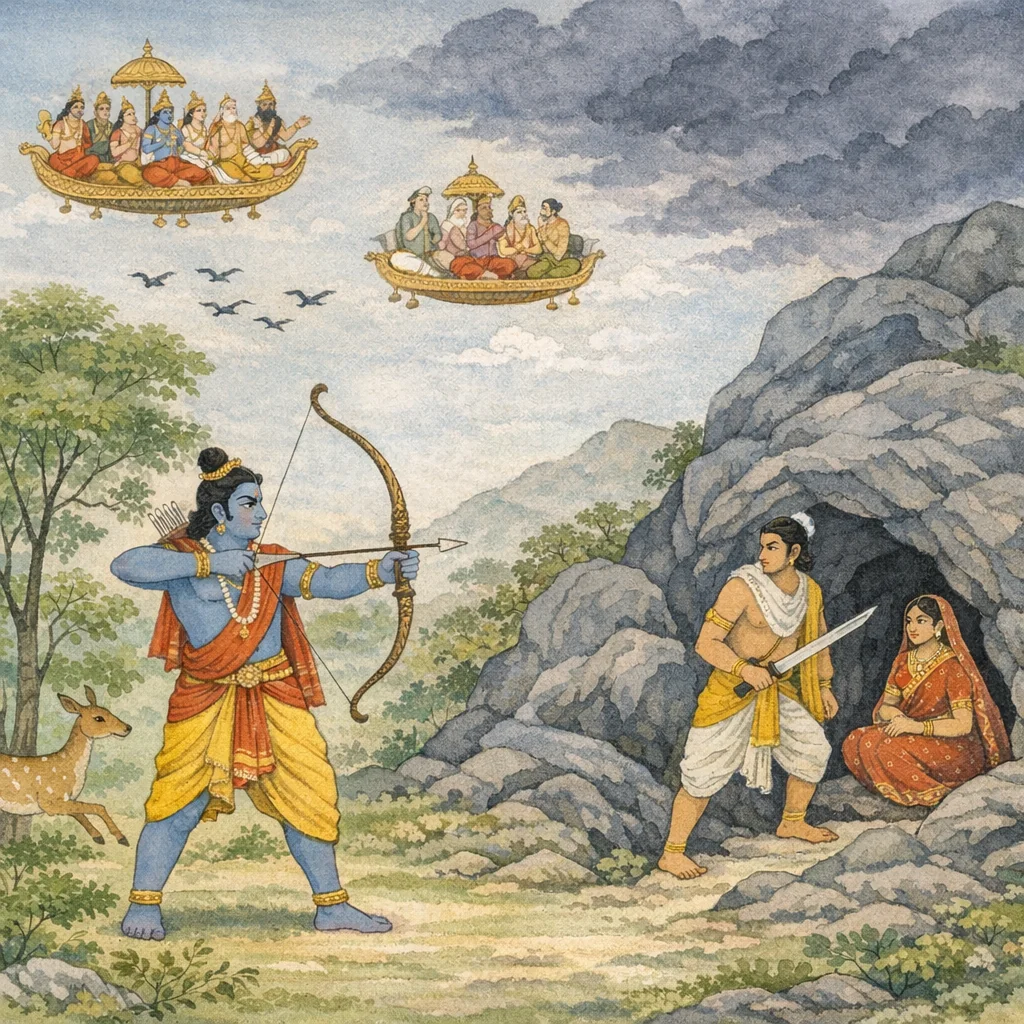
In this sarga, as Khara advances toward the hermitage in the Dandaka forest, Rama and Lakshmana behold grave portents of calamity: donkey-shaped clouds raining streams of blood, birds crying in distorted tones, arrows seeming to smoke, and ominous throbbing in the arms. Rama counsels Lakshmana that the wise must guard against danger before it arrives. To protect Sita, Rama commands Lakshmana to take Vaidehi and seek refuge in a secure cave amid the rocky hills; Lakshmana enters, bow and arrows in hand. Rama dons his armor, lifts his mighty bow, and with the twang of the string fills the quarters, standing firm at the forefront of battle. Devas, gandharvas, siddhas, charanas, and rishis gather in their vimanas to witness the combat; they utter blessings for the welfare of cows, brahmins, and the people, and pray for Raghava’s victory, yet marvel at the disparity—Rama alone against fourteen thousand rakshasas. Then the dreadful approach of the yatudhana host is described, with banners, armor, and weapons, the booming of war-drums and a din like lions’ roars; the forest creatures flee. Rama surveys Khara’s army coming to meet him, restrains his wrath, and readies himself to destroy the foes.
Shlokas
Verse 1
आश्रमं प्रति याते तु खरे खरपराक्रमे।तानेवौत्पातिकान्रामस्सह भ्रात्रा ददर्श ह।।।।
When Khara—fierce in his wicked might—marched toward the hermitage, Rāma too, together with his brother, saw those very portents that bode calamity.
Verse 2
तानुत्पातान्महोघोरानुत्थितान्रोमहर्षणान्।प्रजानामहितान्दृष्ट्वा रामो लक्ष्मणमब्रवीत्।।।।
Seeing those most dreadful portents arise—terrifying, hair-raising, and harmful to living beings—Rāma spoke to Lakṣmaṇa.
Verse 3
इमान्पश्य महाबाहो सर्वभूतापहारिणः।समुत्थितान्महोत्पातान्संहर्तुं सर्वराक्षसान्।।।।
O mighty-armed one, look at these great portents that have arisen—omens of sweeping destruction—foretelling the annihilation of all the rākṣasas.
Verse 4
अमी रुधिरधारास्तु विसृजन्तः खरस्वनाः।व्योम्नि मेघा विवर्तन्ते परुषा गर्दभारुणाः।।।।
Those clouds—harsh in sound and rough, donkey-brown—wheel through the sky, pouring down streams that look like blood.
Verse 5
सधूमाश्च शरास्सर्वे मम युद्धाभिनन्दिनः।रुक्मपृष्ठानि चापानि विचेष्टन्ते च लक्ष्मण।।।।
O Lakshmana, all my arrows are smoking, and the gold-backed bows seem to quiver—as though welcoming me to battle.
Verse 6
यादृशा इह कूजन्ति पक्षिणः वनचारिणः।अग्रतो नो भयं प्राप्तं संशयो जीवितस्य च।।।।
The way these forest-dwelling birds are crying out here makes me foresee danger ahead; even our very survival has become doubtful.
Verse 7
सम्प्रहारस्तु सुमहान्भविष्यति न संशयः।अयमाख्याति मे बाहुस्स्फुरमाणो मुहुर्मुहुः।।।।सन्निकर्षे तु न श्शूर जयं शत्रोः पराजयम्।सप्रभं च प्रसन्नं च तव वक्त्रं हि लक्ष्यते।।।।
A very great and deadly battle will occur—there is no doubt. My arm keeps trembling again and again, foretelling it. Yet, O brave one, it also points to our victory and the enemy’s defeat; for your face appears radiant and serene.
Verse 8
सम्प्रहारस्तु सुमहान्भविष्यति न संशयः।अयमाख्याति मे बाहुस्स्फुरमाणो मुहुर्मुहुः।।3.24.7।।सन्निकर्षे तु न श्शूर जयं शत्रोः पराजयम्।सप्रभं च प्रसन्नं च तव वक्त्रं हि लक्ष्यते।।3.24.8।।
A very great battle will surely take place; my repeatedly trembling arm signals it. And yet, O brave one, the near outcome is our victory and the enemy’s defeat—your face is seen to be bright and composed.
Verse 9
उद्यतानां हि युद्धार्थं येषां भवति लक्ष्मण।निष्प्रभं वदनं तेषां भवत्यायुः परिक्षयः।।।।
O Lakshmana, when men set themselves for battle, those whose faces grow lusterless are marked for the waning of life—death draws near to them.
Verse 10
रक्षसां नर्दतां घोरश्श्रूयते च महाध्वनिः।आहतानां च भेरीणां राक्षसैः क्रूरकर्मभिः।।।।
A dreadful, thunderous uproar was heard—the roaring of rākṣasas and the booming of bherī kettle-drums beaten by those demons of cruel deeds.
Verse 11
अनागतविधानं तु कर्तव्यं शुभमिच्छता।आपदं शङ्कमानेन पुरुषेण विपश्चिता।।।।
One who seeks auspicious well-being—and the wise who foresee danger—should make provision beforehand, before calamity arrives.
Verse 12
तस्माद्गृहीत्वा वैदेहीं शरपाणिर्धनुर्धरः।गुहामाश्रय शैलस्य दुर्गां पादपसङ्कुलाम्।।।।
Therefore take Vaidehī (Sītā) with you and, bow in hand and arrows at the ready, seek refuge in an inaccessible, well-defended cave of the mountain, thick with trees.
Verse 13
प्रतिकूलितुमिच्छामि न हि वाक्यमिदं त्वया।शापितो मम पादाभ्यां गम्यतां वत्स मा चिरम्।।।।
I do not wish you to oppose this word of mine. Bound by my solemn vow at my feet, dear child—go at once, without delay.
Verse 14
त्वं हि शूरश्च बलवान्हन्याह्येतान्न संशयः।स्वयं तु हन्तुमिच्छामि सर्वानेव निशाचरान्।।।।
You are indeed brave and strong—there is no doubt you could slay them. Yet I myself wish to destroy all these night-roamers.
Verse 15
एवमुक्तस्तु रामेण लक्ष्मणस्सह सीताया।शरानादाय चापं च गुहां दुर्गां समाश्रयत्।।।।
Thus instructed by Rāma, Lakṣmaṇa took up the arrows and the bow and, with Sītā, entered and sought refuge in the inaccessible cave.
Verse 16
तस्मिन्प्रविष्टे तु गुहां लक्ष्मणे सह सीतया।हन्त निर्युक्तमित्युक्त्वा रामः कवचमाविशत्।।।।
When Lakṣmaṇa had entered the cave with Sītā, Rāma said, “Well, the task is set in order,” and then donned his armor.
Verse 17
स तेनाग्नि निकाशेन कवचेन विभूषितः।बभूव राम स्तिमिरे विधूमोऽग्निरिवोत्थितः।।।।
Adorned with that fire-like armor, Rāma shone in the darkness like smokeless fire rising up.
Verse 18
स चापमुद्यम्य महच्छरानादाय वीर्यवान्।बभूवावस्थितस्तत्र ज्यास्वनैः पूरयन्दिशः।।।।
Valiant Rāma raised his great bow, took up his arrows, and stood firm there, filling the quarters with the resonant twang of the bowstring.
Verse 19
ततो देवास्सगन्धर्वास्सिद्धाश्च सह चारणैः।समेयुश्च महात्मानो युद्धदर्शनकाङ्क्षिणः।।।।
Then the gods—along with Gandharvas, Siddhas, and Cāraṇas—great beings all, gathered there, eager to witness the battle.
Verse 20
ऋषयश्च महात्मानो लोके ब्रह्मर्षिसत्तमाः।समेत्य चोचुस्सहिता अन्योन्यं पुण्यकर्मणः।।।।
And great-souled sages—foremost Brahmarṣis in the world, men of holy deeds—assembled together and spoke among themselves.
Verse 21
स्वस्ति गोब्राह्मणेभ्योऽस्तु लोकानां येऽभिसङ्गताः।जयतां राघवो युद्धे पौलस्त्यान् रजनीचरान्।।।।चक्रहस्तो यथा युद्धे सर्वानसुर पुङ्गवान्।
May there be well-being for cows and brāhmaṇas, and for all the worlds gathered here. May Rāghava be victorious in battle over the Paulastya night-rangers, as the Disc-wielding Lord (Viṣṇu) once overcame the foremost of the asuras in war.
Verse 22
एवमुक्त्वा पुनः प्रोचुरालोक्य च परस्परम्।।।।चतुर्दश सहस्राणि रक्षसां भीमकर्मणाम्।एकश्च रामो धर्मात्मा कथं युद्धं भविष्यति।।।।
Having spoken thus, they again looked at one another and said: “Fourteen thousand rākṣasas of dreadful deeds—and Rāma, righteous and alone. How can this battle unfold?”
Verse 23
एवमुक्त्वा पुनः प्रोचुरालोक्य च परस्परम्।।3.24.22।।चतुर्दश सहस्राणि रक्षसां भीमकर्मणाम्।एकश्च रामो धर्मात्मा कथं युद्धं भविष्यति।।3.24.23।।
So they spoke, looking at one another, and said again: “Fourteen thousand rākṣasas of dreadful deeds—and Rāma, righteous and alone. How will this battle be?”
Verse 24
इति राजर्षयस्सिद्धास्सगणाश्च द्विजर्षभाः।जातकौतूहलास्तस्थुर्विमानस्थाश्च देवताः।।।।
Thus spoke the royal seers, the siddhas, and the foremost of brahmins with their retinues; and the gods, stationed in their aerial chariots, stood waiting—curiosity awakened—to witness what would happen.
Verse 25
आविष्टं तेजसा रामं सङ्ग्रामशिरसि स्थितम्।दृष्ट्वा सर्वाणि भूतानि भयाद्विव्यथिरे तदा।।।।
Then, seeing Rāma stationed at the forefront of battle, possessed of blazing splendor, all beings trembled in fear.
Verse 26
रूपमप्रतिमं तस्य रामस्याक्लिष्टकर्मणः।बभूव रूपं क्रुद्धस्य रुद्रस्येव पिनाकिनः।।।।
That incomparable form of Rāma—unwearied in action—now appeared like the form of wrathful Rudra, the wielder of the Pināka bow.
Verse 27
ततो गम्भीरनिर्ह्रादं घोरवर्मायुधध्वजम्।अनीकं यातुधानानां समन्तात्प्रत्यदृश्यत।।।।
Then the host of the yātudhānas came into view on every side, raising deep and thunderous cries—terrifying with armor, weapons, and banners.
Verse 28
सिंहनादं विसृजतामन्योन्यमभिगर्जताम्।चापानि विस्फ़ारयतां जृम्भतामप्यभीक्ष्णशः।।।।विप्रघुष्टस्वनानां च दुन्धुभींश्चापि निघ्नताम्।तेषां सुतुमुलश्शब्दः पूरयामास तद्वनम्।।।।
Roaring like lions, they bellowed at one another, again and again twanging their bows, even yawning repeatedly. With loud cries and the beating of dundubhi drums, their mighty tumult filled that forest.
Verse 29
सिंहनादं विसृजतामन्योन्यमभिगर्जताम्।चापानि विस्फ़ारयतां जृम्भतामप्यभीक्ष्णशः।।3.24.28।।विप्रघुष्टस्वनानां च दुन्धुभींश्चापि निघ्नताम्।तेषां सुतुमुलश्शब्दः पूरयामास तद्वनम्।।3.24.29।।
In this recension the description is repeated: roaring like lions, they shouted at one another, ceaselessly twanging their bows; with loud cries and the beating of dundubhi drums, their uproar filled the forest.
Verse 30
तेन शब्देन वित्रस्ताश्वापदा वनचारिणः।दुद्रुवुर्यत्र निश्शब्दं पृष्ठतो न व्यलोकयन्।।।।
Startled by that din, the wild beasts that roamed the forest fled to wherever it was silent, not even turning back to look behind them.
Verse 31
तत्त्वनीकं महाघोरं रामं समुपसर्पत।धृतनानाप्रहरणं गम्भीरं सागरोपमम्।।।।
That dread host, bearing many kinds of weapons—vast and deep like the sea—drew near to Rama.
Verse 32
रामोऽपि चारयंश्चक्षुस्सर्वतो रणपण्डितः।ददर्श खरसैन्यं तद्युद्धाभिमुखमुत्थितम्।।।।
Rama too, skilled in the science of war, swept his gaze in every direction and saw Khara’s army rise and stand, turned toward battle.
Verse 33
वितत्य च धनुर्भीमं तूण्याश्चोद्धृत्य सायकान्।क्रोधमाहारयत्तीव्रं वधार्थं सर्वरक्षसाम्।।।।
He strung his formidable bow, drew arrows from the quiver, and gathered a fierce wrath—aimed at the destruction of all the rākṣasas.
Verse 34
दुष्प्रेक्ष्यस्सोऽभवत्कृद्धो युगान्ताग्निरिव ज्वलन्।तं दृष्ट्वा तेजसाविष्टं प्राद्रवन्वनदेवताः।।।।
In his wrath he became hard to behold, blazing like the fire at the end of an age; seeing him filled with radiance, even the deities of the forest fled away.
Verse 35
तस्य क्रुद्धस्य रूपं तु रामस्य ददृशे तदा।दक्षस्येव क्रतुं हन्तुमुद्यतस्य पिनाकिनः।।।।
Then Rama’s angry form appeared like that of the Pināka-bearing Śiva, poised to destroy Dakṣa’s sacrifice.
Verse 36
आविष्टं तेजसा रामं सङ्ग्रामशिरसि स्थितम्।दृष्ट्वा सर्वाणि भूतानि भयार्तानि प्रदुद्रुवुः।।।।
Seeing Rama—filled with splendor—standing at the very forefront of battle, all beings, stricken with fear, ran away.
Verse 37
तत्कार्मुकैराभरणैर्ध्वजैश्च तैर्वर्मभिश्चाग्निसमानवर्णैः।बभूव सैन्यं पिशिताशनानां सूर्योदये नीलमिवाभ्रबृन्दम्।।।।
With their bows, ornaments, banners, and fire-hued armor, the army of the flesh-eaters looked, at sunrise, like a mass of dark-blue clouds.
Frequently Asked Questions
The pivotal action is Rāma’s decision to separate roles under crisis: he assigns Lakṣmaṇa the protective duty of escorting Sītā to an inaccessible cave, while he himself assumes the frontline responsibility—balancing compassion-based safeguarding with duty-based confrontation.
The explicit upadeśa is: “अनागतविधानं… कर्तव्यम्”—a prudent, learned person should plan defense before danger fully arrives. The teaching frames preparedness as a dharmic discipline, not as fear, integrating foresight with moral intent (śubham icchatā).
Geographically, the scene centers on the āśrama region in the forest and a दुर्ग-शैल-गुहा (inaccessible mountain cave) used as a protective refuge. Culturally, the ‘गोब्राह्मण-स्वस्ति’ benediction and the assembly of devas/ṛṣis as war-witnesses mark the conflict as a cosmos-observed dharma-event.