Sarga 15
पञ्चवटी-निवासः (Settlement at Pañcavaṭī and Construction of the Hermitage)
अरण्यकाण्ड
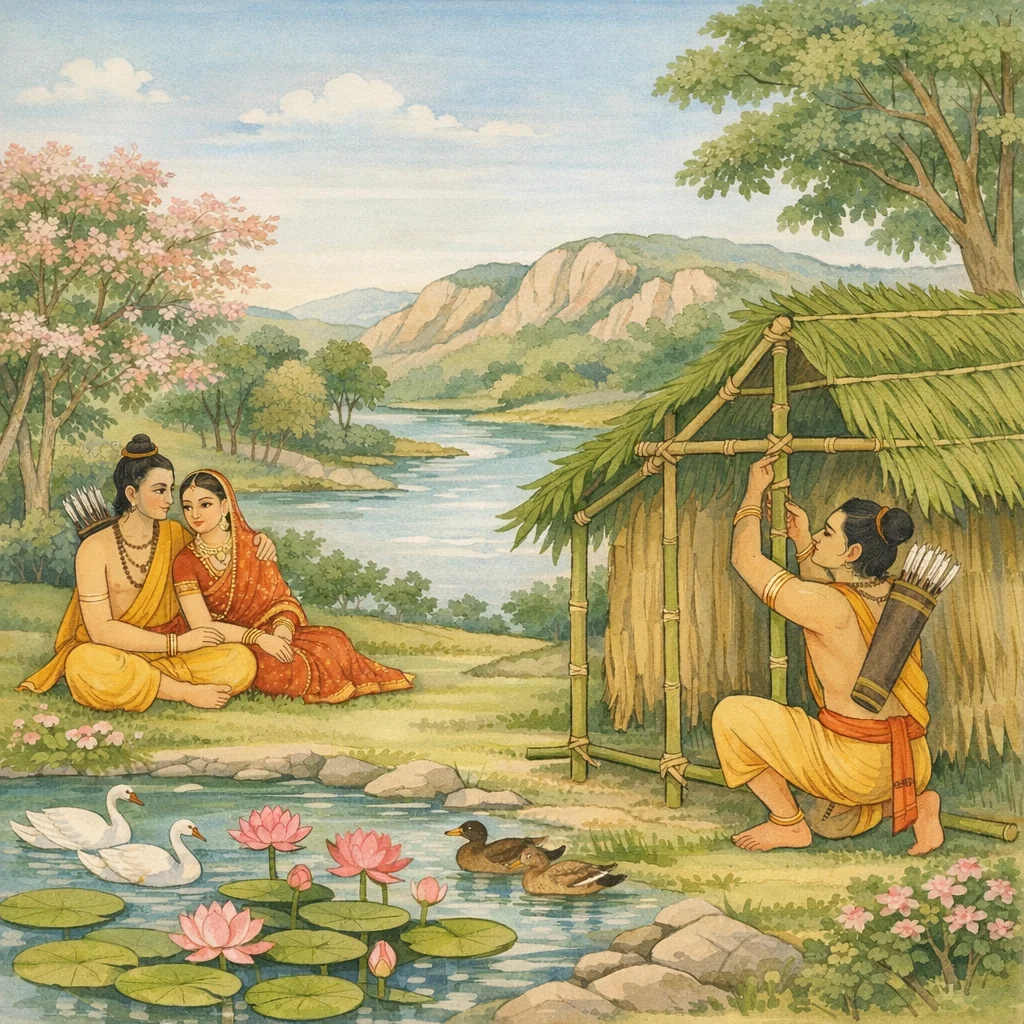
This sarga marks the shift from journey to dwelling. Rāma and Lakṣmaṇa reach Pañcavaṭī, a forest tract both lovely and perilous, inhabited by many kinds of wild and fierce creatures. Praising Lakṣmaṇa’s discernment, Rāma asks him to survey the area and choose an āśrama-site fit for Sītā—near water, rich in ritual necessities such as samidh and kuśa, with flowers and clean water readily available, and with pleasing ground. After due consideration, Rāma selects a level spot ringed with trees and points out the surrounding blessings: a fragrant lotus-tank and the Godāvarī river, renowned in the sages’ tradition (Agastya is mentioned), alive with swans, ducks, and cakravāka birds. Distant hills are adorned with mineral streaks, likened to decorative windows and to the forms of elephants. The narrative then turns to action. Lakṣmaṇa swiftly builds a leaf-hut (parṇaśālā) with bamboo supports, branches and ropes, leveled earth, and a roof of grass and leaves. Bathing in the Godāvarī, he brings lotuses, performs customary flower-offerings and a peace-invocation before occupancy, and presents the finished hermitage. Rāma and Sītā rejoice; Rāma embraces Lakṣmaṇa, praising his gratitude, knowledge of dharma, and sensitivity of heart. Thus the three dwell there happily for a time, serene as the gods.
Shlokas
Verse 1
ततः पञ्चवटीं गत्वा नानाव्यालमृगायुताम्।उवाच भ्रातरं रामस्सौमित्रिं दीप्ततेजसम्।।।।
Then, reaching Pañcavaṭī teeming with many kinds of fierce beasts, Rāma spoke to his brother Saumitri (Lakṣmaṇa), who shone with blazing energy.
Verse 2
आगताः स्म यथोद्दिष्टममुं देशं महर्षिणा।अयं पञ्चवटीदेशस्सौम्य पुष्पितपादपः।।।।
O gentle one, as the great sage directed, we have reached this place—this is Pañcavaṭī, a region adorned with trees in full bloom.
Verse 3
सर्वतश्चार्यतां दृष्टिः कानने निपुणोह्यसि।आश्रमः कतरस्मिन्नो देशे भवति सम्मतः।।।।
Let your gaze range everywhere in this forest; you are indeed skilled in judgment. In what place here would a hermitage be fitting for us?
Verse 4
रमते यत्र वैदेही त्वमहं चैव लक्ष्मण।तादृशो दृश्यतां देशस्सन्निकृष्टजलाशयः।।।।वनरामण्यकं यत्र स्थलरामण्यकं तथा।सन्निकृष्टं च यत्र स्यात्समित्पुष्पकुशोदकम्।।।।
O Lakṣmaṇa, look for a place where Vaidehī will take delight—and where you and I too can live happily—near a water-source; where the forest is charming and the ground itself is pleasant, and where firewood for sacred rites, flowers, kuśa-grass, and water are easily available.
Verse 5
रमते यत्र वैदेही त्वमहं चैव लक्ष्मण।तादृशो दृश्यतां देशस्सन्निकृष्टजलाशयः।।3.15.4।।वनरामण्यकं यत्र स्थलरामण्यकं तथा।सन्निकृष्टं च यत्र स्यात्समित्पुष्पकुशोदकम्।।3.15.5।।
O Lakṣmaṇa, find such a place—one that delights Vaidehī and also you and me—near a water-source; where the forest and the land are both charming, and where firewood for sacred use, flowers, kuśa-grass, and water are readily at hand.
Verse 6
एवमुक्तस्तु रामेण लक्ष्मण संयताञ्जलिः।सीतासमक्षं काकुत्स्थमिदं वचनमब्रवीत्।।।।
Thus instructed by Rāma, Lakṣmaṇa—hands folded in reverence—spoke these words to Kakutstha (Rāma) in Sītā’s presence.
Verse 7
परवानस्मि काकुत्स्थ त्वयि वर्षशतं स्थिते।स्वयं तु रुचिरे देशे क्रियतामिति मां वद।।।।
O Kakutstha, I am dependent upon you—even were you to remain thus for a hundred years. Only tell me the lovely place of your own choosing, saying, “Let it be made there.”
Verse 8
सुप्रीतस्तेन वाक्येन लक्ष्मणस्य महात्मनः।विमृशन्रोचयामास देशं सर्वगुणान्वितम्।।।।
Pleased by the words of great-souled Lakṣmaṇa, Rāma reflected and then chose a site endowed with every good quality.
Verse 9
स तं रुचिरमाक्रम्य देशमाश्रमकर्मणि।हस्तौ गृहीत्वा हस्तेन रामस्सौमित्रिमब्रवीत्।।।।
Having reached that lovely spot suited for establishing a hermitage, Rāma took Saumitri (Lakṣmaṇa) by both hands in his own and spoke to him.
Verse 10
अयं देशस्समश्रीमान् पुष्पितैस्तरुभिर्वृतः।इहाऽश्रमपदं सौम्य यथावत्कर्तुमर्हसि।।।।
“This region is level and beautiful, encircled by flowering trees. Here, O gentle one, you should build the hermitage properly.”
Verse 11
इयमादित्यसङ्काशैः पद्मैस्सुरभिगन्धिभिः।अदूरे दृश्यते रम्या पद्मिनी पद्मशोभिता।।।।
“Not far from here is seen a lovely lotus-tank, adorned with lotuses that gleam like the sun and are fragrant with sweet scent.”
Verse 12
यथातख्यातमगस्त्येन मुनिना भावितात्मना।इयं गोदावरी रम्या पुष्पितैस्तरुभिर्वृता।।।।हंसकारण्डवाकीर्णा चक्रवाकोपशोभिता।
Just as the self-mastered sage Agastya had described, this delightful Godāvarī is encircled by trees in bloom, teeming with swans and ducks, and made radiant by flocks of cakravāka birds.
Verse 13
नातिदूरे न चासन्ने मृगयूथपिपीडिताः।।।।मयूरनादिता रम्याः प्रांशवो बहुकन्दराः।दृश्यन्ते गिरयः सौम्य फुल्लैस्तरुभिरावृताः।।।।
Neither too far nor too near, O gentle one, mountains come into view—lovely and tall, with many caves; they echo with peacocks’ calls, are frequented by herds of deer, and are covered with flowering trees.
Verse 14
नातिदूरे न चासन्ने मृगयूथपिपीडिताः।।3.15.13।।मयूरनादिता रम्याः प्रांशवो बहुकन्दराः।दृश्यन्ते गिरयः सौम्य फुल्लैस्तरुभिरावृताः।।3.15.14।।
Neither too far nor too near, the mountains appear—tall and many-caverned, alive with peacock-calls, covered with flowering trees, and frequented by herds of deer.
Verse 15
सौवर्णैराजतैस्ताम्रैर्देशे देशे च धातुभिः।गवाक्षिता इवाभान्ति गजाः परमभक्तिभिः।।।।
With veins of minerals—gold, silver, and copper—showing in place after place, the mountains shine as though patterned with window-like panels, splendid like great elephants marked with radiant streaks.
Verse 16
सालैस्तालैस्तमालैश्च खर्जूरपनसाम्रकैः।नीवारैस्तिमिशैश्चैव पुन्नागैश्चोपशोभिताः।।।।चूतैरशोकैस्तिलकैश्चम्पकैः केतकैरपि।पुष्पगुल्मलतोपेतैस्तैस्तैस्तरुभिरावृताः।।।।चन्दनैस्पन्दनैर्नीपैः पर्णासैर्लिकुचैरपि।धवाश्वकर्णखदिरैः शमीकिंशुकपाटलैः।।।।
The land is richly adorned—filled with sāla, tāla, and tamāla trees, with date palms, jackfruit, and mango; with wild rice and dense timiśa, and with punnāga. It is covered with mango, aśoka, tilaka, campaka, and ketaka, with flowering shrubs and creepers; and also with sandalwood, spandana, nīpa, parṇāsa, likuca, dhava, aśvakarṇa, khadira, śamī, kiṃśuka, and pāṭala trees.
Verse 17
सालैस्तालैस्तमालैश्च खर्जूरपनसाम्रकैः।नीवारैस्तिमिशैश्चैव पुन्नागैश्चोपशोभिताः।।3.15.16।।चूतैरशोकैस्तिलकैश्चम्पकैः केतकैरपि।पुष्पगुल्मलतोपेतैस्तैस्तैस्तरुभिरावृताः।।3.15.17।।चन्दनैस्पन्दनैर्नीपैः पर्णासैर्लिकुचैरपि।धवाश्वकर्णखदिरैः शमीकिंशुकपाटलैः।।3.15.18।।
This passage presents (3.15.16–3.15.18) as a single block, reiterating the long catalogue of trees, wild grains, and flowering growth that adorn the Pañcavaṭī region.
Verse 18
सालैस्तालैस्तमालैश्च खर्जूरपनसाम्रकैः।नीवारैस्तिमिशैश्चैव पुन्नागैश्चोपशोभिताः।।3.15.16।।चूतैरशोकैस्तिलकैश्चम्पकैः केतकैरपि।पुष्पगुल्मलतोपेतैस्तैस्तैस्तरुभिरावृताः।।3.15.17।।चन्दनैस्पन्दनैर्नीपैः पर्णासैर्लिकुचैरपि।धवाश्वकर्णखदिरैः शमीकिंशुकपाटलैः।।3.15.18।।
This record repeats the same flora-description block (3.15.16–3.15.18), listing the many trees and plants that cover and beautify the Pañcavaṭī area.
Verse 19
इदं पुण्यमिदं मेध्यमिदं बहुमृगद्विजम्।इह वत्स्याम सौमित्रे सार्धमेतेन पक्षिणा।।।।
This place is sacred; this place is fit for rites; this place abounds in animals and birds. Here, O Saumitra, we shall dwell—together with this bird (Jaṭāyu).
Verse 20
एवमुक्तस्तु रामेण लक्ष्मणः परवीरहा।अचिरेणाऽश्रमं भ्रातुश्चकार सुमहाबलः।।।।
Thus instructed by Rāma, Lakṣmaṇa—slayer of enemy champions and mighty in strength—quickly built a hermitage (āśrama) for his brother.
Verse 21
पर्णशालां सुविपुलां तत्र सङ्खातमृत्तिकाम्।सुस्तम्भां मस्करैर्दीर्घैः कृतवंशां सुशोभनाम्।।3.15. 21।।शमीशाखाभिरास्तीर्य दृढपाशावपाशिताम्।कुशकाशशरैः पर्णैस्सुपरिच्छादितां तथा।।3.15.22।।समीकृततलां रम्यां चकार लघुविक्रमः।निवासं राघवस्यार्थे प्रेक्षणीयमनुत्तमम्।।3.15.23।।
There Lakṣmaṇa—swift in execution—prepared a spacious leaf-hut: he dug and set the earthwork, raised firm supports with long bamboo poles, and made the structure well-formed and pleasing to behold.
Verse 22
पर्णशालां सुविपुलां तत्र सङ्खातमृत्तिकाम्।सुस्तम्भां मस्करैर्दीर्घैः कृतवंशां सुशोभनाम्।।3.15. 21।।शमीशाखाभिरास्तीर्य दृढपाशावपाशिताम्।कुशकाशशरैः पर्णैस्सुपरिच्छादितां तथा।।।।समीकृततलां रम्यां चकार लघुविक्रमः।निवासं राघवस्यार्थे प्रेक्षणीयमनुत्तमम्।।।।
He spread śamī branches across, bound them fast with strong ropes, and then carefully roofed and covered the hut with kuśa grass, kāśa grass, reeds, and leaves.
Verse 23
पर्णशालां सुविपुलां तत्र सङ्खातमृत्तिकाम्।सुस्तम्भां मस्करैर्दीर्घैः कृतवंशां सुशोभनाम्।।3.15. 21।।शमीशाखाभिरास्तीर्य दृढपाशावपाशिताम्।कुशकाशशरैः पर्णैस्सुपरिच्छादितां तथा।।3.15.22।।समीकृततलां रम्यां चकार लघुविक्रमः।निवासं राघवस्यार्थे प्रेक्षणीयमनुत्तमम्।।3.15.23।।
The swift-acting Lakṣmaṇa levelled the ground and made a charming dwelling—an excellent, sight-worthy residence—intended for Rāghava (Rāma).
Verse 24
सहसा लक्ष्मणः श्रीमान् नदीं गोदावरीं तदा।स्नात्वा पद्मानि चादाय सफलः पुनरागतः।।।।
At once the handsome Lakṣmaṇa went to the Godāvarī River; having bathed, he gathered lotuses and returned, his task fulfilled.
Verse 25
ततः पुष्पबलिं कृत्वा शान्तिं च स यथाविधि।दर्शयामास रामाय तदाश्रमपदं कृतम्।।।।
Thereafter he made an offering of flowers and performed the rite of peace according to the prescribed rule; then he showed Rāma the prepared site of the hermitage.
Verse 26
स तं दृष्ट्वा कृतं सौम्यमाश्रमं सीतया सह।राघवः पर्णशालायां हर्षमाहारयत्परम्।।।।
Seeing, together with Sītā, the gentle and well-made hermitage, Rāghava felt profound joy within that leaf-hut.
Verse 27
सुसंहृष्टः परिष्वज्य बाहुभ्यां लक्ष्मणं तदा।अतिस्निग्धं च गाढं च वचनं चेदमब्रवीत्।।।।
Overjoyed, he embraced Lakṣmaṇa with both arms—tight and with deep affection—and spoke these heartfelt words.
Verse 28
प्रीतोऽस्मि ते महत्कर्म त्वया कृतमिदं प्रभो।प्रदेयो यन्निमित्तं ते परिष्वङ्गो मया कृतः।।।।
“I am pleased with you, O noble one; this is a great deed you have done. Therefore I give you what I can at present—my embrace.”
Verse 29
भावज्ञेन कृतज्ञेन धर्मज्ञेन च लक्ष्मण।त्वया पुत्रेण धर्मात्मा न संवृत्तः पिता मम।।।।
O Lakṣmaṇa, because I have you—a brother like a son, who knows another’s heart, is grateful, and understands dharma—my righteous father is, as it were, not lost to me.
Verse 30
एवं लक्ष्मणमुक्त्वा तु राघवो लक्ष्मिवर्धनः।तस्मिन् देशे बहुफले न्यवसत्सुसुखं वशी।।।।
Having spoken thus to Lakṣmaṇa, Rāghava—enhancer of prosperity, self-controlled—dwelt there very happily, in that place rich with fruits.
Verse 31
कञ्चित्कालं स धर्मात्मा सीतया लक्ष्मणेन च।अन्वास्यमानो न्यवसत्स्वर्गलोके यथामरः।।।।
For some time, that righteous-souled one lived there, with Sītā and Lakṣmaṇa attending upon him—like an immortal in heaven.
Frequently Asked Questions
The pivotal action is the disciplined choice of an āśrama-site and the responsible establishment of residence: Rāma prioritizes Sītā’s wellbeing, access to water, and availability of sacrificial requisites, while Lakṣmaṇa executes the task as an act of seva and duty rather than personal preference.
The sarga teaches that dharma is sustained through practical order: discernment in selecting supportive conditions for righteous living, gratitude toward service, and ritual-ethical mindfulness (offerings and peace-invocation) when transitioning into a new space.
Pañcavaṭī is presented as a forest settlement zone anchored by the Godāvarī and a nearby lotus-tank; the river’s sanctity is reinforced via Agastya’s traditional testimony, while the described hills, birds, and mineral-streaked rocks function as a cultural-geographic signature of the region.