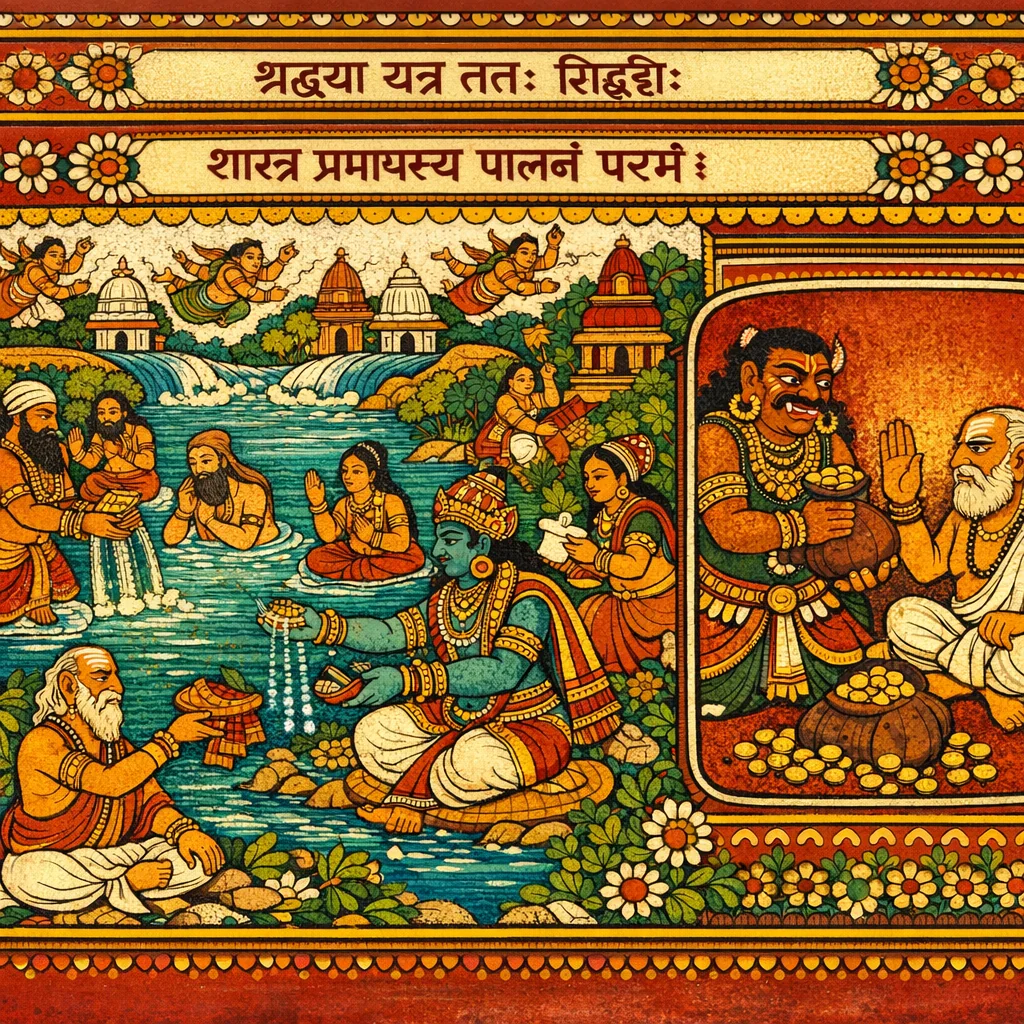
Adhyaya 109: The Greatness of Prayāga (Tīrtharāja) and the Measure of Dharma, Yoga, and Right Giving
प्रयागमाहात्म्य एवं तीर्थराजप्रतिपादनम्
Speaker: Mārkaṇḍeya, Yudhiṣṭhira
Mārkaṇḍeya begins by recalling Brahmā’s teaching that innumerable tīrthas purify, and he praises Somatīrtha for its power to destroy sin. Yudhiṣṭhira replies with a hierarchy of holy places—Naimiṣa on earth, Puṣkara in the mid-region, and Kurukṣetra renowned across the three worlds—and asks how one site can be called “supreme” without firm proof, especially if vast dharma is said to arise from minimal discipline. Mārkaṇḍeya answers that the faithless do not accept truth; for unseen matters śāstra is pramāṇa, and one should practice ātma-yoga. Yoga is usually attained only after thousands of births, and even great dāna does not guarantee it; yet dying at Prayāga grants the highest attainment. He grounds this in the vision of Brahman pervading all beings and declares that Prayāga is worshipped in all worlds as Tīrtharāja, remembered even by Brahmā. Yudhiṣṭhira then asks about yoga-attainment versus heaven gained through karma. Mārkaṇḍeya responds with Rajadharma-like injunctions: protect key sanctities, honor parents, warn of hell for sin, and condemn offerings made from stolen goods—clarifying the fruits of truth and untruth, and of affirmation and denial.
Key Concepts
Shlokas in Adhyaya 109
Verse 1
*मार्कण्डेय उवाच श्रुतं मे ब्रह्मणा प्रोक्तं पुराणे ब्रह्मसम्भवे तीर्थानां तु सहस्राणि शतानि नियुतानि च सर्वे पुण्याः पवित्राश्च गतिश्च परमा स्मृता //
Mārkaṇḍeya said: I have heard, as declared by Brahmā in the Brahma-sambhava Purāṇa, that there are thousands, hundreds, and even myriads of sacred fords (tīrthas). All of them are meritorious and purifying, and are remembered as a supreme means of spiritual attainment.
Verse 2
सोमतीर्थं महापुण्यं महापातकनाशनम् स्नानमात्रेण राजेन्द्र पुरुषांस्तारयेच्छतम् तस्मात्सर्वप्रयत्नेन तत्र स्नानं समाचरेत् //
Somatīrtha is supremely meritorious and destroys even the gravest sins. O best of kings, by bathing there alone one may ferry across a hundred men; therefore, with every effort, one should undertake bathing at that sacred place.
Verse 3
*युधिष्ठिर उवाच पृथिव्यां नैमिषं पुण्यम् अन्तरिक्षे च पुष्करम् त्रयाणामपि लोकानां कुरुक्षेत्रं विशिष्यते //
Yudhiṣṭhira said: “On the earth, Naimiṣa is holy; and in the mid-region (the space between earth and heaven), Puṣkara is holy. Yet, among all the three worlds, Kurukṣetra is pre-eminent.”
Verse 4
सर्वाणि तानि संत्यज्य कथमेकं प्रशंससि अप्रमाणं तु तत्रोक्तम् अश्रद्धेयमनुत्तमम् //
After setting aside all those, how can you praise just one? For there it has been stated to be without valid proof—unreliable and yet claimed as ‘supreme’.
Verse 5
गतिं च परमां दिव्यां भोगांश्चैव यथेप्सितान् किमर्थमल्पयोगेन बहु धर्मं प्रशंससि एतन्मे संशयं ब्रूहि यथादृष्टं यथाश्रुतम् //
“(You speak of) the supreme, divine destination, and also of enjoyments as one may desire—why then do you praise extensive Dharma as attainable through only a small measure of discipline? Please resolve this doubt of mine, just as you have seen and just as you have heard from authoritative tradition.”
Verse 6
*मार्कण्डेय उवाच अश्रद्धेयं न वक्तव्यं प्रत्यक्षमपि यद्भवेत् नरस्याश्रद्दधानस्य पापोपहतचेतसः //
Mārkaṇḍeya said: “One should not speak of a matter that will not be believed—even if it is directly evident—when addressing a man who lacks faith, whose mind has been struck and clouded by sin.”
Verse 7
अश्रद्दधानो ह्यशुचिर् दुर्मतिस्त्यक्तमङ्गलः एते पातकिनः सर्वे तेनेदं भाषितं त्वया //
Indeed, one who is faithless is impure, ill-minded, and has abandoned auspicious conduct—such people are all sinners; it is with reference to them that this has been spoken by you.
Verse 8
शृणु प्रयागमाहात्म्यं यथादृष्टं यथाश्रुतम् प्रत्यक्षं च परोक्षं च यथान्यस्तं भविष्यति //
Listen to the greatness (māhātmya) of Prayāga, as it has been seen and as it has been heard—both what is directly known and what is known indirectly—exactly as it has been set down in tradition, and as it shall be recounted.
Verse 9
यथैवान्यददृष्टं च यथादृष्टं यथाश्रुतम् शास्त्रं प्रमाणं कृत्वा च युज्यते योगमात्मनः //
In the same way—regarding what is unseen, what is directly seen, and what is heard from reliable tradition—one should take the śāstra as pramāṇa, the valid means of knowledge; and, having made it the authority, one should apply oneself to the yoga of the Self (Ātman).
Verse 10
क्लिश्यते चापरस्तत्र नैव योगमवाप्नुयात् जन्मान्तरसहस्रेभ्यो योगो लभ्येत मानवैः //
Another person, though striving there, becomes worn down and still does not attain Yoga; for human beings, Yoga is obtained only after thousands of births.
Verse 11
यथा योगसहस्रेण योगो लभ्येत मानवैः यस्तु सर्वाणि रत्नानि ब्राह्मणेभ्यः प्रयच्छति //
Just as yoga is attained by people through a thousandfold practice of yogic discipline, so too does one attain that spiritual gain who bestows all precious jewels upon Brahmins.
Verse 12
तेन दानेन दत्तेन योगं नाभ्येति मानवः प्रयागे तु मृतस्येदं सर्वं भवति नान्यथा //
By that act of charity—though duly given—a person does not attain the supreme spiritual union (yoga). But for one who dies at Prayāga, all this (highest merit and spiritual attainment) indeed comes to pass—there is no other outcome.
Verse 13
प्रधानहेतुं वक्ष्यामि श्रद्दधत्स्व च भारत यथा सर्वेषु भूतेषु ब्रह्म सर्वत्र दृश्यते //
O Bhārata, I shall explain the primal cause; have faith—so that you may understand how Brahman is seen everywhere, present within all beings.
Verse 14
ब्राह्मणे वास्ति यत्किंचिद् अब्राह्मम् इति वोच्यते एवं सर्वेषु भूतेषु ब्रह्म सर्वत्र पूज्यते //
Whatever exists in a brāhmaṇa is spoken of as ‘not non‑Brahman’; in the same way, in all beings Brahman is to be revered everywhere.
Verse 15
तथा सर्वेषु लोकेषु प्रयागं पूजयेद्बुधः पूज्यते तीर्थराजस्तु सत्यमेव युधिष्ठिर //
Likewise, in all worlds the wise should venerate Prayāga; for the King of Tīrthas, the supreme sacred ford, is truly worshipped—this is the truth, O Yudhiṣṭhira.
Verse 16
ब्रह्मापि स्मरते नित्यं प्रयागं तीर्थमुत्तमम् तीर्थराजम् अनुप्राप्य न चान्यत्किंचिदर्हति //
Even Brahmā continually remembers Prayāga, the supreme Tīrtha; having reached that King of Tīrthas, nothing else is regarded as comparable or worth seeking.
Verse 17
को हि देवत्वमासाद्य मनुष्यत्वं चिकीर्षति अनेनैवोपमानेन त्वं ज्ञास्यसि युधिष्ठिर यथा पुण्यतमं चास्ति तथैव कथितं मया //
For who, having attained the state of a deva, would wish to become a human? By this very comparison, O Yudhiṣṭhira, you will understand: whatever is most supremely meritorious (puṇyatama), that alone I have stated.
Verse 18
*युधिष्ठिर उवाच श्रुतं चेदं त्वया प्रोक्तं विस्मितो ऽहं पुनः पुनः कथं योगेन तत्प्राप्तिः स्वर्गवासस्तु कर्मणा //
Yudhiṣṭhira said: “I have heard what you have explained, and again and again I am filled with wonder. How is that attainment achieved through Yoga, while residence in heaven is attained through action (karma)?”
Verse 19
दाता वै लभते भोगान् गां च यत्कर्मणः फलम् तानि कर्माणि पृच्छामि पुनस्तैः प्राप्यते मही //
Indeed, the giver attains enjoyments and also cattle—the fruit corresponding to his deed. I ask again about those very acts: by which of them is the earth (land/kingdom) obtained?
Verse 20
*मार्कण्डेय उवाच शृणु राजन्महाबाहो यथोक्तकरणं महीम् गामग्निं ब्राह्मणं शास्त्रं काञ्चनं सलिलं स्त्रियः //
Mārkaṇḍeya said: Hear, O king of mighty arms, the rule as it has been laid down: the earth, the cow, fire, the brāhmaṇa, the sacred teaching (śāstra), gold, water, and women are to be duly protected and regarded as inviolable.
Verse 21
मातरं पितरं चैव ये निन्दन्ति नराधमाः न तेषामूर्ध्वगमनम् इदमाह प्रजापतिः //
Those vilest of men who revile their mother and father do not attain the upward path (the higher realms). Thus has Prajāpati declared.
Verse 22
एवं योगस्य सम्प्राप्तिस्थानं परमदुर्लभम् गच्छन्ति नरकं घोरं ये नराः पापकर्मिणः //
Thus, the state that leads to the attainment of Yoga is exceedingly hard to obtain; those men who commit sinful deeds go to a terrible hell.
Verse 23
हस्त्यश्वं गाम् अनड्वाहं मणिमुक्तादिकाञ्चनम् परोक्षं हरते यस्तु पश्चाद्दानं प्रयच्छति //
Whoever secretly steals an elephant, a horse, a cow, a bull, or gold and valuables such as gems and pearls, and then afterward offers them as a “gift”—such giving is not true charity, but a continuation of wrongdoing.
Verse 24
न ते गच्छन्ति वै स्वर्गं दातारो यत्र भोगिनः अनेनकर्मणा युक्ताः पच्यन्ते नरके पुनः //
Truly, those “givers” do not attain heaven—those who give while remaining attached to enjoyment. Bound by such action, they are cooked again in hell.
Verse 25
एवं योगं च धर्मं च दातारं च युधिष्ठिर यथा सत्यमसत्यं वा अस्ति नास्तीति यत्फलम् निरुक्तं तु प्रवक्ष्यामि यथाह स्वयमंशुमान् //
Thus, O Yudhiṣṭhira, concerning yoga, dharma, and the giver, I shall now explain—exactly as the radiant one himself declared—the fruits that arise from holding to truth or to untruth, and from affirming “it exists” or denying “it does not exist.”
Frequently Asked Questions
The chapter teaches that while many tīrthas are meritorious, Prayāga is upheld as the pre-eminent “Tīrtharāja,” and that sacred merit must be integrated with śraddhā and ethical conduct. It contrasts the difficulty of attaining yoga through long discipline with the extraordinary salvific claim that death at Prayāga yields the highest spiritual attainment, while also warning that dharma is nullified by impure motives and wrongdoing (e.g., giving stolen wealth).
This adhyāya is primarily Dharma and Tīrtha Mahātmya. It covers sacred geography (Somatīrtha, Naimiṣa, Puṣkara, Kurukṣetra, Prayāga), epistemology (śāstra as pramāṇa for unseen results), yoga–karma comparison, and Rajadharma-style ethics (protecting key sanctities; honoring parents; condemning theft-backed ‘charity’). It does not address Vāstu/temple architecture or genealogies in these verses.
Mārkaṇḍeya argues that for matters beyond ordinary perception, śāstra and trusted tradition guide hierarchy; Prayāga is presented as worshipped across worlds, remembered by Brahmā, and incomparable once attained. The supremacy is framed both devotionally (Tīrtharāja) and soteriologically (exceptional spiritual fruit, especially the claim regarding dying at Prayāga).
It states yoga is generally attained only after many births and intense discipline, and even substantial charity (like gifting jewels) does not automatically confer the highest yoga. By contrast, Prayāga is depicted as granting the highest outcome in a unique way, while karma-based results like enjoyments and prosperity correspond to deeds. The chapter thus distinguishes worldly fruits of action from the rarer goal of yoga.
The chapter condemns giving that is sourced from theft—stealing elephants, horses, cows, bulls, gold, gems, pearls, and then “donating” them. Such giving is portrayed as binding and hell-leading, especially when coupled with attachment to enjoyment (bhoga). True dāna is implied to require lawful acquisition and inner purity.