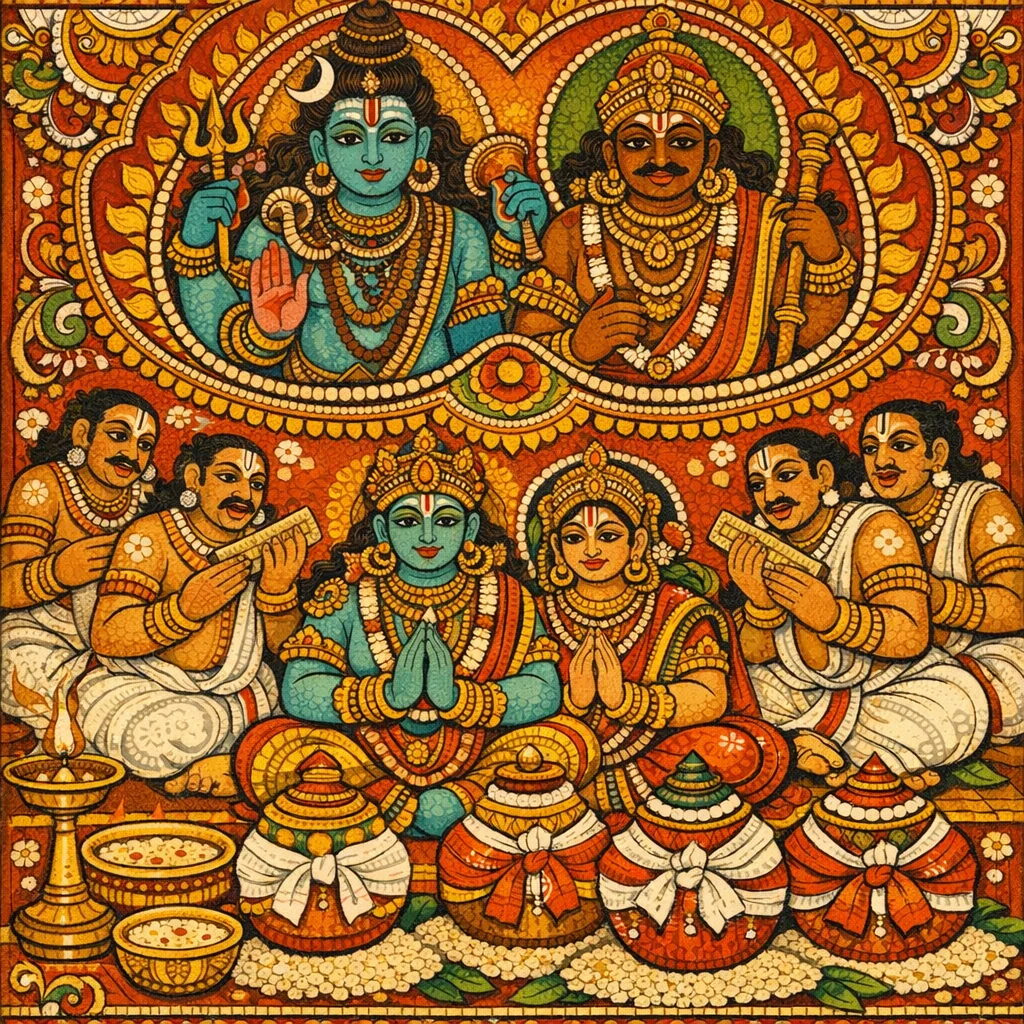
Adhyaya 96: The Greatness and Procedure of the Sarva-Phala-Tyaga Vrata (Renouncing the Fruits of Actions)
सर्वफलत्यागव्रतमाहात्म्यम्
Speaker: Nandikeśvara, Nārada
Nandikeśvara instructs Nārada, first praising the supreme, imperishable reward gained by renouncing the fruits of action. He then states the vrata’s commencement in Mārgaśīrṣa (śukla pakṣa), on tṛtīyā or alternatively on dvādaśī/aṣṭamī/caturdaśī, with brāhmaṇas reciting. The observance includes yearly abstentions and ordered charity: feeding dvijas with pāyasa and giving dakṣiṇā; preparing symbolic gifts—a golden Rudra and a golden Dharma-rāja with a bull, and also a cow; arranging ritual vessels, cloth-covered water pots set upon grains, and a prepared bed with garments. A long inventory lists fruits and roots and their crafted equivalents in silver and copper, stressing giving according to one’s means. Mantras and prayers affirm the non-difference of Śiva, Viṣṇu, Sūrya, and Brahmā, seeking steadfast refuge in Śaṅkara. The chapter ends with eligibility (Bhāgavatas, Sauras, Vaiṣṇavas, yogins, and women) and a phalaśruti promising removal of sins, long support in life, honor in Rudraloka, and access to Indra’s and Viṣṇu’s abodes even for the poor who merely listen or recite.
Key Concepts
Shlokas in Adhyaya 96
Verse 1
*नन्दिकेश्वर उवाच फलत्यागस्य माहात्म्यं यद्भवेच्छृणु नारद यदक्षयं परं लोके सर्वकामफलप्रदम् //
Nandikeśvara said: “O Nārada, listen to the greatness of renouncing the fruits of one’s actions; by it there arises in the next world an imperishable, supreme reward, bestowing the results of all rightful desires.”
Verse 2
मार्गशीर्षे शुभे मासि तृतीयायां मुने व्रतम् द्वादश्यामथवाष्टम्यां चतुर्दश्यामथापि वा आरभेच्छुक्लपक्षस्य कृत्वा ब्राह्मणवाचनम् //
O sage, in the auspicious month of Mārgaśīrṣa one should commence the vow on the third lunar day; or else on the twelfth, the eighth, or even the fourteenth, during the bright fortnight (śukla-pakṣa), after arranging for a Brāhmaṇa to perform the recitation.
Verse 3
अन्येष्वपि हि मासेषु पुण्येषु मुनिसत्तम सदक्षिणं पायसेन भोजयेच्छक्तितो द्विजान् //
Even in the other auspicious months, O best of sages, one should, according to one’s capacity, feed the dvija (the twice-born) with sweet milk-rice (pāyasa), together with a fitting dakṣiṇā (honorarium/offering).
Verse 4
अष्टादशानां धान्यानाम् अन्यच्च फलमूलकम् वर्जयेदब्दमेकं तु ऋते औषधकारणम् सवृषं काञ्चनं रुद्रं धर्मराजं च कारयेत् //
One should abstain for a full year from the eighteen kinds of grains, and also from other fruits and roots—except when required as medicine. Thereafter, according to one’s means, one should commission golden images of Rudra and of Dharma-rāja, together with a bull.
Verse 5
कूष्माण्डं मातुलिङ्गं च वार्ताकं पनसं तथा आम्रातकं कपित्थानि कलिङ्गमथ वालुकम् //
To the recommended list of produce are to be added: ash-gourd (winter melon), citron, eggplant, and jackfruit; as well as hog-plum, wood-apples, the kalinga melon, and the sand-melon.
Verse 6
श्रीफलाश्वत्थबदरं जम्बीरं कदलीफलम् काश्मरं दाडिमं शक्त्या कालधौतानि षोडश //
Coconut, the fruit of the aśvattha (sacred fig), jujube, citron, banana, kāśmara fruit, and pomegranate—according to one’s capacity—are to be offered as sixteen items, duly purified and prepared.
Verse 7
मूलकामलकं जम्बूतिन्तिडीकरमर्दकम् कङ्कोलैलाकतुण्डीरकरीरकुटजं शमी //
These are to be taken/used: the root of āmalaka (Indian gooseberry), jambū (rose-apple), tintiḍī (tamarind), karamarda (karonda); also kaṅkola (cubeb), ilā (cardamom), katuṇḍīra, karīra, kuṭaja (kurchi), and śamī.
Verse 8
औदुम्बरं नारिकेलं द्राक्षाथ बृहतीद्वयम् रौप्याणि कारयेच्छक्त्या फलानीमानि षोडश //
According to one’s means, one should have these sixteen fruits fashioned in silver: the audumbara fruit, the coconut, grapes, and the pair of bṛhatī fruits.
Verse 9
ताम्रं तालफलं कुर्याद् अगस्तिफलमेव च पिण्डारकाश्मर्यफलं तथा सूरणकन्दकम् //
One should employ copper, the fruit of the palmyra palm, and also the fruit of Agasti; likewise the fruits of piṇḍāraka and kāśmarya, and the tuber (bulb) of sūraṇa.
Verse 10
रक्तालुकाकन्दकं च कनकाह्वं च चिर्भिटम् चित्रवल्लीफलं तद्वत् कूटशाल्मलिजं फलम् //
Also (there are) the red yam-tuber, the tuber called Kanakāhva, and cirbhiṭa (a gourd-like vegetable); likewise the fruit of the Citravallī creeper, and the fruit produced from the Kūṭa-śālmali tree.
Verse 11
आम्रनिष्पावमधुकवटमुद्गपटोलकम् ताम्राणि षोडशैतानि कारयेच्छक्तितो नरः //
A man should, according to his means, have these sixteen copper implements/vessels made—(bearing the names or forms of) mango, niṣpāva (bean), madhūka, vaṭa (banyan), mudga (green gram), and paṭola (pointed gourd).
Verse 12
उदकुम्भद्वयं कुर्याद् धान्योपरि सवस्त्रकम् ततश्च कारयेच्छय्यां यथोपरि सुवाससी //
One should place two water-pitchers, covered with cloth, upon a heap of grains; then one should have a bed prepared, and upon it arrange fine garments (as prescribed).
Verse 13
भक्ष्यपात्रत्रयोपेतं यमरुद्रवृषान्वितम् धेन्वा सहैव शान्ताय विप्रायाथ कुटुम्बिने सपत्नीकाय सम्पूज्य पुण्ये ऽह्नि विनिवेदयेत् //
On an auspicious day, one should duly worship and then offer to a peaceful Brāhmaṇa who maintains a household—together with his wife—a gift consisting of three vessels of edible offerings, along with images/emblems of Yama, Rudra, and a bull, and also a cow.
Verse 14
यथा फलेषु सर्वेषु वसन्त्यमरकोटयः तथा सर्वफलत्यागव्रताद्भक्तिः शिवे ऽस्तु मे //
As countless hosts of the immortals abide within all fruits, so may devotion to Śiva arise in me through the vow of renouncing every self-seeking fruit of action.
Verse 15
यथा शिवश्च धर्मश्च सदानन्तफलप्रदौ तद्युक्तफलदानेन तौ स्यातां मे वरप्रदौ //
As Śiva and Dharma ever bestow endless fruits, so may those two become granters of boons to me through the offering of merits aligned with them.
Verse 16
यथा फलान्यनन्तानि शिवभक्तेषु सर्वदा तथानन्तफलावाप्तिर् अस्तु जन्मनि जन्मनि //
As the fruits of merit are ever infinite for the devotees of Śiva, so may the attainment of infinite fruits be ours—birth after birth.
Verse 17
यथा भेदं न पश्यामि शिवविष्ण्वर्कपद्मजान् तथा ममास्तु विश्वात्मा शंकरः शंकरः सदा //
As I perceive no difference between Śiva, Viṣṇu, the Sun, and the Lotus-born (Brahmā), so may Śaṅkara—who is the very Soul of the universe—ever be mine, ever be my refuge.
Verse 18
इति दत्त्वा च तत्सर्वम् अलंकृत्य च भूषणैः शक्तिश्चेच्छयनं दद्यात् सर्वोपस्करसंयुतम् //
Thus, having given all that and having adorned it with ornaments, if one has the means one should also gift a bed—complete with all its accessories and furnishings.
Verse 19
अशक्तस्तु फलान्येव यथोक्तानि विधानतः तथोदकुम्भसंयुक्तौ शिवधर्मौ च काञ्चनौ //
But if one is unable to give the primary prescribed gifts, one should offer fruits alone, exactly as stated and according to the proper procedure; likewise, one should present two golden items—an auspicious water-pot (udaka-kumbha) together with the gifts called Śiva and Dharma.
Verse 20
विप्राय दत्त्वा भुञ्जीत वाग्यतस्तैलवर्जितम् अन्यान्यपि यथाशक्त्या भोजयेच्छक्तितो द्विजान् //
After first offering food to a brāhmaṇa, one should then eat in silence and without oil; and, according to one’s ability, one should also feed other twice-born (dvija) persons as far as one’s means allow.
Verse 21
एतद्भागवतानां तु सौरवैष्णवयोगिनाम् शुभं सर्वफलत्यागव्रतं वेदविदो विदुः //
The knowers of the Veda declare that this auspicious vow—renunciation of all fruits, ritual and worldly—is meant for the devotees of the Lord, for the Sauras and the Vaiṣṇavas, and for yogins.
Verse 22
नारीभिश्च यथाशक्त्या कर्तव्यं द्विजपुंगव एतस्मान्नापरं किंचिद् इह लोके परत्र च व्रतमस्ति मुनिश्रेष्ठ यदनन्तफलप्रदम् //
O best among twice-born men, women too should perform this observance according to their ability. For there is no other vow, O foremost of sages, in this world or the next that grants such endless fruit.
Verse 23
सौवर्णरौप्यताम्रेषु यावन्तः परमाणवः भवन्ति चूर्ण्यमानेषु फलेषु मुनिसत्तम तावद्युगसहस्राणि रुद्रलोके महीयते //
O best of sages, for as many atoms as arise when gold, silver, and copper are ground into powder, for that many thousands of yugas one is honored and exalted in Rudra’s world (Rudraloka).
Verse 24
एतत्समस्तकलुषापहरं जनानाम् आजीवनाय मनुजेषु च सर्वदा स्यात् जन्मान्तरेष्वपि न पुत्रवियोगदुःखम् आप्नोति धाम च पुरंदरलोकजुष्टम् //
This teaching/recitation removes all impurity and sin from people; among human beings it ever becomes a lifelong support. Even in later births one does not suffer the grief of separation from one’s sons, and one attains a blessed abode, enjoyed in the world of Purandara (Indra).
Verse 25
यो वा शृणोति पुरुषो ऽल्पधनः पठेद्वा देवालयेषु भवनेषु च धार्मिकाणाम् पापैर्वियुक्तवपुरत्र पुरं मुरारेर् आनन्दकृत्पदमुपैति मुनीन्द्र सो ऽपि //
Even a man of little wealth—if he listens to this teaching or recites it in temples or in the homes of the righteous—becomes freed from sins here itself; and he too, O best of sages, attains the bliss-bestowing abode, the city of Murāri (Viṣṇu).
Frequently Asked Questions
The chapter teaches that true spiritual gain arises from phala-tyāga—renouncing attachment to the results of one’s actions. Nandikeśvara frames this as a supreme vow that yields imperishable merit, while also giving a concrete ritual framework (timing, restraint, feeding, and gifting) to embody inner renunciation through disciplined charity and worship aligned with Rudra and Dharma-rāja.
This adhyaya is primarily Dharma-focused, specifically Vrata-Dharma and Dāna-Dharma. It does not treat Vastu Shastra measurements or royal policy, nor does it present genealogy; instead it details observance rules, dietary restrictions, brāhmaṇa-feeding, icon/metal gifts, and the promised spiritual results (phalaśruti).
It is to be commenced in the auspicious month of Mārgaśīrṣa during the bright fortnight, preferably on the third lunar day (tṛtīyā), with alternatives given as dvādaśī (12th), aṣṭamī (8th), or caturdaśī (14th), after arranging brāhmaṇa recitation.
Key acts include feeding dvijas with sweet milk-rice (pāyasa) and giving dakṣiṇā; abstaining for a year from eighteen grains; and donating crafted items such as golden Rudra and Dharma-rāja images with a bull, plus a cow. The rite also includes ritual vessels (two cloth-covered water pots set on grains), garments, and optionally a complete bed with furnishings.
No. It explicitly states the vow is for devotees of the Lord and is suitable for Sauras, Vaiṣṇavas, and yogins, and it includes prayers expressing non-difference between Śiva, Viṣṇu, the Sun, and Brahmā—indicating a harmonizing, inclusive theology.
The text promises removal of impurity and sin, lifelong support, and avoidance of the sorrow of separation from sons in later births. It also describes exaltation in Rudraloka for vast spans and attainment of blessed abodes associated with Indra (Purandara) and Viṣṇu (Murāri), even for those of little wealth who listen or recite in temples or righteous homes.