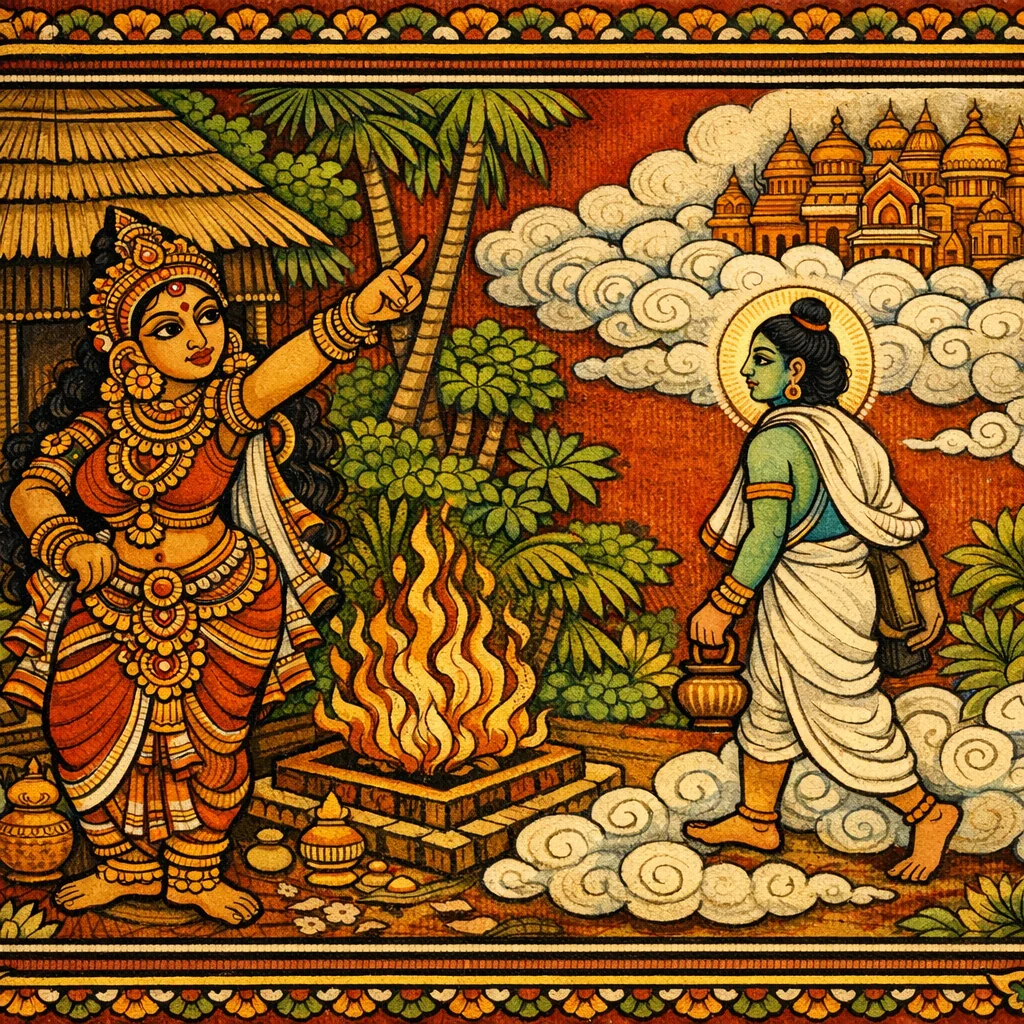
Adhyaya 26: The Dialogue of Kacha and Devayani: Dharma, Refusal of Marriage, and the Curse on Knowledge
कच-देवयानी संवादः (शाप-प्रतिशाप-प्रसङ्गः)
Speaker: Śaunaka, Devayānī, Kaca, The Devas (with Indra)
Śaunaka relates that after completing his vowed observance and being dismissed by his teacher, Kaca departs for the realm of the Thirty-three gods. Devayānī speaks first, praising his conduct and learning, and asks him to marry her by rites sanctioned with mantras. Kaca replies reverently that she must always be honored as the guru’s daughter and therefore cannot be approached as a wife. Devayānī argues that she protected and loved him through his repeated deaths at Asura hands, and that leaving her violates dharma. Kaca reaffirms dharma: she is like a sister, since when revived he had dwelt in Śukra’s womb, and he takes his leave. Devayānī curses that his vidyā will not succeed; Kaca accepts her right to curse, refuses to curse her in return, but declares that no sage’s son will marry her, and resolves to pass the knowledge onward so it bears fruit through another. Śaunaka concludes that Kaca reaches the Devas; they honor Bṛhaspati and praise Kaca’s wondrous service and enduring fame.
Key Concepts
Shlokas in Adhyaya 26
Verse 1
*शौनक उवाच समापितव्रतं तं तु विसृष्टं गुरुणा तदा प्रस्थितं त्रिदशावासं देवयानीदमब्रवीत् //
Śaunaka said: When he had completed his vowed observance and was then dismissed by his teacher, as he set out for the abode of the Thirty-three gods, Devayānī spoke these words to him.
Verse 2
*देवयान्युवाच ऋषेर् अङ्गिरसः पौत्र वृत्तेनाभिजनेन च भ्राजसे विद्यया चैव तपसा च दमेन च //
Devayānī said: “O grandson of the sage Aṅgiras, you shine—by your noble conduct and high birth, and also by learning, austerity, and self-restraint.”
Verse 3
ऋषिर् यथाङ्गिरा मान्यः पितुर्मम महायशाः तथा मान्यश्च पूज्यश्च मम भूयो बृहस्पतिः //
Just as the great and illustrious sage Aṅgirā is honored by my father, so too is Bṛhaspati—ever more—worthy of my honor and worship.
Verse 4
एवं ज्ञात्वा विजानीहि यद्ब्रवीमि तपोधन व्रतस्थे नियमोपेते यथा वर्ताम्यहं त्वयि //
Knowing thus, understand well what I declare, O treasure of austerity: as you stand firm in your vow and are endowed with disciplined observances, so do I conduct myself toward you accordingly.
Verse 5
स समापितविद्यो मां भक्तां न त्यक्तुमर्हसि गृहाण पाणिं विधिवन् मम मन्त्रपुरस्कृतम् //
Now that your studies are complete, you should not forsake me, your devoted one. Accept my hand in marriage according to proper procedure—sanctified by the recitation of mantras.
Verse 6
*कच उवाच पूज्यो मान्यश्च भगवान् यथा मम पिता तव तथा त्वमनवद्याङ्गि पूजनीयतमा मता //
Kaca said: “Just as the venerable Lord—my father—is to be worshipped and honored by you, so too are you, O flawless-limbed one, regarded by me as most worthy of worship.”
Verse 7
आत्मप्राणैः प्रियतमा भार्गवस्य महात्मनः त्वं भद्रे धर्मतः पूज्या गुरुपुत्री सदा मम //
O auspicious lady, you are dearer to the great Bhārgava than his very life-breaths; and, by the rule of dharma, you are always worthy of my reverence, for you are the daughter of my teacher.
Verse 8
यथा मम गुरुर्नित्यं मान्यः शुक्रः पिता तव देवयानि तथैव त्वं नैवं मां वक्तुमर्हसि //
Just as your father Śukra is ever worthy of honor as my guru, O Devayānī, so too you should honor that bond, and you ought not speak to me in this manner.
Verse 9
*देवयान्युवाच गुरुपुत्रस्य पुत्रो मे न तु त्वमसि मे पितुः तस्मान्मान्यश्च पूज्यश्च ममापि त्वं द्विजोत्तम //
Devayānī said: “You are the son of my father’s disciple (the guru’s son), not my father himself. Therefore, O best of the twice-born, you are worthy of honor and worship even for me.”
Verse 10
असुरैर्हन्यमाने तु कचे त्वयि पुनः पुनः तदाप्रभृति या प्रीतिस् तां त्वमेव स्मरस्व मे //
O Kaca, when you were being slain again and again by the Asuras, the affection that arose in me from that time onward—remember that love of mine yourself.
Verse 11
सौहार्दे चानुरागे च वेत्थ मे भक्तिमुत्तमाम् न मामर्हसि धर्मज्ञ त्यक्तुं भक्तामनागसम् //
You know my supreme devotion—born of friendship and loving attachment. Therefore, O knower of dharma, you should not abandon me, your devoted one who is without fault.
Verse 12
*कच उवाच अनियोज्ये नियोगे मां नियुनक्षि शुभव्रते प्रसीद सुभ्रूर्मह्यं त्वं गुरोर् गुरुतरा शुभे //
Kaca said: “O you of auspicious vows, though this appointment (niyoga) is not proper to be imposed, you are enjoining it upon me. Be gracious, O fair-browed one; to me you are even weightier in authority than my teacher—O auspicious lady.”
Verse 13
यत्रोषितं विशालाक्षि त्वया चन्द्रनिभानने तत्राहमुषितो भद्रे कुक्षौ काव्यस्य भामिनि //
O large-eyed one, O moon-faced lady—where you have dwelt, there indeed have I dwelt as well, O auspicious one; for I resided in the womb of Kāvya (Śukra), O radiant and passionate woman.
Verse 14
भगिनी धर्मतो मे त्वं मैवं वोचः शुभानने सुखेनाध्युषितो भद्रे न मन्युर्विद्यते मम //
Sister, by the rule of dharma you are mine; do not speak in this way, O fair-faced one. I dwell contentedly, dear lady—there is no anger in me at all.
Verse 15
आपृच्छे त्वां गमिष्यामि शिवमस्त्वथ मे पथि अविरोधेन धर्मस्य स्मर्तव्यो ऽस्मि कथान्तरे अप्रमत्तोद्यता नित्यम् आराधय गुरुं मम //
I take leave of you; I shall depart. Let there be auspiciousness on my path. Remember me again at another time, without transgressing dharma. Be ever vigilant and diligent, and continually revere my teacher (guru).
Verse 16
*देवयान्युवाच दैत्यैर्हतस्त्वं यद्भर्तृबुद्ध्या त्वं रक्षितो मया यदि मां धर्मकामार्थं प्रत्याख्यास्यसि धर्मतः //
Devayānī said: “You would have been slain by the Dāityas, but I protected you, taking you to be my husband. If now, in the name of dharma, you reject me—who sought dharma, love, and rightful prosperity—then you act against righteousness.”
Verse 17
ततः कच न ते विद्या सिद्धिमेषा गमिष्यति //
Therefore, O Kaca, this knowledge will not attain fulfillment (success) for you.
Verse 18
*कच उवाच गुरुपुत्रीति कृत्वाहं प्रत्याख्यास्ये न दोषतः गुरुणा चाभ्यनुज्ञातः काममेव शपस्व माम् //
Kaca said: “Since you have addressed me as ‘the preceptor’s daughter,’ I shall refuse you without incurring fault; and having been permitted by the teacher, curse me as you please.”
Verse 19
आर्षं धर्मं ब्रुवाणो ऽहं देवयानि यथा त्वया शप्तुं नार्हो ऽस्मि कल्याणि कामतो ऽद्य च धर्मतः //
O Devayānī, auspicious one, as I speak the dharma taught by the seers, I am not fit to curse you as you have cursed me—neither today out of personal desire nor even on grounds of righteousness.
Verse 20
तस्माद्भवत्या यः कामो न तथा सम्भविष्यति ऋषिपुत्रो न ते कश्चिज् जातु पाणिं ग्रहीष्यति //
Therefore, the desire you cherish will not come to pass in that way; no son of a sage will ever take your hand in marriage.
Verse 21
फलिष्यति न मे विद्या त्वद्वचश्चेति तत्तया अध्यापयिष्यामि च यं तस्य विद्या फलिष्यति //
“My learning will not bear fruit—such is your word.” Therefore, with that resolve, I shall teach the one whom you indicate; his knowledge will indeed bear fruit.
Verse 22
*शौनक उवाच एवमुक्त्वा नृपश्रेष्ठ देवयानीं कचस्तदा त्रिदशेशालयं शीघ्रं जगाम द्विजसत्तमः //
Śaunaka said: Having spoken thus to Devayānī, O best of kings, Kacha—foremost among the twice-born—then swiftly went to the abode of the lord of the gods.
Verse 23
तमागतमभिप्रेक्ष्य देवाः सेन्द्रपुरोगमाः बृहस्पतिं सभाज्येदं कचमाहुर्मुदान्विताः //
Seeing him arrive, the gods—led by Indra—first honored Bṛhaspati; then, filled with joy, they spoke these words to Kaca.
Verse 24
*देवा ऊचुः त्वं कचास्मद्धितं कर्म कृतवान्महदद्भुतम् न ते यशः प्रणशिता भागभाक्च भविष्यसि //
The gods said: “O Kaca, you have performed for our welfare a great and wondrous deed. Your fame will not perish, and you too shall become a rightful recipient of a share (of honor and reward).”
Frequently Asked Questions
The chapter teaches that dharma—especially guru-dharma—can override personal desire. Kaca refuses Devayānī’s proposal because the guru is to be treated like a father and the guru’s daughter must be honored accordingly. It also illustrates how speech-acts (curses) shape the ‘fruit’ (siddhi) of knowledge and how knowledge can still bear fruit through rightful transmission to another.
This adhyaya is primarily Dharma-focused within a Puranic-genealogical narrative frame: guru–śiṣya ethics, marital propriety, niyoga/improper imposition, curse mechanics, and the Deva–Asura context involving Śukra, Bṛhaspati, Indra, and Kaca. Vastu or architectural measurements are not discussed in this chapter.