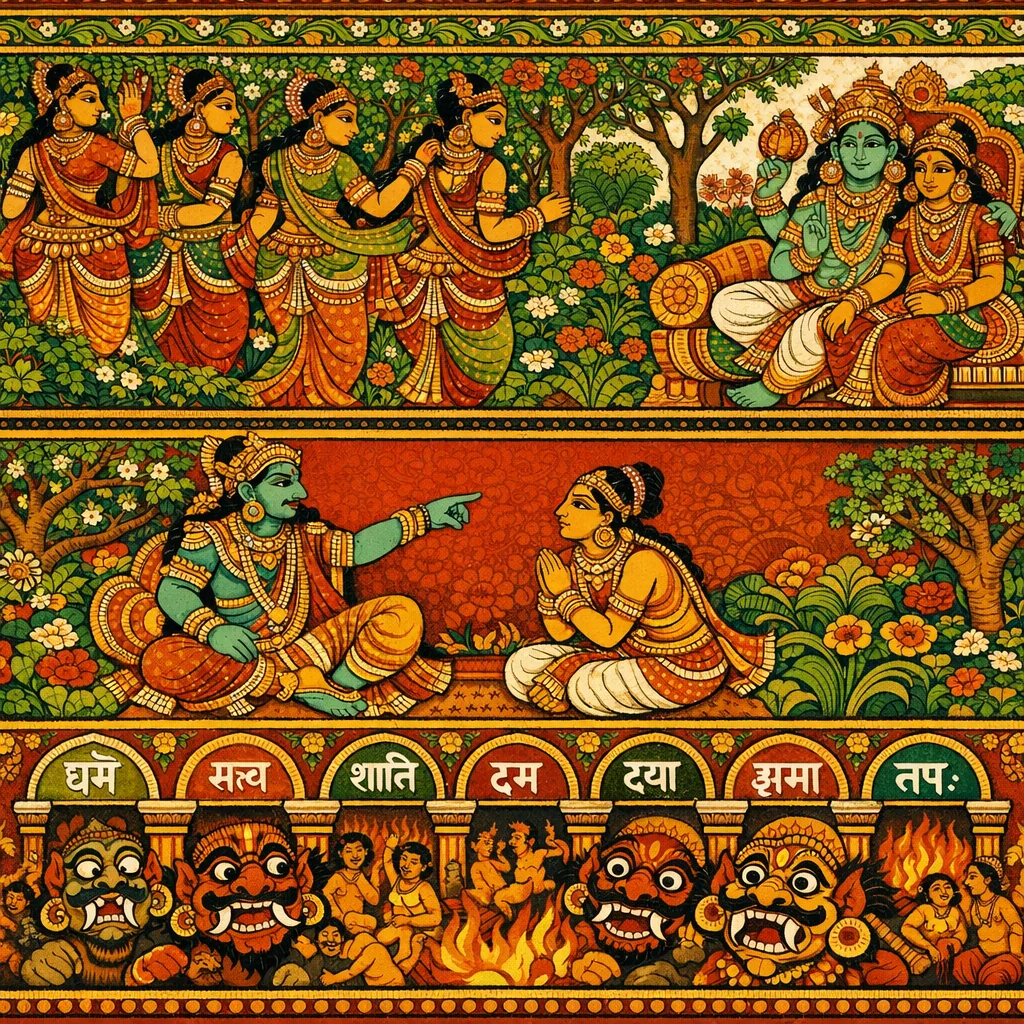
Adhyaya 39: Dialogue of Aṣṭaka and Yayāti: Exhaustion of Merit, Earthly Hell, Rebirth Mechanism, and the Seven Gates to Heaven
अष्टक-ययाति संवादः — क्षीणपुण्य, भौमनरक, गर्भोत्पत्ति, स्वर्गद्वार-उपदेशः
Speaker: Aṣṭaka, Yayāti
Aṣṭaka asks why Yayāti departs from Nandana in Kāmarūpa. Yayāti teaches that when merit is exhausted (kṣīṇa-puṇya), the soul is forsaken even in heaven and falls into bhauma-naraka, an “earthly hell,” suffering for long ages and being driven by fearsome earth-born beings. Pressed about the origin of these tormentors and the mechanism of embodiment, Yayāti explains conception and embryonic growth (vāyu drawing semen and menstrual essences; development governed by tanmātra), and then how sensory cognition operates after birth. The dialogue returns to dharma: auspicious worlds are attained through tapas and virtues, yet pride corrupts ritual, sacred silence, study, and sacrifice. The chapter ends by praising refuge in the Purāṇa as a support that purifies the mind and grants peace in life and after death.
Key Concepts
Shlokas in Adhyaya 39
Verse 1
*अष्टक उवाच यदा वसन्नन्दने कामरूपे संवत्सराणामयुतं शतानाम् किंकारणं कार्तयुगप्रधान हित्वा तद्वै वसुधाम् अन्वपद्यः //
Aṣṭaka said: “When you dwelt in Nandana, in Kāmarūpa, for ten thousand hundreds of years, for what reason, O foremost one of the Kṛta Yuga, did you abandon that very land and depart elsewhere?”
Verse 2
*ययातिरुवाच ज्ञातिः सुहृत्स्वजनो यो यथेह क्षीणे वित्ते त्यज्यते मानवैर्हि तथा स्वर्गे क्षीणपुण्यं मनुष्यं त्यजन्ति सद्यः खेचरा देवसंघाः //
Yayāti said: “Just as here in this world, when a man’s wealth is exhausted, his relatives, friends, and even his own people abandon him—so too in heaven, when a man’s merit is spent, the airborne hosts of gods at once forsake him.”
Verse 3
*अष्टक उवाच कथं तस्मिन्क्षीणपुण्या भवन्ति संमुह्यते मे ऽत्र मनो ऽतिमात्रम् किंविशिष्टाः कस्य धामोपयान्ति तद्वै ब्रूहि क्षेत्रवित्त्वं मतो मे //
Aṣṭaka said: “How do beings there become ‘exhausted of merit’ (kṣīṇa-puṇya)? My mind is greatly bewildered about this. What distinctive state do they attain, and to whose abode do they go? Tell me this indeed—for you are regarded by me as one who truly knows the sacred fields (kṣetra).”
Verse 4
*ययातिरुवाच इमं भौमं नरकं ते पतन्ति लालप्यमाना नरदेव सर्वे ते कङ्कगोमायुपलाशनार्थं क्षितौ विवृद्धिं बहुधा प्रयान्ति //
Yayāti said: “O king of men, all those beings fall into this earthly hell, wailing and lamenting. Seeking only to become food for vultures and jackals, they undergo many kinds of growth and transformation upon the ground (that is, repeated embodied states of suffering).”
Verse 5
तस्मादेवं वर्जनीयं नरेन्द्र दुष्टं लोके गर्हणीयं च कर्म आख्यातं ते पार्थिव सर्वमेतद् भूयश्चेदानीं वद किं ते वदामि //
Therefore, O king, such wicked conduct—censured by the world—must be avoided. O ruler of men, I have explained all this to you; if you wish to hear more now, speak—what shall I tell you further?
Verse 6
*अष्टक उवाच यदा तु तांस् ते वितुदन्ते वयांसि तथा गृध्राः शितिकण्ठाः पतंगाः कथं भवन्ति कथमाभवन्ति त्वत्तो भौमं नरकमहं शृणोमि //
Aṣṭaka said: “When birds peck at them, and likewise vultures and dark-throated flying creatures torment them—how do these beings come to be, and how did they arise? From you I wish to hear about the earthly hell (Bhauma-naraka).”
Verse 7
*ययातिरुवाच ऊर्ध्वं देहात्कर्मणो जृम्भमाणाद् व्यक्तं पृथिव्याम् अनुसंचरन्ति इमं भौमं नरकं ते पतन्ति नावेक्षन्ते वर्षपूगाननेकान् //
Yayāti said: “After leaving the body, as their own karma swells into full force, they are manifestly driven to wander upon the earth; they fall into this earthly hell, and for many accumulated years they do not behold any relief or higher state.”}]}
Verse 8
षष्टिं सहस्राणि पतन्ति व्योम्नि तथाशीतिं चैव तु वत्सराणाम् तान्वै नुदन्ते प्रपतन्तः प्रयातान् भीमा भौमा राक्षसास् तीक्ष्णदंष्ट्राः //
Sixty thousand fall through the sky—and likewise eighty more—over the course of years. As they plunge onward, dreadful earth-born Rākṣasas with sharp fangs strike them down and drive them away.
Verse 9
*अष्टक उवाच यदेतांस्ते संपततस्तुदन्ति भीमा भौमा राक्षसास्तीक्ष्णदंष्ट्राः कथं भवन्ति कथमाभवन्ति कथंभूता गर्भभूता भवन्ति //
Aṣṭaka said: “Those dreadful, earth-born Rākṣasas with sharp fangs, who swoop down and torment these beings—how do they come into existence? From what do they originate? Of what nature are they, and in what manner do they become embodied in the womb?”
Verse 10
*ययातिरुवाच असृग्रेतः पुष्परसानुयुक्तम् अन्वेति सद्यः पुरुषेण सृष्टम् तव तरया रज आपद्यते च स गर्भभूतः समुपैति तत्र //
Yayāti said: “The semen—mingled with the essence of the flowers—immediately follows the course set by the man at the moment of emission. Through your (female) channel the menstrual fluid also becomes involved; and there, it comes together, becoming an embryo.”
Verse 11
वनस्पतीन् ओषधींश्चाविशन्ति अपो वायुं पृथिवीं चान्तरिक्षम् चतुष्पदं द्विपदं चापि सर्व एवंभूता गर्भभूता भवन्ति //
Trees and medicinal herbs enter into the waters, the wind, the earth, and the mid-space (atmosphere). Likewise all beings—whether four-footed or two-footed—become of that condition and pass into an embryonic, seed-like state.
Verse 12
*अष्टक उवाच अन्यद्वपुर्विदधातीह गर्भ उताहोस्वित्स्वेन कामेन याति आपद्यमानो नरयोनिमेताम् आचक्ष्व मे संशयात्पृच्छतस्त्वम् //
Aṣṭaka said: “Does the embryo here fashion for itself another body, or does it—driven by its own desire—enter upon and attain this human womb? Tell me clearly, for I ask you in doubt.”
Verse 13
शरीरदेहादिसमुच्छ्रयं च चक्षुःश्रोत्रे लभते केन संज्ञाम् एतत्सर्वं तात आचक्ष्व पृष्टः क्षेत्रज्ञं त्वां मन्यमाना हि सर्वे //
O dear one, by whom does this aggregate—body, embodied condition, and the rest—together with the eye and the ear, obtain awareness and recognition? Thus questioned, explain all this, for indeed everyone regards you as the Knower of the Field (kṣetrajña).
Verse 14
*ययातिरुवाच वायुः समुत्कर्षति गर्भयोनिम् ऋतौ रेतः पुष्परसानुयुक्तम् स तत्र तन्मात्रकृताधिकारः क्रमेण संवर्धयतीह गर्भम् //
Yayāti said: In the proper season, the vital wind (vāyu) draws the semen—joined with the essences of the menstrual flow—toward the womb. There, its function being determined only by the subtle elements (tanmātra), it gradually nourishes and develops the embryo.
Verse 15
स जायमानो ऽथ गृहीतमात्रः संज्ञामधिष्ठाय ततो मनुष्यः स श्रोत्राभ्यां वेदयतीह शब्दं स वै रूपं पश्यति चक्षुषा च //
Then, as soon as he is born and taken up into care, the human being becomes established in awareness; thereafter, through the two ears he cognizes sound in this world, and indeed he beholds form through the eyes.
Verse 16
घ्राणेन गन्धं जिह्वयाथो रसं च त्वचा स्पर्शं मनसा देवभावम् इत्यष्टकेहोपचितं हि विद्धि महात्मनः प्राणभृतः शरीरे //
Know, O great-souled one, that within the body of the living being—the bearer of prāṇa—there is an eightfold accumulation: smell through the nose, taste through the tongue, touch through the skin, and the divine disposition (higher awareness) through the mind.
Verse 17
*अष्टक उवाच यः संस्थितः पुरुषो दह्यते वा निखन्यते वापि निकृष्यते वा अभावभूतः स विनाशमेत्य केनात्मानं चेतयते पुरस्तात् //
Aṣṭaka said: “That embodied person who remains here—whether he is burnt, buried, or dragged away—having become a state of non-being, goes to destruction. Then by what does the Self (ātman) become aware beforehand, that is, while still living?”
Verse 18
*ययातिरुवाच हित्वा सो ऽसून् सुप्तवन्निष्ठितत्वात् पुरोधाय सुकृतं दुष्कृतं च अन्यां योनिं पुण्यपापानुसारां हित्वा देहं भजते राजसिंह //
Yayāti said: “Having abandoned the vital breaths—like one who has fallen asleep, through the body’s cessation—carrying forward one’s merit and demerit, the being attains another womb in accordance with virtue and sin; leaving one body behind, O lion among kings, it takes up another.”
Verse 19
पुण्यां योनिं पुण्यकृतो विशन्ति पापां योनिं पापकृतो व्रजन्ति कीटाः पतंगाश्च भवन्ति पापान् न मे विवक्षास्ति महानुभाव //
Doers of merit enter a meritorious womb, while doers of sin go to a sinful womb. Because of sins, one becomes a worm or an insect. I do not wish to speak further of these matters, O great-souled one.
Verse 20
चतुष्पदा द्विपदाः पक्षिणश्च तथाभूता गर्भभूता भवन्ति आख्यातमेतन्निखिलं हि सर्वं भूयस्तु किं पृच्छसि राजसिंह //
Thus, the four-footed creatures, the two-footed beings, and the birds likewise come into being as womb-born. I have now explained this entire matter in full—what more do you wish to ask, O lion among kings?
Verse 21
*अष्टक उवाच किं स्वित्कृत्वा लभते तात संज्ञां मर्त्यः श्रेष्ठां तपसा विद्यया वा तन्मे पृष्टः शंस सर्वं यथावच् छुभांल्लोकान् येन गच्छेत्क्रमेण //
Aṣṭaka said: “Dear father, by doing what does a mortal obtain the highest renown and standing—by austerity, or by sacred knowledge? Since I have asked you, tell me everything rightly, by which one may proceed step by step to the auspicious worlds.”
Verse 22
*ययातिरुवाच तपश्च दानं च शमो दमश्च ह्रीर् आर्जवं सर्वभूतानुकम्पा स्वर्गस्य लोकस्य वदन्ति सन्तो द्वाराणि सप्तैव महान्ति पुंसाम् //
Yayāti said: Austerity and charity, tranquility and self-restraint, modesty, straightforwardness, and compassion toward all beings—these, the virtuous declare, are the seven great gates for men to reach the world of heaven.
Verse 23
सर्वाणि चैतानि यथोदितानि तपःप्रधानान्यभिमर्षकेण नश्यन्ति मानेन तमो ऽभिभूताः पुंसः सदैवेति वदन्ति सन्तः //
All these practices, as stated, though centered on austerity (tapas), are ruined by the sting of pride. Overpowered by darkness (tamas), a person’s merits perish—so the righteous continually declare.
Verse 24
अधीयानः पण्डितं मन्यमानो यो विद्यया हन्ति यशः परस्य तस्यान्तवन्तः पुरुषस्य लोका न चास्य तद्ब्रह्मफलं ददाति //
Even if one is learned and considers oneself a scholar, if one uses one’s knowledge to destroy another person’s good name, the worlds attained by that person become perishable, and that learning does not grant the true fruit of sacred wisdom (brahma-phala).
Verse 25
चत्वारि कर्माणि भयंकराणि भयं प्रयच्छन्त्ययथाकृतानि मानाग्निहोत्रमुत मानमौनं मानेनाधीतमुत मानयज्ञः //
Four acts become dreadful and bring fear when performed wrongly: the fire-offering (agnihotra) done with pride, silence (mauna) observed with pride, study pursued with pride, and sacrifice (yajña) undertaken with pride.
Verse 26
न मान्यमानो मुदमाददीत न संतापं प्राप्नुयाच्चावमानात् सन्तः सतः पूजयन्तीह लोके नासाधवः साधुबुद्धिं लभन्ते //
When not honored, one should not seize upon joy; and when insulted, one should not fall into anguish. In this world, the noble honor the truly good—yet the unvirtuous do not attain the understanding of the virtuous.
Verse 27
इति दद्यादिति यजेद् इत्यधीयीत मे श्रुतम् इत्येतान्यभयान्याहुस् तान्य् अवर्ज्यानि नित्यशः //
“Thus one should give; thus one should sacrifice; thus one should study; thus one should heed what I have taught.” These, they say, are acts that bring fearlessness, and therefore they are never to be neglected—always.
Verse 28
येनाश्रयं वेदयन्ते पुराणं मनीषिणो मानसे मानयुक्तम् तन्निःश्रेयस् तेन संयोगमेत्य परां शान्तिं प्राप्नुयुः प्रेत्य चेह //
By taking refuge in this Purāṇa—known and taught by the wise as a revered support that refines the mind—one attains the highest good through union with it, and gains supreme peace both here and after death.
Frequently Asked Questions
The chapter’s primary instruction is ethical and karmic: merit is exhaustible (kṣīṇa-puṇya), and when it ends the soul falls from heavenly enjoyment into bhauma-naraka and then into new births according to virtue and sin. Therefore one should cultivate the seven gates to heaven—tapas (austerity), dāna (charity), śama (tranquility), dama (self-restraint), hrī (modesty), ārjava (straightforwardness), and compassion toward all beings—while avoiding māna (pride), which ruins ritual, study, and ascetic practice.
This adhyāya is primarily Dharma and Sṛṣṭi-related rather than Vāstu or genealogy. It covers Rajadharma-adjacent moral instruction (virtues for reaching svarga), afterlife cosmology (kṣīṇa-puṇya and bhauma-naraka), and creation/embodiment themes through a conception-and-embryo account (vāyu, tanmātras, prāṇa, senses) plus karma-based rebirth into different yonis.