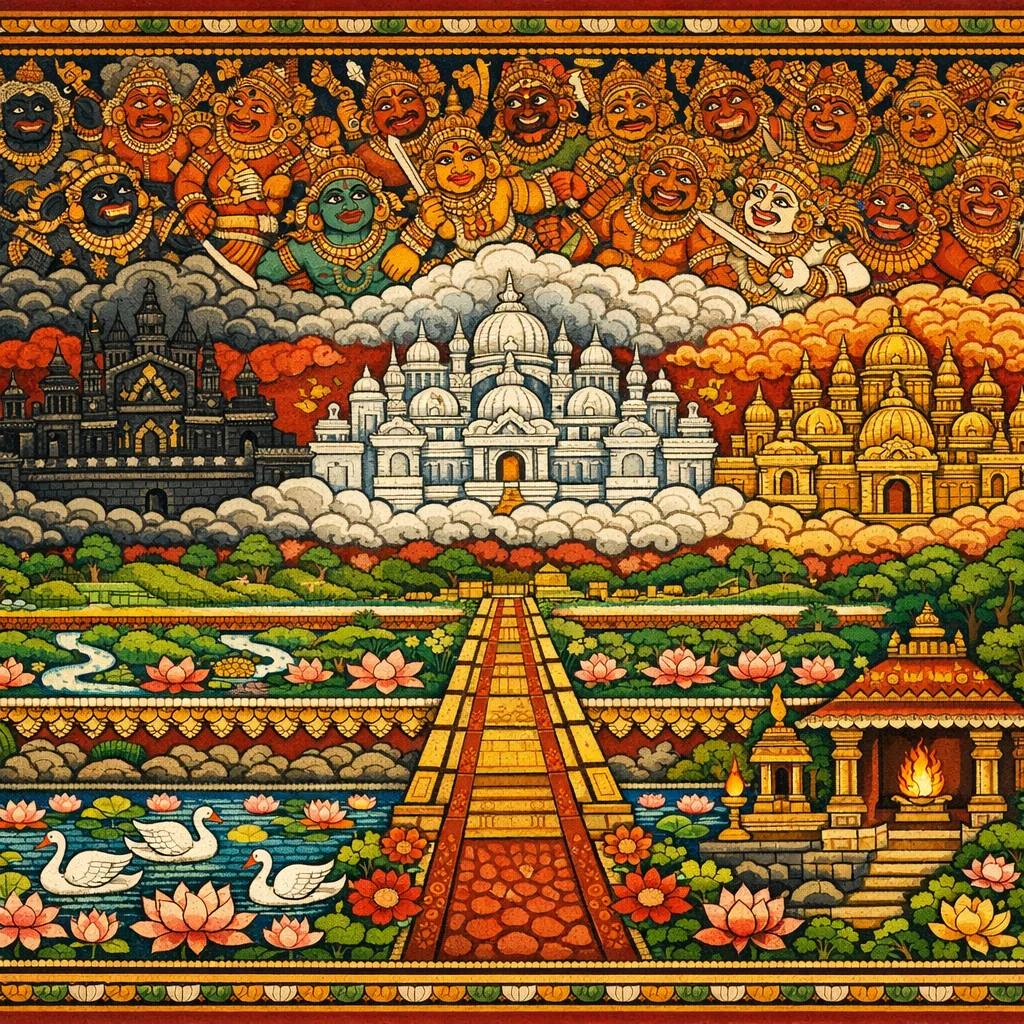
Adhyaya 130: Design and Splendour of Tripura: Maya’s Threefold Moving Fortress
त्रिपुरदुर्गविधानवर्णनम्
Speaker: Sūta
Sūta continues the mythic-architectural account: by a divine stratagem the Daitya first designs in his mind a mobile fortress-city, Tripura, and Maya then brings it forth as a threefold city. The planned features are detailed—ramparts and walls, gopuras, specialized gateways, broad royal roads and lanes, rest-houses, squares, palace precincts, Rudra shrines, and vast water bodies. The three cities are identified by material and ruler: iron Tripura ruled by Tāraka, silver Tripura ruled by Vidyunmālī, and gold Tripura ruled by Maya. Their separations are set at a hundred yojanas, and auspicious timing is stressed, especially the Puṣya conjunction. The narrative lingers on sensory opulence and ritual-like adornment—bells, fragrance, flowers, and offerings—and ends with formidable defenses: jeweled walls, many gopuras, and deep moats, drawing thousands of mighty Diti-born Asuras who fill Tripura as rain-clouds fill the sky.
Key Concepts
Shlokas in Adhyaya 130
Verse 1
*सूत उवाच इति चिन्तायुतो दैत्यो दिव्योपायप्रभावजम् चकार त्रिपुरं दुर्गं मनःसंचारचारितम् //
Sūta said: Thus the Daitya, filled with anxious thought, by the power of a divine stratagem, fashioned the fortress called Tripura, which moved and functioned in accord with the motion of the mind.
Verse 2
प्राकारो ऽनेन मार्गेण इह वामुत्र गोपुरम् इह चाट्टालकद्वारम् इह चाट्टालगोपुरम् //
Along this prescribed route stands the enclosing rampart; here and there rise gopuras, the gateway-towers. Here is a gate with an upper pavilion of the cāṭṭālaka type (cāṭṭālaka-dvāra), and here a gateway-tower furnished with such an upper pavilion (cāṭṭālaka-gopura).
Verse 3
राजमार्ग इतश्चापि विपुलो भवतामिति रथ्योपरथ्याः सत्त्रिका इह चत्वर एव च //
“Let the royal highway here also be made broad.” Likewise, there should be streets and by-streets, charitable rest-houses (sattras), and here too the public squares (catvaras).
Verse 4
इदमन्तःपुरस्थानं रुद्रायतनमत्र च सवटानि तडागानि ह्य् अत्र वाप्यः सरांसि च //
“Here is the site of the inner palace; and here too is a sanctuary of Rudra. Here are wells and tanks; here are stepwells (vāpīs) and natural lakes as well.”
Verse 5
आरामाश्च सभाश्चात्र उद्यानान्यत्र वा तथा उपनिर्गमो दानवानां भवत्यत्र मनोहरः //
Here there should be pleasure-groves (ārāmas) and assembly halls (sabhās); likewise, gardens as well. In this place the approach and the exit-pathway becomes delightful—fit for the Dānavas (the royal and elite residents) to move about.
Verse 6
इत्येवं मानसं तत्राकल्पयत्पुरकल्पवित् मयेन तत्पुरं सृष्टं त्रिपुरं त्विति नः श्रुतम् //
Thus, there the knower of city-planning conceived it in his mind; by Māyā that city was fashioned—this is what we have heard—hence it is called Tripura, the “threefold city.”
Verse 7
कार्ष्णायसमयं यत्तु मयेन विहितं पुरम् तारकाख्यो ऽधिपस्तत्र कृतस्थानाधिपो ऽवसत् //
And that city, wrought of black iron (kārṣṇāyasa) and constructed by Māyā—there a lord named Tāraka dwelt, established as the ruler of that founded seat (the capital).
Verse 8
यत्तु पूर्णेन्दुसंकाशं राजतं निर्मितं पुरम् विद्युन्माली प्रभुस्तत्र विद्युन्माली त्विवाम्बुदः //
And that city, shining like the full moon—fashioned of silver—there Vidyunmālī was the lord; indeed, Vidyunmālī was like a rain-cloud charged with lightning.
Verse 9
सुवर्णाधिकृतं यच्च मयेन विहितं पुरम् स्वयमेव मयस्तत्र गतस्तदधिपः प्रभुः //
And that city which Māya had constructed—adorned and furnished with gold—Māya himself went there, becoming its sovereign lord and master.
Verse 10
तारकस्य पुरं तत्र शतयोजनमन्तरम् विद्युन्मालिपुरं चापि शतयोजनके ऽन्तरे //
There, the city of Tāraka lies at a distance of one hundred yojanas; and the city of Vidyunmālī too is separated by a gap of one hundred yojanas.
Verse 11
मेरुपर्वतसंकाशं मयस्यापि पुरं महत् पुष्यसंयोगमात्रेण कालेन स मयः पुरा //
Māya’s great city too was like Mount Meru in splendour; and in former times, that Māya accomplished it merely by choosing the proper time—when the asterism Puṣya was in conjunction.
Verse 12
कृतवांस्त्रिपुरं दैत्यस् त्रिनेत्रः पुष्पकं यथा येन येन मयो याति प्रकुर्वाणः पुरं पुरात् //
Just as the three-eyed one (Śiva) destroyed the Daitya’s Tripura, and just as Rāvaṇa’s Puṣpaka moved at will, so too Māyā the architect went wherever he wished—continually fashioning city after city.
Verse 13
प्रशस्तास्तत्र तत्रैव वारुण्यामालयाः स्वयम् रुक्मरूप्यायसानां च शतशो ऽथ सहस्रशः //
There, in many places, excellent abodes of Vāruṇī (the deity/power of Varuṇa and the waters) manifested of themselves—hundreds and even thousands—made of gold, silver, and iron.
Verse 14
रत्नाचितानि शोभन्ते पुराण्यमरविद्विषाम् प्रासादशतजुष्टानि कूटागारोत्कटानि च //
The cities of the foes of the gods shine, inlaid with jewels—adorned with hundreds of palaces, and made imposing with lofty mansions and peaked-roofed halls.
Verse 15
सर्वेषां कामगानि स्युः सर्वलोकातिगानि च सोद्यानवापीकूपानि सपद्मसरवन्ति च //
For all who dwell there, they become places that grant every desired enjoyment and even surpass the delights of all worlds—endowed with pleasure-gardens, tanks, wells, and lakes filled with lotuses.
Verse 16
अशोकवनभूतानि कोकिलारुतवन्ति च चित्रशालाविशालानि चतुःशालोत्तमानि च //
They are set amid aśoka-groves, resonant with the calls of cuckoos; they have spacious and richly decorated halls, and the finest type of four-courtyard residences.
Verse 17
सप्ताष्टदशभौमानि सत्कृतानि मयेन च बहुध्वजपताकानि स्रग्दामालंकृतानि च //
And I too had them properly prepared—seventeen ground-level structures (or platforms), set out with many flags and pennants, and adorned with garlands and festoons.
Verse 18
किङ्किणीजालशब्दानि गन्धवन्ति महान्ति च सुसंयुक्तोपलिप्तानि पुष्पनैवेद्यवन्ति च //
There should be the sound of nets of tiny bells; the arrangements should be fragrant and grand, well-assembled and properly anointed/plastered, and also furnished with flowers and food-offerings (naivedya).
Verse 19
यज्ञधूमान्धकाराणि संपूर्णकलशानि च गगनावरणाभानि हंसपङ्क्तिनिभानि च //
There appear masses of darkness like sacrificial smoke, and also forms like brimming water-pots—shapes that seem to veil the sky, resembling rows of swans.
Verse 20
पङ्क्तीकृतानि राजन्ते गृहाणि त्रिपुरे पुरे मुक्ताकलापैर्लम्बद्भिर् हसन्तीव शशिश्रियम् //
In the city of Tripura, the houses, set in orderly rows, shone brilliantly; with strings of pearls hanging down, they seemed—as it were—to smile forth with the moon’s own radiance.
Verse 21
मल्लिकाजातिपुष्पाद्यैर् गन्धधूपाधिवासितैः पञ्चेन्द्रियसुखैर्नित्यं समैः सत्पुरुषैरिव //
Let it be continually made delightful with the pleasures of the five senses—pervaded with fragrance and incense, and with jasmine (mallikā), jāti and other flowers—balanced and harmonious, as though in the company of noble, even-minded persons.
Verse 22
हेमराजतलोहाद्यमणिरत्नाञ्जनाङ्किताः प्राकारास्त्रिपुरे तस्मिन् गिरिप्राकारसंनिभाः //
In that Tripura, the enclosing ramparts were inlaid and ornamented with gold, silver, and other metals, as well as gems and collyrium-like dark stone; those walls resembled the encircling fortifications of a mountain.
Verse 23
एकैकस्मिन्पुरे तस्मिन् गोपुराणां शतं शतम् सपताकाध्वजवतां दृश्यन्ते गिरिशृङ्गवत् //
In each city there were hundreds upon hundreds of gateway‑towers (gopuras), furnished with pennants and flags, appearing like mountain peaks.
Verse 24
नूपुरारावरम्याणि त्रिपुरे तत्पुराण्यपि स्वर्गातिरिक्तश्रीकाणि तत्र कन्यापुराणि च //
In Tripurā, those cities too were delightful with the charm of Nūpurā; they possessed a splendour surpassing even heaven, and there were also cities there known as Kanyāpurā.
Verse 25
आरामैश्च विहारैश्च तडागवटचत्वरैः सरोभिश्च सरिद्भिश्च वनैश्चोपवनैरपि //
“(A settlement/region) should be graced with pleasure‑gardens and recreation grounds, with tanks, banyan trees, and public squares; with lakes and rivers; and also with forests and cultivated groves.”
Verse 26
दिव्यभोगोपभोगानि नानारत्नयुतानि च पुष्पोत्करैश्च सुभगास् त्रिपुरस्योपनिर्गमाः परिखाशतगम्भीराः कृता मायानिवारणैः //
Tripurā’s exits and gateways were splendid—furnished with celestial luxuries and enjoyments, adorned with many kinds of jewels, and beautified with heaps of flowers. Around it were moats, hundreds of them, exceedingly deep, constructed as barriers to ward off deceptive māyā and hostile stratagems.
Verse 27
निशम्य तद्दुर्गविधानमुत्तमं कृतं मयेनाद्भुतवीर्यकर्मणा दितेः सुता दैवतराजवैरिणः सहस्रशः प्रापुरनन्तविक्रमाः //
Hearing of that superb plan of fortification—fashioned by Maya, whose deeds and prowess were wondrous—the sons of Diti, enemies of the king of the gods, gathered there by the thousands, possessed of boundless valour.
Verse 28
तदासुरैर्दर्पितवैरिमर्दनैर् जनार्दनैः शैलकरीन्द्रसंनिभैः बभूव पूर्णं त्रिपुरं तथा पुरा यथाम्बरं भूरिजलैर् जलप्रदैः //
Then Tripura became completely filled, as in former times—by those proud Asuras, crushers of their foes, mighty as mountains and like lordly elephants—just as the sky is filled by rain-bearing clouds laden with abundant waters.
Frequently Asked Questions
Adhyaya 130’s core teaching is a Puranic model of complete city-planning and fortification: a well-zoned metropolis should integrate defense (ramparts, many gopuras, deep moats), circulation (broad royal highway plus streets and by-streets), civic welfare (rest-houses and public squares), sacred space (Rudra shrine), and water infrastructure (wells, tanks, stepwells, lakes). It also stresses that a city’s excellence includes sensory harmony—fragrance, flowers, bells, ornamentation—alongside strategic protection against hostile stratagems (māyā).
This chapter is primarily Vastu/urbanism and fortification lore: prākāra (ramparts), gopuras and specialized gateways, road hierarchy, civic squares, gardens and groves, and water bodies, plus defensive moats built to counter deception. It is also mythic narrative (Asura architect Maya; Tripura’s three cities and rulers Tāraka, Vidyunmālī, and Maya) and includes a ritual-technical note on auspicious timing (Puṣya conjunction) and offerings (naivedya). Genealogy and Rajadharma are not central in this adhyaya.
Tripura is described as a ‘threefold city’ created by Maya: one city of black iron ruled by Tāraka, a second city of silver ruled by Vidyunmālī, and a third city adorned with gold where Maya himself is sovereign. The text also notes spatial separation—each city is said to be about a hundred yojanas apart—emphasizing Tripura as a multi-nodal fortified system rather than a single settlement.
Key elements include the planned alignment of ramparts along a prescribed route, repeated gopuras and cāṭṭālaka-type gateways, a broad rājamārga (royal highway), rathyā and uparathyā (streets/by-streets), catvaras (public squares), sattras (rest-houses), distinct palace precincts, integration of a Rudra-āyatana (Śiva shrine), and a strong emphasis on water management via wells, tanks, stepwells, and lakes.