Adhyaya 61
Āśrama-dharma: Duties of the Four Life-Stages (आश्रमधर्मः)
Upa-parva: Mokṣadharma Anuśāsana (Āśrama–Varṇa Duties Discourse)
Bhīṣma enumerates the four āśramas—brahmacarya, gārhasthya, vānaprastha, and a bhikṣu/renunciant mode characterized by alms and homelessness—and sketches their defining disciplines. He describes prerequisites of study and saṃskāra for twice-born life, then frames the transition from household to forest-dwelling as a move toward intensified restraint and study of āraṇyaka teachings. The renunciant is portrayed as without fire and fixed abode, living on what is obtained, maintaining equanimity, non-attachment, and minimal consumption. The gṛhastha ideal is detailed through regulated marital conduct, truthfulness, gentleness, gratitude, hospitality, generosity toward twice-born recipients, and attentiveness to ritual obligations; it is presented as socially sustaining and spiritually fruitful when purified. The chapter concludes with brahmacārin norms: continual vows, disciplined study and duties, service to the teacher, reverence, and avoidance of improper associations—defining student life as a foundational training in restraint and obedience.
Chapter Arc: युधिष्ठिर पितामह भीष्म से पूछते हैं—राजा कब शत्रु पर चढ़ाई करे, और राज्य-वृद्धि तथा राज-समृद्धि के मूल उपाय क्या हैं। → प्रश्न राजधर्म से आगे बढ़कर समाज-व्यवस्था तक फैलता है—सर्ववर्ण-साधारण धर्म, चातुर्वर्ण्य के पृथक् कर्तव्य, और आश्रम-धर्मों का राज-नीति से संबंध। भीष्म क्रमशः वर्णानुसार आचरण, जीविका, संरक्षण और यज्ञ-व्यवस्था का विधान रखते हैं। → भीष्म शूद्र-धर्म और उसकी धार्मिक-आर्थिक व्यवस्था पर निर्णायक निर्देश देते हैं—उसके लिए पाकयज्ञों का विधान, दान-दक्षिणा की मर्यादा, तथा द्विजों द्वारा शूद्र-सेवा/पालन की जिम्मेदारी; साथ ही यह भी कि कुछ वस्तुएँ (जैसे फटे-पुराने वस्त्र) शूद्र को देना ही धर्मधन है। → अध्याय एक व्यवस्थित निष्कर्ष पर आता है—राज्य की वृद्धि, प्रजा-पालन, और वर्णाश्रम-धर्म के पालन से सामाजिक स्थैर्य; ऋषियों द्वारा यज्ञ-कर्म की प्रशंसा और ‘सर्वदा वर्णानुसार यष्टव्य’ का निर्णय।
Shlokas
Verse 1
प्याज बछ। जज: > शत्रुपर चढ़ाई करनेके चार अवसर ये हैं--(१) अपने मित्रोंकी वृद्धि। (२) अपने कोशका भरपूर संग्रह। (३) शत्रुके मित्रोंका नाश। (४) शत्रुके कोशकी हानि। > पहला शत्रु राजा, दूसरा मित्र राजा, तीसरा शत्रुका मित्र राजा, चौथा मित्रका मित्र राजा, पाँचवाँ शत्रुके मित्रका मित्र राजा, छठा अपने पृष्ठभागकी रक्षाके लिये स्वयं उपस्थित हुआ राजा, सातवाँ शत्रुकी सहायता एवं पृष्ठपोषणके लिये स्वयं उपस्थित राजा, आठवाँ अपने पक्षमें बुलानेपर आया हुआ राजा, नवाँ शत्रुपक्षमें बुलानेपर आया हुआ राजा, दसवाँ स्वयं विजयाभिलाषी नरेश, ग्यारहवाँ अपने और शत्रु दोनोंकी ओरसे मध्यस्थ राजा, बारहवाँ सबसे अधिक शक्तिशाली एवं उदासीन राजा--ये द्वादश राजमण्डल कहे गये हैं। ३-विष्णु, २-विरजा, ३-कीर्तिमान्, ४-कर्दम, ५-अनड्र, ६-अतिबल, ७-वेन, ८-पृथु। इस प्रकार गणना करनेपर राजा पृथु भगवान् विष्णुसे आठवीं पीढ़ीमें ज्ञात होते हैं। षष्टितमो< ध्याय: वर्ण-धर्मका वर्णन वैशम्पायन उवाच ततः पुनः स गाड़ेयमभिवाद्य पितामहम् । प्राउ्जलिरनियतो भूत्वा पर्यपूच्छद् युधिछिर:,वैशम्पायनजी कहते हैं--जनमेजय! तब राजा युधिष्ठिरने मनको वशमें करके गड़ानन्दन पितामह भीष्मको प्रणाम किया और हाथ जोड़कर पूछा--
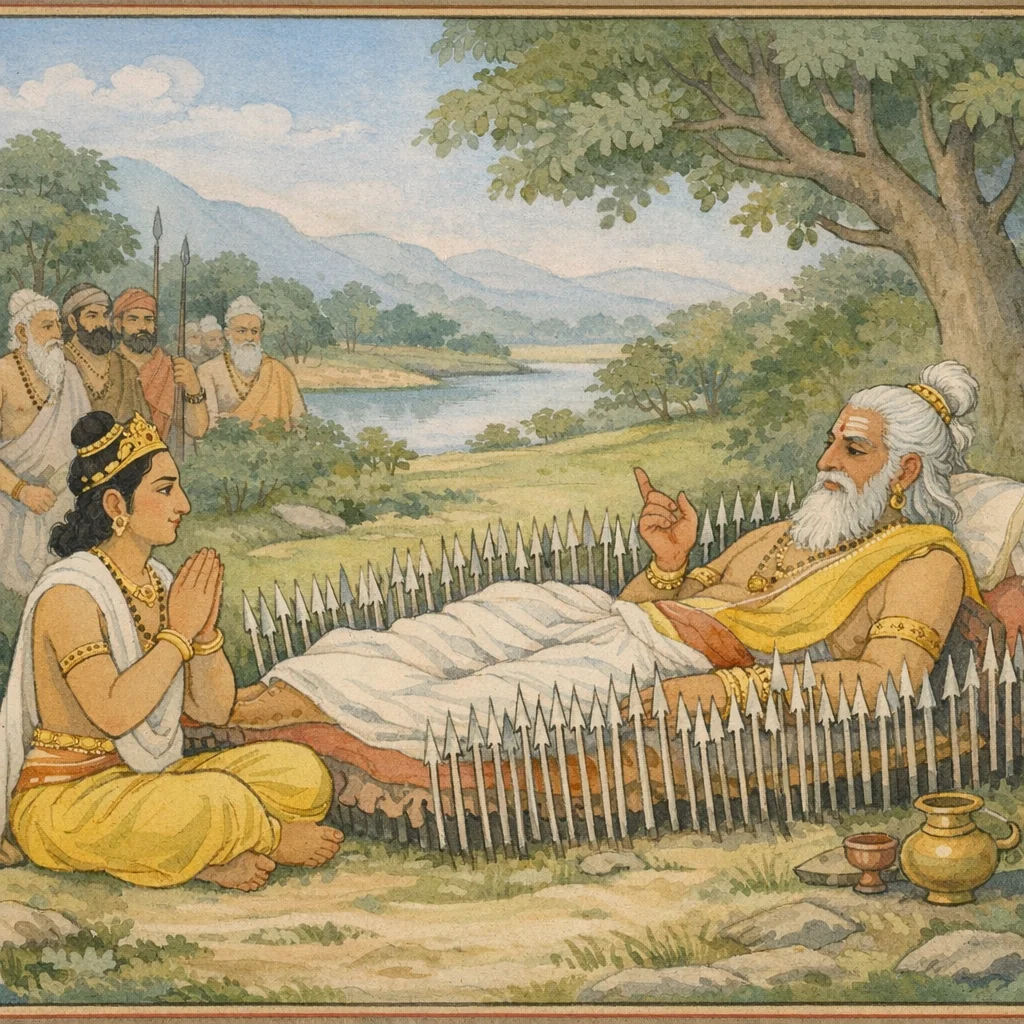
Vaiśampāyana said: Then, once again, Yudhiṣṭhira bowed in reverence to the grandsire Bhīṣma, the son of the Gaṅgā. With palms joined and his mind restrained and composed, he respectfully questioned him—seeking guidance on right conduct and the ordering of life.
Verse 2
के धर्मा: सर्ववर्णानां चातुर्वर्ण्यस्य के पृथक् चातुर्वर्ण्याश्रमाणां च राजधर्माश्व॒ के मता:,'पितामह! कौन-से ऐसे धर्म हैं, जो सभी वर्णोके लिये उपयोगी हो सकते हैं। चारों वर्णोंके पृथक्-पृथक् धर्म कौन-से हैं? चारों वर्णोके साथ ही चारों आश्रमोंके भी धर्म कौन हैं तथा राजाके द्वारा पालन करने योग्य कौन-कौन-से धर्म माने गये हैं?
Vaiśampāyana said: “O Grandsire, which duties are beneficial for all the social orders? What are the distinct duties of the four varṇas? What are the duties pertaining to the four varṇas together with the four āśramas? And which duties are regarded as the king’s dharma—those he must uphold in governance?”
Verse 3
केन वै वर्धते राष्ट्र राजा केन विवर्धते । केन पौराश्च भृत्याश्न वर्धन्ते भरतर्षभ,'राष्ट्रकी वृद्धि कैसे होती है, राजाका अभ्युदय किस उपायसे होता है? भरतश्रेष्ठ! पुरवासियों और भरण-पोषण करने योग्य सेवकोंकी उन्नति भी किस उपायसे होती है?
Vaiśampāyana said: “By what means does a kingdom truly prosper? By what means does a king rise to greater flourishing? And by what means do the townspeople and the dependents who are to be maintained also thrive, O bull among the Bharatas?”
Verse 4
कोशं दण्डं च दुर्ग च सहायान् मन्त्रिणस्तथा । ऋत्विक्पुरोहिताचार्यान् कीदृशान् वर्जयेन्नप:,“राजाको किस प्रकारके कोश, दण्ड, दुर्ग, सहायक, मन्त्री, ऋत्विकू, पुरोहित और आचार्योंका त्याग कर देना चाहिये?
Vaiśampāyana said: “What kind of treasury, coercive power (punishment/army), fortifications, allies, ministers, and what sort of officiating priests, royal chaplains, and teachers should a king renounce (i.e., avoid or dismiss)?”
Verse 5
केषु विश्वसितव्यं स्याद् राज्ञा कस्याज्चिदापदि । कुतो वा5>त्मा दृढं रक्ष्यस्तन्मे ब्रूहि पितामह,“पितामह! किसी आपत्तिके आनेपर राजाको किन लोगोंपर विश्वास करना चाहिये और किन लोगोंसे अपने शरीरकी दृढ़तापूर्वक रक्षा करनी चाहिये? यह मुझे बताइये'
Vaiśampāyana said: “Grandfather, when some calamity befalls a king, in whom should he place his trust? And from whom should he most firmly protect his own person? Tell me this.”
Verse 6
भीष्म उवाच नमो धर्माय महते नमः कृष्णाय वेधसे । ब्राह्मणेभ्यो नमस्कृत्य धर्मान् वक्ष्यामि शाश्वतान्,भीष्मजीने कहा--महान् धर्मको नमस्कार है, विश्वविधाता श्रीकृष्णको नमस्कार है। अब मैं उपस्थित ब्राह्मणोंको नमस्कार करके सनातन धर्मका वर्णन आरम्भ करता हूँ
Bhishma said: “Homage to the great Dharma; homage to Krishna, the Ordainer of the universe. Now, having bowed to the Brahmins, I shall begin to speak of the eternal laws of dharma.”
Verse 7
अक्रोध: सत्यवचनं संविभाग: क्षमा तथा । प्रजन: स्वेषु दारेषु शौचमद्रोह एव च,किसीपर क्रोध न करना, सत्य बोलना, धनको बाँटकर भोगना, क्षमाभाव रखना, अपनी ही पत्नीके गर्भसे संतान पैदा करना, बाहर-भीतरसे पवित्र रहना, किसीसे द्रोह न करना, सरलभाव रखना और भरण-पोषण के योग्य व्यक्तियोंका पालन करना--ये नौ सभी वर्णोंके लिये उपयोगी धर्म हैं। अब मैं केवल ब्राह्णका जो धर्म है, उसे बता रहा हूँ
Bhishma said: “Freedom from anger, truthfulness in speech, sharing one’s resources, and forbearance; begetting children only with one’s own lawful wife; purity outwardly and inwardly; and never bearing malice toward anyone—these are the (common) duties beneficial for all social orders.”
Verse 8
आर्जवं भृत्यभरणं नवैते सार्ववर्णिका: । ब्राह्मणस्य तु यो धर्मस्तं ते वक्ष्यामि केवलम्,किसीपर क्रोध न करना, सत्य बोलना, धनको बाँटकर भोगना, क्षमाभाव रखना, अपनी ही पत्नीके गर्भसे संतान पैदा करना, बाहर-भीतरसे पवित्र रहना, किसीसे द्रोह न करना, सरलभाव रखना और भरण-पोषण के योग्य व्यक्तियोंका पालन करना--ये नौ सभी वर्णोंके लिये उपयोगी धर्म हैं। अब मैं केवल ब्राह्णका जो धर्म है, उसे बता रहा हूँ
Bhishma said: “Straightforwardness and the duty of supporting those who depend on one—together with the other virtues—make nine forms of conduct beneficial to all social orders. Now, however, I shall declare to you the dharma that belongs specifically to the Brahmin alone.”
Verse 9
दममेव महाराज धर्ममाहु: पुरातनम् । स्वाध्यायाभ्यसनं चैव तत्र कर्म समाप्यते,महाराज! इन्द्रिय-संयमको ब्राह्मणोंका प्राचीन धर्म बताया गया है। इसके सिवा, उन्हें सदा वेद-शास्त्रोंका स्वाध्याय करना चाहिये; क्योंकि इसीसे उनके सब कर्मोकी पूर्ति हो जाती है
Bhishma said: “O great king, self-restraint alone is declared to be the ancient dharma. Along with that, constant practice of sacred study (svādhyāya) is enjoined; for by it a Brahmin’s duties find their completion.”
Verse 10
त॑ चेद् द्विजमुपागच्छेद् वर्तमानं स्वकर्मणि । अकुर्वाणं विकर्माणि शान्तं प्रज्ञानतर्पितम्
Bhīṣma said: “If one should approach a twice-born man who is steadily engaged in his own prescribed duty—who does not commit forbidden acts, who is tranquil, and whose mind is satisfied and nourished by wisdom—one should regard him as a worthy person to seek and learn from.”
Verse 11
कुर्वीतापत्यसंतानमथो दद्याद् यजेत च । संविभज्य च भोक्तव्यं धन॑ सद्धिरितीर्यते
Bhishma said: “One should beget and continue one’s lineage, one should give in charity, and one should perform sacrifices (yajña). Wealth, it is taught by the virtuous, is to be enjoyed only after sharing it—by distributing it rightly among others.”
Verse 12
यदि अपने वर्णोचित कर्ममें स्थित, शान्त और ज्ञान-विज्ञानसे तृप्त ब्राह्मणको किसी प्रकारके असत् कर्मका आश्रय लिये बिना ही धन प्राप्त हो जाय तो वह उस धनसे विवाह करके संतानकी उत्पत्ति करे अथवा उस धनको दान और यज्ञमें लगा दे। धनको बाँटकर ही भोगना चाहिये, ऐसा सत्पुरुषोंका कथन है ।। परिनिषितकार्यस्तु स्वाध्यायेनैव ब्राह्मण: । कुर्यादन्यन्न वा कुर्यान्मैत्रो ब्राह्मण उच्यते
Bhishma teaches that if a Brahmin, established in the duties proper to his order—tranquil and satisfied through knowledge and learning—should obtain wealth without resorting to any unrighteous act, then he should use that wealth either to marry and beget offspring, or to employ it in charity and sacrifice (yajña). The virtuous declare that wealth is to be enjoyed only after it has been shared. And the Brahmin who has duly completed his obligatory duties should be content with sacred study (svādhyāya) alone; whether he undertakes other worldly actions or refrains from them, such a steady, non-harming, well-disposed Brahmin is called ‘maitra’, a friend to all beings.
Verse 13
ब्राह्मण केवल वेदोंके स्वाध्यायसे ही कृतकृत्य हो जाता है। वह दूसरा कर्म करे या न करे। सब जीवोंके प्रति मैत्रीभाव रखनेके कारण वह मैत्र कहलाता है ।। क्षत्रियस्यापि यो धर्मस्तं ते वक्ष्यामि भारत । दद्याद् राजन् न याचेत यजेत न च याजयेत्,भरतनन्दन! क्षत्रियका भी जो धर्म है, वह तुम्हें बता रहा हूँ। राजन! क्षत्रिय दान तो करे, किंतु किसीसे याचना न करे; स्वयं यज्ञ करे, किंतु पुरोहित बनकर दूसरोंका यज्ञ न करावे
Bhishma said: “A brahmin becomes fulfilled simply through the self-study of the Vedas—whether he undertakes other works or not. Because he maintains a spirit of friendship toward all beings, he is called ‘maitra’ (one devoted to amity). Now, O Bharata, I shall also tell you the dharma of the kshatriya: O king, he should give in charity but not beg; he should perform sacrifices for himself, but he should not officiate as a priest conducting sacrifices for others.”
Verse 14
नाध्यापयेदधीयीत प्रजाश्न॒ परिपालयेत् । नित्योद्युक्तो दस्युवधे रणे कुर्यात् पराक्रमम्,वह अध्ययन करे, किंतु अध्यापक न बने, प्रजाजनोंका सब प्रकारसे पालन करता रहे। लुटेरों और डाकुओंका वध करनेके लिये सदा तैयार रहे। रणभूमिमें पराक्रम प्रकट करे
Bhishma said: “He should study, but not take up the role of a teacher. He should protect and maintain the people in every way. Ever ready to destroy robbers and bandits, he should display valor on the battlefield.”
Verse 15
ये तु क्रतुभिरीजाना: श्रुतवन्तश्न भूमिपा: । य एवाहवजेतारस्त एषां लोकजित्तमा:,इन राजाओंमें जो भूपाल बड़े-बड़े यज्ञ करनेवाले तथा वेदशास्त्रोंके ज्ञानसे सम्पन्न हैं और जो युद्धमें विजय प्राप्त करनेवाले हैं, वे ही पुण्यलोकोंपर विजय प्राप्त करनेवालोंमें उत्तम हैं
Among these kings, those lords of the earth who perform great sacrifices, who are endowed with knowledge of the Vedas and the shastras, and who are victors in war—those alone are the foremost among the conquerors of the worlds of merit.
Verse 16
अविक्षतेन देहेन समराद् यो निवर्तते । क्षत्रियो नास्य तत् कर्म प्रशंसन्ति पुराविद:,जो क्षत्रिय शरीरपर घाव हुए बिना ही समर-भूमिसे लौट आता है, उसके इस कर्मकी पुरातन धर्मको जाननेवाले विद्वान् प्रशंसा नहीं करते हैं
Bhishma said: “A kshatriya who turns back from the battlefield with his body unscarred—without having received any wound—wins no praise for that act from the wise who know the ancient dharma.”
Verse 17
एवं हि क्षत्रबन्धूनां मार्गमाहु: प्रधानतः । नास्य कृत्यतमं किंचिदन्यद् दस्युनिबर्हणात्,इस प्रकार युद्धको ही क्षत्रियोंके लिये प्रधान मार्ग बताया गया है, उसके लिये लुटेरोंके संहारसे बढ़कर दूसरा कोई श्रेष्ठतम कर्म नहीं है। यद्यपि दान, अध्ययन और यज्ञ--इनके अनुष्ठानसे भी राजाओंका कल्याण होता है, तथापि युद्ध उनके लिये सबसे बढ़कर है; अतः विशेषरूपसे धर्मकी इच्छा रखनेवाले राजाको सदा ही युद्धके लिये उद्यत रहना चाहिये
Bhishma said: “Indeed, for those of the kshatriya order, this is declared to be the foremost path: for him there is no duty more imperative than the suppression and destruction of robbers and lawless marauders. Though gifts, study, and sacrifice also bring welfare to kings, battle—undertaken for the protection of order—stands above all for them. Therefore, a king who especially desires dharma should always remain prepared for war.”
Verse 18
दानमध्ययन यज्ञो राज्ञां क्षेमो विधीयते । तस्माद् राज्ञा विशेषेण योद्धव्यं धर्ममीप्सता,इस प्रकार युद्धको ही क्षत्रियोंके लिये प्रधान मार्ग बताया गया है, उसके लिये लुटेरोंके संहारसे बढ़कर दूसरा कोई श्रेष्ठतम कर्म नहीं है। यद्यपि दान, अध्ययन और यज्ञ--इनके अनुष्ठानसे भी राजाओंका कल्याण होता है, तथापि युद्ध उनके लिये सबसे बढ़कर है; अतः विशेषरूपसे धर्मकी इच्छा रखनेवाले राजाको सदा ही युद्धके लिये उद्यत रहना चाहिये
Bhishma said: Charity, the study of sacred knowledge, and sacrifice are indeed prescribed as sources of welfare for kings. Yet for a ruler who seeks dharma, fighting—above all—is especially required; therefore a king intent on righteousness should be particularly prepared to wage war in the protection of order.
Verse 19
स्वेषु धर्मेष्ववस्थाप्य प्रजा: सर्वा महीपति: । धर्मेण सर्वकृत्यानि शमनिष्ठानि कारयेत्,राजा समस्त प्रजाओंको अपने-अपने धर्मोमें स्थापित करके उनके द्वारा शान्तिपूर्ण समस्त कर्मोंका धर्मके अनुसार अनुष्ठान करावे
Bhishma said: Having established all his subjects firmly in their respective duties, the king should, in accordance with dharma, cause every necessary undertaking to be carried out in a spirit of peace and restraint—so that public life proceeds through lawful, calming, and welfare-oriented action rather than coercion or disorder.
Verse 20
परिनिछितकार्यस्तु नृपति: परिपालनात् | कुर्यादन्यन्न वा कुयदिन्द्रो राजन्य उच्यते
Bhīṣma said: A king, having firmly determined what must be done, should act for the protection and proper governance of his realm. Whether he undertakes additional measures or refrains from them, he is called ‘Indra among kings’ when his rule is grounded in resolute duty and the safeguarding of his subjects.
Verse 21
राजा दूसरा कर्म करे या न करे, प्रजाकी रक्षा करने-मात्रसे वह कृतकृत्य हो जाता है। उसमें इन्द्र देवता-सम्बन्धी बलकी प्रधानता होनेसे राजा 'ऐन्द्र' कहलाता है ।। वैश्यस्यापि हि यो धर्मस्तं ते वक्ष्यामि शाश्वतम् | दानमध्ययनं यज्ञ: शौचेन धनसंचय:,अब वैश्यका जो सनातन धर्म है, वह तुम्हें बता रहा हूँ। दान, अध्ययन, यज्ञ और पवित्रतापूर्वक धनका संग्रह ये वैश्यके कर्म हैं
Bhishma said: “Whether a king does other deeds or not, by the protection of his subjects alone he becomes one whose duty is fulfilled. And because the Indra-like power is foremost in him, the king is called ‘Aindra’. Now I shall tell you the timeless duty of the Vaishya: charity, study of sacred knowledge, the performance of sacrifice, and the accumulation of wealth through purity and honest means—these are the proper works of the Vaishya.”
Verse 22
पितृवत् पालयेद् वैश्यो युक्त: सर्वान् पशूनिह । विकर्म तद् भवेदन्यत् कर्म यत् स समाचरेत्,वैश्य सदा उद्योगशील रहकर पुत्रोंकी रक्षा करनेवाले पिताके समान सब प्रकारके पशुओंका पालन करे। इन कर्मोंके सिवा वह और जो कुछ भी करेगा, वह उसके लिये विपरीत कर्म होगा
Bhishma said: The Vaishya, ever industrious and disciplined, should tend and protect all kinds of livestock like a father safeguarding his children. Any other work he undertakes beyond these duties becomes for him vikarma—action contrary to his proper calling.
Verse 23
रक्षया स हि तेषां वै महत् सुखमवाप्नुयात् प्रजापतिर्हि वैश्याय सृष्टवा परिददौ पशून्,पशुओंके पालनसे वैश्यको महान् सुखकी प्राप्ति हो सकती है। प्रजापतिने पशुओंकी सृष्टि करके उनके पालनका भार वैश्यको सौंप दिया था
Bhishma said: “By protecting them, he indeed attains great happiness. For Prajāpati, having created the cattle, entrusted them to the Vaiśya—placing upon him the responsibility of their care and protection.”
Verse 24
ब्राह्मणाय च राज्ञे च सर्वा: परिददे प्रजा: । तस्य वृत्तिं प्रवक्ष्यामि यच्च तस्योपजीवनम्,ब्राह्मण और राजाको उन्होंने सारी प्रजाके पोषणका भार सौंपा था। अब मैं वैश्यकी उस वृत्तिका वर्णन करूँगा, जिससे उसका जीवन-निर्वाह हो
Bhishma said: “To the Brahmin and to the king, all the subjects were entrusted for protection and maintenance. Now I shall explain the vocation of the Vaishya—what his proper livelihood is and by what means he sustains himself.”
Verse 25
षण्णामेकां पिबेद् धेनुं शताच्च मिथुन हरेत् । लब्धाच्च सप्तमं भागं तथा शृड्गे कलां खुरे,वैश्य यदि राजा या किसी दूसरेकी छः: दुधारू गौओंका एक वर्षतक पालन करे तो उनमेंसे एक गौका दूध वह स्वयं पीये (यही उसके लिये वेतन है)। यदि दूसरेकी एक सौ गौओंका वह पालन करे तो सालभरमें एक गाय और एक बैल मालिकसे वेतनके रूपमें ले ले। यदि उन पशुओंके दूध आदि बेचनेसे धन प्राप्त हो तो उसमें सातवाँ भाग वह अपने वेतनके रूपमें ग्रहण करे। सींग बेचनेसे जो धन मिले, उसमेंसे भी वह सातवाँ भाग ही ले; परंतु पशुविशेषका बहुमूल्य खुर बेचनेसे जो धन प्राप्त हो, उसका सोलहवाँ भाग ही उसे ग्रहण करना चाहिये
Bhishma said: If a man tends another’s six milch-cows for a year, he may drink the milk of one cow as his wage. If he tends a hundred cows, he may take, at the end of the year, a pair (a cow and a bull) as remuneration. If profit is obtained by selling milk and the like, he should take a seventh share as his wage; likewise, from the proceeds of selling horns he should take only a seventh. But from the sale of a particularly valuable hoof, he should take only a sixteenth. Thus the wage of a herdsman is to be fixed by fair proportion, avoiding greed and protecting the owner’s property while ensuring the worker’s livelihood.
Verse 26
सस्यानां सर्वबीजानामेषा सांवत्सरी भृति: । न च वैश्यस्य काम: स्यान्न रक्षेयं पशूनिति,दूसरेके अनाजकी फसलों तथा सब प्रकारके बीजोंकी रक्षा करनेपर वैश्यको उपजका सातवाँ भाग वेतनके रूपमें ग्रहण करना चाहिये। यह उसके लिये वार्षिक वेतन है। वैश्यके मनमें कभी यह संकल्प नहीं उठना चाहिये कि “मैं पशुओंका पालन नहीं करूँगा”
Bhishma said: “For guarding the crops and all kinds of seeds, this is the annual remuneration: the Vaiśya should take a seventh share of the produce as wages. And the Vaiśya should never entertain the desire, ‘I will not protect and tend the cattle.’”
Verse 27
वैश्ये चेच्छति नान्येन रक्षितव्या: कथंचन । शूद्रस्यापि हि यो धर्मस्तं ते वक्ष्यामि भारत,जबतक वैश्य पशुपालनका कार्य करना चाहे, तबतक मालिकको दूसरे किसीके द्वारा किसी तरह भी वह कार्य नहीं कराना चाहिये, भारत! अब मैं शूद्रका भी धर्म तुम्हें बता रहा हूँ
Bhishma said: “So long as a Vaiśya wishes to carry out the work of tending and protecting cattle, the owner should not, in any way, have that task done through someone else. O Bhārata, I shall now also tell you the duty (dharma) that pertains to the Śūdra.”
Verse 28
प्रजापतिर्हि वर्णानां दासं शूद्रमकल्पयत् । तस्माच्छुद्रस्य वर्णानां परिचर्या विधीयते,प्रजापतिने अन्य तीनों वर्णोके सेवकके रूपमें शूद्रकी सृष्टि की है; अतः शूद्रके लिये तीनों वर्णोकी सेवा ही शास्त्र-विहित कर्म है
Bhīṣma said: “For Prajāpati fashioned the Śūdra as the attendant of the other social orders. Therefore, for the Śūdra, service and attendance upon the other varṇas is laid down as the prescribed duty.”
Verse 29
तेषां शुश्रूषणाच्चैव महत् सुखमवाप्रुयात् । शूद्र एतान् परिचरेत् त्रीन् वर्णाननुपूर्वश:,वह उन तीनों वर्णोकी सेवासे ही महान् सुखका भागी हो सकता है। अतः शूद्र इन तीनों वर्णोंकी क्रमश: सेवा करे
Bhīṣma said: “By devoted attendance upon them, one attains great well-being. Therefore, a Śūdra should render service to these three varṇas—Brāhmaṇa, Kṣatriya, and Vaiśya—in due order.”
Verse 30
संचयांश्व न कुर्वीत जातु शूद्र: कथंचन । पापीयान् हि धनं लब्ध्वा वशे कुर्याद गरीयस:,शूद्रको कभी किसी प्रकार भी धनका संग्रह नहीं करना चाहिये; क्योंकि धन पाकर वह महान् पापमें प्रवृत्त हो जाता है और अपनेसे श्रेष्ठठटम पुरुषोंको भी अपने अधीन रखने लगता है
Bhīṣma said: “A Śūdra should never, in any manner, accumulate wealth; for, having obtained riches, he is said to become more inclined to wrongdoing and to seek to bring even those superior to him under his control.”
Verse 31
राज्ञा वा समनुज्ञात: काम॑ कुर्वीत धार्मिक: । तस्य वृत्तिं प्रवक्ष्यामि यच्च तस्योपजीवनम्,धर्मात्मा शूद्र राजाकी आज्ञा लेकर अपनी इच्छाके अनुसार कोई धार्मिक कृत्य कर सकता है। अब मैं उसकी वृत्तिका वर्णन करूँगा, जिससे उसकी आजीविका चल सकती है
Bhīṣma said: “Or, when duly permitted by the king, a righteous man may pursue his chosen undertaking. Now I shall describe his proper means of livelihood—the way by which he may sustain himself—so that his living remains aligned with dharma.”
Verse 32
अवश्यं भरणीयो हि वर्णानां शूद्र उच्यते । छत्र॑ वेष्टनमौशीरमुपानद् व्यजनानि च
Bhīṣma said: “Among the social orders, the Śūdra is described as one who must necessarily be employed in service and support. In this context, items such as an umbrella, a head-wrap, fragrant auśīra (vetiver), footwear, and fans are also mentioned.”
Verse 33
यातयामानि देयानि शूद्राय परिचारिणे । तीनों वर्णोकी शूद्रका भरण-पोषण अवश्य करना चाहिये; क्योंकि वह भरण-पोषण करने योग्य कहा गया है। अपनी सेवामें रहनेवाले शूद्रको उपभोगमें लाये हुए छाते, पगड़ी, अनुलेपन, जूते और पंखे देने चाहिये || ३२ ई ।। अधार्याणि विशीर्णानि वसनानि द्विजातिभि:
Bhishma said: “To a Śūdra who serves in one’s household, one should give what has already been used—things fit to be passed on. Worn-out garments, no longer proper for the twice-born (dvija) to wear, should be given to the attendant Śūdra.”
Verse 34
यं च कज्चिद् द्विजातीनां शूद्र: शुश्रूषुराव्रजेत्
Bhīṣma said: “And if any Śūdra, intent on respectful service, should approach one of the twice-born (Brāhmaṇa, Kṣatriya, or Vaiśya)…”
Verse 35
देय: पिण्डो5नपत्याय भर्तव्यौ वृद्धदुर्बली,यदि स्वामी संतानहीन हो तो सेवा करनेवाले शूद्रको ही उसके लिये पिण्डदान करना चाहिये। यदि स्वामी बूढ़ा या दुर्बल हो तो उसका सब प्रकारसे भरण-पोषण करना चाहिये। किसी आप त्तिमें भी शूद्रकों अपने स्वामीका परित्याग नहीं करना चाहिये। यदि स्वामीके धनका नाश हो जाय तो शूद्रको अपने कुट॒म्बके पालनसे बचे हुए धनके द्वारा उसका भरण- पोषण करना चाहिये
Bhīṣma said: “For a master who has no offspring, the funeral offering (piṇḍa) should be given. If the master is aged or infirm, he must be supported and cared for in every way. Even in times of distress, a Śūdra who serves should not abandon his master. And if the master’s wealth is lost, the Śūdra should maintain him with whatever remains after providing for his own household.”
Verse 36
शूद्रेण तु न हातव्यो भर्ता कस्याज्चिदापदि । अतिरेकेण भर्तव्यो भर्ता द्रव्यपरिक्षये,यदि स्वामी संतानहीन हो तो सेवा करनेवाले शूद्रको ही उसके लिये पिण्डदान करना चाहिये। यदि स्वामी बूढ़ा या दुर्बल हो तो उसका सब प्रकारसे भरण-पोषण करना चाहिये। किसी आप त्तिमें भी शूद्रकों अपने स्वामीका परित्याग नहीं करना चाहिये। यदि स्वामीके धनका नाश हो जाय तो शूद्रको अपने कुट॒म्बके पालनसे बचे हुए धनके द्वारा उसका भरण- पोषण करना चाहिये
Bhīṣma said: “Even in times of distress, a Śūdra should not abandon or harm his master. Rather, when circumstances demand it—especially when the master’s wealth has been exhausted—he should support and maintain him with special care.”
Verse 37
न हि स्वमस्ति शूद्रस्य भर्तृहार्यधनो हि सः । उक्तस्त्रयाणां वर्णानां यज्ञस्तस्य च भारत । स्वाहाकारवषट्कारीौ मन्त्र: शूद्रे न विद्यते,शूद्रका अपना कोई धन नहीं होता। उसके सारे धनपर उसके स्वामीका ही अधिकार होता है। भरतनन्दन! यज्ञका अनुष्ठान तीनों वर्णों तथा शूद्रके लिये भी आवश्यक बताया गया है। शूद्रके यज्ञमें स््वाहाकार, वषट्कार तथा वैदिक मन्त्रोंका प्रयोग नहीं होता है
Bhishma said: “A Śūdra has no independent property; indeed, his wealth is held to be liable to the claim of his master. O Bharata, sacrifice (yajña) is enjoined for the three higher social orders—and it is also spoken of for him; yet in the Śūdra’s rite there is no use of the Vedic mantra, nor the ritual exclamations ‘svāhā’ and ‘vaṣaṭ.’”
Verse 38
तस्माच्छूद्र: पाकयज्जैर्यजेताव्रतवान् स्वयम् । पूर्णपात्रमयीमाहु: पाकयज्ञस्य दक्षिणाम्,अतः शूद्र स्वयं वैदिक व्रतोंकी दीक्षा न लेकर पाकयज्ञों (बलिवैश्वदेव आदि) द्वारा यजन करे। पाकयज्ञकी दक्षिणा पूर्णपात्रमयी- बतायी गयी है
Bhishma said: Therefore, a Shudra, without undertaking the formal initiations of Vedic vows, should worship by his own effort through the household pākayajñas (such as bali-offerings and the vaiśvadeva rite). The proper dakṣiṇā for a pākayajña, they say, is a “full vessel”—a complete and fitting gift, offered with sincerity. The moral is that one should follow the form of religious duty suited to one’s eligibility, while sustaining generosity and reverence through domestic rites.
Verse 39
शूद्र: पैजवनो नाम सहस्राणां शतं ददौ | ऐन्द्राग्नेन विधानेन दक्षिणामिति न: श्रुतम्,हमने सुना है कि पैजवन नामक शाद्रने ऐन्द्राग्न यज्ञकी विधिसे मन्त्रहीन यज्ञका अनुष्ठान करके उसकी दक्षिणाके रूपमें एक लाख पूर्णपात्र दान किये थे
Bhishma said: “We have heard that a Shudra named Paijavana gave a hundred thousand as sacrificial fees, bestowed according to the rite connected with Indra and Agni.” The saying shows that moral worth is measured by generosity and by adherence to prescribed duty in sacrifice, not merely by social rank.
Verse 40
यतो हि सर्ववर्णानां यज्ञस्तस्यैव भारत । अग्रे सर्वेषु यज्ञेषु श्रद्धायज्ञो विधीयते,भरतनन्दन! ब्राह्मण आदि तीनों वर्णोंका जो यज्ञ है वह सब सेवाकार्य करनेके कारण शूद्रका भी है ही (उसे भी उसका फल मिलता ही है; अतः उसे पृथक यज्ञ करनेकी आवश्यकता नहीं है)। सम्पूर्ण यज्ञोंमें पहले श्रद्धारूप यज्ञका ही विधान है
Bhishma said: “O Bharata, the sacrificial duty of all the social orders ultimately rests upon that very principle—service and support. Therefore, among all sacrifices, the sacrifice that consists of faith is enjoined first. Since the sacrifices performed by the three higher orders are sustained by the Shudra’s service-work, their merit reaches him as well; hence he need not undertake a separate sacrificial rite. In every sacrifice, faith is prescribed as the foremost offering.”
Verse 41
दैवतं हि महच्छुद्धा पवित्र यजतां च यत् । दैवतं हि परं विप्रा: स्वेन स्वेन परस्परम्
Bhishma said: “O pure ones, that which is great and sanctifying—worthy of being honored by those who perform sacrifices—is truly ‘the divine.’ Indeed, O Brahmins, the highest divinity for each of you is found in one another, each in his own way.”
Verse 42
क्योंकि श्रद्धा सबसे बड़ा देवता है। वही यज्ञ करने-वालोंको पवित्र करती है। ब्राह्मण साक्षात् यज्ञ करानेके कारण परम देवता माने गये हैं। सभी वर्णोके लोग अपने-अपने कर्मद्वारा एक-दूसरेके यज्ञोंमें सहायक होते हैं ।। अयजजन्नरिह सत्रैस्ते तैस्तै: कामै: समाहिता: । संसृष्टा ब्राह्मणैरेव त्रिषु वर्णेषु सृष्टय:
Bhishma explains that in this world faith (śraddhā) is the greatest divinity, for it purifies those who sacrifice. Brahmins are regarded as the highest sacred power because they directly preside over and accomplish the yajña. All social orders aid one another’s sacrifices through their respective works. People undertake satra-yajñas, each intent on particular aims and desires; yet these rites are properly constituted only through association with Brahmins, for the social orders are established and sustained through the Brahmins’ ritual and sacred function. The moral is that religious action and social cooperation depend on right guidance and mutual support among the varṇas, with Brahmins serving as indispensable ritual mediators.
Verse 43
सभी वर्णके लोगोंने यहाँ यज्ञोंका अनुष्ठान किया है और उनके द्वारा वे मनोवाञ्छित फलोंसे सम्पन्न हुए हैं। ब्राह्मणोंने ही तीनों वर्णोकी संतानोंकी सृष्टि की है ।। देवानामपि ये देवा यद् ब्रूयुस्ते परं हितम् । तस्माद् वर्ण: सर्वयज्ञा: संसृज्यन्ते न काम्यया,जो देवताओंके भी देवता हैं, वे ब्राह्मण जो कुछ कहें, वही सबके लिये परम हितकारक है; अतः अन्य वर्णोके लोग ब्राह्मणोंके बताये अनुसार ही सब यज्ञोंका अनुष्ठान करें, अपनी इच्छासे न करें
Bhishma said: Here, people of all the social orders have performed sacrifices, and through those rites they have attained the fruits they desired. It is the Brahmins who have brought forth the progeny of the three orders. Those Brahmins—who are, as it were, ‘gods even of the gods’—whatever they declare is the highest good for all. Therefore the other orders should undertake every sacrifice in accordance with what the Brahmins prescribe, not merely according to personal desire.
Verse 44
ऋग्यजु:सामवित् पूज्यो नित्यं स्थाद् देववद् द्विज: । अनृग्यजुरसामा च प्राजापत्य उपद्रव: । यज्ञों मनीषया तात सर्ववर्णेषु भारत,ऋतक्, साम और यजुर्वेदका ज्ञाता ब्राह्मण सदा देवताके समान पूजनीय है। दास या शूद्र ऋक, यजु और सामके ज्ञानसे शून्य होता है; तो भी वह “प्राजापत्य” (प्रजापतिका भक्त) कहा गया है। तात! भरतनन्दन! मानसिक संकल्पद्वारा जो भावनात्मक यज्ञ होता है, उसमें सभी वर्णोका अधिकार है
Bhishma said: “A twice-born man who knows the Ṛg, Yajus, and Sāman should always be honored—revered like a deity. Even one who lacks the knowledge of Ṛg, Yajus, and Sāman—such as a servant or a Śūdra—may still be called ‘Prājāpatya,’ a devotee aligned with Prajāpati. O dear one, O descendant of Bharata: the sacrifice performed inwardly through intention and understanding—the mental offering—belongs to all social orders.”
Verse 45
नास्य यज्ञकृतो देवा ईहन्ते नेतरे जना: । ततः सर्वेषु वर्णेषु श्रद्धायज्ञो विधीयते,इस मानसिक यज्ञ करनेवाले यजमानके यज्ञमें देवता और मनुष्य सभी भाग ग्रहण करनेकी अभिलाषा रखते हैं; क्योंकि उसका यज्ञ श्रद्धाके कारण परम पवित्र होता है; अतः श्रद्धाप्रधान यज्ञ करनेका अधिकार सभी वर्णोंको प्राप्त है
Bhīṣma said: The gods do not seek a share in the sacrifice of one who performs no sacrifice, nor do other people. Therefore, in all social orders, the sacrifice grounded in faith is enjoined—because a rite performed with sincere śraddhā becomes supremely purifying, drawing the participation and goodwill of both divine and human beings. Hence, the right to perform a faith-centered (inner) sacrifice belongs to all varṇas.
Verse 46
स्वं दैवतं ब्राह्मण: स्वेन नित्यं परान् वर्णानयजन्नैवमासीत् | अधरो वितान: संसृष्टो वैश्यो ब्राह्मणस्त्रिषु वर्णेषु यज्ञसृष्ट:,ब्राह्मण अपने कर्मोंद्वारा ही सदा दूसरे वर्णोके लिये अपने-अपने देवताके समान है; अतः वह दूसरे वर्णोका यज्ञ न करता हो, ऐसी बात नहीं है। जिस यज्ञमें वैश्य आचार्य आदिके रूपमें कार्य कर रहा हो, वह निकृष्ट माना गया है। विधाताने केवल ब्राह्मणको ही तीनों वर्णोंका यज्ञ करानेके लिये उत्पन्न किया है
Bhishma said: By his own ordained duties, the Brahmin is ever, for the other social orders, like their very deity; therefore it is not the case that he does not perform sacrifice on behalf of the other orders. A sacrifice in which a Vaiśya is mixed in as the officiant (such as ācārya and the like) is regarded as inferior. The Ordainer created the Brahmin specifically to conduct sacrifices for the three orders.
Verse 47
तस्माद् वर्णा ऋजवो ज्ञातिवर्णा: संसृज्यन्ते तस्य विकार एव । एकं साम यजुरेकमृगेका विप्रश्नैको निश्चये तेषु सृष्ट:,विधाता एकमात्र ब्राह्मणसे ही अन्य तीन वर्णोकी सृष्टि करते हैं, अतः शेष तीन वर्ण भी ब्राह्यणके समान ही सरल तथा उनके जाति-भाई या कुटुम्बी हैं। क्षत्रिय आदि तीनों वर्ण ब्राह्मणगकी संतान ही हैं। जैसे ऋक्ू, यजु:ः और साम एकमात्र अकारसे ही प्रकट होनेके कारण परस्पर अभिन्न हैं, उसी प्रकार उन सभी वर्णोमें तत्त्वका निश्चय किया जाय तो एकमात्र ब्राह्मण ही उन सबके रूपमें प्रकट हुआ है, अतः ब्राह्मणके साथ सबकी अभिन्नता है
Bhīṣma said: Therefore the social orders are straightforward and are, in truth, kin to one another; they are produced as transformations of that single source. Just as Sāman, Yajus, and Ṛk are each traced back to one underlying principle and are not essentially separate, so too—when one inquires into their reality and decides their true nature—one finds a single foundational essence manifesting as all the varṇas. Hence, their deepest identity is one, and the divisions are secondary to the shared origin.
Verse 48
अत्र गाथा यज्ञगीता: कीर्तयन्ति पुराविद: | वैखानसानां राजेन्द्र मुनीनां यट्टमिच्छताम्,राजेन्द्र! प्राचीन बातोंको जाननेवाले विद्वान् इस विषयमें यज्ञकी अभिलाषा रखनेवाले वैखानस मुनियोंकी कही हुई एक गाथाका उल्लेख किया करते हैं, जो यज्ञके सम्बन्धमें गायी गयी है
Here, O Rajendra, the sages who know the lore of old recite a gāthā sung concerning yajña—a verse spoken by the Vaikhānasa munis who long for sacrifice.
Verse 49
उदितेडनुदिते वापि श्रद्धधानो जितेन्द्रिय: । वह्निं जुहोति धर्मेण श्रद्धा वै कारणं महत्,'सूर्यके उदय होनेपर अथवा सूर्योदयसे पहले ही श्रद्धालु एवं जितेन्द्रिय मनुष्य जो धर्मके अनुसार अग्निमें आहुति देता है, उसमें श्रद्धा ही प्रधान हेतु है
Bhīṣma said: Whether at sunrise or even before the sun has risen, when a self-controlled and faithful person offers oblations into the sacred fire in accordance with dharma, it is faith (śraddhā) that stands as the chief and decisive cause behind the rite’s true efficacy.
Verse 50
यत् स्कन्नमस्य तत् पूर्व यदस्कन्नं तदुत्तरम् | बहूनि यज्ञरूपाणि नानाकर्मफलानि च,(बह्वृच ब्राह्मणमें सोलह प्रकारके अग्निहोत्र बताये गये हैं) होताका किया हुआ जो हवन वायुदेवताके उद्देश्यसे होता है, वह स्कन्नसंज्ञक होम प्रथम है और उससे भिन्न जो स्कन्नसंज्ञक होम है, वह अन्तिम या सबसे उत्कृष्ट है। इसी प्रकार रौद्र आदि बहुत-से यज्ञ हैं, जो नाना प्रकारके कर्मफल देनेवाले हैं
Bhīṣma said: “That offering in this rite which is called ‘skanna’ is the earlier (preliminary) one; and that which is ‘askanna’ comes later (as the subsequent or culminating offering). In this way there are many forms of sacrifice, and they yield many different fruits according to the actions and intentions involved.”
Verse 51
तानि यः सम्प्रजानाति ज्ञाननिश्चयनिश्षित: । द्विजाति: श्रद्धयोपेत: स यह्टूं पुरुषो5रहति
Bhīṣma said: The person who clearly understands those matters, whose conviction is sharpened by settled knowledge, and who is a twice-born endowed with faith—such a man is fit to perform sacrifice.
Verse 52
उन षोडश प्रकारके अग्निहोत्रोंकोी जो जानता है, वही यज्ञ-सम्बन्धी निश्चयात्मक ज्ञानसे सम्पन्न है। ऐसा ज्ञानी एवं श्रद्धालु द्विज ही यज्ञ करनेका अधिकारी है ।। स्तेनो वा यदि वा पापो यदि वा पापकृत्तम: | यट्टुमिच्छति यज्ञं यः साधुमेव वदन्ति तम्,यदि कोई चोर हो, पापी हो अथवा पापाचारियोंमें भी सबसे महान् हो तो भी जो यज्ञ करना चाहता है, उसे सभी लोग 'साधु” ही कहते हैं
Bhishma said: Only the one who truly understands the sixteen forms of the Agnihotra possesses firm, decisive knowledge concerning sacrifice; such a learned and faithful twice-born alone is fit to perform a yajña. Even if a man is a thief, or sinful, or the worst among wrongdoers, if he sincerely wishes to offer a sacrifice, people still speak of him as a ‘good man’—for the very intention to turn toward sacred duty is treated as a movement toward virtue.
Verse 53
ऋषयस्तं प्रशंसन्ति साधु चैतदसंशयम् । सर्वथा सर्वदा वर्णर्यष्टव्यमिति निर्णय:,ऋषि भी उसकी प्रशंसा करते हैं। यह यज्ञ-कर्म श्रेष्ठ है, इसमें कोई संदेह नहीं है; अतः सभी वर्णके लोगोंको सदा सब प्रकारसे यज्ञ करना चाहिये, यही शास्त्रोंका निर्णय है
Bhishma said: “The sages praise this, and rightly so—there is no doubt about it. Therefore, in every way and at all times, people of all social orders should perform sacrifice; this is the settled conclusion of the scriptures.”
Verse 54
न हि यज्ञसमं किज्वचित् त्रिषु लोकेषु विद्यते । तस्माद् यष्टव्यमित्याहु: पुरुषेणानसूयता । श्रद्धापवित्रमाश्रित्य यथाशक्ति यथेच्छया,तीनों लोकोंमें यज्ञके समान कुछ भी नहीं है; इसलिये मनुष्यको दोषदृष्टिका परित्याग करके शास्त्रीय विधिका आश्रय ले अपनी शक्ति और इच्छाके अनुसार उत्तम श्रद्धापूर्वक यज्ञका अनुष्ठान करना चाहिये, ऐसा मनीषी पुरुषोंका कथन है
Bhishma said: “In the three worlds there is nothing equal to sacrifice (yajña). Therefore, the wise declare that a person should perform sacrifice—free from fault-finding and envy—relying on the purifying power of faith, and undertaking it according to one’s capacity and one’s chosen intent.”
Verse 60
इति श्रीमहाभारते शान्तिपर्वणि राजधर्मानुशासनपर्वणि वर्णाश्रमधर्मकथने षष्टितमो5 ध्याय:,इस प्रकार श्रीमह्ाा भारत शान्तिपर्वके अन्तर्गत राजधर्मानुशासनपर्वमें वर्णाश्रमधर्मका वर्णनविषयक साठवाँ अध्याय पूरा हुआ
Thus, in the Śrī Mahābhārata, within the Śānti Parva—specifically in the section on the instruction of royal duty—ends the sixtieth chapter, whose subject is the exposition of the duties of the social orders and stages of life (varṇa and āśrama).
Verse 336
शूद्रायैव प्रदेयानि तस्य धर्मधनं हि तत् । फटे-पुराने कपड़े, जो अपने धारण करने योग्य न रहें, वे द्विजातियोंद्वारा शूद्रको ही दे देने योग्य हैं; क्योंकि धर्मतः वे सब वस्तुएँ शूद्रकी ही सम्पत्ति हैं
Bhishma says that such items should be given only to a Śūdra, for by the rule of dharma they are regarded as his rightful property. In ethical terms, what is no longer fit for a twice-born person’s use—such as worn or torn garments—should not be hoarded or misused, but transferred as a duty-bound act of giving to one for whom it is deemed appropriate and beneficial.
Verse 343
कल्प्यां तेन तु ते प्राहुर्वृत्ति धर्मविदो जना: । द्विजातियोंमेंसे जिस किसीकी सेवा करनेके लिये कोई शूद्र आवे, उसीको उसकी जीविकाकी व्यवस्था करनी चाहिये; ऐसा धर्मज्ञ पुरुषोंका कथन है
Bhīṣma said: The learned authorities on dharma declare that one should duly provide the means of livelihood for that person—especially a Śūdra—who comes to render service to a twice-born (dvija). In this way, service is to be met with responsible maintenance, aligning social duty with ethical care.
Frequently Asked Questions
The implicit dilemma is how to balance social obligations (family support, ritual duties, hospitality) with the aspiration for inner freedom—resolved by presenting staged duties where restraint and detachment can intensify over time.
The chapter advises disciplined household life—truth, regulated conduct, generosity, and attentiveness to duties—as a rigorous ethical practice, while also legitimizing later transitions toward greater austerity and non-attachment.
Yes. It associates purified performance of āśrama duties—especially restraint, equanimity, and disciplined living—with attaining a higher, stable spiritual state (often expressed as reaching the imperishable, akṣara-oriented goal).