Adhyaya 172
Ajagara-vrata (The ‘Python’ Discipline): Prahrāda Questions a Wandering Sage
Upa-parva: Mokṣa-dharma (Liberation Teachings) — Ajagara-vrata / Prahrāda–Ājagara Saṃvāda Context
Yudhiṣṭhira asks Bhīṣma how one may live on earth free of grief and attain the highest end. Bhīṣma responds with an ancient narrative: Prahrāda encounters a wandering brāhmaṇa-sage whose demeanor is calm, self-restrained, and oddly childlike in detachment. Prahrāda observes that the sage neither pursues gain nor laments loss, appears unshaken amid social currents, and remains disengaged from the ordinary triad of dharma–artha–kāma as commonly practiced. Pressed to explain his learning and conduct, the sage describes a worldview formed by observing origination and dissolution across beings—decline, growth, and death as universal and time-bound—thereby avoiding elation or distress. He accepts food, shelter, and clothing as they arrive by chance (yadṛcchā), without refusal of what is proper and without craving for what is rare. This is formulated as ajagara-vrata: steady, fear-reduced, anger- and greed-attenuated, with regulated senses, minimal accumulation, and a witness-like mind that sees pleasure and pain as law-governed outcomes. Bhīṣma concludes that one who follows this discipline with subdued attachment lives happily in the world.
Chapter Arc: आपद्धर्म की कठोर भूमि पर कथा एक ऐसे ब्राह्मण-रूपधारी के सामने खुलती है, जो पूछे जाने पर गोत्र-शाखा का नाम तो बताता है, पर ब्रह्मतेज और स्वाध्याय की दीप्ति से रिक्त दिखता है—मानो धर्म का आवरण, पर धर्म का प्राण नहीं। → राक्षसराज उससे निवास, कुल और आचरण पूछकर भय-रहित होने का आश्वासन देता है; पर प्रश्नोत्तर में ही संकेत उभरता है कि यह ‘द्विज’ केवल गोत्रमात्र-विद है। उधर कृतध्न भीतर-ही-भीतर प्राणरक्षा का उपाय खोजता है और अवसरवाद की ओर झुकता है—‘अब किस उपाय से जीवित रहूँ?’ → कृतध्न का मन निर्णायक रूप से हिंसा/छल की ओर मुड़ता है: वह ‘बकपति’ के पीछे पड़े महान् मांस-राशि को देखकर उसे मारकर छीन लेने का संकल्प करता है—आपद्धर्म के नाम पर अधर्म का तीक्ष्णतम मोड़। → कथा-धारा यह दिखाती है कि बाह्य ब्राह्मण-चिह्न, गोत्र-उच्चारण और दान-भोज की चमक (आषाढ़-माघ पूर्णिमा के सत्कार, स्वर्ण-रजत-मणि-मौक्तिक का वितरण) भी तब निष्फल है जब भीतर कृतज्ञता, सत्य और संयम न हों; कृतध्न का ‘उपाय’ वस्तुतः पतन का द्वार बनता है। → कृतध्न जिस पर आक्रमण का निश्चय करता है, उस ‘बकपति’ के साथ अगला टकराव क्या रूप लेगा—क्या वह दंड पाएगा या आपत्ति का बहाना उसे और गहरा गिराएगा?
Shlokas
Verse 1
इस प्रकार श्रीमह्याभारत शान्तिपर्वके अन्तर्गत आपद्धर्मपर्वमें कृतध्नका उपाख्यानविषयक एक सौ सत्तरवाँ अध्याय पूरा हुआ ॥/ १७० ॥/ अपन का छा | अत---#करत एकसप्तत्याधिकशततमो< ध्याय: गौतमका राक्षसराजके यहाँसे सुवर्णणशि लेकर लौटना और अपने मित्र बकके वधका घृणित विचार मनमें लाना भीष्म उवाच ततः स विदितो राज्ञ: प्रविश्य गृहमुत्तमम् । पूजितो राक्षसेन्द्रेण निषसादासनोत्तमे,भीष्मजी कहते हैं--राजन्! तदनन्तर राजाको उसके आगमनकी सूचना दी गयी और वह उनके उत्तम भवनमें प्रविष्ट हुआ। वहाँ राक्षसराजने उसका विधिवत् पूजन किया। तत्पश्चात् वह एक उत्तम आसनपर विराजमान हुआ
Bhishma said: Thereafter, the king was informed of his arrival, and the visitor entered the king’s splendid residence. The lord of the Rakshasas received him with due honor, and then he sat upon an excellent seat. The episode underscores the outward observance of hospitality and protocol—an ethical surface that may conceal darker intentions soon to unfold in the narrative.
Verse 2
पृष्टश्न गोत्रचरणं स्वाध्यायं ब्रह्मचारिकम् । न तत्र व्याजहारान्यद् गोत्रमात्रादृते द्विज:,विरूपाक्षने गौतमसे उसके गोत्र, शाखा और ब्रह्मचर्य-पालनपूर्वक किये गये स्वाध्यायके विषयमें प्रश्न किया; परंतु उसने गोत्र (जाति)-के सिवा और कुछ नहीं बताया
Bhishma said: When he was questioned about his lineage, his Vedic branch and discipline, and about the self-study he had pursued while observing brahmacarya, the twice-born man disclosed nothing there except his lineage alone. (Thus, he withheld further particulars of his learning and conduct.)
Verse 3
ब्रह्मवर्चसहीनस्य स्वाध्यायोपरतस्य च । गोत्रमात्रविदो राजा निवासं समपृच्छत,तब ब्राह्मणोचित तेजसे हीन, स्वाध्यायसे उपरत, केवल गोत्र अथवा जातिका नाम जाननेवाले उस ब्राह्मणसे राजाने उसका निवासस्थान पूछा
Bhīṣma said: The king questioned about the residence of a Brahmin who lacked the radiance born of sacred learning, had ceased his Vedic study, and knew only his lineage-name. The scene underscores that mere birth-identification without discipline and learning is an empty credential, and that true Brahminical worth is measured by conduct, study, and inner lustre rather than by gotra alone.
Verse 4
राक्षस उवाच क्व ते निवास: कल्याण किंगोत्रा ब्राह्मणी च ते । तच्त्वं ब्रूहि न भी: कार्या विश्वसस्व यथासुखम्,राक्षसराज बोले--भद्र! तुम्हारा निवास कहाँ है? तुम्हारी पत्नी किस गोत्रकी कन्या है? यह सब ठीक-ठीक बताओ। भय न करो। मुझपर विश्वास करो और सुखसे रहो
The Rākṣasa said: “Auspicious one, where is your dwelling? And of what lineage (gotra) is your Brāhmaṇa wife? Tell me all this accurately. Do not be afraid—place your trust in me and remain at ease.”
Verse 5
गौतम उवाच मध्यदेशप्रसूतो5हं वासो मे शबरालये । शूद्रा पुनर्भूर्भार्या मे सत्यमेतद् ब्रवीमि ते,गौतमने कहा--राक्षसराज! मेरा जन्म तो हुआ है मध्यदेशमें, किंतु मैं एक भीलके घरमें रहता हूँ। मेरी स्त्री शूद्र जातिकी है और मुझसे पहले दूसरेकी पत्नी रह चुकी है। यह बात मैं आपसे सत्य ही कहता हूँ
Gautama said: “I was born in the Madhyadeśa, yet I dwell in the home of a Śabara. My wife is a Śūdra woman, and she has been married before. I tell you this truthfully.”
Verse 6
भीष्म उवाच ततो राजा विममृशे कथं कार्यमिदं भवेत् । कथं वा सुकृतं मे स्यथादिति बुद्धयान्वचिन्तयत्,भीष्मजी कहते हैं--युधिष्ठि! यह सुनकर राक्षसराज मन-ही-मन विचार करने लगे कि अब किस तरह काम करना चाहिये? कैसे मुझे पुण्य प्राप्त हो सकता है? इस प्रकार उन्होंने बारंबार बुद्धि लगाकर सोचा और विचारा
Bhishma said: Then the king reflected to himself, “How should this task now be carried out? And how may merit accrue to me?” Thus, applying his mind again and again, he pondered and deliberated—seeking a course of action aligned with righteous gain rather than mere success.
Verse 7
अयं वै जन्मना विप्र: सुहृत् तस्य महात्मन: । सम्प्रेषितश्न॒ तेनायं काश्यपेन ममान्तिकम्,वे मन ही-मन कहने लगे, “यह केवल जन्मसे ही ब्राह्मण है; परंतु महात्मा राजधर्माका सुहृद् है। उन कश्यपकुमारने ही इसे यहाँ मेरे पास भेजा है; अतः उनका प्रिय कार्य अवश्य करूँगा। वह सदा मुझपर भरोसा रखता है और मेरा भाई, बान्धव तथा हार्दिक मित्र भी है
Bhishma said: “This man is a brahmin only by birth; yet he is the trusted well-wisher of that great-souled one. It is that Kāśyapa who has sent him here to me. Therefore I shall certainly accomplish what is dear to him.”
Verse 8
तस्य प्रियं करिष्यामि स हि मामाश्रित: सदा । भ्राता मे बान्धवश्चासौ सखा च हृदयज्भम:,वे मन ही-मन कहने लगे, “यह केवल जन्मसे ही ब्राह्मण है; परंतु महात्मा राजधर्माका सुहृद् है। उन कश्यपकुमारने ही इसे यहाँ मेरे पास भेजा है; अतः उनका प्रिय कार्य अवश्य करूँगा। वह सदा मुझपर भरोसा रखता है और मेरा भाई, बान्धव तथा हार्दिक मित्र भी है
Bhishma said: “I will do what is dear to him, for he has always relied upon me. He is my brother, my kinsman, and a friend who is close to my heart.”
Verse 9
कार्तिक्यामद्य भोक्तार: सहस्र मे द्विजोत्तमा: । तत्रायमपि भोक्ता च देयमस्मै च मे धनम्
Bhīṣma said: “Today, on the Kārtikī observance, a thousand eminent brāhmaṇas are to be fed by me. Let this man also be included among the diners there; and from my own wealth, a gift should be given to him as well.”
Verse 10
स चाद्य दिवस: पुण्यो हतिथिश्चायमागतः । संकल्पितं चैव धनं कि विचार्यमत: परम्
Bhīṣma said: “This day is auspicious, and this fitting lunar date has arrived. The wealth has already been resolved upon (set aside by intention); what more is there to deliberate beyond this?”
Verse 11
“आज कार्तिककी पूर्णिमा है। आजके दिन सहसों श्रेष्ठ ब्राह्मण मेरे यहाँ भोजन करेंगे। उन्हींमें यह भी भोजन कर लेगा, उन्हींके साथ इसे भी धन देना चाहिये। आज पुण्य दिवस है, यह ब्राह्मण अतिथिरूपसे यहाँ आया है और मैंने धन दान करनेका संकल्प कर ही रक््खा है। अब इसके बाद क्या विचार करना है?' ।। ततः सहस्र॑ विप्राणां विदुषां समलंकृतम् । सस््नातानामनुसम्प्राप्तं सुमहत् क्षौमवाससाम्,तदनन्तर भोजनके समय हजारों विद्वान ब्राह्मण स्नान करके रेशमी वस्त्र और अलंकार धारण किये वहाँ आ पहुँचे
Bhishma said: “Today is the full-moon day of Kartika. On this day, thousands of eminent Brahmins will dine in my house. Let this man also eat among them; and along with them, wealth should be given to him as well. Today is a holy day; this Brahmin has come here in the form of a guest, and I have already resolved to give a gift of wealth. What is there left to deliberate after this?” Then, at the time of the meal, a great assembly of a thousand learned Brahmins arrived—having bathed, adorned with ornaments, and wearing fine linen garments.
Verse 12
तानागतान् द्विजश्रेष्ठान् विरूपाक्षो विशाम्पते । यथा प्रतिजग्राह विधिदृष्टेन कर्मणा,प्रजानाथ! विरूपाक्षने वहाँ पधारे हुए जन श्रेष्ठ ब्राह्मणोंका शास्त्रीय विधिके अनुसार यथायोग्य स्वागत-सत्कार किया
Bhishma said: O lord of the people, Virupaksha received those eminent Brahmins who had arrived, welcoming and honoring them in the proper manner, performing the rites exactly as prescribed by sacred rule.
Verse 13
बस्यस्तेषां तु संन्यस्ता राक्षसेन्द्रस्य शासनात् । भूमौ वरकुशा: स्तीर्णा: प्रेष्यर्भरतसत्तम,भरतश्रेष्ठ! राक्षसराजकी आज्ञासे सेवकोंने जमीनपर उनके लिये कुशके सुन्दर आसन बिछा दिये
Bhīṣma said: “Then, by the command of the lord of the Rākṣasas, the attendants spread fine kuśa-grass seats upon the ground for them.”
Verse 14
तासु ते पूजिता राज्ञा निषण्णा द्विजसत्तमा: । तिलदर्भोदकेनाथ अर्चिता विधिवद् द्विजा:,राजाके द्वारा सम्मानित वे श्रेष्ठ ब्राह्मण जब उन आसनोंपर विराजमान हो गये तब विरूपाक्षने तिल, कुश और जल लेकर उनका विधिवत् पूजन किया
Bhishma said: When those foremost Brahmins, having been honored by the king, had taken their seats upon those seats, then Virūpākṣa, taking sesame, kuśa-grass, and water, worshipped those Brahmins in due ritual form.
Verse 15
विश्वलेदेवा: सपितर: साग्नयश्नोपकल्पिता: । विलिप्ता: पुष्पवन्तश्न सुप्रचारा: सुपूजिता: । व्यराजन्त महाराज नक्षत्रपतयो यथा,उनमें विश्वेदेवों, पितरों तथा अग्निदेवकी भावना करके उन सबको चन्दन लगाया, फ़ूलोंकी मालाएँ पहनायीं और सुन्दर रीतिसे उनकी पूजा की। महाराज! उन आसनोंपर बैठकर वे ब्राह्मण चन्द्रमाकी भाँति शोभा पाने लगे
Bhīṣma said: “O King, those Brāhmaṇas were duly attended to as embodiments of the Viśvedevas, the Pitṛs, and Agni. They were anointed with sandal paste, adorned with garlands of flowers, and worshipped with proper rites. Seated upon their appointed seats, they shone with splendour—like the lords of the stars (the Moon) in the night sky.”
Verse 16
ततो जाम्बूनदी: पात्रीर्वजाड़का विमला: शुभा: । वरान्नपूर्णा विप्रेभ्य: प्रादान्मधुघृतप्लुता:,तत्पश्चात् उसने हीरोंसे जड़ी हुई सोनेकी स्वच्छ सुन्दर थालियोंमें घीसे बने हुए मीठे पकवान परोसकर उन ब्राह्मणोंके आगे रख दिये
Then he presented to the brāhmaṇas spotless, auspicious trays of Jāmbūnada-gold, inlaid with diamonds, filled with choice foods—sweetmeats prepared with ghee and drenched in honey and clarified butter—thus honoring them through lavish hospitality and reverent giving.
Verse 17
तस्य नित्यं सदा5<षाढ्यां माघ्यां च बहवो द्विजा: । ईप्सितं भोजनवरं लभन्ते सत्कृतं सदा,उसके यहाँ आषाढ़ और माघकी पूर्णिमाको सदा बहुत-से ब्राह्मण सत्कारपूर्वक अपनी इच्छाके अनुसार उत्तम भोजन पाते थे
Bhishma said: At his house, on the full-moon days of Āṣāḍha and Māgha, many Brahmins would regularly receive, with respectful hospitality, excellent food exactly as they desired. The passage highlights the ethical ideal of steady generosity—timely, reverent giving to worthy recipients as a lived expression of dharma.
Verse 18
विशेषतस्तु कार्तिक्यां द्विजेभ्य: सम्प्रयच्छति । शरद् व्यपाये रत्नानि पौर्णमास्यामिति श्रुति:,विशेषत:ः कार्तिककी पूर्णिमाको, जब कि शरद्-ऋतुकी समाप्ति होती है, वह ब्राह्मणोंको रत्नोंका दान करता था; ऐसा सुननेमें आया है
Bhishma said: It is especially said that on the full-moon day of Kārtika—when the autumn season is passing away—he would bestow jewels as gifts upon the twice-born (Brahmins). Such is the tradition heard of in sacred report.
Verse 19
सुवर्ण रजतं चैव मणीनथ च मौक्तिकान्,भारत! भोजनके पश्चात् ब्राह्मणोंके समक्ष बहुत-से सोने, चाँदी, मणि, मोती, बहुमूल्य हीरे, वैदूर्यमणि, रंकुमृगके चर्म तथा रत्नोंके कई ढेर लगाकर महाबली विरूपाक्षने उन श्रेष्ठ ब्राह्मणोंसे कहा--'द्विजवरो! आपलोग अपनी इच्छा और उत्साहके अनुसार इन रत्नोंको उठा ले जायेँ और जिनमें आपलोगोंने भोजन किया है, उन पात्रोंको भी अपने घर लेते जाये
Bhishma said: “O Bharata! After the meal, the mighty Virupaksha piled up before the Brahmins many heaps of gold and silver, gems and pearls—along with costly diamonds, vaidurya stones, the hide of the rangu deer, and other treasures. Then he addressed those excellent Brahmins: ‘Best of the twice-born! Take these jewels away according to your own wish and zeal; and also carry to your homes the very vessels from which you have eaten.’”
Verse 20
वज्ान् महाधनांश्वैव वैदूर्याजिनराड्कवान् । रत्नराशीन् विनिक्षिप्य दक्षिणार्थे स भारत,भारत! भोजनके पश्चात् ब्राह्मणोंके समक्ष बहुत-से सोने, चाँदी, मणि, मोती, बहुमूल्य हीरे, वैदूर्यमणि, रंकुमृगके चर्म तथा रत्नोंके कई ढेर लगाकर महाबली विरूपाक्षने उन श्रेष्ठ ब्राह्मणोंसे कहा--'द्विजवरो! आपलोग अपनी इच्छा और उत्साहके अनुसार इन रत्नोंको उठा ले जायेँ और जिनमें आपलोगोंने भोजन किया है, उन पात्रोंको भी अपने घर लेते जाये
Bhīṣma said: “O Bhārata, after setting aside heaps of jewels as a priestly gift (dakṣiṇā)—including diamonds, great treasures, vaidūrya gems, and even valuable hides—he arranged these riches to be given away.” The passage highlights the ethic of honoring learned Brāhmaṇas after hospitality, and the ideal of using wealth as a means of dharma through generous, respectful giving.
Verse 21
भारत! भोजनके पश्चात् ब्राह्मणोंके समक्ष बहुत-से सोने, चाँदी, मणि, मोती, बहुमूल्य हीरे, वैदूर्यमणि, रंकुमृगके चर्म तथा रत्नोंके कई ढेर लगाकर महाबली विरूपाक्षने उन श्रेष्ठ ब्राह्मणोंसे कहा--'द्विजवरो! आपलोग अपनी इच्छा और उत्साहके अनुसार इन रत्नोंको उठा ले जायेँ और जिनमें आपलोगोंने भोजन किया है, उन पात्रोंको भी अपने घर लेते जाये
Bhishma said: “O Bharata! After the meal, the mighty Virupaksha heaped before the Brahmanas piles of gold, silver, gems, pearls, precious diamonds, vaidurya-stones, the hide of the ranku-deer, and many other treasures. Then he addressed those eminent Brahmanas: ‘O best of the twice-born! Take these jewels according to your own wish and zeal, and also carry home the vessels in which you have dined.’”
Verse 22
येषु येषु च भाण्डेषु भुक्त वो द्विजसत्तमा: । तान्येवादाय गच्छथ्वं स्ववेश्मानीति भारत,भारत! भोजनके पश्चात् ब्राह्मणोंके समक्ष बहुत-से सोने, चाँदी, मणि, मोती, बहुमूल्य हीरे, वैदूर्यमणि, रंकुमृगके चर्म तथा रत्नोंके कई ढेर लगाकर महाबली विरूपाक्षने उन श्रेष्ठ ब्राह्मणोंसे कहा--'द्विजवरो! आपलोग अपनी इच्छा और उत्साहके अनुसार इन रत्नोंको उठा ले जायेँ और जिनमें आपलोगोंने भोजन किया है, उन पात्रोंको भी अपने घर लेते जाये
Bhishma said: “O best of Brahmins, in whatever vessels you have eaten, take those very vessels with you and depart to your own homes, O Bharata.”
Verse 23
इत्युक्तवचने तस्मिन् राक्षसेन्द्रे महात्मनि । यथेष्टं तानि रत्नानि जग॒हुब्रह्मिणर्षभा:,उन महात्मा राक्षसराजके ऐसा कहनेपर उन ब्राह्मणोंने इच्छानुसार उन सब रत्नोंको ले लिया
Bhishma said: When that great-souled lord of the Rakshasas had spoken thus, the bull-like Brahmins took those jewels as they pleased.
Verse 24
ततो महारहैस्ते सर्वे रत्नैरभ्यर्चिता: शुभै: । ब्राह्मणा मृष्टवसना: सुप्रीता: सम ततो5भवन्
Bhishma said: Then all those Brāhmaṇas were honored with auspicious, exceedingly precious jewels. Clad in clean and fine garments, they became fully pleased and thereafter were in a state of contentment.
Verse 25
तत्पश्चात् उन सुन्दर एवं महामूल्यवान् रत्नोंद्वारा पूजित हुए वे सभी उज्ज्वल वस्त्रधारी ब्राह्मण बड़े प्रसन्न हुए ।। ततस्तान् राक्षसेन्द्रश्न द्विजानाह पुनर्वच: । नानादेशगतान् राजन् राक्षसान् प्रतिषिध्य वै,राजन! इसके बाद राक्षसराज विख्ूपाक्षने नाना देशोंसे आये हुए राक्षसोंको हिंसा करनेसे रोककर उन ब्राह्मणोंसे कहा--“'विप्रगण! आज एक दिनके लिये आपलोगोंको राक्षमोंकी ओरसे कहीं कोई भय नहीं है; अतः: आनन्द कीजिये और शीघ्र ही अपने अभीष्ट स्थानको चले जाइये। विलम्ब न कीजिये”
Bhishma said: Thereafter, those Brahmins—clad in bright garments—having been honored with beautiful and exceedingly precious jewels, became greatly delighted. Then the lord of the Rakshasas, having restrained the Rakshasas who had come from many lands, addressed the Brahmins again: “O venerable Brahmins, for this one day you shall have no fear anywhere from the Rakshasas. Therefore rejoice, and quickly go to the place you desire. Do not delay.”
Verse 26
अद्यैक॑ दिवसं विप्रा न वो5स्तीह भयं क्वचित् | राक्षसे भ्य: प्रमोदध्वमिष्टतो यात माचिरम्,राजन! इसके बाद राक्षसराज विख्ूपाक्षने नाना देशोंसे आये हुए राक्षसोंको हिंसा करनेसे रोककर उन ब्राह्मणोंसे कहा--“'विप्रगण! आज एक दिनके लिये आपलोगोंको राक्षमोंकी ओरसे कहीं कोई भय नहीं है; अतः: आनन्द कीजिये और शीघ्र ही अपने अभीष्ट स्थानको चले जाइये। विलम्ब न कीजिये”
Bhishma said: “O brahmins, for today—this one day—there is no fear for you here from the rākṣasas at any place. Therefore rejoice, and go quickly to the destination you desire. Do not delay, O king.”
Verse 27
ततः प्रदुद्रुवु: सर्वे विप्रसंघा: समनन््ततः । गौतमो<पि सुवर्णस्य भारमादाय सत्वर:,यह सुनकर सब ब्राह्मणसमुदाय चारों ओर भाग चले। गौतम भी सुवर्णका भारी भार लेकर बड़ी कठिनाईसे ढोता हुआ जल्दी-जल्दी चलकर बरगदके पास आया। वहाँ पहुँचते ही थककर बैठ गया। वह भूखसे पीड़ित और क्लान्त हो रहा था
Bhīṣma said: Thereupon all the groups of brāhmaṇas fled in every direction. Gautama too, quickly taking up the heavy load of gold, hurried along; burdened and strained, he made his way toward the banyan tree. Reaching it, he sat down exhausted—afflicted by hunger and overcome with fatigue.
Verse 28
कृच्छात् समुद्धरन् भार न्यग्रोधं समुपागमत् । न्यषीदच्च परिश्रान्तः क्लान्तश्न क्षुधितश्न॒ सः,यह सुनकर सब ब्राह्मणसमुदाय चारों ओर भाग चले। गौतम भी सुवर्णका भारी भार लेकर बड़ी कठिनाईसे ढोता हुआ जल्दी-जल्दी चलकर बरगदके पास आया। वहाँ पहुँचते ही थककर बैठ गया। वह भूखसे पीड़ित और क्लान्त हो रहा था
With great difficulty, bearing the heavy load, he reached the banyan tree. Arriving there, he sat down, utterly exhausted—worn out and tormented by hunger.
Verse 29
ततः प्राह द्विजश्रेष्ठान विरूपाक्षो महाबल: । गृह्नीत रत्नान्येतानि यथोत्साहं यथेष्टत:,ततस्तमध्यगाद् राजन् राजधर्मा खगोत्तम: । स्वागतेनाभिनन्दंक्ष गौतम॑ मित्रवत्सल: राजन! तत्पश्चात् पक्षियोंमें श्रेष्ठ मित्रवत्सल राजधर्मा गौतमके पास आया और स्वागतपूर्वक उसका अभिनन्दन किया
Bhishma said: “Then the mighty Virūpākṣa addressed the foremost of the twice-born: ‘Accept these jewels—according to your capacity and as you desire.’ After that, O King, Rājadharmā, the best of birds and affectionate to friends, approached Gautama and greeted him with due hospitality, honoring him warmly.”
Verse 30
तस्य पक्षाग्रविक्षेपै: क्लमं व्यपनयत् खगः । पूजां चाप्यकरोद् धीमान् भोजनं चाप्यकल्पयत्,उस बुद्धिमान पक्षीने अपने पंखोंके अग्रभागका संचालन करके उसे हवा की और उसकी सारी थकावट दूर कर दी; फिर उसका पूजन किया तथा उसके लिये भोजनकी व्यवस्था की
Bhishma said: By fanning him with the tips of his wings, the bird dispelled his weariness with a cooling breeze. Then that wise creature honored him with due reverence and also arranged food for him.
Verse 31
स भुक्तवान् सुविश्रान्तो गौतमो5चिन्तयत् तदा । हाटकस्याभिरूपस्य भारो5यं सुमहान् मया
Having eaten and then rested well, Gautama reflected at that time: “This is a very great burden upon me—this splendid mass of gold.”
Verse 32
गृहीतो लोभमोहाशभ्यां दूरं च गमनं मम । न चास्ति पथि भोक्तव्यं प्राणसंधारणं मम
Bhīṣma said: “I have been seized by greed, delusion, and hope, and so my journey has carried me far. Yet on this road there is nothing for me to consume—nothing by which I might sustain my life.”
Verse 33
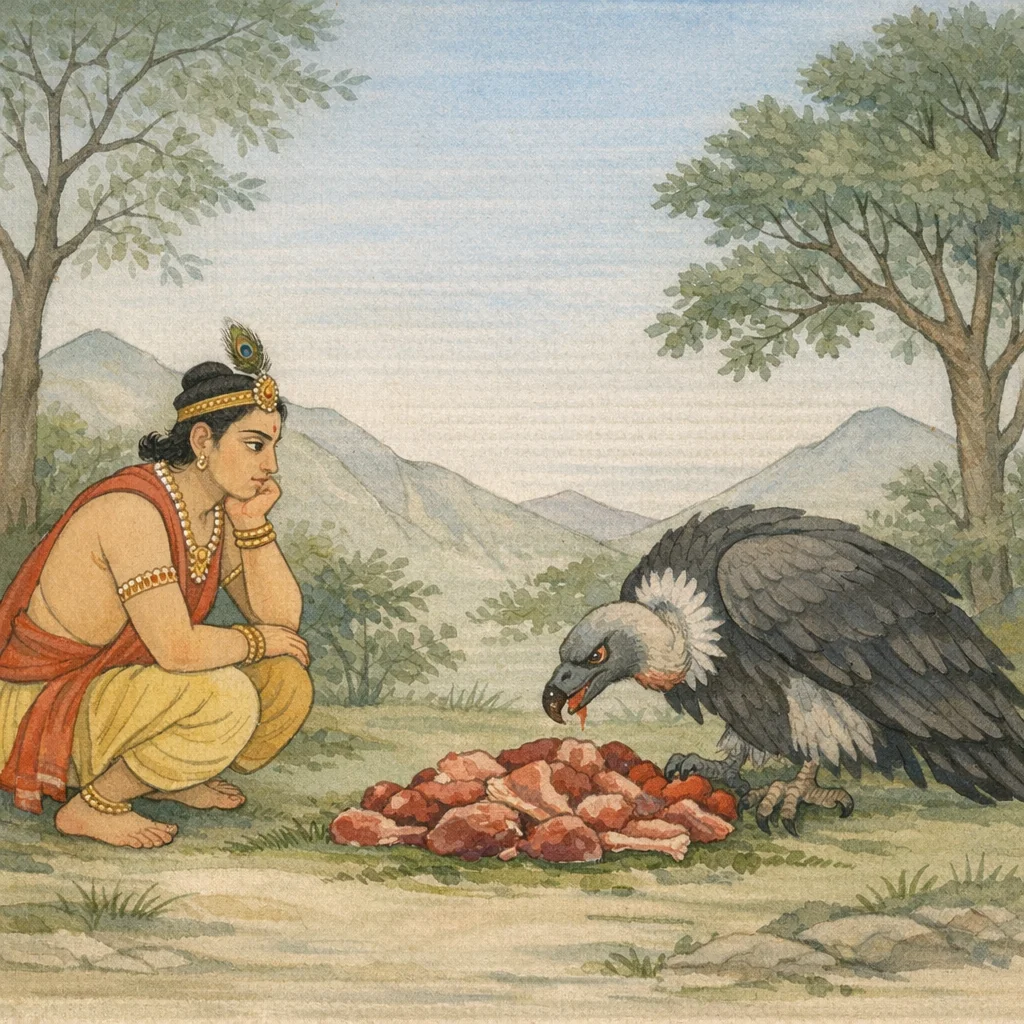
भोजन करके विश्राम कर लेनेपर गौतम इस प्रकार चिन्ता करने लगा--“अहो! मैंने लोभ और मोहसे प्रेरित होकर सुन्दर सुवर्णका यह महान् भार ले लिया है। अभी मुझे बहुत दूर जाना है। रास्तेमें खानेके लिये कुछ भी नहीं है, जिससे मेरे प्राणोंकी रक्षा हो सके ।। कि कृत्वा धारयेयं वै प्राणानित्यभ्यचिन्तयत् । ततः स पथि भोक्तवयं प्रेक्षमाणो न किंचन,“अब मैं कौन-सा उपाय करके अपने प्राणोंको धारण कर सकूँगा?' इस प्रकारकी चिन्तामें वह मग्न हो गया। पुरुषसिंह! तदनन्तर मार्गमें भोजनके लिये कुछ भी न देखकर उस कृतघ्नने मन-ही-मन इस प्रकार विचार किया--'यह बगुलोंका राजा राजधर्मा मेरे पास ही तो है। यह मांसका एक बहुत बड़ा ढेर है। इसीको मारकर ले लूँ और शीचघ्रतापूर्वक यहाँसे चल दूँ”
After eating and then taking rest, Gautama began to brood: “Alas! Driven by greed and delusion I have taken up this splendid but heavy load of gold. I still have a long way to go, and on the road there is nothing to eat by which I might preserve my life. By what means can I keep my life-breaths?” Thus he worried. Then, seeing nothing edible along the way, that ungrateful man reflected inwardly: “The king of herons, Rājadharmā, is right here with me. He is a great heap of meat. I will kill him, take him, and quickly depart from here.”
Verse 34
कृतध्न: पुरुषव्याप्र मनसेदमचिन्तयत् । अयं बकपति: पाश्चे मांसराशि: स्थितो महान्,“अब मैं कौन-सा उपाय करके अपने प्राणोंको धारण कर सकूँगा?' इस प्रकारकी चिन्तामें वह मग्न हो गया। पुरुषसिंह! तदनन्तर मार्गमें भोजनके लिये कुछ भी न देखकर उस कृतघ्नने मन-ही-मन इस प्रकार विचार किया--'यह बगुलोंका राजा राजधर्मा मेरे पास ही तो है। यह मांसका एक बहुत बड़ा ढेर है। इसीको मारकर ले लूँ और शीचघ्रतापूर्वक यहाँसे चल दूँ”
Bhishma said: “O tiger among men, that ungrateful man reflected in his mind: ‘This king of herons is right here beside me—like a great heap of flesh. What means can I adopt to keep myself alive? I shall kill him, take him as food, and quickly depart from this place.’ Thus, seeing no other food on the road, he became absorbed in such self-serving thoughts.”
Verse 35
इमं हत्वा गृहीत्वा च यास्ये5हं समभिद्रुतम्,“अब मैं कौन-सा उपाय करके अपने प्राणोंको धारण कर सकूँगा?' इस प्रकारकी चिन्तामें वह मग्न हो गया। पुरुषसिंह! तदनन्तर मार्गमें भोजनके लिये कुछ भी न देखकर उस कृतघ्नने मन-ही-मन इस प्रकार विचार किया--'यह बगुलोंका राजा राजधर्मा मेरे पास ही तो है। यह मांसका एक बहुत बड़ा ढेर है। इसीको मारकर ले लूँ और शीचघ्रतापूर्वक यहाँसे चल दूँ”
Bhīṣma said: “Having killed this one and seized it, I shall depart at once, quickly.” Thus, overwhelmed by anxious thought—‘By what means can I now preserve my life?’—the ungrateful man, seeing no food on the road, reflected inwardly: ‘The king of herons, Rājadharmā, is right here with me. He is a great heap of flesh. I will kill him, take him, and swiftly leave this place.’
Verse 171
इति श्रीमहाभारते शान्तिपर्वणि आपद्धर्मपर्वणि कृतघ्नोपाख्याने एकसप्तत्यधिकशततमो<ध्याय:
Thus ends the one-hundred-and-seventy-second chapter of the Śānti Parva of the Śrī Mahābhārata, within the section on conduct in times of distress (Āpaddharma), in the episode known as the ‘Tale of the Ungrateful.’
Frequently Asked Questions
The dilemma is practical and ethical: how to live responsibly in the world while remaining free from grief—i.e., how to relate to success/failure, pleasure/pain, and social change without being driven by craving or aversion.
By repeatedly contemplating universal impermanence and the inevitability of separation, one cultivates steadiness; accepting appropriate provisions as they arise (without hoarding or refusal) supports a disciplined equanimity identified as ajagara-vrata.
A concluding evaluative statement functions as outcome-claim: Bhīṣma asserts that a person who follows ajagara-like conduct with reduced attachment, fear, anger, greed, and delusion ‘lives happily’—positioning the discipline as conducive to peace and the highest good.