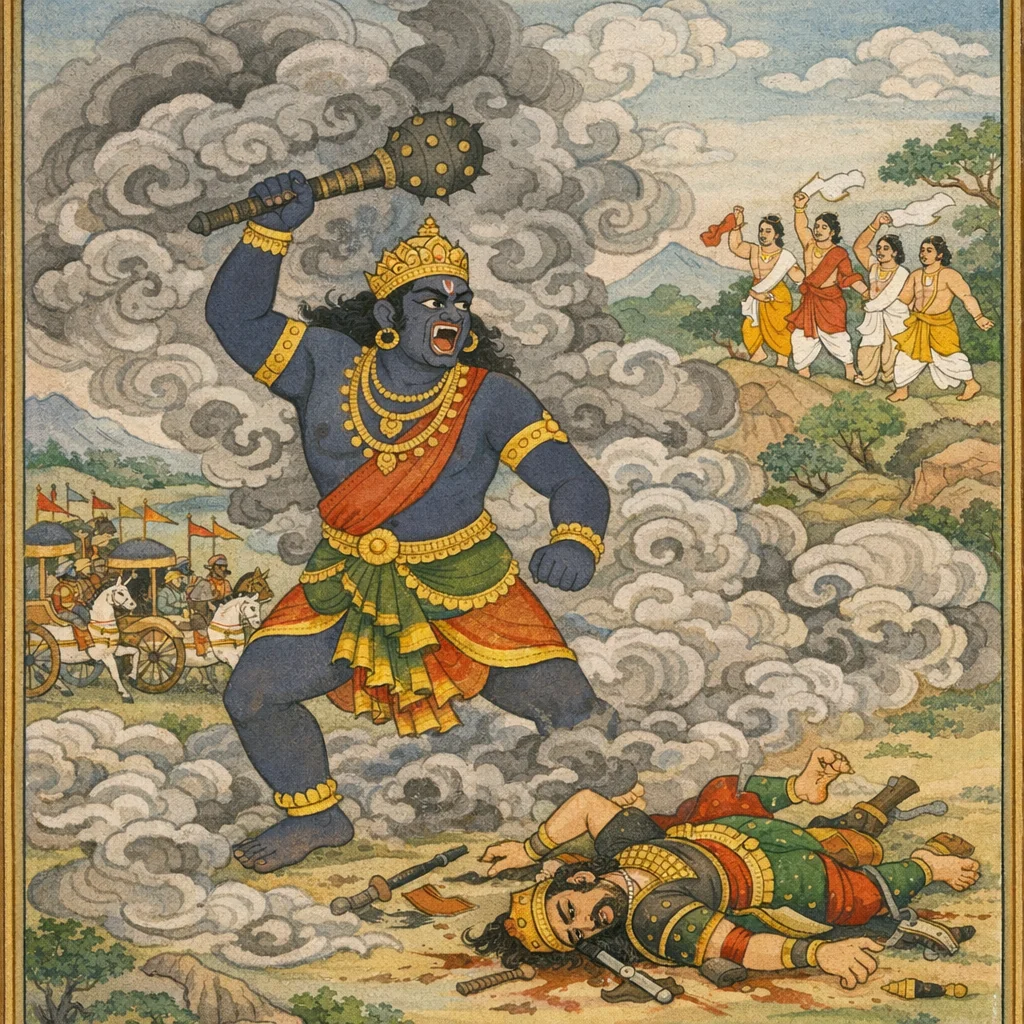
Adhyaya 111
कर्णभीमसेनयुद्धम् | Karṇa–Bhīmasena Engagement (Chapter 111)
Upa-parva: Karna–Bhīmasena Saṃgrāma (Combat Episode within Droṇa-parva)
Saṃjaya reports that Karṇa, seeing Dhṛtarāṣṭra’s sons fallen, is overtaken by intense anger and a life-weariness, interpreting his situation as culpable or stained. He rushes Bhīmasena and opens with a volley, which Bhīma answers by rejecting the derisive display and striking Karṇa heavily, including severing Karṇa’s bow. Karṇa re-arms and attempts to overwhelm Bhīma with arrow-cover; Bhīma retaliates by killing Karṇa’s horses and charioteer and cutting down the bow again, forcing Karṇa to dismount and throw a mace, which Bhīma checks with arrows. Bhīma then releases a large barrage; Karṇa parries and succeeds in dislodging Bhīma’s armor, then pins him with additional shots. Bhīma counters by piercing Karṇa’s armor and right arm; observing Karṇa on foot and pressed, Duryodhana orders his sons to bring a replacement chariot. Several named sons advance but Bhīma rapidly fells them along with their chariot-standards and attendants. Karṇa, seeing them slain, enters a state of distress, then mounts a newly prepared chariot and re-engages. The chapter closes with both heroes exchanging dense arrow-storms, described through vivid similes (flowering trees, serpents shedding skins, elephants in contest, thundercloud and mountain), while the Kaurava princes witness Bhīma’s valor, strength, and composure.
Chapter Arc: संजय धृतराष्ट्र से कहते हैं—रणभूमि में निर्भय विचरते हुए अलम्बुष को देखकर घटोत्कच उसके सामने आ खड़ा होता है; राक्षस-वीरों का यह सामना मानो दो प्रलयकारी शक्तियों का टकराव है। → दोनों ‘राक्षससिंह’ विविध मायाओं का प्रयोग करते हैं—इन्द्र और शम्बरासुर के युद्ध की भाँति छल, रूप-परिवर्तन, भ्रम और भीषण प्रहारों से रणक्षेत्र काँप उठता है। अलम्बुष क्रोध में घटोत्कच पर आघात करता है; प्रत्युत्तर में घटोत्कच रथ-समूहों पर उल्काओं-से बाण-वर्षा कर चारों ओर आतंक फैला देता है। महानाद से पृथ्वी कम्पित होती है और सेनाएँ भय-हर्ष के बीच डगमगाती हैं। → घोर विद्ध होने पर भी घटोत्कच अपनी राक्षसी शक्ति समेटकर निर्णायक प्रहार करता है—अलम्बुष (शालकटंकट-पुत्र) के अंग-प्रत्यंग विदीर्ण हो जाते हैं, अस्थियाँ चूर-चूर होती हैं और वह रणभूमि में ढह पड़ता है। घटोत्कच बलासुर-वध के बाद इन्द्र की भाँति सिंहनाद करता है। → अलम्बुष-वध से पाण्डव-सेना में हर्ष की लहर दौड़ती है—कुन्ती-पुत्र सिंहनाद करते हैं, वस्त्र उछालते हैं और रणक्षेत्र में उत्साह का घोष फैलता है। घटोत्कच की उपस्थिति से कौरव-पक्ष में भय और पाण्डव-पक्ष में संबल दृढ़ होता है। → घटोत्कच क्रुद्ध होकर समस्त सेनाओं को भयभीत करता हुआ आगे बढ़ता है—उसकी रात्रिचर-शक्ति के सामने कौरव-नीति अब कौन-सा प्रतिकार रचेगी?
Shlokas
Verse 1
ऑपन--माज बछ। असि<-छऋाल जा नवाधिकशततमो<्ध्याय: घटोत्कचद्वारा अलम्बुषका वध और पाण्डव-सेनामें हर्ष- ध्वनि संजय उवाच अलनम्बुषं तथा युद्धे विचरन्तमभीतवत् । हैडिम्बि: प्रययौ तूर्ण विव्याध निशितै: शरै:,संजय कहते हैं--राजन! युद्धमें इस प्रकार निर्भय-से विचरते हुए अलम्बुषके पास हिडिम्बाकुमार घटोत्कच बड़े वेगसे जा पहुँचा और उसे अपने तीखे बाणोंद्वारा बींधने लगा
Sañjaya said: O King, as Alambuṣa moved about the battlefield in that fearless manner, the son of Hiḍimbā—Ghaṭotkaca—rushed swiftly toward him and began to pierce him with sharp arrows.
Verse 2
तयो: प्रतिभयं युद्धमासीद् राक्षससिंहयो: । कुर्वतोर्विविधा माया: शक्रशम्बरयोरिव,वे दोनों राक्षसोंमें सिंहके समान पराक्रमी थे और इन्द्र तथा शम्बरासुरके समान नाना प्रकारकी मायाओंका प्रयोग करते थे। उन दोनोंमें बड़ा भयंकर युद्ध हुआ
Sañjaya said: Between those two lion-like Rākṣasas there arose a truly terrifying battle. As they fought, they deployed many kinds of deceptive powers and stratagems, like Indra and the Asura Śambara of old—making the combat not only a test of strength, but also of discernment amid illusion.
Verse 3
अलनम्बुषो भृशं क्रुद्धो घटोत्कचमताडयत् । तयोरयुद्धं समभवद् रक्षोग्रामणिमुख्ययो:
Sañjaya said: Alaṇambuṣa, inflamed with fierce anger, struck Ghaṭotkaca. Then a direct combat arose between those two foremost leaders—chiefs among the rākṣasas—each driven by wrath and the grim duties of war.
Verse 4
घटोत्कचस्तु विंशत्या नाराचानां स्तनान्तरे
Sañjaya said: Ghaṭotkaca, with twenty nārāca arrows, struck him in the region of the chest—an image of the war’s relentless precision, where valor is measured not only by strength but by the grim resolve to meet violence with violence.
Verse 5
अलम्बुषमथो विद्ध्वा सिंहवद् व्यनदन्मुहुः । घटोत्कचने बीस नाराचोंद्वारा अलम्बुषकी छातीमें गहरी चोट पहुँचाकर बारंबार सिंहके समान गर्जना की ।। ४ $ || तथैवालम्बुषो राजन् हैडिम्बिं युद्धदुर्मदम्
Sañjaya said: Having struck Alambuṣa, Ghaṭotkaca roared again and again like a lion. Then Alambuṣa too, O King, in the same manner confronted the Haiḍimba (Ghaṭotkaca), who was intoxicated with the fury of battle. The scene underscores how, in the chaos of war, prowess and wrath answer prowess and wrath, while the moral weight of violence continues to accumulate on both sides.
Verse 6
तथा तौ भृशसंक्रुद्धौ राक्षसेन्द्री महाबलौ
Sañjaya said: Thus those two—mightily enraged—stood forth as a powerful rākṣasa-lord and rākṣasī, their strength swelling with wrath. The verse underscores how anger, when ungoverned, becomes a force that intensifies violence and hardens the heart in the midst of war.
Verse 7
मायाशतसूृजौ नित्यं मोहयन्तौ परस्परम्
Sañjaya said: “Ever producing hundreds of stratagems, the two kept deluding one another—each answering illusion with illusion.”
Verse 8
यां यां घटोत्कचो युद्धे मायां दर्शयते नूप
Sañjaya said: “Whatever illusion or magical stratagem Ghaṭotkaca displays in the battle, it appears in ever-new forms—deceptive in sight and unsettling in effect.”
Verse 9
तां तामलम्बुषो राजन् माययैव निजध्निवान् | नरेश्वर! घटोत्कच युद्धस्थलमें जो-जो माया दिखाता, उसे अलम्बुष अपनी मायाद्वारा ही नष्ट कर देता था ।। तं॑ तथा युध्यमानं तु मायायुद्धविशारदम्
Sañjaya said: O King, Alambuṣa countered each and every illusion by his own sorcery alone. O lord of men, whatever magical display Ghaṭotkaca produced on the battlefield, Alambuṣa neutralized it with a matching illusion. Thus, as that expert in magical warfare continued to fight in this manner…
Verse 10
त एनं॑ भृशसंविग्ना: सर्वतः प्रवरा रथै:
Sañjaya said: Deeply shaken and alarmed, they closed in on him from every side with their finest chariots.
Verse 11
त एन॑ कोष्ठकीकृत्य रथवंशेन मारिष
Sañjaya said: “O venerable one, having hemmed him in—boxing him into a confined space—they struck him with the chariot’s pole.”
Verse 12
सर्वतो व्यकिरन् बाणैरुल्काभिरिव कुञ्जरम् | माननीय नरेश! जैसे जलती हुई उल्काओंद्वारा चारों ओरसे घेरकर हाथीपर प्रहार किया जाता है, उसी प्रकार रथसमूहके द्वारा अलम्बुषको कोष्ठबद्ध करके वे सब लोग चारों ओरसे उसपर बाणोंकी वर्षा करने लगे ।। स तेषामस्त्रवेगं तं प्रतिहत्यास्त्रमायया
Sañjaya said: “O revered king, just as a great elephant is hemmed in on all sides and struck as though by blazing meteors, so did the mass of chariots close in and pen in Alambuṣa, and from every direction they began to shower him with arrows. But he, by the deceptive power of weapons, checked the rush of their missiles.”
Verse 13
स विस्फार्य धनुर्घोरमिन्द्राशनिसमस्वनम्
Sañjaya said: He drew back and fully stretched his dreadful bow, whose sound was like Indra’s thunderbolt—an ominous signal that the battle’s violence was about to intensify.
Verse 14
युधिष्टिरं त्रिभिविद्ध्वा सहदेवं च सप्तभि:,आर्य! उसने युधिष्ठिरको तीन, सहदेवको सात, नकुलको तिहत्तर और द्रौपदीपुत्रोंको पाँच-पाँच बाणोंसे घायल करके घोर गर्जना की
Sañjaya said: Having pierced Yudhiṣṭhira with three arrows and Sahadeva with seven, the warrior then struck Nakula with seventy-three arrows and wounded each of Draupadī’s sons with five; thereafter he let out a terrible roar, proclaiming dominance and spreading fear amid the chaos of battle.
Verse 15
नकुलं च त्रिसप्तत्या द्रौपदेयांश्व॒ मारिष | पज्चभि: पज्चभिर्विद्ध्वा घोरं॑ नादं ननाद ह,आर्य! उसने युधिष्ठिरको तीन, सहदेवको सात, नकुलको तिहत्तर और द्रौपदीपुत्रोंको पाँच-पाँच बाणोंसे घायल करके घोर गर्जना की
Sañjaya said: “O venerable one, after wounding Nakula with seventy-three arrows and the sons of Draupadī with five arrows each, he let out a dreadful roar.” The verse points to the kṣatriya custom of proclaiming prowess aloud—meant to unsettle foes and hearten one’s own.
Verse 16
त॑ भीमसेनो नवभि: सहदेवस्तु पठ्चभि: । युधिष्ठिर: शतेनैव राक्षसं प्रत्यविध्यत,तब भीमसेनने नौ, सहदेवने पाँच और युधिष्छिरने सौ बाणोंसे राक्षस अलम्बुषको घायल कर दिया
Sañjaya said: Bhīmasena struck the rākṣasa with nine arrows, Sahadeva with five, and Yudhiṣṭhira with a full hundred—thus wounding the demon Alambuṣa. The scene underscores disciplined, coordinated resistance against a cruel and unlawful foe amid the chaos of war.
Verse 17
नकुलस्तु चतु:षष्ट्या द्रौपदेयास्त्रिभिस्त्रिभि: । हैडिम्बो राक्षसं विद्ध्वा युद्धे पड्चाशता शरै:
Sañjaya said: Nakula struck the rākṣasa Haiḍimba in the battle with sixty-four arrows, while the sons of Draupadī each pierced him with three arrows. Thus, amid the disciplined violence of war, the Pāṇḍava side acted in coordinated measure to check a dangerous foe rather than in reckless cruelty.
Verse 18
तस्य नादेन महता कम्पितेयं वसुंधरा
Sañjaya said: By that mighty roar, the very earth shook—an omen-like tremor that heightened the dread and the moral weight of the battle as it unfolded.
Verse 19
सपर्वतवना राजन् सपादपजलाशया | राजन्! उसके महान् सिंहनादसे वृक्षों, जलाशयों, पर्वतों और वनोंसहित यह सारी पृथ्वी काँप उठी ।। सो5तिविद्धो महेष्वासै: सर्वतस्तैर्महारथै:
Sañjaya said: O King, the whole earth—together with its mountains and forests, its trees and reservoirs—trembled at that mighty lion-roar. And he, the great archer, was then pierced from every side by those great chariot-warriors, masters of the bow.
Verse 20
तंक्रुद्धं राक्षसं युद्धे प्रतिक्रुद्धस्तु राक्षस:
Sañjaya said: In the midst of battle, that enraged Rākṣasa was met by another Rākṣasa who, in turn, rose in equal wrath—anger answering anger as the violence of war intensified.
Verse 21
सो5तिविद्धो बलवता राक्षसेन्द्रोी महाबल:
Sañjaya said: The mighty lord of the Rākṣasas, himself of great strength, was struck through and through by a powerful blow—an image of how, in the fury of war, even the most formidable fall when met by superior force.
Verse 22
व्यसृजत् सायकांस्तूर्ण रुक्मपुड्खान् शिलाशितान् | बलवान घटोत्कचद्वारा अत्यन्त क्षत-विक्षत होकर उस महाबली राक्षसराजने तुरंत ही सानपर चढ़ाकर तेज किये हुए सुवर्णमय पंखवाले बाणोंकी वर्षा आरम्भ कर दी ।। २१ $ || ते शरा नतपर्वाणो विविशू राक्षसं तदा
Sañjaya said: Then he swiftly discharged arrows—golden-feathered and stone-whetted. Those shafts, with their joints bent back by force, at that moment pierced into the rākṣasa. The scene underscores the relentless escalation of battle: skill and strength are turned toward wounding, while the moral weight of violence in a dharma-war remains palpable through the narrator’s sober tone.
Verse 23
ततस्ते पाण्डवा राजन् समन्तान्निशितान् शरान्
Sañjaya said: “Then, O King, the Pāṇḍavas, from all sides, let fly their keen, sharpened arrows.”
Verse 24
स विध्यमान: समरे पाण्डवैर्जितकाशिभि:
Sañjaya said: In the midst of battle he was being struck by the Pāṇḍavas—those who had conquered Kāśī—showing that valor and past victories do not shield one from war’s immediate consequences and the relentless turning of fate upon the field.
Verse 25
तत: समरशौण्डो वै भैमसेनिर्महाबल:
Sañjaya said: Then Bhīmasena—mighty in strength and famed for his relish for battle—stepped forward, ready for combat, as the war’s fierce momentum pressed on.
Verse 26
वेग॑ चक्रे महान्तं च राक्षसेन्द्ररथं प्रति
Sañjaya said: He gathered great speed and surged forward, driving straight toward the chariot of the lord of the Rākṣasas—an image of relentless martial resolve in a war where courage and duty are tested at every instant.
Verse 27
रथाद् रथमभिद्र॒त्य क्रुद्धों हैडिम्बिराक्षिपत्
Sañjaya said: In a surge of wrath, he rushed from chariot to chariot and hurled the Haiḍimba weapon—an act that intensified the battle’s ferocity and showed how anger, once unleashed, drives warriors toward ever more destructive means.
Verse 28
समुत्क्षिप्प च बाहुभ्यामाविध्य च पुनः पुन:
Sañjaya said: “Lifting it up with both arms, and then whirling it again and again…” The line conveys a surge of martial energy—an emphatic display meant to intimidate the foe and steel one’s own side, showing how, in war’s chaos, physical prowess and psychological pressure become instruments alongside questions of duty and restraint.
Verse 29
बललाघवसम्पन्न: सम्पन्नो विक्रमेण च
Sañjaya said: “He was endowed with strength and agility, and he was also accomplished in valor.”
Verse 30
स विस्फारितसर्वाड्रिश्ूर्णितास्थिविंभीषण:
Sañjaya said: He appeared terrifying—like a mountain split open—his bones shattered, a dreadful sight amid the carnage of war.
Verse 31
ततः सुमनस:ः पार्था हते तस्मिन् निशाचरे
Sañjaya said: Then, when that night-stalking foe had been slain, the sons of Pṛthā became glad at heart.
Verse 32
तावकाश्च हत॑ दृष्ट्वा राक्षसेन्द्रे महाबलम्,भरतश्रेष्ठ! टूट-फ़ूटकर गिरे हुए पर्वतके समान महाबली राक्षसराज अलम्बुषको मारा गया देख आपके शूरवीर योद्धा तथा उनकी सारी सेनाएँ हाहाकार करने लगीं
Sañjaya said: O best of the Bharatas, when your warriors saw the mighty lord of the Rākṣasas slain—Alambuṣa, fallen like a shattered mountain—they and all their forces broke into cries of terror and lamentation.
Verse 33
यादृगेव पुरा वृत्तं रामरावणयो: प्रभो । अलम्बुषने अत्यन्त कुपित होकर घटोत्कचको घायल कर दिया। वे दोनों राक्षस समाजके मुखिया थे। प्रभो! जैसे पूर्वकालमें श्रीराम और रावणका संग्राम हुआ था, उसी प्रकार उन दोनोंमें भी युद्ध हुआ,अलनम्बुषं तथा शूरा विशीर्णमिव पर्वतम् । हाहाकारमकार्षुश्व सैन्यानि भरतर्षभ भरतश्रेष्ठ! टूट-फ़ूटकर गिरे हुए पर्वतके समान महाबली राक्षसराज अलम्बुषको मारा गया देख आपके शूरवीर योद्धा तथा उनकी सारी सेनाएँ हाहाकार करने लगीं
Sañjaya said: O lord, just as in former times the battle between Rama and Ravana took place, so too did a fierce combat arise between those two. Alambusha, enraged to the utmost, grievously wounded Ghatotkacha. And when the mighty Alambusha lay shattered like a broken mountain, the warriors and the armies raised a great cry of alarm, O bull among the Bharatas.
Verse 34
जनाश्च तद् ददृशिरे रक्ष: कौतूहलान्विता: । यदृ्च्छया निपतितं भूमावज्भारकं यथा,पृथ्वीपर अकस्मात् टूटकर गिरे हुए मंगल ग्रहके समान धराशायी हुए उस राक्षसको बहुत-से मनुष्य कौतूहलवश देखने लगे
Sañjaya said: Many people, seized with curiosity, gathered to look at that rākṣasa lying there—fallen to the ground by sheer chance, like a heavy load suddenly dropped upon the earth.
Verse 35
घटोत्कचस्तु तद्धत्वा रक्षो बलवतां वरम् | मुमोच बलवतन्नादं बल॑ हत्वेव वासव:,जैसे इन्द्रने बलासुरका वध करके महान् सिंहनाद किया था, उसी प्रकार घटोत्कचने उस बलवानोंमें श्रेष्ठ अलम्बुषको मारकर बड़े जोरसे गर्जना की
Sañjaya said: Having slain that mighty Rākṣasa—Alambuṣa, the foremost among the strong—Ghaṭotkaca let out a thunderous roar, like Vāsava (Indra) roaring after killing the demon Bala. The cry signals both the turning of the battle’s momentum and the fierce resolve of a warrior who removes a grave threat from the field.
Verse 36
(ततो5भिगम्य राजानं धर्मपुत्रं युधिष्ठिरम् । स्वकमविदयमन्मूर्थधना साञउ्जलिनिपपात ह ।। मूर्थ्युपाप्राय तं ज्येष्ठ: परिष्वज्य च पाण्डव: । प्रीतो$स्मीत्यब्रवीद् राजन् हर्षादुत्फुल्ललोचन: ।। घटोत्कचेन निष्पिष्टे मृते शालकटड्कटे । बभूवुर्मुदिता: सर्वे हते तस्मिन् निशाचरे ।।) तदनन्तर घटोत्कच धर्मपुत्र राजा युधिष्ठिरके पास जाकर हाथ जोड़ मस्तक नवाकर अपना कर्म निवेदन करता हुआ उनके चरणोंमें गिर पड़ा। राजन्! तब ज्येष्ठ पाण्डवने उसका मस्तक सूँघकर उसे हृदयसे लगा लिया और कहा--'वत्स! मैं तुमपर बहुत प्रसन्न हूँ! उस समय युधिष्ठिरके नेत्र हर्षसे खिल उठे थे। शालकटंकटाके पुत्र राक्षस अलम्बुषको जब घटोत्कचने पृथ्वीपर रगड़कर मार डाला, तब सब लोग बहुत प्रसन्न हुए। स पूज्यमान: पितृभि: सबान्धवै- घटोत्कच: कर्मणि दुष्करे कृते । रिपुं निहत्याभिननन्द वै तदा हालम्बुषं पक्वमलम्बुषं यथा,पके हुए अलम्बुष (मुंडीर) फलके समान अपने शत्रु अलम्बुषको मारकर घटोत्कच वह दुष्कर पराक्रम करनेके कारण अपने पिता पाण्डवों तथा बन्धु-बान्धवोंसे सम्मानित एवं प्रशंसित हो उस समय बड़ी प्रसन्नताका अनुभव करने लगा
Sañjaya said: Thereafter Ghaṭotkaca approached King Yudhiṣṭhira, the son of Dharma. With hands joined and head bowed, he reported his deed and fell at the king’s feet. The eldest Pāṇḍava, overjoyed, smelled his head in affection, embraced him, and said, “My child, I am greatly pleased with you,” his eyes blossoming with delight. When the night-ranging rākṣasa Alambuṣa, son of Śālakaṭaṅkaṭa, had been crushed and slain by Ghaṭotkaca, everyone rejoiced. Honoured and praised by his fathers and kinsmen for accomplishing a difficult feat, Ghaṭotkaca felt deep satisfaction after killing his enemy—like striking down a ripe alambuṣa fruit.
Verse 37
ततो निनाद: सुमहान् समुत्थित: सशड्खनानाविधबाणघोषवान् | निशम्य त॑ प्रत्यनदंस्तु पाण्डवा- स््ततो ध्वनिर्भुवनमथास्पृशद् भूशम्,तत्पश्चात् पाण्डवपक्षमें शंखध्वनि तथा नाना प्रकारके बाणोंकी सनसनाहटके शब्दसे मिला हुआ बड़ा भारी आनन्द-कोलाहल प्रकट हुआ। उसे सुनकर समस्त पाण्डव बड़े प्रसन्न हुए। वह आनन्दध्वनि जगतमें बहुत दूरतक फैल गयी
Sañjaya said: Then a very great roar arose, accompanied by the blare of conches and the many kinds of sounds made by arrows. Hearing it, the Pāṇḍavas responded with joyful acclaim; and that triumphant sound spread far and wide, touching the world on every side. In the ethical frame of the epic, the verse marks the surge of collective resolve and morale on the Pāṇḍava side as the battle’s violence is signaled by martial instruments, yet their response is presented as confident and heartening rather than merely destructive.
Verse 53
विद्ध्वा विद्ध्वा नदद्धृष्ट:पूरयन् खं समन्ततः । राजन! इसी प्रकार अलम्बुष भी युद्धदुर्मद घटोत्कचको बारंबार घायल करके समूचे आकाशको हर्षपूर्वक गुँजाता हुआ सिंहनाद करता था
Sanjaya said: “Having struck him again and again, he showed no sign of faltering, and he filled the sky on every side. O King, in the same way Alambusha too—repeatedly wounding Ghaṭotkacha, who was maddened by the fury of battle—made the whole firmament resound with exultation, roaring like a lion.”
Verse 63
निर्विशेषमयुध्येतां मायाभिरितरेतरम् । इस प्रकार अत्यन्त क्रोधमें भरे हुए वे दोनों महाबली राक्षसराज परस्पर मायाओंको प्रयोग करते हुए समानरूपसे युद्ध करने लगे
Sañjaya said: Overcome by intense wrath, those two mighty rākṣasa-kings fought on without distinction—each countering the other with deceptive stratagems and illusory powers, matching force with force in a grim, evenly balanced combat.
Verse 76
मायायुद्धेषु कुशलौ मायायुद्धमयुध्यताम् । वे प्रतिदिन सैकड़ों मायाओंकी सृष्टि करनेवाले थे और दोनों ही मायायुद्धमें कुशल थे। अतः एक-दूसरेको मोहित करते हुए मायाद्वारा ही युद्ध करने लगे
Sañjaya said: Skilled in battles of illusion, the two fought one another by means of illusion itself. Day after day they produced hundreds of deceptive stratagems, each seeking to bewilder the other—showing how, in war, victory can be pursued not only by strength but also by delusion and counter-delusion.
Verse 96
अलम्बुषं राक्षसेन्द्रं दृष्टवाक्रुध्यन्त पाण्डवा: | मायायुद्धविशारद राक्षसराज अलम्बुषको इस प्रकार युद्ध करते देख समस्त पाण्डव कुपित हो उठे
Sañjaya said: Seeing Alambuṣa, the lord of the Rākṣasas—skilled in warfare by illusion—fighting in that manner, all the Pāṇḍavas were stirred to anger. The verse highlights how deceptive, māyā-driven combat provokes righteous indignation in those committed to straightforward kṣatriya conduct on the battlefield.
Verse 103
अभ्यद्रवन्त संक्रुद्धा भीमसेनादयो नृप । राजन! वे अत्यन्त उद्विग्न हुए भीमसेन आदि श्रेष्ठ वीर क्रोधमें भरकर रथोंद्वारा सब ओरसे अलम्बुषपर टूट पड़े
Sanjaya said: O king, Bhimasena and the other warriors, inflamed with anger, charged forward. Great heroes though they were, they had become intensely agitated; mounting their chariots, they rushed at Alambusha from every side.
Verse 109
इति श्रीमहाभारते द्रोणपर्वणि जयद्रथवधपर्वणि अलम्बुषवधे नवाधिकशततमोड<ध्याय:
Thus, in the Śrī Mahābhārata, within the Droṇa Parva—specifically in the section concerning the slaying of Jayadratha—ends the one-hundred-and-ninth chapter, dealing with the killing of Alambuṣa.
Verse 123
तस्माद् रथव्रजान्मुक्तो वनदाहादिव द्विप: । उस समय अलम्बुष अपने अस्त्रोंकी मायासे उनके उस महान् अस्त्रवेगको दबाकर रथसमूहके उस घेरेसे मुक्त हो गया, मानो कोई गजराज दावानलके घेरेसे बाहर हो गया हो
Sañjaya said: Therefore, freed from the packed ranks of chariots, he burst out and escaped—like a mighty elephant slipping clear of a forest fire. By the illusory power of his weapons, Alambuṣa checked the fierce rush of that great missile and broke from the chariot-ring, as an elephant-king steps beyond a circle of flame.
Verse 133
मारुतिं पञ्चविंशत्या भैमसेनिं च पठ्चभि: । उसने इन्द्रके वज्ञकी भाँति घोर टंकार करनेवाले अपने भयंकर धनुषको तानकर भीमसेनको पचीस और उनके पुत्र घटोत्कचको पाँच बाण मारे
Sañjaya said: Drawing his dreadful bow, roaring terribly like Indra’s thunderbolt, he struck Bhīmasena with twenty-five arrows, and Ghaṭotkaca—Bhīma’s son—with five.
Verse 173
पुनर्विव्याध सप्तत्या ननाद च महाबल: । तत्पश्चात् नकुलने चौंसठ और द्रौपदीकुमारोंने तीन-तीन बाणोंसे अलम्बुषको बींध डाला। तदनन्तर महाबली हिडिम्बाकुमारने युद्धस्थलमें उस राक्षसको पचास बाणोंसे घायल करके पुनः सत्तर बाणोंद्वारा बींध डाला और बड़े जोरसे गर्जना की
Then Alambuṣa, mighty in strength, pierced again with seventy arrows and roared aloud. After that, Nakula transfixed him with sixty-four arrows, and Draupadī’s sons struck him with three arrows each. Thereupon Ghaṭotkaca, the powerful son of Hiḍimbā, wounded that rākṣasa on the battlefield with fifty arrows, then pierced him again with seventy more, and bellowed with great force.
Verse 196
प्रतिविव्याध तान् सर्वान् पज्चभि: पज्चभि: शरै: | उन महाधनुर्थर महारथियोंद्वारा सब ओरसे अत्यन्त घायल होकर बदलेमें अलम्बुषने भी पाँच-पाँच बाणोंसे उन सबको वेध दिया
Sañjaya said: Though grievously wounded from every side by those great bowmen, mighty chariot-warriors, Alambuṣa retaliated at once and pierced them all—five arrows to each.
Verse 203
हैडिम्बो भरतश्रेष्ठ शरैरविव्याध सप्तभि: । भरतश्रेष्ठ) उस युद्धस्थलमें कुपित हुए राक्षस अलम्बुषको क्रोधमें भरे हुए निशाचर घटोत्कचने सात बाणोंसे घायल कर दिया
Sañjaya said: O best of the Bharatas, the Haiḍimba (Ghaṭotkaca) pierced and wounded Alambuṣa on the battlefield with seven arrows.
Verse 226
रुषिता: पन्नगा यद्धद् गिरिशूड़ं महाबला: । जैसे रोषमें भरे हुए महाबली सर्प पर्वतसे शिखरपर चढ़ जाते हैं, उसी प्रकार अलम्बुषके वे झुकी हुई गाँठवाले बाण उस समय घटोत्कचके शरीरमें घुस गये
Sañjaya said: “As mighty serpents, enraged, climb up to a mountain peak, so at that moment Alambuṣa’s knotted, downward-bending arrows pierced into Ghaṭotkaca’s body.”
Verse 233
प्रेषयामासुरुद्धिग्ना हैडिम्बश्न घटोत्कच: । राजन्! तदनन्तर पाण्डव तथा हिडिम्बाकुमार घटोत्कच--सबने उद्विग्न होकर सब ओरसे अलम्बुषपर पैने बाणोंकी वर्षा प्रारम्भ कर दी
Sañjaya said: Disturbed and alarmed, the Haiḍimba, Ghaṭotkaca, launched his attack. Then, O King, immediately afterward the Pāṇḍavas—together with Hiḍimbā’s son Ghaṭotkaca—grew fiercely roused and began on all sides a sharp, relentless shower of arrows against Alambuṣa.
Verse 243
मर्त्यधर्ममनुप्राप्त: कर्तव्यं नानवपद्यत | विजयसे उल्लसित होनेवाले पाण्डवोंद्वारा समरभूमिमें विद्ध होकर मर्त्यधर्मको प्राप्त हुए अलम्बुषसे कुछ भी करते न बना
Sañjaya said: Having fallen under the mortal law, Alambuṣa could no longer act as he ought. Struck on the battlefield by the exultant Pāṇḍavas, he met the fate of mortals and was left incapable of doing anything further.
Verse 253
समीक्ष्य तदवस्थं तं वधायास्य मनो दे | तब समरकुशल महाबली भीमसेनकुमारने अलम्बुषको उस अवस्थामें देखकर मन-ही- मन उसके वधका निश्चय किया
Sañjaya said: Seeing him in that condition, Bhīmasena’s son—mighty and skilled in battle—resolved in his heart to kill Alambuṣa.
Verse 266
दग्धाद्रिकूटशृज्ञाभं भिन्नाउजजनचयोपमम् । उसने जले हुए पर्वतशिखर तथा कटे-छटे कोयलेके पहाड़के समान प्रतीत होनेवाले राक्षसराज अलम्बुषके रथपर पहुँचनेके लिये महान् वेग प्रकट किया
Sañjaya said: He displayed tremendous speed to reach the chariot of the rākṣasa-king Alambuṣa, who looked like a scorched mountain-peak and like a heap of shattered black rock—an image of war’s fierce, smoke-darkened ruin closing in upon the battlefield.
Verse 273
उदबबर्ह रथाच्चापि पन्नगं गरुडो यथा । क्रोधमें भरे हुए हिडिम्बाकुमारने अपने रथसे अलम्बुषके रथपर कूदकर उसे पकड़ लिया और जैसे गरुड़ सर्पको टाँग लेता है, उसी प्रकार उसने भी अलम्बुषको रथसे उठा लिया
Sañjaya said: In the fury of battle, the son of Hiḍimbā sprang from his own chariot onto Alambuṣa’s chariot, seized him, and lifted him up—just as Garuḍa snatches a serpent. The image underscores the ruthless momentum of war, where wrath turns strength into overpowering violence and the battlefield becomes a place of swift, decisive domination rather than deliberative restraint.
Verse 283
निष्पिपेष क्षितौ क्षिप्र॑ पूर्णकुम्भमिवाश्मनि । दोनों भुजाओंसे अलम्बुषको ऊपर उठाकर घटोत्कचने बारंबार घुमाया और जैसे जलसे भरे हुए घड़ेको पत्थरपर पटक दिया जाय, उसी प्रकार उसे शीघ्र ही पृथ्वीपर दे मारा
Sañjaya said: Ghaṭotkaca swiftly crushed Alambuṣa down upon the earth, as one would smash a water-filled jar against a stone. The image underscores the brutal momentum of battle—strength used without restraint, where a warrior’s body becomes as fragile as pottery before overwhelming force.
Verse 303
घटोत्कचेन वीरेण हत: शालकटड्कट: । वीर घटोत्कचके द्वारा मारे गये शालकटंकटाके पुत्र अलम्बुषके सारे अंग फट गये थे। उसकी हडियाँ चूर-चूर हो गयी थीं और वह बड़ा भयंकर दिखायी देता था
Sañjaya said: The fierce warrior Śālakaṭaṅkaṭa was slain by the hero Ghaṭotkaca. In the brutal momentum of this night-battle, the fall of such a fighter underscores the Mahābhārata’s recurring ethical tension: valor and prowess can decide outcomes on the field, yet every victory is inseparable from grievous bodily ruin and the widening circle of grief that war inevitably brings.
Verse 316
चुक्रुशु: सिंहनादांश्व वासांस्यादुधुवुश्च ह । उस निशाचर अल्म्बुषके मारे जानेपर कुन्तीके सभी पुत्र प्रसन्नचित्त हो सिंहनाद करने और वस्त्र हिलाने लगे
Sañjaya said: When the night-roaming Alambuṣa had been slain, all the sons of Kuntī, their minds uplifted, raised lion-like victory-cries and waved their garments in exultation. The moment marks a surge of morale on the Pāṇḍava side, where the fall of a fearsome foe is met with public celebration and renewed resolve amid the harsh ethics of war.
Verse 2936
भैमसेनी रणे क्रुद्ध: सर्वसैन्यान्य भीषयत् । घटोत्कचमें बल और फुर्ती दोनों विद्यमान थे। वह अद्भुत पराक्रमसे सम्पन्न था। उसने रणक्षेत्रमें कुपित होकर आपकी समस्त सेनाओंको भयभीत कर दिया
Sañjaya said: Enraged in the thick of battle, Bhīmasena’s son struck terror into all the armies. Ghaṭotkaca possessed both strength and swift agility; endowed with extraordinary valor, he raged on the battlefield and made your entire host tremble with fear.
Frequently Asked Questions
The chapter frames a dilemma of duty under grief: Karṇa’s rage and despair push him toward immediate violent redress, while the narrative simultaneously shows how such responses intensify collective harm and entangle personal vows with wider responsibility.
Agency remains operative even amid extreme emotion: the text illustrates how disciplined choices (methodical counter-tactics, restraint in sequencing actions) can redirect outcomes, whereas affect-dominant decisions amplify suffering and reduce strategic clarity.
No explicit phalaśruti is presented here; the chapter functions as narrative-ethical documentation, using simile-rich description and observed reactions to imply interpretive lessons about consequence, reputation, and the costs of retaliatory escalation.