Adhyaya 107
Droṇa-parva Adhyāya 107: Karṇa–Bhīma Saṃmarda (Arrow-storm Engagement)
Upa-parva: Karna–Bhīma Saṃmarda (Duel Episode within Droṇa-parva)
Dhṛtarāṣṭra questions Saṃjaya about the reactions of Duryodhana and Karṇa upon seeing a key figure appear turned away in battle. Saṃjaya reports that Karṇa, after taking up another properly prepared chariot, advances toward Bhīma, whose presence is likened to a blazing fire. The Kauravas perceive Bhīma as if offered to Yama’s mouth, indicating the dread his momentum inspires. Karṇa closes with loud bow and chariot-signal sounds; a renewed, severe clash begins between the two. Both warriors are described as mutually intent on each other’s defeat, glaring as if burning with their eyes, then colliding and striking in close contest. Bhīma’s internal motivation is explicitly tied to remembered hardships and humiliations: the dice-game, forest exile, Virāṭa residence, the seizure of wealth, and the attempted harm and public insult directed at Kuntī and Draupadī, including harsh speech attributed to Karṇa in the assembly. The duel becomes a dense missile exchange: Bhīma covers Karṇa with arrow-nets; Karṇa counters and pierces Bhīma with multiple sharp arrows. Their movements are compared to maddened elephants; conches and drums stir the host; mixed-colored horses and the spectacle of the combat draw the gaze of surrounding mahārathas. The narrative stresses the difficulty of discerning advantage, the creation of a sky-veiling arrow-rain, and the collateral collapse of men, horses, and elephants, producing rapid local devastation among Dhṛtarāṣṭra’s forces.
Chapter Arc: संजय धृतराष्ट्र से कहते हैं—राजन्, उन महात्मा महारथियों के रथों पर फहराते नाना-रूप ध्वजों को सुनो; युद्धभूमि में वे अग्नि-शिखाओं की तरह चमक रहे हैं। → ध्वजों के रूप, वर्ण, नाम और अलंकरण का क्रमशः वर्णन युद्ध की तैयारी को दृश्य-रूप देता है—स्वर्णमय दंड, काञ्चन-पीठ, घंटिकाओं की झंकार; हर ध्वज अपने स्वामी के स्वभाव, कुल-कीर्ति और प्रतिज्ञा का उद्घोष बन जाता है। → अर्जुन का विशाल वानर-चिह्न ध्वज (हनुमान-केतु) हिमालय पर दहकती अग्नि-सा देदीप्यमान बताया जाता है; उसी के साथ ‘जयद्रथ-वध’ की अभिलाषा लिए गाण्डीव का खिंचना—ध्वज-वैभव से प्रतिज्ञा-वैभव तक कथा का शिखर बनता है। → ध्वज-परिचय के माध्यम से दोनों पक्षों की शक्ति, गर्जना और मनोबल का तुल्य-प्रदर्शन होता है; रथों का ‘व्यतिक्षेप’ और परस्पर गर्जना युद्ध के अगले प्रहारों का संकेत देकर अध्याय को समेटती है। → अर्जुन की प्रतिज्ञा (जयद्रथ-वध) अब कर्म-रूप लेने को है—अगला क्षण किसके ध्वज को धूल में झुकाएगा?
Shlokas
Verse 1
#-+>.ी >> हु हि की ३. आजानेयका लक्षण इस प्रकार है-गुडगन्धा: काये ये सुश्लक्ष्णा: कान्तितो जितक्रोधा: । सारयुता जितेन्द्रिया: क्षुत्त॒डाहितं चापि नो दुःखम् ।॥। जानन्त्याजानेया निर्दिष्टा वाजिनो धीरै: । अर्थात् जिनके शरीरसे गुड़की-सी गन्ध आती हो, जो कान्तिसे अत्यन्त चिकने और चमकीले जान पड़ते हों, क्रोधको जीत चुके हों, बलवान् और जितेन्द्रिय हों तथा भूख-प्यासके कष्टका अनुभव न करते हों, उन घोड़ोंको धीर पुरुषोंने “आजानेय” कहा है। २. पर्वतीय घोड़ोंका लक्षण यों होना चाहिये--वाहास्तु पर्वतीया बलान्विता: स्निग्धकेशाश्न वृत्तखुरा दृढपादा महाजवास्ते5तिविख्याता: । अर्थात् अत्यन्त विख्यात 'पर्वतीय' घोड़े बलवान होते हैं, उनके बाल चिकने, टाप गोल, पैर सुदृढ़ और वेग महान होते हैं। ३. नदीज या दरियाई घोड़ोंका लक्षण इस प्रकार है--अश्वाः सकर्णिकारा: क्वचन नदीतीरजा: समुद्दिष्टा: । पूर्वार्थेषूदग्रा: पश्चार्थे चानता: किंचित् | कहीं नदीके तटपर उत्पन्न हुए कनेरयुक्त अश्व “नदीज” कहलाते हैं। वे आगेके आधे शरीरसे ऊँचे और पिछले आधे शरीरसे कुछ नीचे होते हैं। पञ्चाधिकशततमोब< ध्याय: अर्जुन तथा कौरव-महारथियोंके ध्वजोंका वर्णन और नौ महारथियोंके साथ अकेले अर्जुनका युद्ध ध्ृतराष्टर उवाच ध्वजान् बहुविधाकारान् भ्राजमानानति श्रिया । पार्थानां मामकानां च तान् ममाचक्ष्व संजय,धृतराष्ट्र बोले--संजय! मेरे तथा कुन्तीके पुत्रोंके जो नाना प्रकारके ध्वज अत्यन्त शोभासे उद्धासित हो रहे थे, उनका मुझसे वर्णन करो
Dhṛtarāṣṭra said: “Sañjaya, describe to me those banners of many different forms—radiant with surpassing splendor—belonging both to the sons of Pṛthā and to my own men.”
Verse 2
संजय उवाच ध्वजान् बहुविधाकारान् शृणु तेषां महात्मनाम् | रूपतो वर्णतश्चैव नामतश्ष निबोध मे,संजयने कहा--राजन्! उन महामनस्वी वीरोंके जो नाना प्रकारकी आकृतिवाले ध्वज फहरा रहे थे, उनका रूप-रंग और नाम मैं बता रहा हूँ, सुनिये
Sañjaya said: O King, listen as I describe the many kinds of banners borne by those great-souled warriors. Understand from me their forms, their colors, and their names—so that the signs by which they are known in battle may be clearly recognized.
Verse 3
तेषां तु रथमुख्यानां रथेषु विविधा ध्वजा: । प्रत्यदृश्यन्त राजेन्द्र ज्वलिता इव पावका:,राजेन्द्र! उन श्रेष्ठ महारथियोंके रथोंपर भाँति-भाँतिके ध्वज प्रज्वलित अग्निके समान तेजस्वी दिखायी देते थे
Sañjaya said: “On the chariots of those foremost chariot-warriors, O best of kings, many kinds of banners were seen, blazing like fire—signs of their prowess and the fierce momentum of war that was now fully unleashed.”
Verse 4
काज्चना: काञज्चनापीडा: काञ्चनस्रगलंकृता: । काज्चनानीव शुड्राणि काञ्चनस्य महागिरे:,वे ध्वज सोनेके बने थे। उनके ऊपरी भागको सुवर्णसे ही सजाया गया था। सोनेकी ही मालाओंसे वे अलंकृत थे। अतः सुवर्णमय महापर्वत सुमेरुके स्वर्णमय शिखरोंके समान सुशोभित होते थे
Sañjaya said: “They were golden, crowned with golden finials, and adorned with garlands of gold. They shone like the golden peaks of a mighty mountain—like the radiant summits of the great golden Mount Sumeru.”
Verse 5
अनेकवर्णा विविधा ध्वजा: परमशोभना: । ते ध्वजा: संवृतास्तेषां पताकाभि: समन्ततः
Sañjaya said: “Their standards were of many colors and many kinds, exceedingly splendid to behold. Yet those very banners were, on every side, enveloped and obscured by surrounding pennants.”
Verse 6
पताकाश्व ततस्तास्तु श्वसनेन समीरिता:
Sañjaya said: Then those banners and horses were set in motion, stirred by the force of their breathing—an image of the battlefield’s restless energy, where even the signs of martial honor (flags) and the instruments of war (horses) respond to the surge of life and exertion amid impending violence.
Verse 7
नृत्यमाना व्यदृश्यन्त रज़्मध्ये विलासिका: । उनकी वे पताकाएँ वायुसे संचालित हो रंगमंचपर नृत्य करनेवाली विलासिनियोंके समान दिखायी देती थीं ।। इन्द्रायुधसवर्णाभा: पताका भरतर्षभ
Sañjaya said: In the midst of the dust, the banners could be seen as though they were graceful dancing women upon a stage, their movements driven by the wind. O bull among the Bharatas, those flags, radiant with hues like Indra’s rainbow, appeared to dance above the battlefield—beauty and spectacle rising even amid the violence of war.
Verse 8
दोधूयमाना रथिनां शोभयन्ति महारथान् | भरतश्रेष्ठ! इन्द्रधनुषके समान प्रभावाली फहराती हुई पताकाएँ रथियोंके विशाल रथोंकी शोभा बढ़ाती थीं ।। सिंहलाड्गूलमुग्रास्यं ध्वजं वानरलक्षणम्
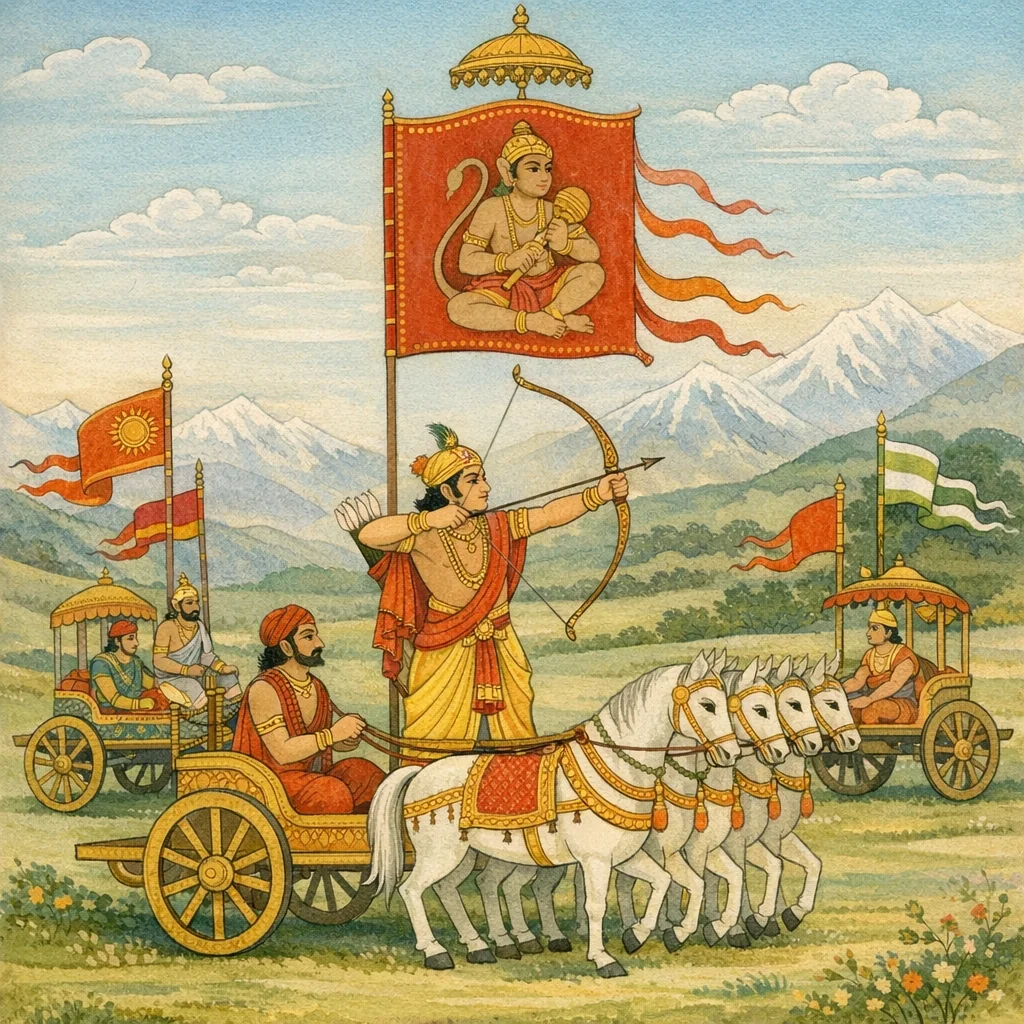
Sanjaya said: O best of the Bharatas, the great charioteers were adorned as their banners—shaking and streaming—rose above their massive cars, radiant like the arc of Indra’s bow. Among them was a standard marked with a monkey, fierce-faced and lion-tailed, proclaiming the might and resolve of its bearer amid the din of war.
Verse 9
स वानरवरो राजन् पताकाभिरलंकृत:
Sanjaya said: O King, that foremost of monkeys, adorned with banners, stood out as a conspicuous emblem of strength and resolve amid the tumult of war—an outward sign meant to hearten allies and unsettle foes.
Verse 10
तथैव सिंहलाडूगूलं द्रोणपुत्रस्य भारत
Sañjaya said: “In the same manner, O Bhārata, the lion-like prowess and fierce might of Droṇa’s son were seen.”
Verse 11
ध्वजाग्रं समपश्याम बालसूर्यसमप्रभम् | भारत! इसी प्रकार हमलोगोंने द्रोणपुत्र अश्वत्थामा-के श्रेष्ठ ध्वजको प्रातः:कालीन सूर्यके समान अरुण कान्तिसे प्रकाशित देखा था। उसमें सिंहकी पूँछका चिह्न था || १०३ || काज्चनं पवनोदधूतं शक्रध्वजसमप्रभम्
Sañjaya said: “O Bhārata, we beheld the banner-top—shining like the young morning sun—golden, fluttering in the wind, and radiant like Indra’s standard.”
Verse 12
हस्तिकक्ष्या पुनर्हमी बभूवाधिरथेर्ध्वज:
Sañjaya said: “Once again, the elephant-banner of Adhiratha’s son came into view.”
Verse 13
पताका काज्चनी स्रग्वी ध्वजे कर्णस्य संयुगे
Sañjaya said: “In the thick of battle, upon Karṇa’s standard there was a golden banner, adorned with garlands.”
Verse 14
आचार्यस्य तु पाण्डूनां ब्राह्मणस्य तपस्विन:,त्रिपुरघ्नरथो यद्वद् गोवृषेण विराजता । पाण्डवोंके आचार्य, तपस्वी ब्राह्मण, गौतमगोत्रीय कृपाचार्यके ध्वजपर एक बैलका सुन्दर चिह्न अंकित था। राजन! उनका वह विशाल रथ उस वृषभचिह्नसे बड़ी शोभा पा रहा था; ठीक उसी तरह, जैसे त्रिपुरनाशक महादेवजीका रथ सुन्दर वृषभचिह्लसे शोभायमान होता था
Sañjaya said: “The preceptor of the Pāṇḍavas—an austere Brahmin—bore upon the banner of his great chariot a splendid bull emblem. O King, that vast car shone all the more for the bull-mark, just as Mahādeva’s chariot, the destroyer of Tripura, is glorified by the noble sign of the bull.”
Verse 15
गोवृषो गौतमस्यासीत् कृपस्य सुपरिष्कृत: । स तेन भ्राजते राजन् गोवृषेण महारथ:
Sañjaya said: “O King, the splendidly adorned bull-banner that once belonged to Gautama is now in Kṛpa’s possession. With that bull-emblem the great chariot-warrior shines forth—his standard proclaiming his lineage and martial dignity amid the turmoil of battle.”
Verse 16
मयूरो वृषसेनस्य काउ्चनो मणिरत्नवान्
Sañjaya said: “(There was) a peacock—belonging to Vṛṣasena—golden in hue and adorned with jewel-gems.”
Verse 17
तेन तस्य रथो भाति मयूरेण महात्मन:
Sañjaya said: “By that peacock emblem, the great-souled warrior’s chariot shines forth—made conspicuous and radiant amid the tumult of battle, as a sign of his presence and stature.”
Verse 18
मद्रराजस्य शल्यस्य ध्वजाग्रेडग्नेशिखामिव
Sañjaya said: “(He appeared) like a flame blazing at the tip of the banner of Śalya, the king of Madra.”
Verse 19
सा सीता भ्राजते तस्य रथमास्थाय मारिष
Sañjaya said: “O venerable one, that Sītā shines forth, having mounted his chariot.”
Verse 20
वराह: सिन्धुराजस्य राजतो5भिविराजते
Sañjaya said: “Varāha, belonging to the king of Sindhu, shone forth conspicuously—standing out in royal splendor amid the tumult of battle.”
Verse 21
शुशुभे केतुना तेन राजतेन जयद्रथ:
Sañjaya said: “Adorned by that shining banner, Jayadratha stood out brilliantly—his emblem making him conspicuous amid the turmoil of battle, a reminder that in war, outward signs of power and prestige can both inspire allies and invite peril.”
Verse 22
सौमदत्ते: पुनर्यूपो यज्ञशीलस्थ धीमतः
Sañjaya said: “Again, the sacrificial post (yūpa) belonging to Saumadatti—the wise man steadfast in sacrificial discipline—(is spoken of/comes into view). The line evokes the ethos of Vedic piety amid warfare, recalling how ritual virtue and inherited dharma are remembered even in the violent press of battle.”
Verse 23
ध्वज: सूर्य इवाभाति सोमश्नात्र प्रदृश्यते । सदा यज्ञमें लगे रहनेवाले बुद्धिमान् भूरिश्रवाके रथमें यूपका चिह्न बना था। वह ध्वज सूर्यके समान प्रकाशित होता था और उसमें चन्द्रमाका चिह्न भी दृष्टिगोचर होता था ।। २२ ई | स यूप: काञउ्चनो राजन सौमदत्तेविराजते
Sañjaya said: “The banner shone like the sun, and upon it the emblem of the moon was also visible. On the chariot of the wise Bhūriśravā—ever engaged in sacrificial observances—there stood the sign of a yūpa (the sacrificial post). That yūpa, O king, made of gold, gleamed splendidly on Saumadatta’s car—linking the warrior’s identity in battle with the prestige and discipline of Vedic rite.”
Verse 24
शलस्य तु महाराज राजतो द्विरदो महान्,महाराज! शलके ध्वजमें चाँदीका महान् गजराज बना हुआ था। भरतश्रेष्ठ! वह ध्वज सुवर्णनिर्मित विचित्र अंगोंवाले मयूरोंसे सुशोभित था और आपकी सेनाकी शोभा बढ़ा रहा था
Sañjaya said: “O great king, Śala’s banner shone brilliantly. Upon that standard was fashioned a mighty lordly elephant of silver. O best of the Bharatas, the flag was further adorned with golden peacocks of wondrously varied limbs, and it heightened the splendor of your army.”
Verse 25
केतु: काञ्चनचित्रा ड्रैर्मयूरिरुपशोभित: । स केतु: शो भयामास सैन्यं ते भरतर्षभ,महाराज! शलके ध्वजमें चाँदीका महान् गजराज बना हुआ था। भरतश्रेष्ठ! वह ध्वज सुवर्णनिर्मित विचित्र अंगोंवाले मयूरोंसे सुशोभित था और आपकी सेनाकी शोभा बढ़ा रहा था
Sañjaya said: O great king, O bull among the Bharatas, a banner—bright with gold and adorned with splendid peacocks of varied hues—stood out prominently. That standard enhanced the beauty and martial splendor of your army, serving as a visible emblem of royal power and the ordered might of the host on the battlefield.
Verse 26
यथा श्वेतो महानागो देवराजचमूं तथा । नागो मणिमयो राज्ञो ध्वज: कनकसंवृत:,जैसे श्वेत वर्णका महान् ऐरावत हाथी देवराजकी सेनाको सुशोभित करता है, उसी प्रकार राजा दुर्योधनका सुवर्णमण्डित ध्वज मणिमय गजराजके चिह्लसे उपलक्षित होता था
Sañjaya said: Just as the great white elephant Airāvata adorns the army of the king of the gods, so too did King Duryodhana’s standard—covered in gold—stand out, marked by the emblem of a jewel-like lordly elephant. The verse underscores how royal power in war is displayed through symbols meant to inspire one’s own side and overawe the enemy, even as such splendor remains morally neutral and depends on the righteousness of the cause it serves.
Verse 27
किंकिणीशतसंह्वादो भ्राजंश्रित्रो रथोत्तमे । व्यभ्राजत भृशं राजन् पुत्रस्तव विशाम्पते
Sañjaya said: “O King, lord of the people, your son shone forth brilliantly upon that excellent chariot—resounding with the clamor of hundreds of tinkling bells—radiant and splendid, as the battle’s pageantry and peril gathered around him.”
Verse 28
नवैते तव वाहिन्यामुच्छिता: परमध्वजा:
Sañjaya said: “These foremost standard-bearers have now been cut down within your army.” The report underscores the grim moral weight of war: even the most eminent warriors, marked by lofty banners and reputation, are not spared when adharma-driven conflict reaches its fiercest pitch.
Verse 29
दशमस्त्वर्जुनस्यासीदेक एव महाकपि:
Sañjaya said: As the tenth (warrior) on Arjuna’s side there was only one—Mahākapi, the mighty ape—standing as a singular, extraordinary support amid the ranks.
Verse 30
ततदश्रित्राणि शुभ्राणि सुमहान्ति महारथा:
Sañjaya said: Then the great chariot-warriors, taking their stand behind those shining, exceedingly large protective coverings, pressed on in the battle—seeking advantage through defense as well as force amid the moral chaos of war.
Verse 31
तथैव धनुरायच्छत् पार्थ: शत्रुविनाशन:
Sañjaya said: In the same manner, Pārtha (Arjuna), the destroyer of foes, drew up his bow—readying himself to meet the enemy with disciplined resolve amid the demands of war.
Verse 32
तवापराधादू राजानो निहता बहुशो युधि
Sañjaya said: “Because of your wrongdoing, O King, many kings have been slain again and again on the battlefield.”
Verse 33
तेषामासीद् व्यतिक्षेपौ गर्जतामितरेतरम्
Sañjaya said: Among them there arose a fierce intermingling and clash, as they roared at one another—each side answering the other’s challenge in the tumult of battle.
Verse 34
दुर्योधनमुखानां च पाण्डूनामृषभस्य च । उस समय एक-दूसरेको लक्ष्य करके गर्जना करनेवाले दुर्योधन आदि महारथियों तथा पाण्डवश्रेष्ठ अर्जुनमें परस्पर आघात-प्रतिघात होने लगा ।। ३३ $ ।। तत्राद्भुतं परं चक्रे कौन्तेयः कृष्णसारथि:
Sañjaya said: As the foremost warriors led by Duryodhana and the bull among the Pāṇḍavas (Arjuna) clashed, striking and counter-striking each other, then the son of Kuntī—whose charioteer was Kṛṣṇa—performed a supreme and wondrous feat.
Verse 35
अशोभत महाबाहुर्गाण्डीवं विक्षिपन् धनु:
Sañjaya said: The mighty-armed warrior shone forth as he brandished the Gāṇḍīva bow—his poised strength and readiness for battle signaling both martial resolve and the grave duty of a kṣatriya amid the unfolding war.
Verse 36
तत्रार्जुनो नरव्याप्र: शरैर्मुक्तै: सहस्रशः
Sañjaya said: There, Arjuna—striving with the full vigor of a heroic man—released arrows in their thousands. In the moral pressure of battle, his disciplined prowess becomes an instrument of duty, showing how resolve and skill are marshalled toward the grim necessities of war.
Verse 37
ततस्ते5पि नरव्याप्रा: पार्थ सर्वे महारथा:
Sañjaya said: Then those mighty chariot-warriors too—men fully engaged in the press of battle—advanced, O Pārtha, all of them renowned as great fighters. The line underscores the collective resolve and martial duty that drives the combatants onward, even as the war’s moral weight continues to deepen.
Verse 38
संवृते नरसिंहैस्तु कुरूणामृषभे<र्जुने । महानासीत् समुद्धूतस्तस्य सैन्यस्य नि:स्वन:,जब कुरुश्रेष्ठ अर्जुन उन पुरुषसिंहोंद्वारा घेर लिये गये, तब उस सेनामें महान् कोलाहल प्रकट हुआ
Sañjaya said: When Arjuna—the bull among the Kurus—was surrounded by those lion-like warriors, a great uproar arose in that host; the din of the army swelled and burst forth, marking the moral intensity of battle where courage and duty collide amid overwhelming force.
Verse 53
नानावर्णविरागाभि: शुशुभु: सर्वतो वृता: । वे परम शोभासम्पन्न अनेक प्रकारके बहुरंगे ध्वज सब ओरसे नाना रंगकी पताकाओंद्वारा घिरकर बड़ी शोभा पाते थे
Sañjaya said: Surrounded on all sides by many-colored, brilliantly dyed banners and streamers, they appeared splendid—an outward display of martial order and confidence amid the unfolding violence of war.
Verse 83
धनंजयस्य संग्रामे प्रत्यदृश्यत भैरवम् । उस संग्राममें अर्जुनका भयंकर ध्वज वानरके चिह्से सुशोभित दिखायी देता था। उस वानरकी पूँछ सिंहके समान थी और उसका मुख बड़ा ही उग्र था
Sañjaya said: In the thick of battle, Dhanañjaya’s banner appeared in a fearsome form—splendidly marked with the emblem of the monkey. Its tail was like a lion’s, and its face was exceedingly fierce, proclaiming Arjuna’s resolve and the righteous confidence that steadies him amid the terror of war.
Verse 96
त्रासयामास तत् सैन्यं ध्वजो गाण्डीवधन्चन: । राजन! श्रेष्ठ वानरसे सुशोभित तथा पताकाओंसे अलंकृत गाण्डीवधारी अर्जुनका वह ध्वज आपकी उस सेनाको भयभीत किये देता था
Sañjaya said: O King, the banner of Arjuna—he who bears the Gāṇḍīva—adorned with the excellent monkey emblem and embellished with streamers, struck terror into that army. In the moral atmosphere of the war, this is not mere display: the standard becomes a visible sign of resolve and prowess, unsettling opponents and shaping the battlefield’s ethical tension between duty and destruction.
Verse 104
इस प्रकार श्रीमहाभारत द्रोणपर्वके अन्तर्गत जयद्रथवधपर्वमें संकुलयुद्धाविषयक एक सौ चारवाँ अध्याय पूरा हुआ
Sanjaya said: Thus, in the Śrī Mahābhārata, within the Droṇa Parva—specifically in the Jayadratha-slaying section—the one-hundred-and-fourth chapter, dealing with the tangled and chaotic nature of the battle, is concluded. The closing formula underscores the relentless complexity of war and frames the narrative as a moral record of actions and consequences within the larger dharmic struggle.
Verse 105
इति श्रीमहाभारते द्रोणपर्वणि जयद्रथवधपर्वणि ध्वजवर्णने पजञ्चाधिकशततमो<ध्याय:
Thus, in the Śrī Mahābhārata, within the Droṇa Parva—specifically in the section concerning the slaying of Jayadratha—ends the one-hundred-and-fifth chapter, themed around the description of banners. This closing colophon frames the narrative as part of the larger moral and historical account of the war, marking a transition point in the unfolding of duty, resolve, and the consequences of martial vows.
Verse 116
नन्दनं कौरवेन्द्राणां द्रौणेलक्ष्म समुच्छितम् अश्व॒त्थामाका इन्द्रध्वजके समान प्रकाशमान सुवर्णमय ऊँचा ध्वज वायुकी प्रेरणासे फहराता हुआ कौरव-नरेशोंका आनन्द बढ़ा रहा था
Sañjaya said: The lofty, golden banner of Aśvatthāmā—shining like Indra’s standard and raised high as the emblem of Droṇa’s line—fluttered under the impulse of the wind and heightened the joy and confidence of the Kaurava kings. In the moral atmosphere of the war, this image underscores how outward signs of power and lineage can inflame pride and morale, even as the battlefield tests the deeper claims of dharma.
Verse 126
आहवे खं महाराज ददृशे पूरयन्निव । अधिरथपुत्र कर्णका ध्वज हाथीकी सुवर्णमयी रस्सीके चिह्नसे युक्त था। महाराज! वह संग्राममें आकाशको भरता हुआ-सा दिखायी देता था
Sañjaya said: O King, in the thick of battle it seemed as though the very sky were being filled. Karṇa’s lofty standard—he, the son of Adhiratha—bore the mark of a golden elephant and was adorned with a golden rope; it loomed on the battlefield as if it occupied the heavens.
Verse 133
नृत्यतीव रथोपस्थे श्वसनेन समीरिता । युद्धसस््थलमें कर्णके ध्वजपर सुवर्णमयी मालासे विभूषित पताका वायुसे आन्दोलित हो रथकी बैठकपर नृत्य-सा कर रही थी
Sañjaya said: Stirred by the rushing wind, the banner—adorned with a golden garland upon Karṇa’s standard—swayed on the battlefield and seemed to dance upon the seat of the chariot.
Verse 153
त्रिपुरघ्नरथो यद्वद् गोवृषेण विराजता । पाण्डवोंके आचार्य, तपस्वी ब्राह्मण, गौतमगोत्रीय कृपाचार्यके ध्वजपर एक बैलका सुन्दर चिह्न अंकित था। राजन! उनका वह विशाल रथ उस वृषभचिह्नसे बड़ी शोभा पा रहा था; ठीक उसी तरह, जैसे त्रिपुरनाशक महादेवजीका रथ सुन्दर वृषभचिह्लसे शोभायमान होता था
Sañjaya said: Just as the chariot of Tripura’s slayer (Śiva) shines with the splendid emblem of the bull, so too did the great chariot of Kṛpācārya—preceptor of the Pāṇḍavas, an austere brāhmaṇa of the Gautama lineage—appear resplendent, bearing on its banner a beautiful bull-mark.
Verse 163
व्याहरिष्यन्निवातिष्ठत् सेनाग्रमुपशो भयन् । वृषसेनका मणिरत्नविभूषित सुवर्णमय ध्वज मयूर-चिह्नसे युक्त था। वह मयूर सेनाके अग्रभागकी शोभा बढ़ाता हुआ इस प्रकार खड़ा था, मानो बोल देगा
Sañjaya said: At the very front of the army there stood a golden standard, adorned with gems, as though it were about to speak. Marked with the emblem of a peacock and enhancing the splendour of the vanguard, it seemed to proclaim—by its very presence—the pride and resolve of Vrishasena’s side in the midst of war.
Verse 183
सौवर्णी प्रतिपश्याम सीतामप्रतिमां शुभाम् । मद्रराज शल्यकी ध्वजाके अग्रभागमें हमने अग्निशिखाके समान उज्ज्वल, सुवर्णमय, अनुपम तथा शुभ लक्षणोंसे युक्त एक सीता (हलसे भूमिपर खींची हुई रेखा) देखी थी
Sañjaya said: We beheld, at the foremost part of the banner of Śalya, king of Madra, a radiant golden ‘sītā’—a furrow-line like a trace drawn by a plough upon the earth—blazing like a tongue of fire, incomparable, and marked with auspicious signs.
Verse 196
सर्वबीजविरूढेव यथा सीता श्रिया वृता । माननीय नरेश! जैसे खेतमें हलकी नोकसे बनी हुई रेखा सभी बीजोंके अंकुरित होनेपर शोभासम्पन्न दिखायी देती है, उसी प्रकार मद्रराजके रथका आश्रय ले वह सीता (हलद्वारा बनी हुई रेखा) बड़ी शोभा पा रही थी
Sañjaya said: “O venerable king, just as the furrow-line made by the tip of a plough in a field appears beautiful when all the seeds have sprouted, so too that ‘Sītā’—the plough-made furrow—seemed to gain great splendour by taking shelter of the Madra king’s chariot.”
Verse 203
ध्वजाग्रेडलोहितार्काभो हेमजालपरिष्कृत: । सिन्धुराज जयद्रथकी ध्वजाके अग्रभागमें उज्ज्वल सूर्यके समान श्वेत कान्तिमान् और सोनेकी जालीसे विभूषित चाँदीका बना हुआ वराहचिह्न अत्यन्त सुशोभित हो रहा था
Sañjaya describes the emblem crowning Jayadratha’s banner: at the very top it shone with a bright, sunlike radiance, gleaming white, and was further adorned with a net-work of gold. Fashioned in silver as a boar-mark, it stood out splendidly.
Verse 213
यथा देवासुरे युद्धे पुरा पूषा सम शोभते । जैसे पूर्वकालमें देवासुर-संग्राममें पूषा शोभा पाते थे, उसी प्रकार उस रजतनिर्मित ध्वजसे जयद्रथकी शोभा हो रही थी
Sañjaya said: Just as Pūṣan once shone forth in the ancient war between the gods and the asuras, so too did Jayadratha appear resplendent, his splendor heightened by that silver-made banner.
Verse 236
राजसूये मखश्रेष्ठे यथा यूप: समुच्छित: । राजन! जैसे यज्ञोंमें श्रेष्ठ राजसूयमें ऊँचा यूप सुशोभित होता है, भूरिश्रवाका वह सुवर्णमय यूप वैसे ही शोभा पा रहा था
Sañjaya said: “O King, just as in the supreme sacrifice—the Rājasūya—a lofty sacrificial post (yūpa) stands resplendent, so too did that golden yūpa belonging to Bhūriśravas appear splendid.”
Verse 286
व्यदीपयंस्ते पृतनां युगान्तादित्यसंनिभा: । ये नौ उत्तम ध्वज आपकी सेनामें बहुत ऊँचे थे और प्रलयकालके सूर्यके समान अपना प्रकाश फैलाते हुए आपकी सेनाको उद्धासित कर रहे थे
Sañjaya said: “Those lofty standards and banners, radiant like the sun at the end of an age, were spreading their blaze and lighting up your army.”
Verse 306
कार्मुकाण्याददुस्तूर्णमर्जुनार्थे परंतपा: । तदनन्तर शत्रुओंको संताप देनेवाले उन सब महारथियोंने अर्जुनको मारनेके लिये तुरंत ही विचित्र, चमकीले और विशाल धनुष हाथमें ले लिये
Sañjaya said: Those mighty warriors, scorchers of foes, swiftly took up their bows for Arjuna’s sake; then, intent on killing Arjuna, they at once seized strange, gleaming, massive bows, ready to inflict torment upon their enemies.
Verse 316
गाण्डीवं दिव्यकर्मा तद् राजन दुर्मन्त्रिते तव । राजन! उसी प्रकार दिव्य कर्म करनेवाले शत्रुनाशन पार्थने भी आपकी कुमन्त्रणाके फलस्वरूप अपने गाण्डीव धनुषको खींचा
Sañjaya said: “O King, because of your ill-judged counsel, the divinely accomplished Arjuna drew his Gāṇḍīva bow as well—he whose deeds are wondrous and who destroys his foes. Thus, by the fruit of your misguided policy, the very forces you should have restrained were compelled into decisive action.”
Verse 326
नानादिग्भ्य: समाहूता: सहया: सरथद्विपा: । महाराज! आपके अपराधसे उस युद्धसस््थलमें अनेक दिशाओंसे आमन्त्रित होकर आये हुए बहुत-से राजा अपने घोड़ों, रथों और हाथियोंसहित मारे गये हैं
Sañjaya said: O great king, because of your wrongdoing, many allied kings—summoned from every direction—have been slain on that battlefield, along with their horses, chariots, and elephants.
Verse 343
यदेको बहुभि: सार्ध समागच्छदभीतवत् | वहाँ श्रीकृष्ण जिनके सारथि हैं, उन कुन्तीकुमार अर्जुनने यह अत्यन्त अद्भुत पराक्रम किया कि अकेले ही बहुतोंके साथ निर्भय होकर युद्ध आरम्भ कर दिया
Sañjaya said: “How wondrous was that valor—Arjuna, the son of Kuntī, with Śrī Kṛṣṇa as his charioteer, fearlessly engaged many opponents all by himself and began the battle alone.”
Verse 353
जिगीषुस्तान् नरव्याप्रो जिघांसुश्च जयद्रथम् । उनपर विजय पानेकी इच्छा रखकर जयद्रथके वधकी अभिलाषासे गाण्डीव धनुषको खींचते हुए पुरुषसिंह महाबाहु अर्जुनकी बड़ी शोभा हो रही थी
Sañjaya said: With the resolve to conquer those foes and with the fierce intent to slay Jayadratha, the tiger among men—mighty-armed Arjuna—shone brilliantly as he drew back the Gāṇḍīva bow.
Verse 363
अदृश्यांस्तावकान् योधानू् प्रचक्रे शत्रुतापन: । उस समय शत्रुओंको संताप देनेवाले नरव्याप्र अर्जुनने अपने छोड़े हुए सहस्तरों बाणोंद्वारा आपके योद्धाओंको अदृश्य कर दिया
Sañjaya said: Arjuna, the scorcher of foes, made your warriors invisible—so wholly were they covered and overwhelmed by the torrents of thousands of arrows he released. In the war’s moral atmosphere, the image declares that prowess, yoked to a vowed cause, can render even mighty fighters powerless and lost to sight amid the consequences of the side they chose.
Verse 376
अदृश्यं समरे चक्र: सायकौचै: समन्तत: । तब उन सभी पुरुषसिंह महारथियोंने भी समरांगणमें सब ओरसे बाणसमूहोंकी वर्षा करके अर्जुनको अदृश्य कर दिया
Sañjaya said: In the thick of battle, they made him invisible on every side with dense masses of arrows. Those lion-like great chariot-warriors, showering volleys all around the field, so covered Arjuna that he could no longer be seen—showing how martial prowess can, for a moment, eclipse even the foremost hero amid the fury of war.
Verse 1763
यथा स्कन्दस्य राजेन्द्र मयूरेण विराजता । राजेन्द्र! जैसे स्वामी स्कन्दका रथ सुन्दर मयूर-चिह्लसे शोभित होता है, उसी प्रकार महामना वृषसेनका रथ उस मयूरचिह्लसे शोभा पा रहा था
Sañjaya said: “O king, just as the chariot of Lord Skanda shines adorned with the peacock emblem, so too does the chariot of the high-minded Vṛṣasena gleam, beautified by that same peacock insignia.”
Verse 2736
ध्वजेन महता संख्ये कुरूणामृषभस्तदा । प्रजानाथ! वह विचित्र ध्वज दुर्योधनके उत्तम रथपर सैकड़ों क्षुद्रधंटिकाओंकी ध्वनिसे शोभायमान था। उस महान् ध्वजसे युद्धस्थलमें आपके पुत्र कुरुश्रेष्ठ दुर्योधनकी उस समय बड़ी शोभा हो रही थी
Sañjaya said: In the thick of battle, your son—Duryodhana, foremost among the Kurus—shone brilliantly. His excellent chariot bore a great banner and a moving, variegated standard, made resplendent by the ringing of hundreds of small bells. By that lofty banner he appeared especially glorious on the battlefield—an image of royal pride and martial display amid the moral gravity of war.
Verse 2936
अदीप्यतार्जुनो येन हिमवानिव वह्नलिना । दसवाँ ध्वज एकमात्र अर्जुनका ही था, जो विशाल वानरचिह्लसे सुशोभित था। उससे अर्जुन उसी प्रकार देदीप्यमान हो रहे थे, जैसे अग्निसे हिमालय पर्वत उद्धासित होता है
Sañjaya said: With that banner, Arjuna blazed forth—like the Himalaya illuminated by a wreath of fire. His chariot bore a single, towering standard, splendid with the emblem of the great monkey; and by it Arjuna appeared radiant, inspiring awe and resolve amid the moral gravity of war.
Frequently Asked Questions
The chapter juxtaposes duty-driven combat with the ethically destabilizing force of grievance: Bhīma’s resolve is fueled by remembered injustices, raising the question of when righteous redress becomes indistinguishable from vengeance within kṣatriya action.
Actions in the present are shown to be conditioned by prior speech and institutional harms; the text implies that unresolved humiliation and public wrongdoing persist as causal seeds, shaping perception, escalation, and the capacity for restraint.
No explicit phalaśruti appears in the provided passage; the meta-level effect is achieved through Saṃjaya’s evaluative similes and Dhṛtarāṣṭra’s inquiry structure, which frame the duel as exemplary of war’s moral and human cost.