Adhyaya 43
Pavitrāropaṇa-vidhi (Rite of Investing Hari with the Pavitra)
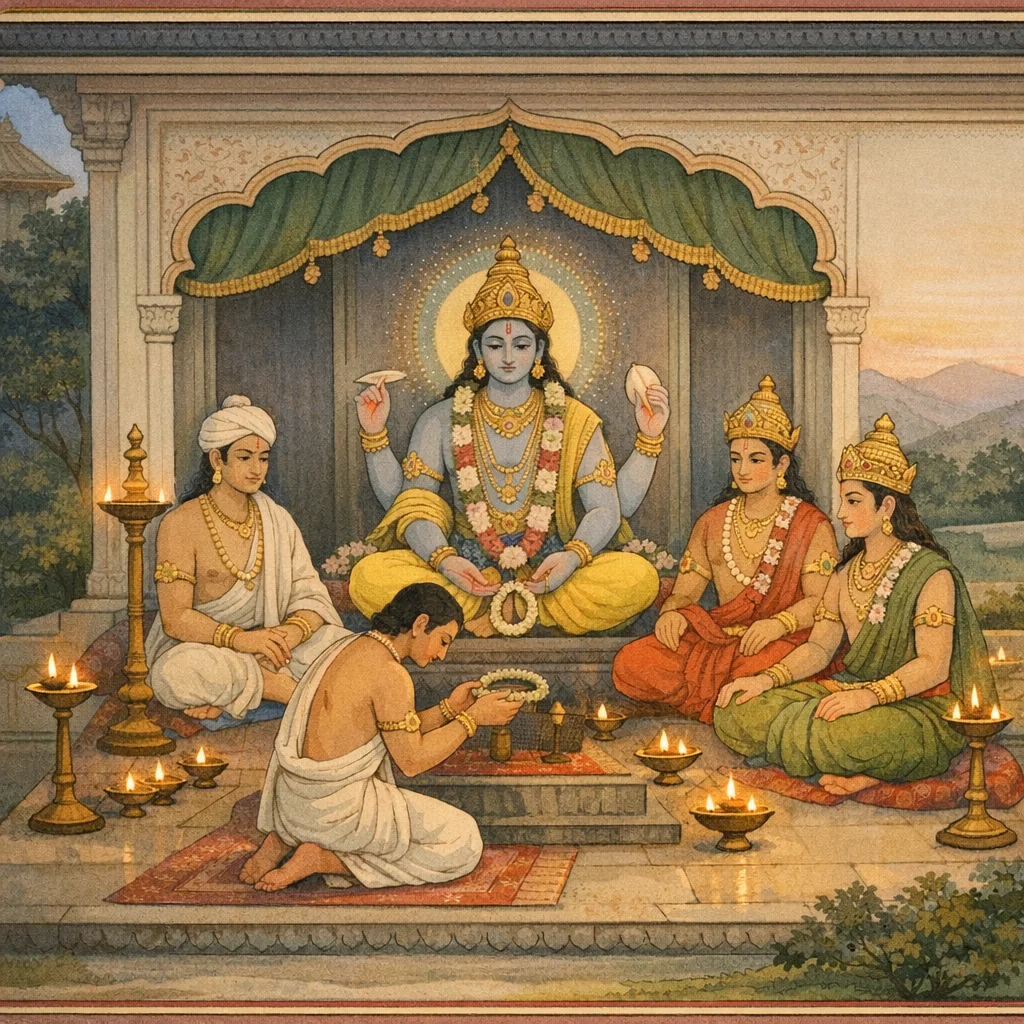
Continuing the ācāra-based guidance for preserving the power of yearly worship, Hari teaches the pavitrāropaṇa rite as a means to gain both rightful enjoyment and liberation. A mythic origin account links the Graiveyaka neck-emblem to divine protection in the Deva–Asura war, establishing the “pavitra” as a named boon. The chapter then gives practical rules: neglect of pavitra worship in the rainy season makes the annual worship fruitless; therefore pavitra-āropaṇa should be scheduled through the tithis up to the full moon, with dvādaśī central for Viṣṇu, and with added observance on vyatīpāta, solstices, and eclipses. It specifies materials by social role (silk, cotton, linen, kuśa, hemp bark), the ritual making of triple and re-triple strands, deity-correspondences within strands and cords, required lengths and measures, and suitable venues (vimāna/sthaṇḍila). It outlines the consecration sequence—anointing, directional placement, mantra-consecration to Vāsudeva, protective circles, naivedya, overnight installation and vigil, dawn worship, closing gifts, and prayers for the completion (pūrṇatā) of all worship—preparing the practitioner to conclude the annual rite with doctrinal precision and proceed to further refinements.
Shlokas
Verse 1
नाम द्विचत्वारिंशो ऽध्यायः हरिरुवाच / पवित्रारोपणं वक्ष्ये भुक्तिमुक्तिप्रदं हरेः / पुरा देवासुरे युद्धे ब्रह्माद्याः शरणं ययुः
Chapter forty-three: Hari said—“I shall explain the rite of wearing Hari’s sacred pavitra, which grants both worldly enjoyment and liberation. Long ago, in the war between the Devas and the Asuras, Brahmā and the other gods sought refuge.”
Verse 2
विष्णुश्च तेषां देवानां ध्वजं ग्रैवेयकं ददौ / एतौ दृष्ट्वा विनङ्क्ष्यन्ति दानवानब्रवीद्धरिः
And Viṣṇu gave those gods a banner called Graiveyaka. Hari said, “On seeing these two, the Dānavas will be destroyed.”
Verse 3
विष्णूक्ते ह्यब्रवीन्नागो वासुकेरनुजस्तदा / वृणीत च वपित्राख्यं वरं चेदं वृषध्वज
When Viṣṇu had spoken thus, the serpent—Vāsuki’s younger brother—then said: “O Vṛṣadhvaja, choose this boon, known as Vapitra.”
Verse 4
ग्रैवेयं हरिदत्तं तु मन्नाम्ना ख्यातिमेष्यति / इत्युक्ते तेन ते देवास्तन्नाम्ना तद्वरं विदुः
“This necklace (graiveya) has indeed been bestowed by Hari; it shall become renowned by my name.” When he spoke thus, the gods recognized that boon by that very name.
Verse 5
प्रावृट्काले तु ये मर्त्या नार्चिष्यन्ति पवित्रकैः / तेषां सांवत्सरी पूजा विफला च भविष्यति
But those mortals who, in the rainy season, do not worship with pavitrakas (consecrated rings/garlands of darbha), their annual worship will indeed become fruitless.
Verse 6
तस्मात्सर्वेषु देवेषु पवित्रारोपणं क्रमात् / प्रतिपत्पौर्णमास्यान्ता यस्य या तिथिरुच्यते
Therefore, for all the deities, the rite of pavitra-āropaṇa—the placing of the sacred thread/garland—should be performed in due order, on the tithi prescribed for each, beginning from pratipat and continuing up to paurṇamāsī (the full-moon day).
Verse 7
द्वादश्यां विष्णवे कार्यं शुक्ले कृष्णे ऽथ वा हर / व्यतीपाते ऽयने चैव चन्दरसूर्यग्रहे शिव
On dvādaśī, the twelfth lunar day, one should perform the rite for Viṣṇu—whether in the bright fortnight or the dark, O Hari. Likewise, at Vyatīpāta, at the solstices (ayana), and at lunar or solar eclipses, O Śiva, it should be performed.
Verse 8
विष्णवे वृद्धिकार्ये च गुरोरागमने तथा / नित्यं पवित्रमुद्दिष्टं प्रावृट्काले त्ववश्यकम्
For the worship of Viṣṇu, for rites undertaken for increase and prosperity, and likewise when the Guru arrives, daily pavitra—purification—is prescribed; and in the rainy season it is especially necessary.
Verse 9
कौशेयं पट्टसूत्रं वा कार्पासं क्षौममेव वा / कुशसूत्र द्विजानां स्याद्राज्ञा कौशेयपट्टकम्
Silk, a woven cloth-cord, cotton, or linen may be used. For the twice-born (dvija) a thread of kuśa grass is prescribed, while for a king a cord of silk and cloth is ordained.
Verse 10
वैश्यानां चीरणं क्षौमं शूद्राणां शणवल्कजम् / कार्पासं पद्मजं चैव सर्वेषां शस्तमीश्वर
For the Vaiśyas, linen garments are prescribed; for the Śūdras, clothing made from hemp-fibre and bark-fibre. Cotton and lotus-fibre cloth are also held to be fitting for all, O Lord.
Verse 11
ब्राह्मण्या कर्तितं सूत्रं त्रिगुणं त्रिगुणीकृतम् / ॐ कारो ऽथ शिवः सोमो ह्यग्निर्ब्रह्या फणी रविः
The sacred thread (yajñopavīta), fashioned by a brāhmaṇa woman, is threefold and again made triple. Its three strands are to be contemplated as Oṃ, as Śiva, as Soma, as Agni, as Brahmā, as Nāga the Serpent, and as Ravi the Sun.
Verse 12
विघ्नेशो विष्णुरित्येते स्थितास्तन्तुषु देवताः / ब्रह्मा विष्णुश्च रुद्रश्च त्रिसूत्रे देवताः स्मृताः
In the individual strands of the sacred thread, the deities are said to abide as Vighneśa and Viṣṇu; and in the triple cord, the deities remembered are Brahmā, Viṣṇu, and Rudra.
Verse 13
सौवर्णे राजते ताम्रे वैणवे मृन्मये न्यसेत् / अङ्गुष्ठेन चतुः षष्टिः श्रेष्ठं मध्यं तदर्धतः
It should be placed in a vessel of gold, silver, copper, bamboo, or clay. Measured by the thumb, sixty-four is the best; the medium is half of that, and the inferior is half again (of the medium).
Verse 14
तदर्धा तु कनिष्ठा स्यात्सूत्रमष्टोत्तरं शतम् / उत्तमं मध्यमं चैव कन्यसं पूर्ववत्क्रमात्
Half of that is held to be the lowest measure; the sacred thread (yajñopavīta) should be one hundred and eight units in length. The best, the middling, and the least are to be understood in the same order as stated earlier.
Verse 15
उत्तमोंऽगुष्ठमानेन मध्यमो मध्यमेन तु / कन्यसे च कनिष्ठेन अङ्गुल्या ग्रन्थयः स्मृताः
The best measure is reckoned by the thumb, the middling by the middle finger, and the smaller by the little finger; thus are the finger-joints (phalanges) traditionally counted by these measures.
Verse 16
विमाने स्थण्डिले चैव एतत्सामान्यलक्षणम् / शिवोद्धृतं पवित्रं तु प्रतिमायां च कारयेत्
Whether in the vimāna (temple-shrine) or upon the consecrated ground-altar (sthaṇḍila), these are the general marks. The sanctifying rite (pavitra), said to have been established by Śiva, should also be performed for a sacred image (pratimā).
Verse 17
हृन्नाभिरू(रु) रुमाने च जानुभ्यामवलम्बिनी / अष्टोत्तरसहस्रेण चत्वारो ग्रन्थयः स्मृताः
Between the heart and the navel, in the region of the thighs, and hanging down toward the knees—these are said to be four principal knots (granthi), numbering one thousand and eight in total.
Verse 18
षट्त्रिं(ड्विं) शच्च चतुर्विशद्द्वादश ग्रन्थयो ऽथवा / उत्तमादिषु विज्ञेयाः पर्वभिर्वा पवित्रकम्
The Pavitraka is said to consist of texts numbering thirty-six (or thirty-two), or again one hundred, or twenty-four, or twelve. It is to be understood according to the ‘Uttama’ and other classifications, or else by its divisions (parvans/sections).
Verse 19
चर्चितं कुङ्कुमेनैव हरिद्राचन्दनेन वा / सोपवासः पवित्रन्तु पात्रस्थमधिवासयेत्
Having anointed it with saffron (kuṅkuma), or with turmeric and sandalwood, and while observing the fast (upavāsa), one should duly consecrate by the rite of adhivāsa the sacred pavitra placed in a vessel.
Verse 20
अश्वत्थपत्रपुटके अष्टदिक्षु निवेशितम् / दण्डकाष्ठं कुशाग्रं च पूर्वे सङ्कर्षणेन तु
In a pouch made of aśvattha (sacred fig) leaves, it is arranged facing the eight directions; and on the eastern side are placed a wooden staff and the pointed tip of kuśa grass, with Saṅkarṣaṇa presiding there.
Verse 21
रोचनाकुङ्कुमेनव प्रद्युम्नेन तु दक्षिणे / युद्धार्थो फलसिद्ध्यर्थमनिरुद्धेन पश्चिमे
With rocanā and saffron (kuṅkuma), one should worship Pradyumna in the south; and for victory in battle and the attainment of desired fruits, one should worship Aniruddha in the west.
Verse 22
चन्दनं नीलयुक्तं च तिलभस्माक्षतं तथा / आग्नेयादिषु कोणेषुर् श्यादीनां तु क्रमान्न्यसेत्
One should place sandalwood mixed with blue pigment, along with sesame-ash and unbroken rice grains (akṣata), in the corner-directions beginning with the southeast, arranging them in the prescribed sequence.
Verse 23
पवित्रं वासुदेवेन अभिमन्त्र्य सकृत्सकृत् / दृष्ट्वा पुनः प्रपूज्याथ वस्त्रेणाच्छाद्य यत्नतः
Having consecrated the sacred pavitra again and again with the Vāsudeva mantra, one should behold it, worship it once more, and then carefully cover it with a cloth.
Verse 24
देवस्य पुरतः स्थाप्यं प्रतिमामण्डलस्य वा / पश्चिमे दक्षिणे चैव उत्तरे पूर्ववत्क्रमात्
It should be set before the Deity, or within the icon’s ritual maṇḍala; and, if arranged by directions, it should also be placed in the west, the south, and the north—following the same sequence previously taught, in proper order.
Verse 25
ब्राह्मादींश्चापि संस्थाप्य कलशं चापि पूजयेत् / अस्त्रेण मण्डलं कृत्वा नैवेद्यञ्च समर्पयेत्
Having duly installed Brahmā and the other deities, one should also worship the consecrated kalaśa, the sacred water-pot. Then, forming a protective maṇḍala with the astra-mantra, one should offer naivedya, the food offering.
Verse 26
अधिवास्य पवित्रं तु त्रिसूत्रेण नवेन वा (च) / वेदिकां वेष्टयित्वा तु आत्मानंम कलशं घृतम्
After consecrating the pavitra, the sacred thread, one should tie it with a three-stranded cord or with a new cord; then, having wrapped the vedikā, the altar-platform, one should also wrap and consecrate oneself, the kalaśa, and the ghṛta (ghee).
Verse 27
अग्निकुण्डं विमानं च मण्डपं गृहमेव च / सूत्रमेकं तु संगृह्य दद्याद्देवस्य मृर्धानि
Having gathered (as offerings) a fire-pit (agnikuṇḍa), a vimāna, a maṇḍapa, and even a house, one should take a single sacred thread and place it upon the deity’s head.
Verse 28
दत्त्वा पठेदिमं मन्त्रं पूजयित्वा महेश्वरम् / आवाहितो ऽसि देवेश पूजार्थं परमेश्वर
After making the offering, one should recite this mantra and worship Mahēśvara: “O Devēśa, Lord of the gods; O Parameśvara, Supreme Lord—you have been invoked (āvāhita) for the sake of worship.”
Verse 29
तत्प्रभातेर्ऽचयिष्यामि सामग्याः सन्निधौ भव / एकरात्रं त्रिरात्रं वा अधिवास्य पवित्रकम्
At the next dawn I shall perform the worship; remain present with the ritual materials. Having installed and kept the pavitraka (sacred thread/amulet) for one night or for three nights, the rite should then be brought to completion.
Verse 30
रात्रौ जागरणं कृत्वा प्रातः संपूज्य केशवम् / आरोपयेत्क्रमेणैव ज्येष्ठमध्यकनीयसम्
Having kept vigil through the night, and at dawn duly worshipped Keśava (Viṣṇu), one should then, in proper order, seat/install them sequentially—the eldest, the middle, and the youngest.
Verse 31
धूपयित्वा पवित्रं तु मन्त्रेणैवाभिमन्त्रयेत् / प्रजप्तग्रन्थिकं चैव पूजयेत्कुसुमादिभिः
Having fumigated and purified the pavitra, one should consecrate it with that very mantra; and one should also worship the mantra-knotted cord, over which the japa has been duly performed, with flowers and other offerings.
Verse 32
गायत्त्र्या चार्चितं तेन देवं संपूज्य दापयेत् / समं पुत्रकलत्राद्यैः सूत्रपुच्छं तु धारयेत्
Having worshipped the deity with the Gāyatrī and duly completed the offering, one should make the prescribed donation. Then, together with one’s son, wife, and other family members, one should wear the thread with its tufted end (sūtra-puccha).
Verse 33
विशुद्धग्रन्थिकं रम्यं महापातकनाशनम् / सर्वपापक्षयं देव तवाग्रे धारयाम्यहम्
O Deva, before you I bear and recite this pure and beautiful sacred compendium, which destroys the great sins and brings about the complete exhaustion of all sins.
Verse 34
एवं धूपादिनाभ्यर्च्य मध्यमादीन्त्समर्पयेत् / पवित्रं वैष्णवं तेजः सर्वपातकनाशनम्
Thus, having worshipped with incense and the like, one should offer the middle and the subsequent items. This is the sacred Vaiṣṇava radiance—purifying and destroying all sins.
Verse 35
धर्मकामार्थसिद्ध्यर्थं स्वकण्ठे धारयाम्यहम् / वनमालां समभ्यर्च्य स्वेन मन्त्रेण दापयेत्
“For the attainment of dharma, kāma, and artha, I wear it upon my own neck.” Having duly worshipped the forest-garland (vanamālā), one should have it placed upon the devotee with one’s own mantra.
Verse 36
नैवेद्यं विविधं दत्त्वा कुसुमादेर्बलिं हरेत् / अग्निं संतर्प्य तत्रापि द्वादशाङ्गुलमानतः
Having offered a variety of naivedya (food-offerings), one should then present a bali of flowers and the like. There too, having satisfied the sacred fire Agni, the rite should be performed with a measure of twelve finger-breadths.
Verse 37
अष्टोत्तरशतेनैव दद्यादेकपवित्रकम् / आदौ दत्त्वार्घ्यमादित्ये तत्र चैकं पवित्रकम्
With one hundred and eight (offerings), one should give a single pavitra, a sacred ring of kuśa-grass. First, after offering arghya (water oblation) to Āditya, one should place there also one pavitra.
Verse 38
विष्वक्सेनं ततः प्रार्च्य सुरुमर्घ्यादिभिर्हर / देवस्याग्रे पठेन्मन्त्रं कृताञ्जलिपुटः स्थितः
Then, O Hara, having duly worshipped Viṣvaksena with fragrant offerings such as arghya and the like, standing before the Lord with folded palms, one should recite the mantra.
Verse 39
ज्ञानतो ऽज्ञानतो वापि पूजनादि कृतं मया / तत्सर्वं पूर्णमेवास्तु त्वत्प्रसादात्सुरेश्वर
Whether done knowingly or unknowingly, whatever acts of worship and the like have been performed by me—may all of that indeed become complete and fruitful, by Your grace, O Lord of the gods.
Verse 40
मणिविद्रुममालभिर्मन्दारकुसुमादिभिः / इयं सांवत्सरी पूजा तवास्तु गरुडध्वज
With garlands of gems and coral, and with mandāra flowers and the like—may this annual worship be offered unto You, O Garuḍa-bannered Lord.
Verse 41
वनमाला यथा देव कौस्तुभं सततं हृदि / तद्वत्पवित्रं तन्तूनां मालां त्वं हृदये धर
O Lord, just as Your forest-garland (vanamālā) and the Kaustubha jewel ever rest upon Your chest, so too may this sacred thread-garland (pavitra) remain upon my heart—may I hold it close within.
Verse 42
एवं प्रार्थ्य द्विजान् भोज्य दत्त्वा तेभ्यश्च दक्षिणाम् / विसर्जयेत्तु तेनैव सायाह्ने त्वपरे ऽहनि
Thus, having respectfully invited the twice-born (brāhmaṇas), having fed them, and having given them the prescribed honorarium (dakṣiṇā), one should then formally take leave of them in the evening—on that very day or on the following day.
Verse 43
सांवत्सरीमिमां पूजां सम्पाद्य विधिवन्मया / व्रजेः पवित्रकेदानीं विष्णुलेकं विसर्जितः
Having duly performed this annual worship according to proper rite, I shall now depart for Pavitraka, having dispatched the written ordinance of Vishnu.
Frequently Asked Questions
The text states that those who do not worship with pavitrakas during the rainy season make their annual worship fruitless—indicating the pavitra functions as a necessary purifier and completion-offering for the year’s rites.
It is anointed (e.g., saffron/turmeric/sandalwood), placed in an appropriate vessel, repeatedly consecrated with the Vāsudeva mantra, arranged with prescribed directional placements and protective rites (astra-mantra), then installed before the deity, kept for one or three nights, and completed with dawn worship, offerings, and concluding donations.
The chapter assigns layered deity-identifications: the three strands are contemplated with sacred principles and deities (including Oṃ, Śiva, Soma, Agni, Brahmā, Nāga, Ravi), while the triple cord recalls Brahmā, Viṣṇu, and Rudra, integrating cosmological theology into the physical thread.