Chapter 8: Chapter 8: Merit, Social Order, and the Ethics of Knowledge
Adhyaya 8
Right Action, Karma, and Moral Responsibility
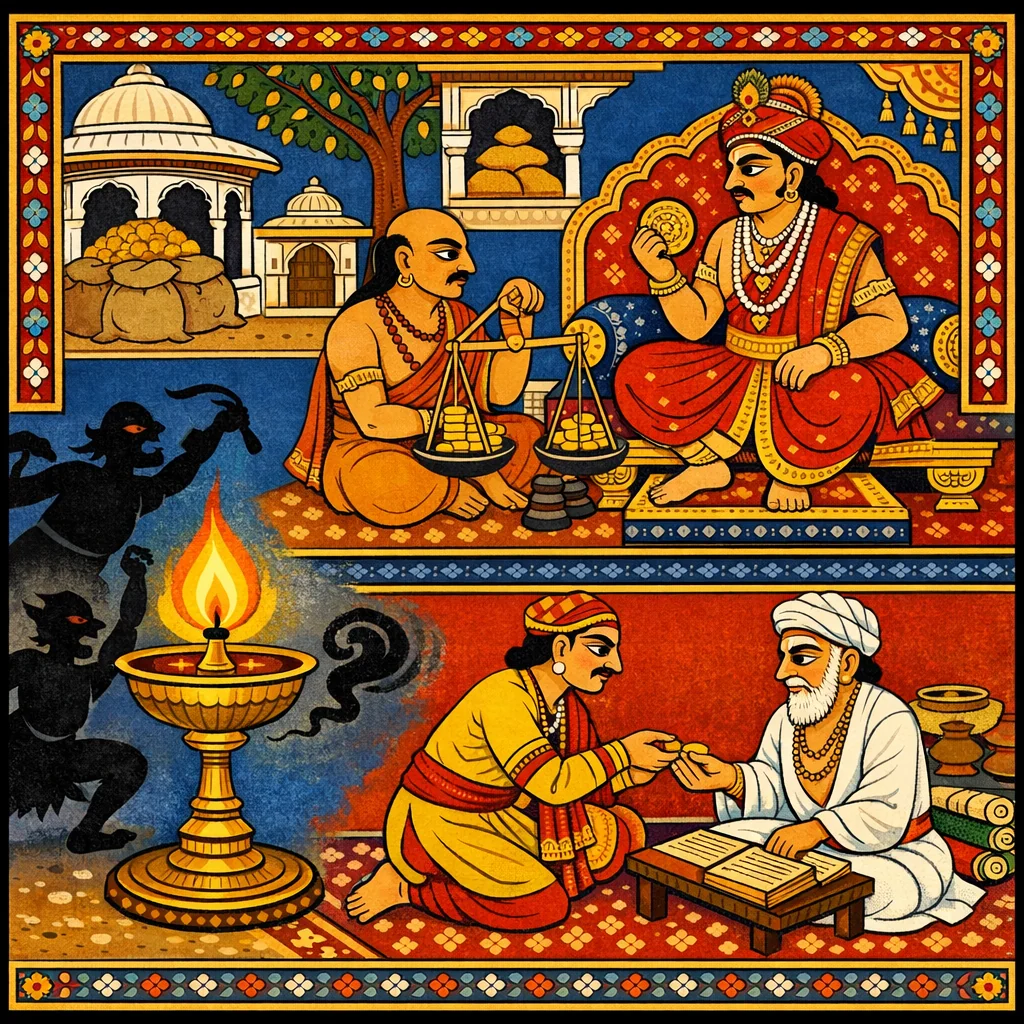
Adhyaya 8 presents a compact set of subhāṣita-style aphorisms that frame ethical and strategic life through contrasts: inferior–middling–superior aims, purity–impurity, knowledge–ignorance, satisfaction–dissatisfaction, and merit–birth. Several verses articulate a historical hierarchy of values in which “honor” (māna) is treated as a higher currency than wealth, and learning (vidyā) is depicted as universally esteemed. The chapter also contains ritual and bodily-regimen observations (e.g., bathing, water as medicine) and moral-causal metaphors (a lamp consuming darkness yet producing soot; food shaping the nature of offspring/subjects). It records archaic social classifications and boundary-making language (e.g., references to caṇḍāla and yavana) as part of premodern discourse on purity, status, and outsider identity. Governance and social stability appear indirectly through claims about the consequences of incompetent action, leaderly cleanliness/security, and the fragility of institutions without proper intent (bhāva/śraddhā). Overall, the material functions as archival evidence for classical Indian ethical-political commonplaces rather than a systematic treatise.
Key Concepts
Key Principles
Strategic Themes
Shlokas in Chapter 8
Verse 1
अधमा धनमिच्छन्ति धनमानौ च मध्यमाः । उत्तमा मानमिच्छन्ति मानो हि महतां धनम् ॥
The low seek wealth; the middling seek wealth and honor; the highest seek honor, for honor is the wealth of the great.
Verse 2
इक्षुरापः पयो मूलं ताम्बूलं फलमौषधम् । भक्षयित्वापि कर्तव्याः स्नानदानादिकाः क्रियाः ॥
Even after consuming sugarcane, water, milk, roots, betel, fruits, and medicines, customary acts such as bathing, charitable giving, and related observances should still be performed.
Verse 3
दीपो भक्षयते ध्वान्तं कज्जलं च प्रसूयते । यदन्नं भक्षयते नित्यं जायते तादृशी प्रजा ॥
A lamp consumes darkness, yet it also produces soot. Whatever is continually consumed as “food,” a people of that very kind comes to be.
Verse 4
वित्तं देहि गुणान्वितेषु मतिमन्नान्यत्र देहि क्वचित् प्राप्तं वारिनिधेर्जलं घनमुखे माधुर्ययुक्तं सदा । जीवान्स्थावरजंगमांश्च सकलान्संजीव्य भूमण्डलं भूयः पश्य तदेव कोटिगुणितं गच्छन्तमम्भोनिधिम् ॥
Give wealth to the virtuous and discerning; do not bestow it elsewhere. Water drawn from the ocean, reaching the face of a rain-cloud, becomes sweet, revives all beings and sustains the earth—then returns to the sea multiplied many times over.
Verse 5
चाण्डालानां सहस्रैश्च सूरिभिस्तत्त्वदर्शिभिः । एको हि यवनः प्रोक्तो न नीचो यवनात्परः ॥
Even set against thousands of caṇḍālas and sages who see the truth, a single “yavana” is called the lowest; nothing is regarded as lower than a yavana.
Verse 6
तैलाभ्यङ्गे चिताधूमे मैथुने क्षौरकर्मणि । तावद्भवति चाण्डालो यावत्स्नानं न चाचरेत् ॥
With oil-anointing, smoke from a funeral pyre, sexual intercourse, and shaving, one is said to be like a “cāṇḍāla” until one has bathed.
Verse 7
अजीर्णे भेषजं वारि जीर्णे वारि बलप्रदम् । भोजने चामृतं वारि भोजनान्ते विषापहम् ॥
In indigestion, water is medicine; after digestion, water gives strength. With a meal, water is like nectar; at the end of eating, water removes the effect of poison.
Verse 8
हतं ज्ञानं क्रियाहीनं हतश्चाज्ञानतो नरः । हतं निर्णायकं सैन्यं स्त्रियो नष्टा ह्यभर्तृकाः ॥
Knowledge without practice is ruined; a person is ruined by ignorance. An army without a decisive commander is ruined; and a woman without a husband, in the old social norm, is said to be without protection.
Verse 9
वृद्धकाले मृता भार्या बन्धुहस्तगतं धनम् । भोजनं च पराधीनं तिस्रः पुंसां विडम्बनाः ॥
Three humiliations for a man: a wife dying in old age, wealth falling under relatives’ control, and food that depends on others.
Verse 10
नाग्निहोत्रं विना वेदा न च दानं विना क्रिया । न भावेन विना सिद्धिस्तस्माद्भावो हि कारणम् ॥
Without agnihotra the Vedas are not truly realized; without giving, action is not complete. Without inner disposition (bhāva), success is not attained; therefore bhāva is the cause.
Verse 11
काष्ठपाषाणधातूनां कृत्वा भावेन सेवनम् । श्रद्धया च तथा सिद्धिस्तस्य विष्णुप्रसादतः ॥
Even wood, stone, and metal, when approached with devotional intent and tended with faith, are said to yield efficacy; that efficacy is by the grace of Viṣṇu.
Verse 12
न देवो विद्यते काष्ठे न पाषाणे न मृण्मये । भावे हि विद्यते देवस्तस्माद्भावो हि कारणम् ॥
Divinity is not in wood, nor in stone, nor in clay. Divinity is in bhāva—inner disposition; therefore bhāva is the cause.
Verse 13
शान्तितुल्यं तपो नास्ति न सन्तोषात्परं सुखम् । अपत्यं च कलत्रं च सतां सङ्गतिरेव च ॥
No austerity equals peace; no happiness surpasses contentment. Children, a spouse, and the company of the virtuous are prized goods.
Verse 14
क्रोधो वैवस्वतो राजा तृष्णा वैतरणी नदी। विद्या कामदुधा धेनुः संतोषो नन्दनं वनम्॥
Anger is King Vaivasvata (Yama); craving is the Vaitaraṇī river. Knowledge is the wish-fulfilling cow; contentment is the Nandana grove.
Verse 15
गुणो भूषयते रूपं शीलं भूषयते कुलम् । प्रासादशिखरस्थोऽपि काकः किं गरुडायते ॥
Virtue adorns beauty; good conduct adorns lineage. Even if a crow stands on a palace peak, it does not become Garuḍa.
Verse 16
निर्गुणस्य हतं रूपं दुःशीलस्य हतं कुलम् । असिद्धस्य हता विद्या ह्यभोगेन हतं धनम् ॥
Beauty is ruined in one without virtue; lineage is ruined in one of bad conduct. Learning is ruined when not brought to fruition; wealth is ruined when not put to use.
Verse 17
शुद्धं भूमिगतं तोयं शुद्धा नारी पतिव्रता । शुचिः क्षेमकरो राजा सन्तोषो ब्राह्मणः शुचिः ॥
Pure is the water found within the earth; pure is the wife devoted to her husband. Pure is the king who is clean and brings security; pure is the Brahmin who is clean and content.
Verse 18
असन्तुष्टा द्विजा नष्टाः सन्तुष्टाश्च महीभृतः । सलज्जा गणिका नष्टा निर्लज्जाश्च कुलाङ्गना ॥
A dissatisfied brahmin is deemed ruined; a ruler who is content and complacent is also deemed ruined. A modest courtesan is deemed ruined; and a shameless woman of a respectable household is likewise ruined.
Verse 19
किं कुलेन विशालेन विद्याहीनेन देहिनाम् । दुष्कुलं चापि विदुषो देवैरपि स पूज्यते ॥
What use is a great lineage to one who lacks learning? Even a man of low birth, if learned, is honored—by the gods themselves.
Verse 20
विद्वान्प्रशस्यते लोके विद्वान् सर्वत्र पूज्यते । विद्यया लभते सर्वं विद्या सर्वत्र पूज्यते ॥
The learned are praised in the world and honored everywhere. Through learning one gains all; learning is revered in every place.
Verse 21
ऋणकर्ता पिता शत्रुर्माता च व्यभिचारिणी । भार्या रूपवती शत्रुः पुत्रः शत्रुरपण्डितः ॥
A father who brings debt is an enemy; a mother who is sexually wayward is an enemy. A wife of excessive beauty is an enemy; an unlearned son is an enemy.
Verse 22
मांसभक्ष्यैः सुरापानैर्मुखैश्चाक्षरवर्जितैः । पशुभिः पुरुषाकारैर्भाराक्रान्ता हि मेदिनी ॥
The earth is weighed down by beasts in human form—meat-eaters, drinkers of liquor, and mouths without letters (without learning).
Verse 23
अन्नहीनो दहेद्राष्ट्रं मन्त्रहीनश्च ऋत्विजः । यजमानं दानहीनो नास्ति यज्ञसमो रिपुः ॥
A realm without food is consumed; a priest without mantras ruins the rite; a sacrificer without gifts harms the sacrifice. No enemy equals a sacrifice when its supports are lacking.
Frequently Asked Questions
The chapter repeatedly treats internal disposition—bhāva (intent, mental orientation) and śraddhā (trust/faith)—as the decisive causal factor behind efficacy in ritual, devotion, and success, while also framing vidyā (learning) and māna (honor) as higher-order social values than material gain.
Relationships are described through cautionary typologies that cast certain close relations as potential adversaries under specific conditions (e.g., indebted father, unchaste mother, very beautiful wife, unlearned son), and through social-status boundary markers (e.g., outsider labels), reflecting historical norms of trust, risk, and social ranking.
Rather than outlining statecraft procedures, the verses supply ethical-psychological and reputational premises that also appear in wider niti and nīti-kathā traditions (including the Panchatantra) and resonate with Arthashastra-era concerns: competence, intent, social cohesion, and the political utility of learning, discipline, and perceived purity as markers of authority.