Chapter 6: On Learning, Time, Social Bonds, and Strategic Dispositions
Adhyaya 6
Mastery Over the Senses and the Mind
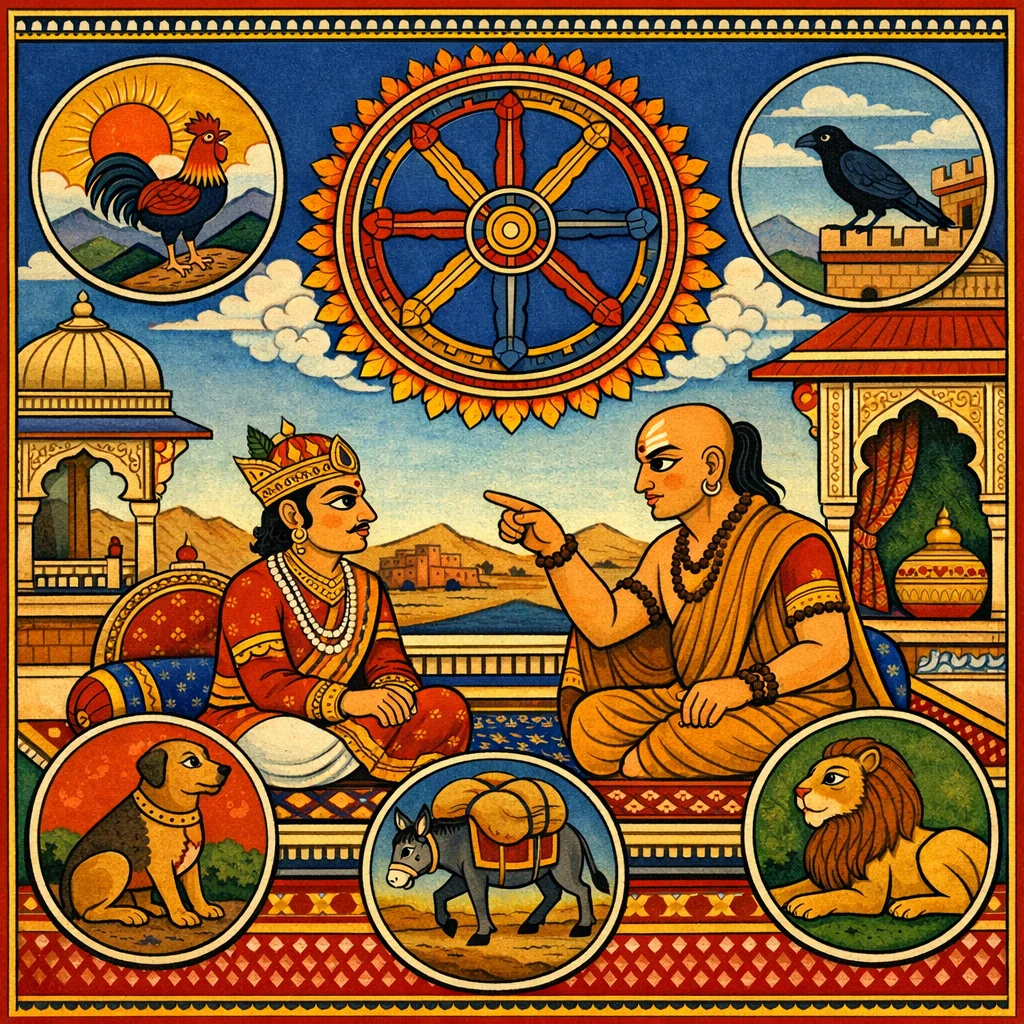
Adhyaya 6 presents a compact set of subhāṣita-style aphorisms that frame ethical and strategic life as an interplay of learning (śravaṇa), self-agency, social reciprocity, and the inescapability of time (kāla). The chapter begins by elevating hearing/learning as a vehicle for dharma, knowledge, and liberation, then shifts to classificatory social observations that mark purity, blame, and status through vivid comparisons. Several verses describe historically situated views of kingship, Brahmin authority, and gendered mobility, functioning as archaic social commentary rather than universal instruction. The text emphasizes wealth as a determinant of social networks, fate-like “becoming” (bhavitavyatā) shaping intelligence and alliances, and the moral logic of karma wherein the individual experiences the fruit of actions. It also records notions of transferred culpability within institutions (king–priest, husband–wife, teacher–student). The closing sequence uses animal exempla (lion, rooster, crow, dog, donkey) to catalogue tactical virtues—initiative, vigilance, distribution, caution, endurance—culminating in a composite profile of “invincibility” in varied operational conditions.
Key Concepts
Key Principles
Strategic Themes
Shlokas in Chapter 6
Verse 1
श्रुत्वा धर्मं विजानाति श्रुत्वा त्यजति दुर्मतिम् । श्रुत्वा ज्ञानमवाप्नोति श्रुत्वा मोक्षमवाप्नुयात् ॥
By hearing, one understands dharma; by hearing, one abandons misguided thought. By hearing, one gains knowledge; by hearing, one may attain liberation (mokṣa).
Verse 2
पक्षिणः काकश्चण्डालः पशूनां चैव कुक्कुरः । मुनीनां पापश्चण्डालः सर्वचाण्डालनिन्दकः ॥
Among birds, the crow is called a caṇḍāla; among animals, the dog likewise. Among sages, the sinful one is a caṇḍāla—and he is the one who reviles all caṇḍālas.
Verse 3
भस्मना शुद्ध्यते कास्यं ताम्रमम्लेन शुद्ध्यति । रजसा शुद्ध्यते नारी नदी वेगेन शुद्ध्यति ॥
Bell-metal is cleansed by ash; copper is cleansed by an acid. A woman is cleansed by menstrual blood; a river is cleansed by the force of its current.
Verse 4
भ्रमन्सम्पूज्यते राजा भ्रमन्सम्पूज्यते द्विजः । भ्रमन्सम्पूज्यते योगी स्त्री भ्रमन्ती विनश्यति ॥
A king is honored even while roaming; a twice-born (learned) man is honored even while roaming. A yogin is honored even while roaming; but a woman who roams is said to come to ruin.
Verse 5
यस्यार्थास्तस्य मित्राणि यस्यार्थास्तस्य बान्धवाः । यस्यार्थाः स पुमाँल्लोके यस्यार्थाः स च पण्डितः ॥
He who has wealth has friends; he who has wealth has kin. He who has wealth is deemed a man of consequence in the world; he who has wealth is deemed learned as well.
Verse 6
तादृशी जायते बुद्धिर्व्यवसायोऽपि तादृशः । सहायास्तादृशा एव यादृशी भवितव्यता ॥
As the intellect arises, so does determination; and so too are one’s companions—according to the destiny that is to unfold.
Verse 7
कालः पचति भूतानि कालः संहरते प्रजाः । कालः सुप्तेषु जागर्ति कालो हि दुरतिक्रमः ॥
Time ripens all beings; Time also dissolves peoples. Time stays awake while others sleep; Time is truly hard to overcome.
Verse 8
न पश्यति च जन्मान्धः कामान्धो नैव पश्यति । मदोन्मत्ता न पश्यन्ति अर्थी दोषं न पश्यति ॥
The blind from birth do not see; those blinded by desire do not see either. Those intoxicated with pride do not see; the profit-driven do not perceive fault.
Verse 9
स्वयं कर्म करोत्यात्मा स्वयं तत्फलमश्नुते । स्वयं भ्रमति संसारे स्वयं तस्माद्विमुच्यते॥
The self performs its deeds itself and itself partakes of their fruits; it wanders in saṃsāra by itself, and by itself is released from it.
Verse 10
राजा राष्ट्रकृतं पापं राज्ञः पापं पुरोहितः । भर्ता च स्त्रीकृतं पापं शिष्यपापं गुरुस्तथा ॥
The king bears the sin committed by the realm; the royal priest bears the king’s sin. The husband bears the sin committed by the wife; likewise the teacher bears the student’s sin.
Verse 11
ऋणकर्ता पिता शत्रुर्माता च व्यभिचारिणी । भार्या रूपवती शत्रुः पुत्रः शत्रुरपण्डितः ॥
A father who incurs debt is an enemy; a mother who is unfaithful is an enemy. A wife of excessive beauty is an enemy; a son without learning is an enemy.
Verse 12
लुब्धमर्थेन गृह्णीयात् स्तब्धमञ्जलिकर्मणा । मूर्खं छन्दोऽनुवृत्त्या च यथार्थत्वेन पण्डितम् ॥
Win the greedy with gain; soften the arrogant with deference. Lead the fool by agreeable compliance; address the learned with truthful, accurate speech.
Verse 13
वरं न राज्यं न कुराजराज्यं वरं न मित्रं न कुमित्रमित्रम् । वरं न शिष्यो न कुशिष्यशिष्यो वरं न दार न कुदरदारः ॥
Better no kingdom than a realm under a bad king; better no friend than a bad friend. Better no student than a bad student; better no spouse than a bad spouse.
Verse 14
कुराजराज्येन कुतः प्रजासुखं कुमित्रमित्रेण कुतोऽभिनिर्वृतिः । कुदारदारैश्च कुतो गृहे रतिः कुशिष्यशिष्यमध्यापयतः कुतो यशः ॥
Under a bad king, where is the people’s happiness? With a friend who is truly a bad ally, where is contentment? With a bad spouse, where is joy at home? For a teacher teaching a bad student, where is renown?
Verse 15
सिंहादेकं बकादेकं शिक्षेच्चत्वारि कुक्कुटात् । वायसात्पञ्च शिक्षेच्च षट्शुनस्त्रीणि गर्दभात् ॥
Learn one thing from the lion, one from the crane, four from the rooster; five from the crow, six from the dog, and three from the donkey.
Verse 16
प्रभूतं कार्यमल्पं वा यन्नरः कर्तुमिच्छति । सर्वारम्भेण तत्कार्यं सिंहादेकं प्रचक्षते ॥
Whether the task is great or small, if a man wishes to do it, he should begin it with full effort—like a lion’s single decisive charge.
Verse 17
इन्द्रियाणि च संयम्य रागद्वेषविवर्जितः । समदुःखसुखः शान्तः तत्त्वज्ञः साधुरुच्यते ॥
He is called a “sādhu” who restrains the senses, is free from attachment and aversion, meets pleasure and pain with equanimity, is calm, and knows the true principles (tattva).
Verse 18
प्रत्युत्थानं च युद्धं च संविभागं च बन्धुषु । स्वयमाक्रम्य भुक्तं च शिक्षेच्चत्वारि कुक्कुटात् ॥
From the rooster one should learn four things: rising promptly, fighting when needed, sharing portions among one’s kin, and eating what one has gained by one’s own initiative.
Verse 19
गूढमैथुनचारित्वं काले काले च सङ्ग्रहम् । अप्रमत्तमविश्वासं पञ्च शिक्षेच्च वायसात् ॥
From the crow one should learn five traits: discretion in sexual conduct, storing up at intervals, gathering at the proper time, constant vigilance, and cautious distrust—do not trust too easily.
Verse 20
बह्वाशी स्वल्पसन्तुष्टः सनिद्रो लघुचेतनः । स्वामिभक्तश्च शूरश्च षडेते श्वानतो गुणाः ॥
Six traits are found in a dog: it eats much, is satisfied with little, sleeps readily, keeps a light (unburdened) mind, is devoted to its master, and is brave.
Verse 21
सुश्रान्तोऽपि वहेद्भारं शीतोष्णं न च पश्यति । सन्तुष्टश्चरते नित्यं त्रीणि शिक्षेच्च गर्दभात् ॥
Even when worn out, it bears the load, noticing neither cold nor heat; ever moving, it remains content. Learn these three traits from the donkey.
Verse 22
य एतान्विंशतिगुणानाचरिष्यति मानवः । कार्यावस्थासु सर्वासु अजेयः स भविष्यति ॥
Whoever practices these twenty qualities becomes unconquerable at every stage of any undertaking.
Frequently Asked Questions
The chapter foregrounds a historical niti framework in which learning (śravaṇa) is portrayed as a conduit to dharma and knowledge, while personal agency is emphasized through karma: the self performs actions and experiences their results. This is paired with a strong determinative role for kāla (time), described as unavoidable and governing worldly processes.
Relationships are described through pragmatic and institutional lenses: wealth (artha) is depicted as shaping friendships and kin-like bonds; certain family roles are framed as potential adversarial conditions (e.g., debt-bearing father, unchaste mother, unlearned son) as a form of social warning taxonomy; and responsibility is presented as transferable within hierarchies (king–priest, husband–wife, teacher–student).
The chapter aligns with broader South Asian didactic traditions by combining moral causality (karma), political sociology (networks around artha), and tactical virtues encoded via animal exempla—an approach also seen in the Panchatantra’s instructional fables. Its attention to kingship, counsel, and operational traits resonates with the Arthashastra’s concern for governance and strategic conduct, though here expressed in condensed aphoristic form suitable for mnemonic transmission.