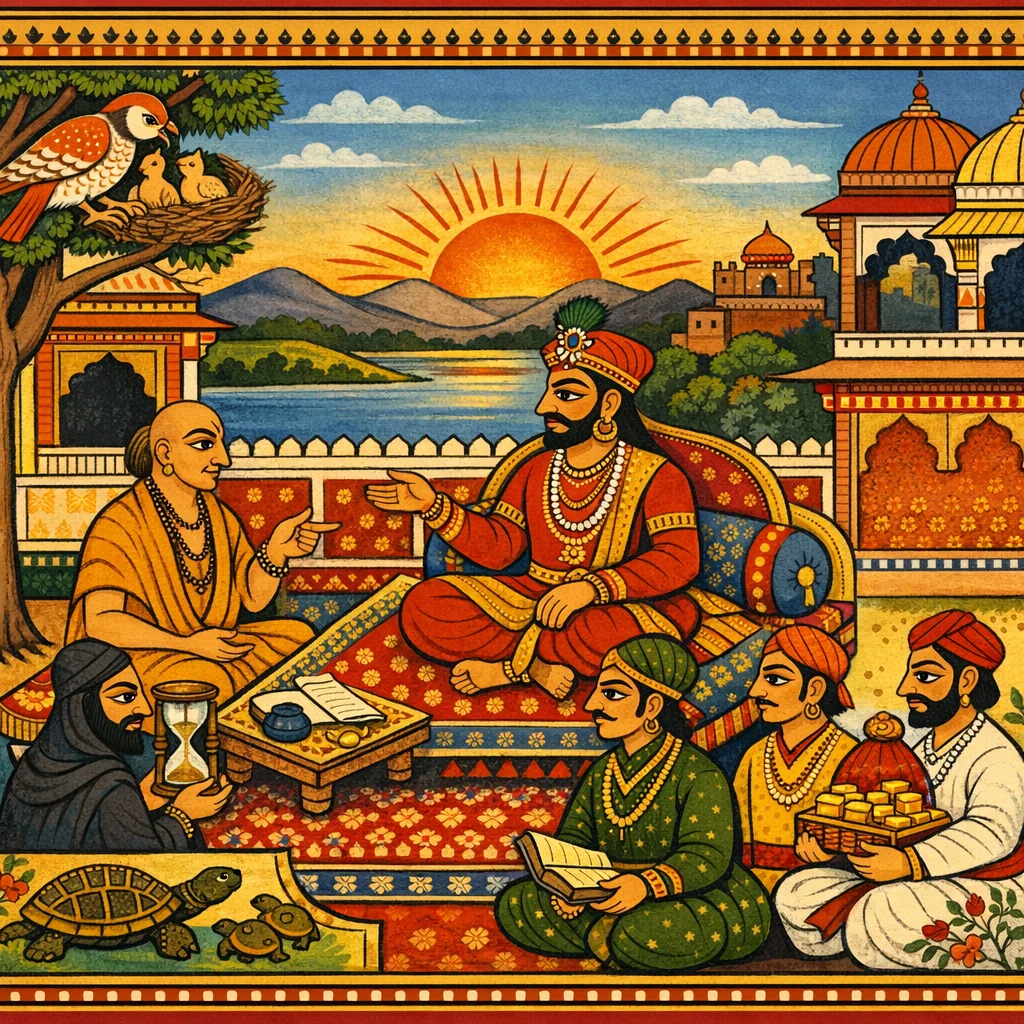
Chapter 4: On Fate, Learning, Family, and Practical Social Conduct
Adhyaya 4
Strategic Thinking and the Use of Strength
Adhyaya 4 presents a cluster of subhāṣita-style aphorisms organized around pragmatic social ethics and household-centered strategy. The chapter opens with a deterministic motif: lifespan, action, wealth, learning, and death are described as pre-formed conditions, framing human agency within a larger cosmological order. Subsequent verses emphasize the social utility of association with the virtuous, portraying moral influence through natural metaphors of care and proximity. A recurring concern is the evaluation of persons and relationships—children, spouses, teachers, and kin—through the lenses of competence (guṇa), loyalty, and reliability, reflecting historical norms of lineage, domestic stability, and reputational capital. Learning is depicted as mobile, protected wealth with instrumental value in travel and adversity, aligning with classical Indian valorizations of vidyā as both status and resource. The chapter also records archaic social observations on marriage, widowhood, poverty, and aging, treating them as experiential categories within traditional household ideology. Overall, it functions as a compact manual of situational judgment—time, place, allies, expenditures, and personal capacity—typical of nīti literature’s intersection of ethics and strategy.
Key Concepts
Key Principles
Strategic Themes
Shlokas in Chapter 4
Verse 1
आयुः कर्म च वित्तं च विद्या निधनमेव च । पञ्चैतानि हि सृज्यन्ते गर्भस्थस्यैव देहिनः ॥
Lifespan, karma (one’s allotted deeds), wealth, learning, and death—these five are said to be set for the embodied being while still in the womb.
Verse 2
साधुभ्यस्ते निवर्तन्ते पुत्रमित्राणि बान्धवाः । ये च तैः सह गन्तारस्तद्धर्मात्सुकृतं कुलम् ॥
Through association with the virtuous (sādhu), one’s children, friends, and relatives do not turn away; and those who go along with them share in that dharma. By that dharma, the family line is firmly established through merit.
Verse 3
दर्शनध्यानसंस्पर्शैर्मत्सी कूर्मी च पक्षिणी । शिशुं पालयते नित्यं तथा सज्जन-संगतिः ॥
The verse describes a traditional comparison: a fish, a tortoise, and a bird are said to nurture their young respectively through sight, mental attention, and physical contact; in the same manner, association with the virtuous (sajjana-saṅgati) is portrayed as continually protective and sustaining.
Verse 4
यावत्स्वस्थो ह्ययं देहो यावन्मृत्युश्च दूरतः । तावदात्महितं कुर्यात्प्राणान्ते किं करिष्यति ॥
The verse describes a traditional view that, so long as the body remains healthy and death is still distant, one undertakes what is considered beneficial for oneself; when life-breath reaches its end, it suggests, little remains to be done.
Verse 5
कामधेनुगुणा विद्या ह्यकाले फलदायिनी । प्रवासे मातृसदृशी विद्या गुप्तं धनं स्मृतम् ॥
The verse describes learning (vidyā) as possessing the qualities of a wish-fulfilling cow (kāmadhenu), understood as yielding results even when the time is inopportune. It further portrays learning as mother-like during travel or exile, and characterizes it in tradition as a form of concealed wealth.
Verse 6
एकोऽपि गुणवान्पुत्रो निर्गुणेन शतेन किम् । एकश्चन्द्रस्तमो हन्ति न च ताराः सहस्रशः ॥
The verse describes a traditional valuation of quality over quantity: even a single son possessing merit is portrayed as more significant than a hundred lacking merit. It further frames this idea through a celestial metaphor, stating that one moon dispels darkness, whereas thousands of stars do not (in the same way).
Verse 7
मूर्खश्चिरायुर्जातोऽपि तस्माज्जातमृतो वरः । मृतः स चाल्पदुःखाय यावज्जीवं जडो दहेत् ॥
The verse presents a traditional valuation in which a long-lived fool is depicted as less preferable than one who is stillborn; it further suggests that the latter brings only limited grief, whereas a dull person is portrayed as causing ongoing affliction for as long as they live.
Verse 8
कुग्रामवासः कुलहीनसेवा कुभोजनं क्रोधमुखी च भार्या । पुत्रश्च मूर्खो विधवा च कन्या विनाग्निना षट्प्रदहन्ति कायम् ॥
Living in a bad village, serving the low-born, poor food, an anger-faced wife; a foolish son and a widowed daughter—these six burn the body even without fire.
Verse 9
किं तया क्रियते धेन्वा या न दोग्ध्री न गर्भिणी । कोऽर्थः पुत्रेण जातेन यो न विद्वान् न भक्तिमान् ॥
What use is a cow that gives no milk and is not pregnant? What use is a son who is neither learned nor devoted?
Verse 10
संसारतापदग्धानां त्रयो विश्रान्तिहेतवः । अपत्यं च कलत्रं च सतां सङ्गतिरेव च ॥
For those scorched by the heat of worldly life, there are three causes of rest: children, a spouse, and the company of the virtuous.
Verse 11
सकृज्जल्पन्ति राजानः सकृज्जल्पन्ति पण्डिताः । सकृत्कन्याः प्रदीयन्ते त्रीण्येतानि सकृत्सकृत् ॥
A king speaks once, a scholar speaks once, and a daughter is given in marriage once—these three are matters of once only.
Verse 12
एकाकिना तपो द्वाभ्यां पठनं गायनं त्रिभिः । चतुर्भिर्गमनं क्षेत्रं पञ्चभिर्बहुभी रणः ॥
Austerity is for one alone; study for two; singing for three; travel for four; fieldwork for five; battle for many.
Verse 13
सा भार्या या शुचिर्दक्षा सा भार्या या पतिव्रता । सा भार्या या पतिप्रीता सा भार्या सत्यवादिनी ॥
A true wife is pure and capable; devoted to her husband, pleasing to him, and truthful in speech.
Verse 14
अपुत्रस्य गृहं शून्यं दिशः शून्यास्त्वबान्धवाः । मूर्खस्य हृदयं शून्यं सर्वशून्या दरिद्रता ॥
For one without a son, the house is empty; for one without kin, the directions are empty; for a fool, the heart is empty; and poverty makes everything empty.
Verse 15
अनभ्यासे विषं शास्त्रमजीर्णे भोजनं विषम् । दरिद्रस्य विषं गोष्ठी वृद्धस्य तरुणी विषम् ॥
Without practice, a treatise is poison; when undigested, food is poison; for the poor, social gatherings are poison; for the old, a young woman is poison.
Verse 16
त्यजेद्धर्मं दयाहीनं विद्याहीनं गुरुं त्यजेत् । त्यजेत्क्रोधमुखीं भार्यां निःस्नेहान्बान्धवांस्त्यजेत् ॥
Abandon dharma devoid of compassion; abandon a teacher devoid of learning; abandon a wife ruled by anger; abandon relatives devoid of affection.
Verse 17
अध्वा जरा देहवतां पर्वतानां जलं जरा । अमैथुनं जरा स्त्रीणां वस्त्राणामातपो जरा ॥
For embodied beings, travel brings wear; for mountains, water brings wear; for women, lack of union brings wear; for garments, the sun brings wear.
Verse 18
कः कालः कानि मित्राणि को देशः कौ व्ययागमौ । कश्चाहं का च मे शक्तिरिति चिन्त्यं मुहुर्मुहुः ॥
What is the right time, who are my allies, what is the place, how are expense and income; who am I and what is my strength—these should be pondered again and again.
Verse 19
अग्निर्देवो द्विजातीनां मुनीनां हृदि दैवतम् । प्रतिमा स्वल्पबुद्धीनां सर्वत्र समदर्शिनः ॥
For the twice-born, fire (Agni) is divine; for sages, the divine dwells in the heart; for the small-minded, an image is the divine. The even-seeing perceives equally everywhere.
Frequently Asked Questions
The text foregrounds a historically common nīti premise of constrained agency: key life factors (e.g., lifespan, wealth, learning, and death) are described as predetermined, while practical wisdom is expressed as discerning action within those constraints—especially through self-interest, reputation, and social stability.
Relationships are treated in functional categories: virtuous associates whose proximity shapes conduct; household relations (spouse, child, kin) evaluated by qualities such as competence, fidelity, and affection; and socially risky ties (e.g., unreliable teachers, hostile spouses, unsympathetic relatives) framed as liabilities within a household economy of trust.
The aphorisms align with broader classical strategy literature by emphasizing situational calculation (time, place, allies, income/expenditure, and capacity) and the instrumental value of knowledge. Comparable concerns appear in the Arthaśāstra’s attention to resources and assessment of persons, and in the Pañcatantra’s use of moralized social observation, though here expressed in compressed household-centered maxims.