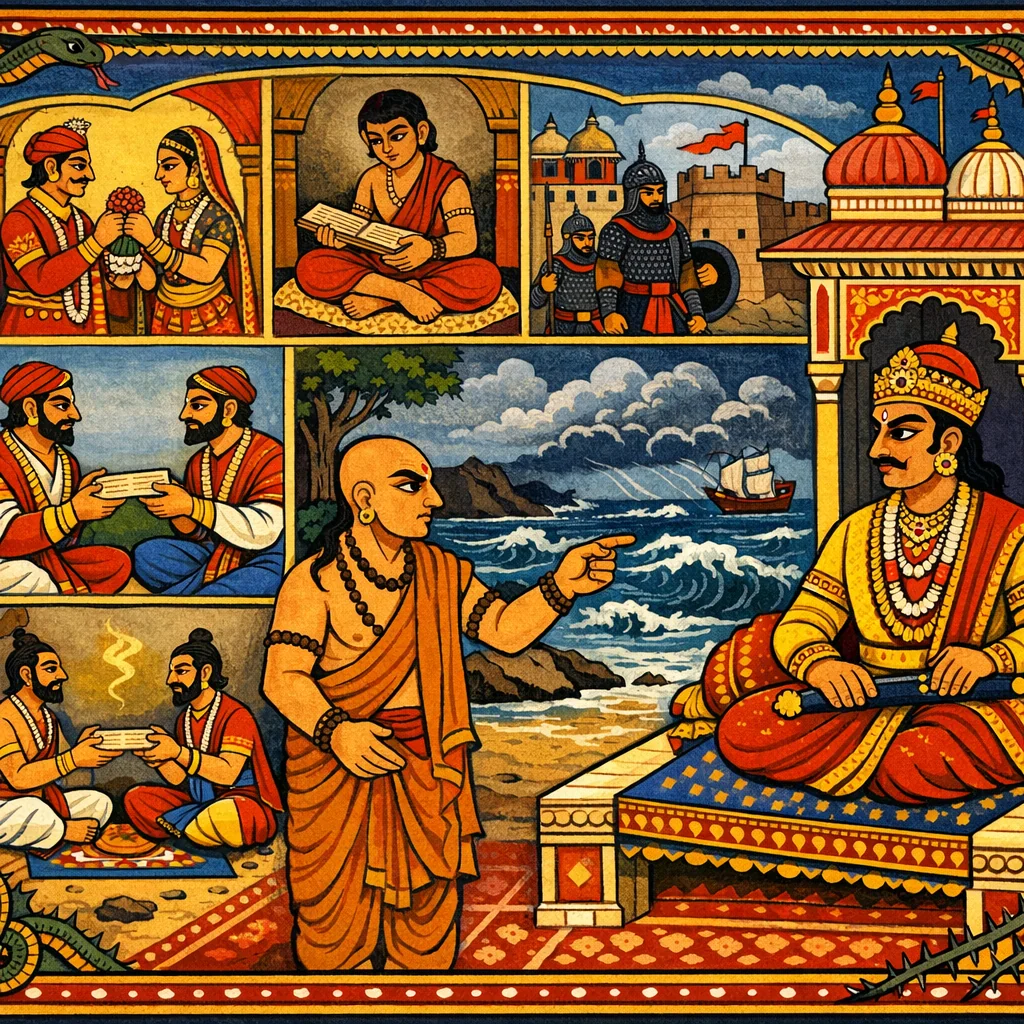
Chapter 3: Chapter 3: Social Conduct, Prudence, and Character in Nīti Literature
अध्याय ३
Marks of Intelligence, Virtue, and Inner Strength
Adhyaya 3 presents a compact set of subhāṣita-style aphorisms that frame ethical life and political prudence through everyday social observation. The verses stress the universality of imperfection and misfortune, then turn to markers of identity and reputation (ācāra, speech, comportment, bodily signs). Several stanzas outline pragmatic relationship management—marriage alliances, education, friendship, and the strategic placement of enemies—reflecting a historical idiom of household and courtly calculation. Recurrent metaphors contrast the predictable danger of a snake with the pervasive harm attributed to a “durjana,” and juxtapose the stabilizing role of “sādhus” against motifs of social breakdown. The chapter also preserves archaic social ideals: chastity as a feminine virtue, discipline in child-rearing, and lineage-centered evaluations of offspring. Alongside these, it articulates proportionality (avoidance of extremes), resilience (industry, vigilance), and the classical four aims (dharma-artha-kāma-mokṣa) as a framework for evaluating a life. For archival research, the unit documents how early ethical-political pedagogy blended moral psychology, kinship strategy, and risk management into memorable, portable maxims.
Key Concepts
Key Principles
Strategic Themes
Shlokas in Chapter 3
Verse 1
कस्य दोषः कुले नास्ति व्याधिना को न पीडितः । व्यसनं केन न प्राप्तं कस्य सौख्यं निरन्तरम् ॥
The verse presents a generalized observation found in the nīti tradition: no lineage is described as entirely free of fault; no person is described as untouched by illness; no one is described as not encountering misfortune; and no one is described as possessing uninterrupted happiness.
Verse 2
आचारः कुलमाख्याति देशमाख्याति भाषणम् । सम्भ्रमः स्नेहमाख्याति वपुराख्याति भोजनम् ॥
The verse describes a traditional view that a person’s conduct indicates their family background; speech indicates their region; respectful attentiveness indicates affection; and the body indicates one’s manner of nourishment.
Verse 3
सुकुले योजयेत्कन्यां पुत्रं विद्यासु योजयेत् । व्यसने योजयेच्छत्रुं मित्रं धर्मेण योजयेत् ॥
The verse describes a traditional scheme of social placement and strategic alignment: a daughter is associated with a ‘good family’, a son with fields of learning, an enemy with times of adversity (as a factor to be engaged or accounted for), and a friend with dharma (ethical duty or normative order).
Verse 4
दुर्जनस्य च सर्पस्य वरं सर्पो न दुर्जनः । सर्पो दंशति काले तु दुर्जनस्तु पदे पदे ॥
Between a wicked man and a snake, the snake is preferable. A snake bites at a certain time; the wicked harm at every step.
Verse 5
एतदर्थे कुलीनानां नृपाः कुर्वन्ति सङ्ग्रहम् । आदिमध्यावसानेषु न ते गच्छन्ति विक्रियाम् ॥
For this reason kings keep the company and patronage of the well-born: at the beginning, middle, and end of affairs, they do not waver or deviate.
Verse 6
प्रलये भिन्नमर्यादा भवन्ति किल सागराः । सागरा भेदमिच्छन्ति प्रलयेऽपि न साधवः ॥
At pralaya the oceans are said to lose their bounds; yet the virtuous, even in pralaya, do not desire division or schism.
Verse 7
मूर्खस्तु प्रहर्तव्यः प्रत्यक्षो द्विपदः पशुः । भिद्यते वाक्य-शल्येन अदृशं कण्टकं यथा ॥
A fool must be checked—an obvious two-footed beast. He is pierced by the barb of words, as an unseen thorn is driven out.
Verse 8
रूपयौवनसम्पन्ना विशालकुलसम्भवाः । विद्याहीना न शोभन्ते निर्गन्धाः किंशुका यथा ॥
Even with beauty, youth, and noble birth, without learning they do not shine—like kiṃśuka blossoms without fragrance.
Verse 9
कोकिलानां स्वरो रूपं स्त्रीणां रूपं पतिव्रतम् । विद्या रूपं कुरूपाणां क्षमा रूपं तपस्विनाम् ॥
A cuckoo’s form is its voice; a woman’s form is fidelity to her husband. Learning is the form of the ill-favoured; forbearance is the form of ascetics.
Verse 10
त्यजेदेकं कुलस्यार्थे ग्रामस्यार्थे कुलं त्यजेत् । ग्रामं जनपदस्यार्थे आत्मार्थे पृथिवीं त्यजेत् ॥
For the sake of a family, one may give up an individual; for a village, give up a family. For a realm, give up a village; for one’s own vital interest, give up even the whole earth.
Verse 11
उद्योगे नास्ति दारिद्र्यं जपतो नास्ति पातकम् । मौनेन कलहो नास्ति नास्ति जागरिते भयम् ॥
With sustained effort there is no poverty; for one who recites, there is no sin. Through silence there is no quarrel; through wakeful vigilance there is no fear.
Verse 12
अतिरूपेण वा सीता अतिगर्वेण रावणः । अतिदानाद्बलिर्बद्धो ह्यतिसर्वत्र वर्जयेत् ॥
Sītā suffered through excessive beauty; Rāvaṇa through excessive pride. Bali was bound through excessive giving—therefore, excess should be avoided in all things.
Verse 13
को हि भारः समर्थानां किं दूरं व्यवसायिनाम् । को विदेशः सुविद्यानां कः परः प्रियवादिनाम् ॥
For the capable, no task is a burden; for the enterprising, no distance is far. For the well-educated, no place is foreign; for the sweet-spoken, no one is an outsider.
Verse 14
एकेनापि सुवृक्षेण पुष्पितेन सुगन्धिना । वासितं तद्वनं सर्वं सुपुत्रेण कुलं यथा ॥
Even one excellent tree—flowering and fragrant—can perfume an entire forest; likewise, one worthy son brings honor to the whole lineage.
Verse 15
एकेन शुष्कवृक्षेण दह्यमानेन वह्निना । दह्यते तद्वनं सर्वं कुपुत्रेण कुलं यथा ॥
One dry tree, once burning, can consume an entire forest; likewise, one bad son can bring ruin upon the whole lineage.
Verse 16
एकेनापि सुपुत्रेण विद्यायुक्तेन साधुना । आह्लादितं कुलं सर्वं यथा चन्द्रेण शर्वरी ॥
Even one virtuous son, learned and upright, delights the whole lineage—just as the moon gladdens the night.
Verse 17
किं जातैर्बहुभिः पुत्रैः शोकसन्तापकारकैः । वरमेकः कुलालम्बी यत्र विश्राम्यते कुलम् ॥
What use are many sons if they bring only grief and distress? Better one who upholds the family, in whom the household finds rest and security.
Verse 18
लालयेत्पञ्चवर्षाणि दशवर्षाणि ताडयेत् । प्राप्ते तु षोडशे वर्षे पुत्रे मित्रवदाचरेत् ॥
For the first five years, cherish the child; for the next ten, discipline him; and when he reaches sixteen, treat him as a friend.
Verse 19
उपसर्गेऽन्यचक्रे च दुर्भिक्षे च भयावहे । असाधुजनसम्पर्के यः पलायेत्स जीवति ॥
In calamity, amid hostile forces, in a frightening famine, and when entangled with the wicked, the one who withdraws or escapes is the one who stays alive.
Verse 20
धर्मार्थकाममोक्षाणां यस्यैकोऽपि न विद्यते । अजागलस्तनस्येव तस्य जन्म निरर्थकम् ॥
If a person has not even one of the four aims—dharma, artha, kāma, or mokṣa—then that birth is purposeless, like the teat of a barren animal.
Verse 21
मूर्खा यत्र न पूज्यन्ते धान्यं यत्र सुसञ्चितम् । दाम्पत्ये कलहो नास्ति तत्र श्रीः स्वयमागता ॥
Where fools are not honored, where grain is well stored, and where married life has no quarrel—there prosperity (Śrī) arrives of its own accord.
Frequently Asked Questions
The text foregrounds nīti as pragmatic moral reasoning: it treats social life as shaped by imperfect conditions (defects, illness, misfortune) and proposes conduct, vigilance, proportion, and reputation-management as historically valued tools for stability in household and polity.
Relationships are framed through functional roles—spouse selection and alliance (kanyā in a good family), education for sons, friendship aligned with dharma, and adversaries treated as strategic variables (placing an enemy in times of crisis). The chapter also contrasts “sādhu” and “durjana” as recurring social types used to describe trust and harm.
The aphorisms resemble broader South Asian niti pedagogy seen in the Panchatantra’s social typologies and the Arthashastra’s attention to alliances, risk, and governance. While not a systematic treatise, the chapter functions as mnemonic political-ethical instruction, linking household order, reputation, and crisis behavior to a wider historical vocabulary of strategic thought.