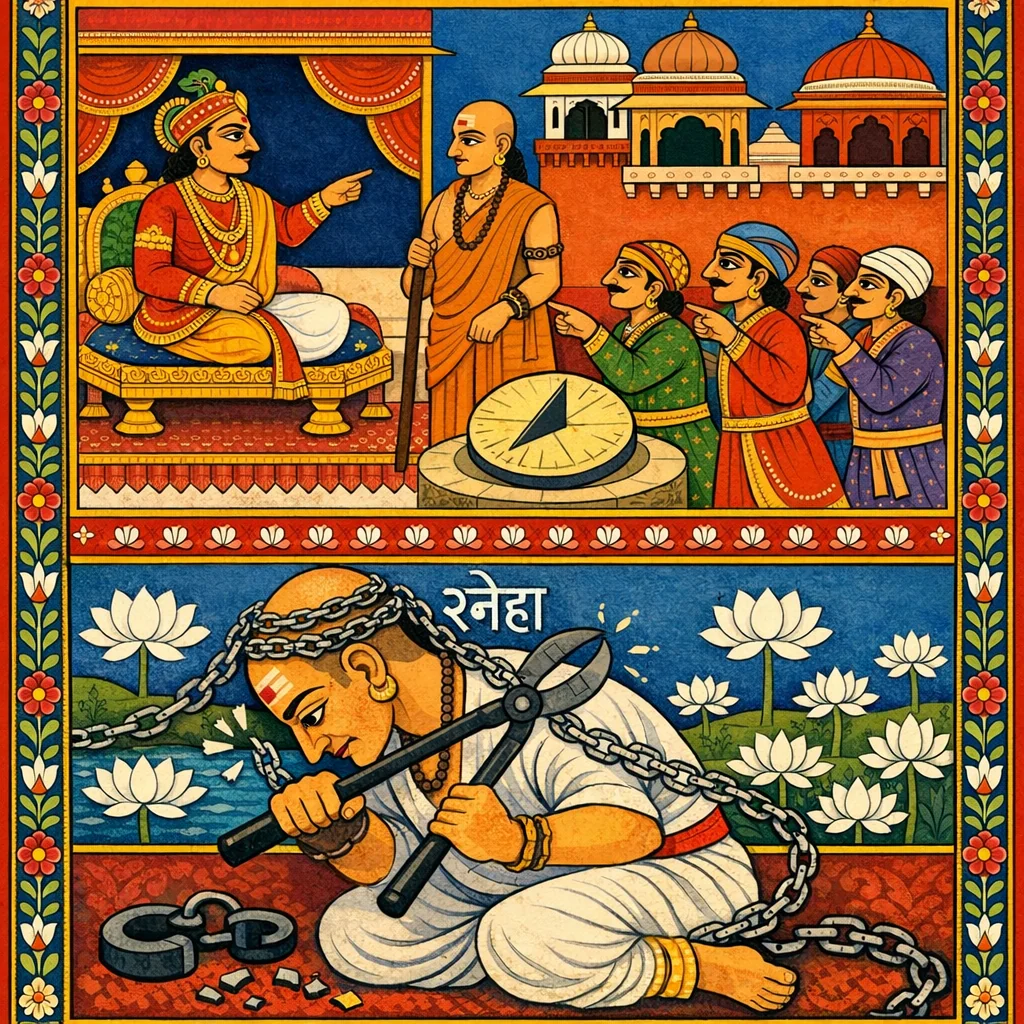
Chapter 13: On Time, Conduct, and the Causes of Bondage and Liberation
Adhyaya 13
Observations on the Strengths and Weaknesses of People
Adhyaya 13 presents a composite set of didactic aphorisms typical of Subhāṣita-style Nīti literature, moving between personal ethics, political sociology, and metaphysical assumptions. The chapter describes a preference for ethically “pure” action even if brief, contrasts prudent attention to the present with unproductive grief over the past or speculation about the future, and frames human life as shaped by preconditions (lifespan, wealth, knowledge, death) conceived as determined from conception. Several verses articulate karmic causality and reciprocity: actions are said to “follow” the agent, and learning is portrayed as attainable through service to teachers. A pronounced political theme appears in the claim that subjects mirror the ruler’s character, situating personal virtue within governance and social order. The text also treats attachment (sneha, viṣayāsaṅga) as a source of fear and suffering, contrasting bondage and liberation as mental states. The chapter closes with ideals of steadfastness and the ritual-ethical importance of honoring the guru, reflecting historical educational norms and social hierarchies.
Key Concepts
Key Principles
Strategic Themes
Shlokas in Chapter 13
Verse 1
मुहूर्तमपि जीवेच्च नरः शुक्लेन कर्मणा । न कल्पमपि कष्टेन लोकद्वयविरोधिना ॥
Better to live even for a moment by pure conduct than to live long in misery by means that oppose both worlds—this one and the next.
Verse 2
गते शोको न कर्तव्यो भविष्यं नैव चिन्तयेत् । वर्तमानेन कालेन वर्तयन्ति विचक्षणाः ॥
Do not grieve over what has passed, nor brood over the future; the discerning live in accord with the present time.
Verse 3
स्वभावेन हि तुष्यन्ति देवाः सत्पुरुषाः पिता । ज्ञातयः स्नानपानाभ्यां वाक्यदानेन पण्डिताः ॥
Deities, the virtuous, and one’s father are pleased by one’s natural disposition; kinsmen by bathing and drink; the learned by the gift of words—speech and discourse.
Verse 4
आयुः कर्म च वित्तं च विद्या निधनमेव च । पञ्चैतानि हि सृज्यन्ते गर्भस्थस्यैव देहिनः ॥
Lifespan, deeds (karma), wealth, learning, and death—these five are said to be set for a being while still in the womb.
Verse 5
अहो बत विचित्राणि चरितानि महात्मनाम् । लक्ष्मीं तृणाय मन्यन्ते तद्भारेण नमन्ति च ॥
Ah, how strange are the ways of the great-souled: they deem Lakṣmī—wealth and fortune—as mere grass, yet they still bend beneath the weight that comes with it.
Verse 6
यस्य स्नेहो भयं तस्य स्नेहो दुःखस्य भाजनम् । स्नेहमूलानि दुःखानि तानि त्यक्त्वा वसेत् सुखम् ॥
For one whose affection turns into fear, that affection becomes a vessel of sorrow. Sufferings are rooted in attachment; abandon that root and dwell in ease.
Verse 7
अनागतविधाता च प्रत्युत्पन्नमतिस्तथा । द्वावेतौ सुखमेधेते यद्भविष्यो विनश्यति ॥
Two prosper with ease: one who plans for what has not yet come, and one whose judgment is effective in the present. But the one who relies only on “what will be” comes to ruin.
Verse 8
राज्ञि धर्मिणि धर्मिष्ठाः पापे पापाः समे समाः । राजानमनुवर्तन्ते यथा राजा तथा प्रजाः ॥
When the king is righteous, the people incline strongly to righteousness; when the king is sinful, they incline to sin; when he is even-tempered, they become like him. As the king, so the people.
Verse 9
जीवन्तं मृतवन्मन्ये देहिनं धर्मवर्जितम् । मृतो धर्मेण संयुक्तो दीर्घजीवी न संशयः ॥
One who lives without dharma I regard as dead. But one who dies united with dharma lives long in enduring repute—without doubt.
Verse 10
धर्मार्थकाममोक्षाणां यस्यैकोऽपि न विद्यते । अजागलस्तनस्येव तस्य जन्म निरर्थकम् ॥
One who has not even one among dharma, artha, kāma, and mokṣa—his birth is purposeless, like teats on a goat’s neck: present, yet of no use.
Verse 11
दह्यमानाः सुतीव्रेण नीचाः परयशोऽग्निना अशक्तास्तत्पदं गन्तुं ततो निन्दां प्रकुर्वते ॥
The low are fiercely scorched by the “fire” of another’s fame; unable to reach that rank, they resort to slander and disparagement.
Verse 12
बन्धाय विषयासङ्गो मुक्त्यै निर्विषयं मनः । मन एव मनुष्याणां कारणं बन्धमोक्षयोः ॥
Attachment to sense-objects brings bondage; a mind free of objects brings liberation. For humans, the mind itself is the chief cause of both bondage and release.
Verse 13
देहाभिमाने गलितं ज्ञानेन परमात्मनि । यत्र यत्र मनो याति तत्र तत्र समाधयः ॥
When identification with the body dissolves through knowledge of the supreme Self, wherever the mind moves, there too is samādhi.
Verse 14
ईप्सितं मनसः सर्वं कस्य सम्पद्यते सुखम् । दैवायत्तं यतः सर्वं तस्मात्सन्तोषमाश्रयेत् ॥
All that the mind desires never becomes lasting happiness for anyone. Since everything depends on fate, take refuge in contentment.
Verse 15
यथा धेनुसहस्रेषु वत्सो गच्छति मातरम् । तथा यच्च कृतं कर्म कर्तारमनुगच्छति ॥
As a calf finds its mother among thousands of cows, so a deed once done unfailingly follows its doer.
Verse 16
अनवस्थितकार्यस्य न जने न वने सुखम् । जनो दहति संसर्गाद्वनं संगविवर्जनात् ॥
For one whose undertakings are unsettled, there is no happiness either among people or in the forest. Society burns by association; the forest burns by lack of association.
Verse 17
यथा खात्वा खनित्रेण भूतले वारि विन्दति । तथा गुरुगतां विद्यां शुश्रूषुरधिगच्छति ॥
As water is found in the earth by digging with a spade, so the diligent disciple, by service and attentive listening, attains the knowledge that rests with the teacher.
Verse 18
कर्मायत्तं फलं पुंसां बुद्धिः कर्मानुसारिणी । तथापि सुधियश्चार्या सुविचार्यैव कुर्वते ॥
A person’s results depend on action, and the intellect tends to follow the course of action. Even so, the wise act only after careful deliberation.
Verse 19
सन्तोषस्त्रिषुकर्तव्य: स्वदारेभोजनेधने || त्रिषुचैवन कर्तव्योऽध्ययनेजपदानयोः ॥
Be content in three: your own spouse, your food, and your wealth. But be not content in three: study, recitation, and giving.
Verse 20
एकाक्षरप्रदातारं यो गुरुं नाभिवन्दते । श्वानयोनिशतं गत्वा चाण्डालेष्वभिजायते ॥
Whoever does not revere a teacher—even one who imparts a single syllable—is said to undergo repeated low rebirths (as if a hundred births in a dog’s womb) and then be born among those called Cāṇḍālas.
Verse 21
युगान्ते प्रचलेन्मेरुः कल्पान्ते सप्त सागराः । साधवः प्रतिपन्नार्थान्न चलन्ति कदाचन ॥
At the end of an age even Mount Meru may shake, and at the end of a cosmic cycle the seven oceans may churn; yet the good never stray from the purpose they have resolved upon.
Frequently Asked Questions
The text repeatedly frames human outcomes through a dual vocabulary of causality: karmic consequence (actions returning to the agent) and fate-like determination (key life parameters described as fixed from conception). Alongside this, it presents a mind-centered account of bondage and liberation, describing attachment and sense-object fixation as causes of suffering and mental restraint/knowledge as linked with composure and meditative stability.
Interpersonal ties are treated through functional and affective categories rather than formal typologies: attachment (sneha) is described as generating fear and sorrow; social interaction is contrasted with solitude as producing different forms of discomfort; and teacher–student relations are presented through norms of reverence and service as the means of acquiring knowledge. The ruler–subject relationship is described as imitative, with public conduct modeled on royal conduct.
The chapter’s strategic relevance lies less in tactical counsel and more in governance psychology and institutional ethics: it links political order to the ruler’s moral profile (a theme compatible with broader Rajadharma discourse) and emphasizes disciplined decision-making in the present. Its karmic and pedagogical motifs parallel common instructional strategies in texts like the Panchatantra’s didactic framing, while the ruler–people mirroring and pragmatic temporality resonate with the Arthashastra-adjacent concern for state stability via leadership conduct and social modeling.