Adhyaya 13
Śrāddha-kalpa: Amarakantaka–Tīrtha-Māhātmya and Akṣaya Pitṛ-Tarpaṇa
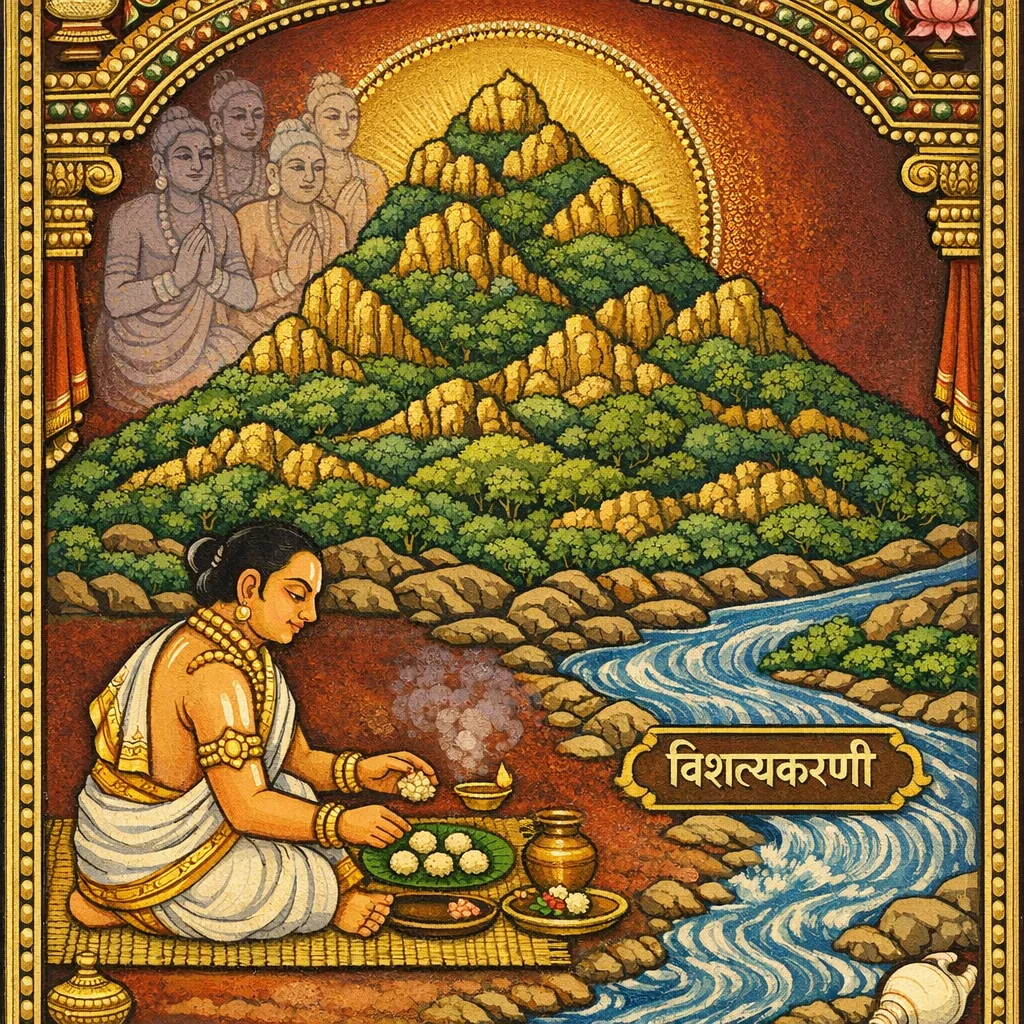
This Adhyāya, within the Śrāddha-kalpa, presents Bṛhaspati’s teaching on the power of honoring the Pitṛs: even a single properly performed act can satisfy the “imperishable” ancestors and aid the sacrificer’s post-mortem ascent to svarga, with mokṣa approached gradually. The teaching then shifts into a catalog of sacred geography—lakes, rivers, tīrthas, regions, mountains, and āśramas—as high-yield sites for ritual merit. Amarakantaka is praised as supremely meritorious in the three worlds, associated with siddhas and the intense tapas of Bhagavān Aṅgiras. Notable features are described, including a sacred reservoir (e.g., Jvālāsaras) visible on observance-days and the healing river Viśalyakaraṇī that removes afflictions, along with directional cues tied to Mālyavat and the Kalinga side. The central ritual claim is that offering piṇḍas on Mount Amarakantaka—especially with excellent darbha/kuśa—produces “akṣaya śrāddha,” increasing Pitṛ satisfaction; the Pitṛs are said to appear and withdraw (antardhāna) upon reaching that kṣetra. Overall, the chapter tightly integrates śrāddha doctrine with a place-based cosmology of merit and tīrtha metadata anchored in Amarakantaka.
Shlokas
Verse 1
इति श्रीब्रह्माण्डे महापुराणे वायुप्रोक्ते मध्यभागे तृतीये उपोद्धातपादे श्राद्धकल्पे द्वादशो ऽध्यायः // १२// बृहस्पतिरुवाच सकृदभ्यर्चिताः प्रीता भवन्ति पितरो ऽव्ययाः / योगात्मानो महात्मानो विपाप्मानो महौजसः
Thus, in the Śrī Brahmāṇḍa Mahāpurāṇa, in the middle section spoken by Vāyu, in the third Upoddhāta-pāda, within the Śrāddha-kalpa, is the twelfth chapter. Bṛhaspati said: Even when worshipped but once, the imperishable Pitṛs become pleased—yogic in essence, great-souled, free from sin, and of mighty splendour.
Verse 2
प्रेत्य च स्वर्गलोकाय कामैश्च बहुलं भुवि / येषु वाप्यनुगृह्णन्ति मोक्षप्राप्तिः क्रमेण तु
After death they bestow attainment of Svarga-loka and abundant fulfilment of desires upon the earth; and those whom they favour attain liberation (mokṣa) in due course.
Verse 3
तानि वक्ष्याम्यहं सौम्य सरांसि सरितस्तथा / तीर्थानि चैव पुण्यानि देशांश्छैलांस्तथाश्रमान्
O gentle one, I shall recount those lakes and rivers, the holy tīrthas, the lands, the mountains, and the āśramas.
Verse 4
पुण्यो हि त्रिषु लोकेषु सदैवामरकण्टकः / पर्वतप्रवरः पुण्यः सिद्धयारणसेवितः
Amarakaṇṭaka is ever holy in the three worlds—foremost of mountains, full of merit, and revered by siddhas and forest-dwelling ascetics.
Verse 5
यत्र वर्षसहस्राणि प्रयुतान्यर्बुदानि च / तपः सुदुश्चरं तेपे भगवानङ्गिराः पुरा
There, in ancient times, the venerable Aṅgirā performed an exceedingly arduous austerity for thousands of years—through spans of prayuta and arbuda.
Verse 6
यत्र मृत्योर्गतिर्न्नास्ति तथैवासुररक्षसाम् / न भयं नैव चालक्ष्मीर्यावद्भूमिर्द्धरिष्यति
There, death finds no passage, nor do asuras and rākṣasas; as long as the earth endures, there is neither fear nor Alakṣmī—misfortune.
Verse 7
तपसा तेजसा तस्य भ्रजते स नगोत्तमः / शृङ्गे माल्यवतो नित्यं वह्निः संवर्त्तको यथा
By his austerity and radiance that best of mountains shines forth, like the Saṃvartaka fire ever blazing upon the peak of Mālyavat.
Verse 8
मृदवस्तु सुगन्धाश्च हेमाभाः प्रियदर्शनाः / शान्ताःकुशा इति ख्याताः परिदक्षिणनर्मदाम्
They are gentle and fragrant, golden-hued and pleasing to behold. They are famed as the “Peaceful Kuśa” and they circumambulate the Narmadā.
Verse 9
दृष्टवान्स्वर्गसोपानं भगवानङ्गिराः पुरा / अग्निहोत्रे महातेजाः प्रस्तारार्थं कुशोत्तमान्
In ancient times, the venerable Aṅgiras beheld the stairway to heaven. Radiant with great splendor, he took the finest kuśa-grass for the prastara in the Agnihotra rite.
Verse 10
तेषु दर्भेषु यः पिण्डान्मरकण्टटकपर्वते / दद्यात्सकृदपि प्राज्ञस्तस्य वक्ष्यामि यत्फलम्
Whoever, being wise, offers piṇḍa even once upon Mount Marakaṇṭaṭaka with that darbha-grass—of that I shall declare the fruit.
Verse 11
तद्भवत्यक्षयं श्राद्धं पितॄणां प्रीतिवर्धनम् / अन्तर्द्धानं च गच्छन्ति क्षेत्रमासाद्य तत्सदा
That śrāddha becomes inexhaustible, increasing the joy of the Pitṛs. Having reached that sacred kṣetra, they ever attain also to antardhāna, the state of hiddenness.
Verse 12
तत्र ज्वालासरः पुण्यं दृश्यते चापि पर्वसु / सशल्यानां च सत्त्वानां विशल्यकरणी नदी
There, on festival days as well, the holy lake Jvālāsara is seen. And that river has the power to make beings with embedded wounds become viśalya—freed of every thorn and dart.
Verse 13
प्राग्दक्षिणायतावर्त्ता वापी सा सुनगोत्तमे / कलिङ्गदेशपश्चार्द्धे शृङ्गे माल्यवतो विभोः
That sacred well-pond, curving toward the east and the south, lies in the excellent place called Sunagottama; in the western half of the land of Kaliṅga, upon the peak of the majestic Mount Mālyavat.
Verse 14
सिद्धिक्षेत्रमृषिश्रेष्ठा यदुक्तं परमं भुवि / संमतं देवदैत्यानां श्लोकं चाप्युशना जगौ
O best of sages! That which is spoken of on earth as the supreme Field of Attainment (Siddhi-kṣetra) is approved by both Devas and Daityas; and concerning it, Uśanā too uttered a śloka.
Verse 15
धन्यास्ते पुरुषा लोके ये प्राप्यामरकण्टकम् / पितॄन्संतर्पयिष्यन्तिश्राद्धे पितृपरायणाः
Blessed in this world are those who, having reached Amarakantaka, devoted to the Fathers, will satisfy the Pitṛs through the śrāddha rite.
Verse 16
अल्पेन तपसा सिद्धिं गमिष्यन्ति न संशयः / सकृदेवार्चितास्तत्र स्वर्गमामरकण्टके
With but little austerity they will attain accomplishment—of this there is no doubt. At Amarakantaka, even a single act of worship offered there leads to heaven.
Verse 17
महेन्द्रःपर्वतः पुण्यो रम्यः शक्रनिषेवितः / तत्रारुह्य भवेत्पूतः श्राद्धं चैव महाफलम्
Mount Mahendra is holy and delightful, frequented by Śakra. By ascending it one becomes purified, and the śrāddha performed there yields great fruit.
Verse 18
वैलाटशिखरे युक्त्वा दिव्यं चक्षुः प्रवर्तते / अधृष्यश्चैव भूतानां देववच्चरते महीम्
Established upon the peak of Vailāṭa, the divine eye comes into play. Unassailable to beings, he roams the earth like a god.
Verse 19
सप्तगोदावरे चैव गोकर्णे च तपोवने / अश्वमेधफलं स्नात्वा तत्र दत्त्वा भवेत्ततः
Bathing at Saptagodāvarī and in the ascetic grove of Gokarṇa yields the fruit of the Aśvamedha. Giving alms there brings an even higher reward.
Verse 20
धूतपापस्थलं प्राप्य पूतः स्नात्वा भवेन्नरः / रुद्रस्तत्र तपस्तेपे देवदेवो महेश्वरः
Reaching the place called Dhūtapāpa and bathing there, a man becomes purified. There Rudra—Mahēśvara, god of gods—performed austerities.
Verse 21
गोकर्णे निहितं देवैर् नास्तिकानां निदर्शनम् / अब्राह्मणस्य सावित्रीं पठतस्तु प्रणश्यति
In Gokarṇa the gods have set a warning sign for the faithless. A non-Brahmin who recites the Sāvitrī (Gāyatrī) comes to ruin.
Verse 22
देवर्षिभवने शृङ्गे सिद्धचारणसेविते / आरुह्यतं निय मवांस्ततो याति त्रिविष्टपम्
On the peak that is the abode of the deva-seers, served by Siddhas and Cāraṇas, one who ascends with a disciplined soul goes from there to Triviṣṭapa (heaven).
Verse 23
दिव्यैश्चन्दनवृक्षैश्च पादपैरुपशोभितम् / आपश्चन्दनसंयुक्ताः स्पन्देति सततं ततः
That region is adorned with divine sandalwood trees and other plants. There the waters, infused with sandal fragrance, ever quiver and ripple without cease.
Verse 24
नदी प्रवर्तते ताभ्यस्ताम्रपर्णीति नामतः / या चन्दनमहाखण्डाद्दक्षिणं याति सागरम्
From there flows a river named Tamraparni; from the great tract of sandalwood it goes southward and reaches the ocean.
Verse 25
नद्यास्तस्याश्च ताम्रायास्तूह्यमाना महोदधौ / शङ्खा भवन्ति शुक्त्यश्च जायते यासु मौक्तिकम्
As that Tamra river pours into the great ocean, conch-shells and pearl-oysters arise, within which pearls are born.
Verse 26
उदकानयनं कृत्वा शङ्खमौक्तिकसंयुतम् / आधिभिर्व्याधिभिश्चैव मुक्ता यान्त्यमरावतीम्
Bringing that water, accompanied by conch and pearl, one is freed from affliction and disease and goes to Amaravati.
Verse 27
चन्दनेभ्यः प्रसूतानां शङ्खानां मौक्तिकस्य वा / पापकर्त्तॄनपि पितॄंस्तारयन्ति यथाश्रुति
As the sacred tradition declares, conches or pearls born of the sandal region bear such merit that they deliver even forefathers who committed sins.
Verse 28
चन्द्रतीर्थे कुमार्यां च कावेरीप्रभवे क्षये / श्रीपर्वतस्य तीर्थेषु वैकृते च तथा गिरौ
At Candratīrtha, at Kumārī (Kanyakumari), at the sacred confluence near the source of the Kāverī, and likewise at the tīrthas of Śrīparvata and on the mountain called Vaikṛta.
Verse 29
एकस्था यत्र दृश्यन्ते वृक्षाह्यौशीरपर्वते / पलाशाः खदिरा बिल्वाः प्लक्षाश्वत्थविकङ्कताः
On Mount Auśīra there is a spot where, in one place, the trees are seen together—palāśa, khadira, bilva, plakṣa, aśvattha, and vikaṅkata.
Verse 30
एवं द्विमण्डलाविद्धं विज्ञेयं द्विजसत्तमाः / अस्मिंस्त्यक्त्वा जनोंऽगाति क्षिप्रं यात्यमरावतीम्
O best of the twice-born, know this place as ‘pierced by two circles (maṇḍalas)’; one who casts off the body here swiftly goes to Amarāvatī.
Verse 31
श्रीपर्वतस्य तीर्थे तु वैकृते च तथा गिरौ / कर्माणि तु प्रयुक्ता नि सिद्ध्यन्ति प्रभवाप्यये
At the tīrtha of Śrīparvata, and likewise on Mount Vaikṛta, the rites one undertakes surely attain fulfillment, even in times of arising and dissolution (prabhava–apyaya).
Verse 32
दुष्प्रयुक्ता हि पितृषु सुप्रयोगा भवन्त्युत / पितॄणां दुहिता पुण्या नर्मदा सरितां वरा
Even offerings wrongly performed for the Pitṛs become rightly performed there; Narmadā, the holy daughter of the Pitṛs, is the finest among rivers.
Verse 33
यत्र श्राद्धानि दत्तांनि ह्यक्षयाणि भवन्त्युत / माठरस्य वने पुण्ये सिद्धचारणसेविते
Wherever the offerings given in śrāddha become truly of imperishable fruit—there, in Māṭhara’s holy forest, attended by Siddhas and Cāraṇas.
Verse 34
अन्तर्द्धानेन गच्छन्ति युक्त्वा तस्मिन्महा गिरौ / विन्ध्ये चैव गिरौ पुण्ये धर्माधर्मनिदर्शनीम्
Established upon that great mountain, they depart by antardhāna—vanishing from sight; and on the holy Vindhya peak appears a sign that reveals dharma and adharma.
Verse 35
धारां पापा न पश्यन्ति धारां पश्यन्ति साधवः / तत्र तद्दृश्यते पापं केषां चित्पापकर्मणाम्
The sinful do not behold that stream, but the righteous behold it; there, the sin of certain doers of evil deeds is seen made manifest.
Verse 36
कैलासे या मतङ्गस्य वापी पापनिषूदनी / स्नात्वा तस्या दिवं यान्ति कामचारा विहङ्गमाः
On Kailāsa is Mataṅga’s lake, the destroyer of sin; bathing in it, even birds that roam at will ascend to heaven.
Verse 37
शौर्पारके तथा तीर्थे पर्वते पालमञ्जरे / पाण्डुकूपे समुद्रान्ते पिण्डारकतटे तथा
At the tīrtha of Śaurpāraka, upon Mount Pālamañjara; at Pāṇḍukūpa by the ocean’s edge, and likewise on the shore of Piṇḍāraka.
Verse 38
विमले च विपापे च संकल्पं प्राप्य चाक्षयम् / श्रीवृक्षे चित्रकूटे च जंबूमार्गे च नित्यशः
In places that are pure and free from sin, one attains an imperishable resolve (saṃkalpa); so too, ever, at Śrīvṛkṣa, at Citrakūṭa, and along the Jambū-path.
Verse 39
असितस्य गिरौ पुण्ये योगाचार्यस्य धीमतः / तत्रापि श्राद्धमानन्त्यमसितायां च नित्यशः
On the holy mountain of Asita, the wise master of Yoga, and likewise at the Asitā tīrtha, the śrāddha offered regularly is said to yield endless merit.
Verse 40
पुष्करेष्वक्षयं श्राद्धं तपश्चैव महाफलमा / महोदधौ प्रभासे च तद्वदेव विनिर्दिशेत्
At Puṣkara, the śrāddha is imperishable and austerity bears great fruit; at Prabhāsa by the mighty ocean, the same is likewise enjoined.
Verse 41
देविकायां वृषो नाम कूपः सिद्धनिषेवितः / समुत्पतन्ति तस्यापो गवां शब्देन नित्यशः
At Devikā there is a well named Vṛṣa, attended by the siddhas; at the sound of cows, its waters ever leap up and surge forth.
Verse 42
योगेश्वरैः सदा जुष्टः सर्वपापबहिष्कृतः / दद्याच्छ्राद्धं तु यस्तस्मिंस्तस्य वक्ष्यामि यत्फलम्
That place is ever cherished by the lords of Yoga and drives away all sin; for whoever offers śrāddha there, I shall declare the fruit that follows.
Verse 43
अक्षयं सर्वकामीयं श्राद्धं प्रीणाति वै पितॄन् / जातवेदः शिला तत्र साक्षादग्नेः सनातनात्
This imperishable Śrāddha, granting every desire, truly delights the Pitṛs. There, the stone called Jātaveda is the very, direct presence of Agni, the Eternal.
Verse 44
श्राद्धानि चाग्निकार्यं च तत्र कुर्यात्सदा क्षयम् / यस्त्वग्निं प्रविशेत्तत्र नाकपृष्ठे स मोदते
There one should always perform Śrāddhas and rites of the sacred fire, yielding imperishable merit. Whoever enters the fire there rejoices upon the heights of heaven.
Verse 45
अग्निशान्तः पुनर्जातस्तत्र दत्तं ततो ऽक्षयम् / दशाश्वमेधिके तीर्थे तीर्थे पञ्चाश्वमेधिके
Pacified by Agni, one is born again; therefore whatever is given there becomes imperishable. That tīrtha is famed as the Daśāśvamedhika and the Pañcāśvamedhika.
Verse 46
यथोद्दिष्टफलं तेषां क्रतूनां नात्र संशयः / ख्यातं हयशिरो नाम तीर्थं सद्यो वरप्रदम्
The fruits of those kratus are obtained here exactly as declared—of this there is no doubt. The famed tīrtha called Hayaśiro grants boons at once.
Verse 47
श्राद्धं तत्र सदाक्षय्यं दाता स्वर्गे च मोदते / श्राद्धं सुंदनिसुंदे च देयं पापनिषू दनम्
The Śrāddha performed there is ever imperishable, and the giver rejoices in heaven. In the place/episode of Sunda and Nisunda too, one should offer Śrāddha, for it destroys sin.
Verse 48
श्राद्धं तत्राक्षयं प्रोक्तं जपहोमतपांसि च / जतुङ्गे शुभे तीर्थे तर्पयेत्सततं पितॄन्
Śrāddha performed there is declared to yield imperishable merit; so too japa, homa, and austerity. At the auspicious tīrtha of Jatuṅga one should ever offer tarpaṇa to the Pitṛs.
Verse 49
दृश्यते पर्वसु च्छाया यत्र नित्यं दिवौकसाम् / पृथिव्यामक्षयं दत्तं विरजा यत्र पादपः
It is the place where, on the parva holy days, the shadow of the heavenly ones is ever seen; where gifts given upon the earth become imperishable, and where the tree named Virajā stands.
Verse 50
योगेश्वरैः सदा जुष्टः सर्वपापबहिष्कृतः / दद्याच्छ्राद्धं तु यस्तस्मिंस्तस्य वक्ष्यामि यत्फलम्
Ever cherished by the Yogeśvaras, that place casts out all sin. For one who offers śrāddha there, I shall declare the fruit that arises.
Verse 51
अर्चितास्तेन वै साक्षाद्भवन्ति पितरः सदा / अस्मिंल्लोके वशी च स्यात्प्रेत्य स्वर्गे मही यते
By that act the Pitṛs are, indeed, directly honored always. In this world he becomes powerful and self-possessed; after death he is exalted in heaven.
Verse 52
प्रायशो मद्रवा पुण्या शिवो नाम ह्रदस्तथा / तत्र व्याससरः पुण्यं दिव्यो ब्रह्मह्रदस्तथा
There is, for the most part, the holy place called Madravā, and likewise a lake named Śiva. There too are the sacred Vyāsa-lake and the divine Brahma-hrada.
Verse 53
ऊर्ज्जन्तः पर्वतः पुण्यो यत्र योगेश्वरालयः / अत्रैव चाश्रमः पुण्यो वसिष्ठस्य महात्मनः
The holy mountain Ūrjjanta is the place where the abode of Lord Yogēśvara stands. Here itself is also the sacred āśrama of the great-souled Vasiṣṭha.
Verse 54
ऋग्यजुः सामशिरसः कपोताः पुष्पसाह्वयाः / आख्यान पञ्चमा वेदाः सृष्टा ह्येते स्वयंभुवा
From the head-portions of the Ṛg, Yajur, and Sāma arose the branches called Kapota and Puṣpa; and with Ākhyāna (sacred narrative) as the fifth Veda, all these were created by Svayaṃbhū.
Verse 55
गत्वैतान्मुच्यते पापद्द्विजो वह्निं समाश्रयन् / श्राद्धं चानन्त्यमेतेषु जपहोमतपांसि च
By going to these sacred places and taking refuge in the holy fire (Agni), a dvija is freed from sin. Here the śrāddha yields endless merit, and so do japa, homa, and austerities.
Verse 56
पुण्डरीके महातीर्थे पुण्डरीकसमं फलम् / ब्रह्मतीर्थे महाप्राज्ञ सर्वयज्ञसमं फलम्
At the great tīrtha of Puṇḍarīka one gains a fruit equal to Puṇḍarīka itself. O greatly wise one, at Brahma-tīrtha the fruit equals that of all sacrifices.
Verse 57
सिंधुसागरसंभेदे तथा पञ्चनदे क्षयम् / विरजायां तथा पुण्यं मद्रवायां च पर्वते
At the meeting of the Sindhu and the ocean, and likewise at Pañcanada, sins are brought to destruction. The same merit is found at Virajā, and also upon Mount Madravā.
Verse 58
देयं सप्तनदे श्राद्धं मानसे वा विशेषतः / महाकूटे ह्यनन्ते च गिरौ त्रिककुदे तथा
In Saptanada—especially at Manasa—one should offer śrāddha; likewise at Mahākūṭa, at Ananta, and on Mount Trikakuda.
Verse 59
संध्यायां च महानद्यां दृश्यते महादद्भुतम् / अश्रद्दधानं नाभ्येति सा चाभ्येति धृतव्रतम्
At twilight on the great river a wondrous marvel is seen: it does not approach one without śraddhā, yet it approaches the steadfast keeper of vows.
Verse 60
संश्रयित्वैकमेकेन सायाह्नं प्रति नित्यशः / तस्मिन्देयं सदा श्राद्धं पितॄणामक्षयार्थिनाम्
Leaning one upon another, they go each day toward the evening; therefore, those who seek imperishable fruit for the Pitṛs should always offer śrāddha there.
Verse 61
कृतात्मा वाकृतात्मा च यत्र विज्ञायते नरः / स्वर्गमार्गप्रदं नाम तीर्थं सद्यो वरप्रदम्
Where a man is discerned as kṛtātmā or akṛtātmā, that sacred ford is famed as Svargamārgaprada, bestowing boons at once.
Verse 62
चीराण्युत्सृज्य यस्मिंस्तु दिवं सप्तर्षयो गाताः / अद्यापि तानि दृश्यन्ते चीराण्यंभोगतानि तु
Where the Saptarṣis cast off their ascetic garments and went to heaven, those garments are seen even today, lying within the waters.
Verse 63
स्नात्वा स्वर्गमवाप्नोति तस्मिंस्तीर्थेत्तमे नरः / ख्यातमायतनं तत्र नन्दिनः सिद्धसेवितम्
Bathing in that most excellent tīrtha, a man attains heaven. There stands the famed abode of Nandin, attended and revered by the siddhas.
Verse 64
नन्दीश्वरस्य सा मूर्त्तिर्निराचारैर्नदृश्यते / दृश्यन्ते काञ्चना युपास्त्वर्चिषो भास्करोदये
That form of Nandīśvara is not seen by those devoid of right conduct. Yet at sunrise, golden yūpa-posts and their radiant splendor are beheld.
Verse 65
कृत्वा प्रदक्षिणं तांस्तु गच्छन्त्यानन्दिता दिवम् / सर्वतश्च कुरुक्षेत्रं सुतीर्थं तु विशेषतः
Having circumambulated them in pradakṣiṇā, the devotees, filled with joy, depart for heaven. All Kurukṣetra is a holy tīrtha, yet this place is especially so.
Verse 66
पुण्यं सनत्कुमारस्य योगेशस्य महात्मनः / कीर्त्यते च तिलान्दत्त्वा पितृभ्योवै सदाक्षयम्
Thus is praised the merit of the great Sanatkumāra, lord of yoga: by offering sesame to the pitṛs, one gains an ever-imperishable reward.
Verse 67
उक्तमेवाक्षयं श्राद्धं धर्मराजनिषेवितम् / श्राद्धं दत्तममावास्यां विधिना च यथाक्रमम्
The imperishable śrāddha is said to be that observed by Dharmarāja: the śrāddha offered on the new-moon day (amāvasyā), duly and in proper order.
Verse 68
पुंसः सन्निहितायां तु कुरूक्षेत्रे विशेषतः / अर्चयित्वा पितॄंस्तत्र स पुत्रस्त्वनृणो भवेत्
In Kurukshetra especially, when one is present there and worships the Pitris, that son becomes free from the debt owed to the ancestors.
Verse 69
सरस्वत्यां विनशने प्लक्षप्रश्रवणे तथा / व्यासतीर्थे दृषद्वत्यां त्रिप्लक्षे च विशेषतः
At Sarasvati’s Vinashana and at Plaksha-prashravana; at Vyasa-tirtha on the Drishadvati; and at Triplaksha too—these places are especially sacred.
Verse 70
देयमोङ्कारपवने श्राद्धमक्षयमिच्छता / शक्रावतारे गङ्गायां मैनाके च नगोत्तमे
Whoever seeks an imperishable Shraddha should offer it at Omkara-pavana; likewise at Shakravatara on the Ganga, and on Mainaka, the foremost of mountains.
Verse 71
यमुनाप्रभवे चैव सर्वपापैः प्रमुच्यते / अत्युष्णाश्चातिशीताश्च आपस्तस्मिन्निदर्शनम्
At the source of the Yamuna one is released from all sins; the waters there are at times exceedingly hot and at times exceedingly cold—this is its sign.
Verse 72
यमस्य भगिनी पुष्या मार्त्तण्डदुहिता शुभा / तत्राक्षयं सदा श्राद्धं पितृभिः पूर्वकीर्त्तितम्
Pushya, sister of Yama, the auspicious daughter of Martanda—there the Pitris have long declared that Shraddha is ever of imperishable fruit.
Verse 73
ब्रह्मतुण्डह्रदे स्नात्वा सद्दयो भवति ब्राह्मणः / तस्मिंस्तु श्राद्धमानन्त्यं जपहोमतपांसि च
Having bathed in the Brahmatuṇḍa lake, a brāhmaṇa becomes pure at once. In that tīrtha, śrāddha yields endless merit, and so do japa, homa, and austerities.
Verse 74
स्थाणुभूतो ऽचरत्तत्र वसिष्टो वै महातपाः / अद्यापि तत्र दृश्यन्ते पादपा मणिबर्हणाः
There the great ascetic Vasiṣṭha dwelt like a motionless pillar. Even today, trees adorned as if with jewels (maṇi-barhaṇa) are seen there.
Verse 75
तुला तु दृश्यते तत्र धर्मान्धर्मनिधर्शिनी / यथा वै तोलितं विप्रैस्तीर्थानां फलमुत्तमम्
There one beholds a balance that tests dharma and adharma. As though the vipras had weighed and revealed the highest fruit of the tīrthas.
Verse 76
पितॄणां दुहिता योगा गन्धकालीति विश्रुता / चतुर्थो ब्रह्मणस्त्वंशः पराशरकुलोद्भवः
The daughter of the Pitṛs is Yogā, famed as Gandhakālī. Born in the line of Parāśara, she is spoken of as the fourth portion of Brahmā.
Verse 77
व्यसिष्यति चतुर्द्धा वै वेदं धीमान्महामुनिः / महायोगं महात्मानं या व्यासं जनयिष्यति
The wise great sage will divide the Veda into four. And she it is who will give birth to Vyāsa, the great yogin and mahātmā.
Verse 78
अच्छोदकं नामसरस्तत्राच्छोदासमुद्भवः / मत्स्ययोनौ पुनर्जाता नियोगात्कारणेन तु
There is a lake named Acchodaka; from it arose Acchodā. Yet by the ordinance of niyoga, she was born again in the womb of a fish.
Verse 79
तस्यास्त्वाद्याश्रमे पुण्ये पुण्यकृद्भिर्निषेविते / दत्तं सकृदपि श्राद्धमक्षयं समुदाहृतम्
In her first holy hermitage, frequented by the doers of merit, even a śrāddha offered but once is declared to yield imperishable (akṣaya) fruit.
Verse 80
नद्यां योगसमाधानं दत्तं युगपदुद्भवेत् / कुबेरतुङ्गे पापघ्नं व्यासतीर्थेतथैव च
A gift bestowed in the river with the mind steadied in yoga and samādhi bears fruit at once. At Kuberatuṅga and at Vyāsa-tīrtha too, it is said to destroy sin.
Verse 81
पुण्यायां ब्रह्मणो वेद्यां श्राद्धमानन्त्यमिष्यते / सिद्धैस्तु सेविता नित्यं दृश्यते तु कृतात्मभिः
A śrāddha performed upon the holy Brahma-vedī is held to grant endless reward. The siddhas serve that place ever, and the perfected in spirit behold it.
Verse 82
अनिवर्तनं तु नन्दायां वेद्याः प्रागुत्तरदिशि / सिद्धिक्षेत्रं सुरैर्जुष्टं यत्प्राप्य न निवर्त्तते
To the northeast of the vedī, at Nandā, lies the siddhi-field called Anivartana, cherished by the gods; having reached it, one does not return again.
Verse 83
महालये पदं न्यस्तं महादेवेन धीमता / भूतानामनुकंपार्थं नास्तिकानां निदर्शनम्
In Mahālaya, the wise Mahādeva set down his sacred footprint—out of compassion for the bhūtas, and as a sign for the faithless.
Verse 84
विरजे त्वक्षयं श्राद्धं पूर्वमेव महालये / नन्दायां विरजे चैव तथैव च महालये
In Virajā and in Mahālaya, from of old the imperishable (akṣaya) śrāddha is performed; likewise in Nandā, in Virajā, and so too in Mahālaya.
Verse 85
आत्मानं तारयन्तीह दशपूर्वान्दशापरान् / काकह्रदे जातिस्मर्यं सुवर्णममितौजसम्
Here they deliver themselves, and also carry across ten generations before and ten after; at Kāka-hrada one gains a boon that grants memory of past births, golden in radiance and of immeasurable splendor.
Verse 86
कौमारं च सरः पुण्यं नागभोगाभिरक्षितम् / कुमारतीर्थे स्नात्वा तु त्रिदिवं याति मानवः
The holy lake called Kaumāra is guarded by the coils of the nāgas; bathing at Kumāra-tīrtha, a person goes to Tridiva, the heavenly realm.
Verse 87
देवालये तपस्तस्वा एकपादेन दुश्चरम् / निराहारो युगं दिव्यमुमातुङ्गो स्थितो ज्वलन्
In the temple of the gods he performed a harsh austerity, standing on one foot; fasting through a divine yuga, Umātuṅga—beloved of Umā—remained there, blazing in splendor.
Verse 88
उमातुङ्गे भृगोस्तुङ्गे ब्रह्मतुङ्गे महालये / तत्र श्राद्धानि देयानि नित्यमक्षयमिच्छता
At Umātuṅga, Bhṛgotuṅga, Brahmatuṅga, and Mahālaya, one who seeks ever-enduring, imperishable merit should offer śrāddha there each day.
Verse 89
अक्षयं तु सदा श्राद्धं शालग्रामे समन्ततः / दुष्कृतं दृश्यते तत्र प्रत्यक्षमकृतात्मनाम्
In Śālagrāma, śrāddha offered on every side is ever imperishable; there the misdeeds of those who lack self-discipline are seen plainly, before one’s eyes.
Verse 90
प्रत्यदेशो ह्यशिष्टानां शिष्टानां च विशेषतः / तत्र देवह्रदः पुण्यो ब्रह्मणो नागराट् शुचिः
That region is a land of chastening for the uncultured, and all the more a place of special blessing for the righteous; there are Brahmā’s holy Devahrada and the pure Nāgarāṭ.
Verse 91
पिण्डं गृह्णति हि सतां न गृह्णात्यसतां सदा / अतिप्रदीप्तैर्भुजगैर्भोक्तुमन्नं न शक्यते
The piṇḍa of the virtuous is indeed accepted there, but that of the wicked is never accepted—just as one cannot eat food amid serpents blazing with fierce heat.
Verse 92
प्रत्यक्षं दृश्यते धर्मस्तीर्थयोर्नतयोर्द्वयोः / कारवत्यां च शाण्डिल्यां गुहायां वामनस्य च
Dharma is seen directly at the two tīrthas called Nata; likewise at Kāravati, at Śāṇḍilyā, and in the sacred cave of Vāmana.
Verse 93
गत्वा चैतानि पूतःस्याच्छ्रदद्धमक्षयमेव च / जपो होमस्तपो ध्यानं यत्किञ्चित्सुकृतं भवेत्
By going to these sacred places one becomes purified, and one’s faith becomes imperishable. Japa, homa, austerity, meditation, and whatever merit one performs—all bear holy fruit.
Verse 94
ब्रह्मचर्यं च यौ धत्ते गुरुभक्तिं शतं समाः / एवमाद्यास्सरिच्छ्रेष्ठा यत्स्नानादघमोक्षणम् / कुमारधारा तत्रैव दृष्टा पापं प्रणश्यति
One who upholds brahmacarya and serves the Guru with devotion for a hundred years—such are the primal, most excellent rivers; bathing in them brings release from sin. There, the very sight of Kumāradhārā makes sin perish.
Verse 95
ध्यानासनं तु तत्रैव व्यासस्याद्यापि दृश्यते / शैलः कान्तिपुराभ्याशे प्रागुदीच्यां दिशि स्थितः
There itself, Vyāsa’s seat of meditation is seen even today. That rocky hill stands near Kāntipurā, in the north‑eastern direction.
Verse 96
पुण्य पुष्करिणी तत्र किरातगणरक्षिता / यस्यां स्नात्वा सकृद्विप्रः कामानाप्नोति शाश्वतान्
There is a holy lotus‑pond (puṣkariṇī) there, guarded by the Kirāta hosts. A brāhmaṇa who bathes in it even once attains enduring, desired boons.
Verse 97
अदृश्यः सर्वभूतानां देववच्चरते महीम्
Invisible to all beings, he moves upon the earth like a god.
Verse 98
काश्यपस्य महातीर्थं कालसर्पिरिति श्रुतम् / तत्र श्राद्धानि देयानि नित्यमक्षयमिच्छता
Kaśyapa’s great tīrtha is famed as “Kālasarpi.” One who seeks unfailing, imperishable merit should always offer śrāddha there.
Verse 99
देवदारुवने वापि धारायास्तु निदर्शनम् / निर्धूतानि तु पापानि दृश्यन्ते सुकृतात्मनाम्
Even in the Devadāru forest, this is seen as a sign of the sacred stream: the sins of the meritorious are beheld as washed away.
Verse 100
भागीरथ्यां प्रयागे तु नित्यमक्षयमुच्यते / कालञ्जरे दशार्णायां नैमिषे कुरुजाङ्गले
At Prayāga on the Bhāgīrathī, the fruit is said to be ever imperishable; so too at Kālañjara, in Daśārṇā, at Naimiṣa, and in Kurujāṅgala.
Verse 101
वाराणस्यां नगर्यां च देयं श्राद्धं प्रयत्नतः / तत्र योगेश्वरो नित्यं तस्यां दत्तमथाक्षयम्
In the city of Vārāṇasī too, śrāddha should be offered with earnest care. There the Lord of Yoga abides forever; thus what is given there becomes imperishable.
Verse 102
गत्वा चैतानि पूर्तः स्याच्छ्राद्धमक्षय्यमेव च / जबो होमस्तथा ध्यानं यत्किञ्चित्सुकृतं भवेत्
By going to these sacred places, one becomes fulfilled with pūrta merit, and śrāddha too becomes truly imperishable. Japa, homa, and meditation—whatever virtuous act is done, all bears fruit.
Verse 103
लौहित्ये वैतरण्यां चस्वर्गवेद्यां तथैव च / सा तु देवी समुद्रान्ते दृश्यते चैव नामभिः
In Lauhitya, in Vaitaraṇī, and likewise in Svargavedī, that Goddess is beheld at the ocean’s edge, revered by many sacred names.
Verse 104
गयायां धर्मवृष्ठे तु सरसि ब्रह्मणस्तथा / गयां गृध्रवटे चैव श्राद्धं दत्तं महाफलम्
In Gayā—at the lake called Dharmavṛṣṭa, at Brahmā’s lake, and at Gṛdhravaṭa in Gayā—śrāddha offered there yields great fruit.
Verse 105
हिमं च पतते तत्र समन्तात्पञ्चयो जनम् / भरतस्याश्रमे पुण्ये ऽरण्यं पुण्यतमं स्मृतम्
There snow falls all around for five yojanas; the forest at Bharata’s holy āśrama is remembered as supremely meritorious.
Verse 106
मतङ्गस्य वनं तत्र दृश्यते सर्वमानुषैः / स्थापितं धर्मसर्वस्वं लोकस्यास्य निदर्शनम्
There the forest of Sage Mataṅga is seen by all people; it stands as an established exemplar, displaying the whole essence of Dharma to this world.
Verse 107
यद्दण्डकवनं पुण्यं पुण्यकृद्भिर्निषेवितम् / यस्मिन्प्राहुर्विशल्येति तीर्थं सद्यो निदर्शनम्
That holy Daṇḍaka forest, frequented by the meritorious, contains the tīrtha called Viśalyā, whose darśana is gained at once.
Verse 108
तुलामानैस्तथा चापि शास्त्रैश्च विविधैस्तथा / उन्मच्चन्ति तथा लग्न ये वै पापकृतो जनाः
Those who commit sin, clinging to measures and to various śāstras, become bound by attachment and act like the maddened.
Verse 109
तृतीयायां तथा पादे निराधायां तु मण्डले / महाह्रदे च कौशिक्यां दत्तं श्राद्धं महाफलम्
In the pāda of the Tṛtīyā tithi, within the Nirādhā maṇḍala, at the great lake of Kauśikī, the śrāddha offered yields great fruit.
Verse 110
मुण्डपृष्टे पदं न्यस्तं महादेवेन धीमता / बहुदेवयुगांस्तप्त्वा तपस्तीव्रं सुदश्चरम्
Upon Muṇḍa’s back the wise Mahādeva set his foot; through many deva-yugas he performed intense tapas, most difficult to endure.
Verse 111
अल्पेनाप्यत्र कालेन नरो धर्मपरायणः / पाप्मानमुत्सृजत्याशु जीर्णां त्वचमिवोरगः
Here, even in a little time, a man devoted to dharma swiftly casts off sin, as a serpent sheds its worn-out skin.
Verse 112
सिद्धानां प्रीतिजननं पपानां च भयङ्करम् / लेलिहानैर्महाघोरै रक्ष्यते सुमहोरगैः
It gladdens the siddhas and is dreadful to sinners; it is guarded by mighty, terrifying serpents, their tongues flickering as they lick.
Verse 113
नाम्ना कनकनन्दीति तीर्थं जगति विश्रुतम् / उदीच्यां मुण्डपृष्टस्य ब्रह्मर्षिगणसेवितम्
The tīrtha known by the name Kanakanandī is famed throughout the world. It lies to the north of Muṇḍapṛṣṭa and is attended by hosts of brahmarṣis.
Verse 114
तत्र स्नात्वा दिवंयान्ति स्वशरीरेण मानवाः / दत्तं वापि सदा श्राद्धमक्षय्यं समुदाहृतम्
Bathing there, people ascend to heaven with their very bodies. And any śrāddha offered there is declared to yield imperishable merit.
Verse 115
ऋणैस्त्रिभिस्ततः स्नात्वा निष्क्रीणाति नरस्तनुम् / मानसे सरसि स्नात्वा श्राद्धंनिर्वर्त्तयेत्ततः
Bathing there, a man is freed from the three sacred debts and redeems his very body. Then, bathing in Lake Mānasa, he should duly perform the śrāddha.
Verse 116
तीरे तु सरसस्तस्य देवस्या यतनं महत् / आरुह्य तु जपंस्तत्र सिद्धो याति दिवं ततः
On the shore of that lake stands the great sanctuary of that Deva. Ascending there and performing japa, one becomes accomplished and then departs to heaven.
Verse 117
उत्तरं मानसं गत्वासिद्धिं प्राप्नोत्यनुत्तमाम् / स्नात्वा तस्मिन्सरश्रेष्ठे दृश्यते महादद्भुतम्
Going to northern Mānasa, one attains the unsurpassed siddhi. Bathing in that most excellent lake, a great wonder is beheld.
Verse 118
दिवश्च्युता महाभागा ह्यन्तरिक्षे विराजते / गङ्गा त्रिपथगा देवी विष्णुपादाच्च्युता सती
The greatly blessed Gaṅgā, fallen from heaven, shines in the mid‑sky. She is the Goddess who flows in three paths, the pure one sprung from Viṣṇu’s foot.
Verse 119
आकाशे दृश्यते तत्र तोरणं सूर्यसन्निभम् / जांबूनदमयं पुण्यं स्वगद्वारमिवायतम्
There in the sky is seen a gateway-arch, radiant like the sun. Holy and wrought of Jāmbūnada gold, it stands like the wide gate of heaven.
Verse 120
ततः प्रवर्त्तते भूयः सर्वसागरमण्डिका / पावनी सर्वभूतानां धर्मज्ञानां विशेषतः
Then she flows onward again, as though forming the girdle of all the seas. She purifies all beings—most of all those who know Dharma.
Verse 121
चन्द्रभागा च सिद्धुश्च शुभे मानससंभवे / सागरं पश्चिमं यातो दिव्यः सिंधुनदो वरः
Candrabhāgā and Sindhu, born from the auspicious Lake Mānas—the divine, excellent river Sindhu—flow on to the western ocean.
Verse 122
पर्वतो हिमवान्नाम नानाधातुविभूषितः / आयतो वै सहस्राणि योजनानां बहुनि तु
The mountain called Himavān is adorned with many kinds of ores and minerals. Its expanse stretches across many thousands of yojanas.
Verse 123
सिद्धचारणसंकीर्णा देवर्षिगणसेविता / तत्र पुष्करिणी रम्या सुषुम्णा नाम नामतः
There, thronged with Siddhas and Cāraṇas and attended by the hosts of deva-ṛṣis, lies a lovely sacred tank, renowned by the name Suṣumnā.
Verse 124
दशवर्षसहस्राणि तस्यां स्नातस्तु जीवति / श्राद्धं भवति चानन्तं तत्र दत्तं महोदयम्
He who bathes in it lives for ten thousand years; and the Śrāddha offered there becomes of endless fruit, bringing about great spiritual merit.
Verse 125
तारयेच्च सदा श्राद्धे दशपूर्वान्दशापरान् / सर्वत्र हिमवान्पुण्यो गङ्गा पुण्या समन्ततः
In the Śrāddha he ever delivers ten generations before and ten generations after; Himavān is holy everywhere, and the Gaṅgā is sacred on every side.
Verse 126
समुद्रगाः समुद्राश्च सर्वे पुण्याः समन्ततः / एवमादिषु चान्येषु श्राद्धं निर्वर्तयेद्बुधः
Rivers that flow to the sea, and the seas themselves, are holy on every side; so too at such places and at other tīrthas, the wise should duly perform the Śrāddha.
Verse 127
पुतो भवति वै स्नात्वा हुत्वा दत्त्वा तथैव च / शेलसानुषु शृङ्गेषु कन्दरेषु गुहासु च
By bathing, offering the homa, and giving gifts, one indeed becomes purified—even upon mountain slopes and peaks, in ravines, and in caves.
Verse 128
उपह्वरनितंबेषु तथा प्रस्रवणेषु च / पुलिनेष्वापगानां च तथैव प्रभवेषु च
On the slopes of ravines, and likewise at springs; on the sandbanks of rivers, and also at their places of origin.
Verse 129
महोदधौ गवां गोष्टे संगमेषु वनेषु च / सुसंमृष्टोपलिप्तेषु त्दृद्येषु सुरभिष्वथ
On the shore of the great ocean, in the cows’ stall, at confluences, and in forests; in places well-smoothed and plastered, firm and fragrant.
Verse 130
गोमयेनोपलिप्तेषु विविक्तेषु गृहेषु च / कुर्याच्छ्राद्धमथैतेषु नित्यमेव यथाविधि
Even in secluded houses plastered with cow-dung; in such places one should perform Śrāddha daily, according to the prescribed rite.
Verse 131
प्राग्दक्षिणां दिशं गत्वा सर्वकामचिकीर्षया / एवमेतेषु सर्वेषु श्राद्धं कुर्यादतन्द्रितः
Going toward the southeast direction, with the wish to fulfill all desires; thus, in all these places, one should perform Śrāddha without sloth.
Verse 132
एतेष्वेव तु मेधावी ब्राह्मीं सिद्धिमवाप्नुयात् / त्रैवर्णविहितैः स्थाने धर्मे वर्णाश्रमे रतैः
In these very places the wise attain Brahmī perfection; in places sanctioned for the three varṇas, where people delight in Dharma and in the discipline of varṇāśrama.
Verse 133
कौपस्थानं च संत्यागात्प्राप्यते पितृपूजनम् / तीर्थान्यनुसरन्वीरः श्रद्दधानः समाहितः
By renouncing the kaupasthāna, one attains the fruit of worship of the Pitṛs. The valiant one, faithful and composed, follows the sacred tīrthas.
Verse 134
कृतपापो ऽपि शुध्येत किं पुनः शुभकर्मकृत् / तिर्यग्योनिं न गच्छेच्च कुदेशे च न जायते
Even one who has committed sin may be purified—how much more one who performs auspicious deeds. He does not go to an animal womb, nor is he born in an unworthy land.
Verse 135
स्वर्गी भवति विप्रो वै मोक्षोपायं च विन्दति / अश्रद्दधानः पापायुर्नास्तिको ऽच्छिन्नसंशयः
The vipra attains heaven and also finds the means to mokṣa. But one without śraddhā, living a sinful life and being a nāstika, does not cut through doubt.
Verse 136
हेतुनिष्ठश्च पञ्चैते न तीर्थे फलभागिनः / गुरुतीर्थे परा सिद्धिस्तीर्थानां परमं पदम्
These five, fixed in mere reasoning, do not share in the fruits of a tīrtha. In the guru-tīrtha is the supreme attainment—the highest station of all tīrthas.
Verse 137
ध्यानं तीर्थं परं तस्माद्ब्रह्मतीर्थं सनातनम् / उपवासात्परं ध्यानमिन्द्रियाणां निवर्त्तनम्
Therefore meditation is the supreme tīrtha—the eternal Brahma-tīrtha. Higher than fasting is meditation, the withdrawal of the senses.
Verse 138
उपवासनिबद्धैर्हि प्राणैरेव पुनः पुनः / प्राणापानौ वशे कृत्वा वशगानीन्दियाणि च
With the prāṇas bound by fasting, again and again bring prāṇa and apāna under control, and make the senses obedient as well.
Verse 139
बुद्धिं मनसि संयम्य सर्वेषां तु निवर्त्तनम् / प्रत्याहारं कृतं विद्धि मोक्षोपायमसंशयम्
Restraining buddhi within the mind and withdrawing from all—know this as pratyāhāra, a sure means to mokṣa.
Verse 140
इन्द्रियाणां मनो घोरं बुद्ध्यादीनां विवर्त्तनम् / अना हारो क्षयं याति विद्यादनशनं तपः
The mind that runs with the senses is fierce, turning even buddhi and the rest; yet non-eating wanes—know anaśana (fasting) as tapas.
Verse 141
निग्रहे बुद्धिमन्सोरन्यबुद्धिर्न जायते / क्षीणेषु सर्वदोषेषु क्षीणेष्वेवेन्द्रियेषु च
When buddhi and mind are restrained, no other thought arises—when all faults are worn away and the senses too are stilled.
Verse 142
परिनिर्वाति शुद्धात्मा यथा वह्निरनिधनः / कारणेभ्यो गुणेभ्यश्च व्यक्ताव्यक्ताच्च कुत्स्नशः
The purified ātman comes to perfect stillness like an unending fire, wholly transcending causes, the guṇas, and all that is manifest and unmanifest.
Verse 143
नियोजयति क्षेत्रज्ञं तेभ्योयोगेन योगवित् / तस्य नास्ति गतिः स्थानं व्यक्ताव्यक्ते च सर्वशः / न सन्नासन्न सदसन्नैव किञ्चिदवस्थितः
The knower of Yoga, by Yoga, appoints the Kṣetrajña among those principles. For Him there is no going and no abode, everywhere in the manifest and the unmanifest. He is neither being nor non-being, nor being-and-non-being—fixed in no state at all.
Frequently Asked Questions
That even a single, properly performed act of Pitṛ worship—especially piṇḍa-dāna and tarpaṇa in a potent kṣetra—can greatly please the Pitṛs and yield enduring (akṣaya) results, supporting heavenly ascent and gradual liberation.
Amarakantaka is foregrounded as a tri-loka-puṇya mountain-kṣetra where tapas traditions (Aṅgiras) and tīrtha features (lakes/rivers) make it a high-intensity node in the Purāṇic merit economy, linking place with post-mortem destiny.
Jvālāsaras is presented as a sacred reservoir manifesting on observance-days, while the river Viśalyakaraṇī is described as removing afflictions; together they mark the site as both ritually efficacious and therapeutically auspicious for śrāddha-associated practice.