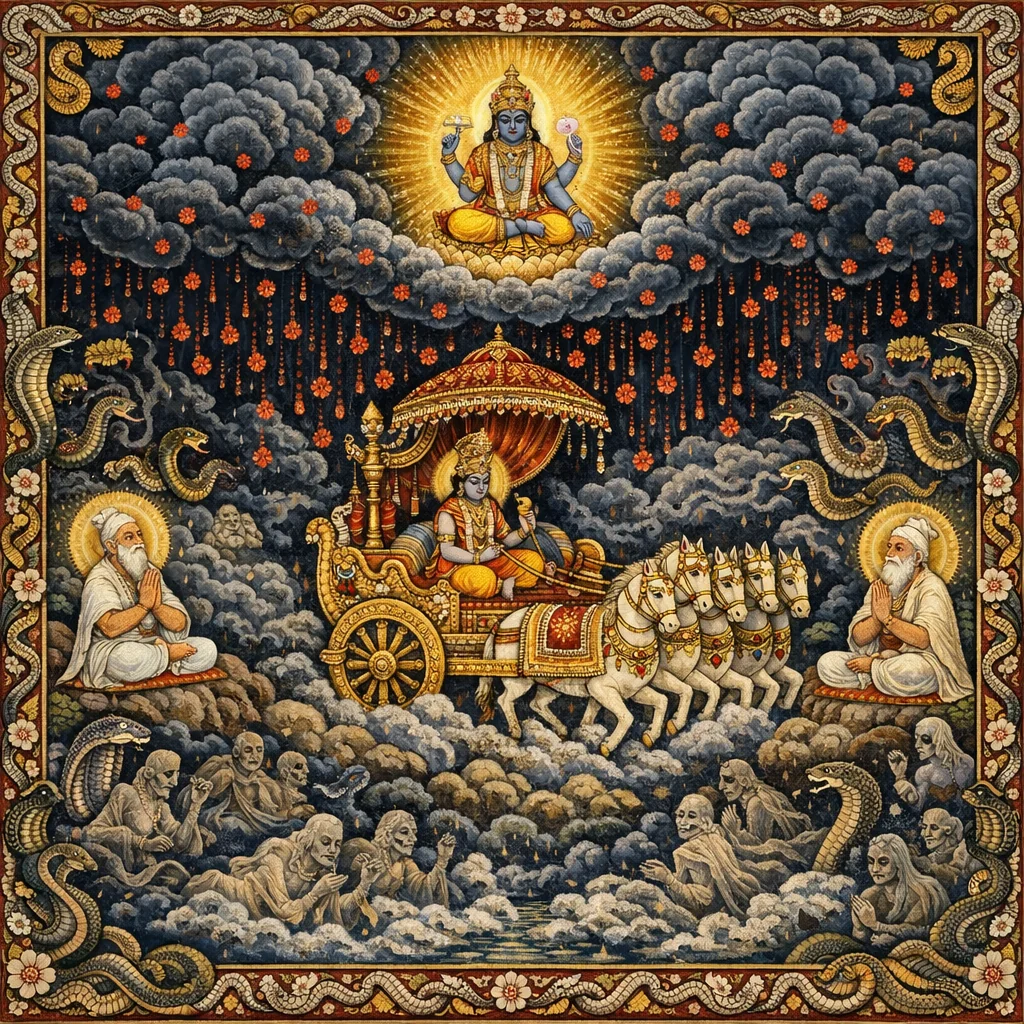
Adhyaya 10
Dhruva’s War with the Yakṣas and the Protection of the Holy Name
Settled in family life, Dhruva is enraged when a Yakṣa kills his brother Uttama. He marches to Alakāpurī, devastating the Yakṣa army until they employ mystic māyā (illusion). Sages intervene, advising Dhruva to invoke Lord Śārṅgadhanvā (Viṣṇu) and take shelter of the Holy Name, which dispels illusion and protects devotees from fear.
Shlokas
Verse 1
मैत्रेय उवाच प्रजापतेर्दुहितरं शिशुमारस्य वै ध्रुव: । उपयेमे भ्रमिं नाम तत्सुतौ कल्पवत्सरौ ॥ १ ॥
Maitreya said: O Vidura, thereafter Dhruva Mahārāja married Bhrami, the daughter of Prajāpati Śiśumāra, and from her were born two sons, Kalpa and Vatsara.
Verse 2
इलायामपि भार्यायां वायो: पुत्र्यां महाबल: । पुत्रमुत्कलनामानं योषिद्रत्नमजीजनत् ॥ २ ॥
The greatly powerful Dhruva Mahārāja also had another wife, Ilā, the daughter of the demigod Vāyu. By her he begot a son named Utkala and a jewel-like, very beautiful daughter.
Verse 3
उत्तमस्त्वकृतोद्वाहो मृगयायां बलीयसा । हत: पुण्यजनेनाद्रौ तन्मातास्य गतिं गता ॥ ३ ॥
Uttama, Dhruva Mahārāja’s younger brother, still unmarried, once went hunting and was slain in the Himalayas by a powerful Yakṣa. His mother, Suruci, too followed her son’s path and passed away.
Verse 4
ध्रुवो भ्रातृवधं श्रुत्वा कोपामर्षशुचार्पित: । जैत्रं स्यन्दनमास्थाय गत: पुण्यजनालयम् ॥ ४ ॥
Hearing of his brother Uttama’s slaying, Dhruva Mahārāja, overwhelmed by grief and wrath, mounted his victorious chariot and set out for Alakāpurī, the city of the Yakṣas, to conquer it.
Verse 5
गत्वोदीचीं दिशं राजा रुद्रानुचरसेविताम् । ददर्श हिमवद्द्रोण्यां पुरीं गुह्यकसङ्कुलाम् ॥ ५ ॥
King Dhruva Mahārāja went north to the Himalayan region served by Rudra’s followers, and in a valley of Himavat he beheld a city crowded with the Guhyakas.
Verse 6
दध्मौ शङ्खं बृहद्बाहु: खं दिशश्चानुनादयन् । येनोद्विग्नदृश: क्षत्तरुपदेव्योऽत्रसन्भृशम् ॥ ६ ॥
Maitreya said: O Vidura, as soon as Dhruva Mahārāja reached Alakāpurī, he at once blew his conchshell; its sound resounded through the sky and in every direction. The Yakṣas’ wives were greatly frightened, and anxiety was plain in their eyes.
Verse 7
ततो निष्क्रम्य बलिन उपदेवमहाभटा: । असहन्तस्तन्निनादमभिपेतुरुदायुधा: ॥ ७ ॥
O heroic Vidura, then the exceedingly powerful Yakṣa champions, led by Upadeva, unable to endure that booming sound, came out of the city with weapons raised and attacked Dhruva.
Verse 8
स तानापततो वीर उग्रधन्वा महारथ: । एकैकं युगपत्सर्वानहन् बाणैस्त्रिभिस्त्रिभि: ॥ ८ ॥
Dhruva Mahārāja, a mighty bowman and great chariot-warrior, at once began to slay the attackers, releasing arrows three at a time and striking them down one after another.
Verse 9
ते वै ललाटलग्नैस्तैरिषुभि: सर्व एव हि । मत्वा निरस्तमात्मानमाशंसन् कर्म तस्य तत् ॥ ९ ॥
Seeing Dhruva Mahārāja’s arrows fixed upon their foreheads, all the Yakṣa heroes understood their defeat was certain. Yet, true to a warrior’s spirit, they praised Dhruva’s deed.
Verse 10
तेऽपि चामुममृष्यन्त: पादस्पर्शमिवोरगा: । शरैरविध्यन् युगपद् द्विगुणं प्रचिकीर्षव: ॥ १० ॥
Like serpents that cannot bear the touch of a foot, the Yakṣas could not tolerate Dhruva Mahārāja’s wondrous prowess; all at once they loosed twice as many arrows, displaying their valor.
Verse 11
तत: परिघनिस्त्रिंशै: प्रासशूलपरश्वधै: । शक्त्यृष्टिभिर्भुशुण्डीभिश्चित्रवाजै: शरैरपि ॥ ११ ॥ अभ्यवर्षन् प्रकुपिता: सरथं सहसारथिम् । इच्छन्तस्तत्प्रतीकर्तुमयुतानां त्रयोदश ॥ १२ ॥
Then the Yakṣas, inflamed with wrath, showered Dhruva Mahārāja—together with his chariot and charioteer—with a rain of weapons: multifeathered arrows, iron bludgeons (parighas), swords (nistriṁśas), tridents (prāsa-śūlas), lances (paraśvadhas), pikes (śaktis), spears (ṛṣṭis), and bhuśuṇḍī weapons.
Verse 12
तत: परिघनिस्त्रिंशै: प्रासशूलपरश्वधै: । शक्त्यृष्टिभिर्भुशुण्डीभिश्चित्रवाजै: शरैरपि ॥ ११ ॥ अभ्यवर्षन् प्रकुपिता: सरथं सहसारथिम् । इच्छन्तस्तत्प्रतीकर्तुमयुतानां त्रयोदश ॥ १२ ॥
The Yakṣa host—one hundred thirty thousand strong—burned with anger, eager to thwart Dhruva Mahārāja’s wondrous deeds; with all their might they rained weapons and arrows upon him, along with his chariot and charioteer.
Verse 13
औत्तानपादि: स तदा शस्त्रवर्षेण भूरिणा । न एवादृश्यताच्छन्न आसारेण यथा गिरि: ॥ १३ ॥
Then Dhruva Mahārāja, the son of Uttānapāda, was wholly covered by a heavy shower of weapons and could no longer be seen—like a mountain veiled by unceasing rain.
Verse 14
हाहाकारस्तदैवासीत्सिद्धानां दिवि पश्यताम् । हतोऽयं मानव: सूर्यो मग्न: पुण्यजनार्णवे ॥ १४ ॥
At that very moment the Siddhas watching from the heavens raised a great outcry: “Dhruva, Manu’s grandson, is like the sun—now he has sunk into the ocean of the Yakṣas, as though the sun had set!”
Verse 15
नदत्सु यातुधानेषु जयकाशिष्वथो मृधे । उदतिष्ठद्रथस्तस्य नीहारादिव भास्कर: ॥ १५ ॥
As the Yakṣas roared in battle, boasting, “We have conquered Dhruva Mahārāja!”, Dhruva’s chariot suddenly appeared—like the sun bursting forth from within a bank of mist.
Verse 16
धनुर्विस्फूर्जयन्दिव्यं द्विषतां खेदमुद्वहन् । अस्त्रौघं व्यधमद्बाणैर्घनानीकमिवानिल: ॥ १६ ॥
Dhruva Mahārāja made his divine bow resound, filling his foes’ hearts with anguish. He loosed an unbroken stream of arrows, shattering their weapons, as a fierce wind scatters gathered clouds.
Verse 17
तस्य ते चापनिर्मुक्ता भित्त्वा वर्माणि रक्षसाम् । कायानाविविशुस्तिग्मा गिरीनशनयो यथा ॥ १७ ॥
The keen arrows released from Dhruva Mahārāja’s bow pierced the rākṣasas’ shields and armor and entered their bodies—like Indra’s thunderbolt shattering the very frames of mountains.
Verse 18
भल्लै: सञ्छिद्यमानानां शिरोभिश्चारुकुण्डलै: । ऊरुभिर्हेमतालाभैर्दोर्भिर्वलयवल्गुभि: ॥ १८ ॥ हारकेयूरमुकुटैरुष्णीषैश्च महाधनै: । आस्तृतास्ता रणभुवो रेजुर्वीरमनोहरा: ॥ १९ ॥
The great sage Maitreya continued: Dear Vidura, the heads severed by Dhruva Mahārāja’s bhalla arrows were exquisitely adorned with earrings and turbans. Their thighs shone like golden palm trunks, their arms were graced with bracelets and armlets, and upon their heads lay priceless, gold-bedecked helmets and crowns. Strewn across the battlefield, these ornaments glittered—captivating enough to bewilder even a hero’s mind.
Verse 19
भल्लै: सञ्छिद्यमानानां शिरोभिश्चारुकुण्डलै: । ऊरुभिर्हेमतालाभैर्दोर्भिर्वलयवल्गुभि: ॥ १८ ॥ हारकेयूरमुकुटैरुष्णीषैश्च महाधनै: । आस्तृतास्ता रणभुवो रेजुर्वीरमनोहरा: ॥ १९ ॥
The great sage Maitreya continued: Dear Vidura, the heads severed by Dhruva Mahārāja’s bhalla arrows were exquisitely adorned with earrings and turbans. Their thighs shone like golden palm trunks, their arms were graced with bracelets and armlets, and upon their heads lay priceless, gold-bedecked helmets and crowns. Strewn across the battlefield, these ornaments glittered—captivating enough to bewilder even a hero’s mind.
Verse 20
हतावशिष्टा इतरे रणाजिराद् रक्षोगणा: क्षत्रियवर्यसायकै: । प्रायो विवृक्णावयवा विदुद्रुवु- र्मृगेन्द्रविक्रीडितयूथपा इव ॥ २० ॥
The remaining Yakṣas who somehow or other were not killed had their limbs cut to pieces by the arrows of the great warrior Dhruva Mahārāja. Thus they began to flee, just as elephants flee when defeated by a lion.
Verse 21
अपश्यमान: स तदाततायिनं महामृधे कञ्चन मानवोत्तम: । पुरीं दिदृक्षन्नपि नाविशद्द्विषां न मायिनां वेद चिकीर्षितं जन: ॥ २१ ॥
Dhruva Mahārāja, the best of human beings, observed that in that great battlefield not one of the opposing soldiers was left standing with proper weapons. He then desired to see the city of Alakāpurī, but he thought to himself, “No one knows the plans of the mystic Yakṣas.”
Verse 22
इति ब्रुवंश्चित्ररथ: स्वसारथिं यत्त: परेषां प्रतियोगशङ्कित: । शुश्राव शब्दं जलधेरिवेरितं नभस्वतो दिक्षु रजोऽन्वदृश्यत ॥ २२ ॥
In the meantime, while Dhruva Mahārāja, doubtful of his mystic enemies, was talking with his charioteer, they heard a tremendous sound, as if the whole ocean were there, and they found that from the sky a great dust storm was coming over them from all directions.
Verse 23
क्षणेनाच्छादितं व्योम घनानीकेन सर्वत: । विस्फुरत्तडिता दिक्षु त्रासयत्स्तनयित्नुना ॥ २३ ॥
Within a moment the whole sky was overcast with dense clouds, and severe thundering was heard. There was glittering electric lightning and severe rainfall.
Verse 24
ववृषू रुधिरौघासृक्पूयविण्मूत्रमेदस: । निपेतुर्गगनादस्य कबन्धान्यग्रतोऽनघ ॥ २४ ॥
My dear faultless Vidura, in that rainfall there was blood, mucus, pus, stool, urine and marrow falling heavily before Dhruva Mahārāja, and there were trunks of bodies falling from the sky.
Verse 25
तत: खेऽदृश्यत गिरिर्निपेतु: सर्वतोदिशम् । गदापरिघनिस्त्रिंशमुसला: साश्मवर्षिण: ॥ २५ ॥
Next a great mountain appeared in the sky, and from every direction hailstones fell, along with lances, clubs, swords, iron bludgeons, and massive stones.
Verse 26
अहयोऽशनिनि:श्वासा वमन्तोऽग्निं रुषाक्षिभि: । अभ्यधावन् गजा मत्ता: सिंहव्याघ्राश्च यूथश: ॥ २६ ॥
Dhruva Mahārāja also saw huge serpents with furious eyes, hissing like thunder and spewing fire as they rushed to devour him, along with herds of mad elephants and groups of lions and tigers.
Verse 27
समुद्र ऊर्मिभिर्भीम: प्लावयन् सर्वतो भुवम् । आससाद महाह्राद: कल्पान्त इव भीषण: ॥ २७ ॥
Then, as if the time of universal dissolution had come, the fierce sea with foaming waves and a mighty roar surged forward before him, flooding the earth on every side.
Verse 28
एवंविधान्यनेकानि त्रासनान्यमनस्विनाम् । ससृजुस्तिग्मगतय आसुर्या माययासुरा: ॥ २८ ॥
Thus, to terrify one of lesser understanding, the Yakṣas—swift and asuric by nature—used their māyā to conjure many strange and dreadful phenomena, for they are inherently cruel.
Verse 29
ध्रुवे प्रयुक्तामसुरैस्तां मायामतिदुस्तराम् । निशम्य तस्य मुनय: शमाशंसन् समागता: ॥ २९ ॥
When the great sages heard that Dhruva Mahārāja was being overwhelmed by the demons’ māyā, so difficult to surmount, they at once assembled and came to offer him auspicious, peace-giving encouragement.
Verse 30
मुनय ऊचु: औत्तानपाद भगवांस्तव शार्ङ्गधन्वा देव: क्षिणोत्ववनतार्तिहरो विपक्षान् । यन्नामधेयमभिधाय निशम्य चाद्धा लोकोऽञ्जसा तरति दुस्तरमङ्ग मृत्युम् ॥ ३० ॥
The sages said: “O Dhruva, son of Uttānapāda, may Bhagavān Śārṅgadhanvā—He who removes the distress of His bhaktas—destroy your threatening foes. The Lord’s holy Name is as powerful as the Lord Himself; by chanting and hearing that Name, people easily cross the hard-to-cross death and are fully protected.”
Frequently Asked Questions
Dhruva attacks because his brother Uttama is killed by a Yakṣa during a Himalayan hunt, and Dhruva becomes overwhelmed by lamentation and anger. The narrative presents a realistic kṣatriya response to perceived injustice, while simultaneously setting up the Bhāgavata’s corrective theme: power and retaliation must be checked by devotion and saintly guidance so that duty does not degrade into adharma.
Yakṣas are a class of powerful beings often associated with wealth, guardianship, and in some contexts fierce or demoniac conduct. In this episode they function as formidable opponents skilled in mystic deception. Alakāpurī is their city in the Himalayan region, depicted as a stronghold populated by ghostly persons and followers linked with Lord Śiva’s sphere, emphasizing the atmosphere of occult power and illusion.
When direct combat fails, the Yakṣas project terrifying illusory phenomena: dust storms, thunderclouds, unnatural rainfall containing blood and impurities, falling body parts, hail and weapons from the sky, fire-breathing serpents, predatory beasts, and an ocean-like deluge resembling cosmic dissolution. The purpose is to destabilize Dhruva’s mind and frighten a less intelligent opponent, showing māyā as a weapon that targets perception and courage.
The sages’ counsel frames the decisive protection (rakṣā) not as mere martial superiority but as surrender to Bhagavān through nāma. They affirm that the Lord’s name is non-different from the Lord in potency, and that chanting and hearing can protect devotees even in life-threatening conditions. Theologically, this reinforces poṣaṇa—the Lord’s special care for His devotee—and redirects Dhruva’s crisis from anger-driven action to bhakti-centered refuge.
Śārṅgadhanvā is a name of Lord Viṣṇu, “He who holds the Śārṅga bow.” The sages invoke Him because Dhruva is facing both physical assault and illusionary threats; Viṣṇu is celebrated as the reliever of devotee distress and the ultimate protector. The epithet also resonates with the battlefield context—divine sovereignty over all weapons and all forms of fear.