Adhyaya 13
Paramahaṁsa-Dharma: The Avadhūta-like Sannyāsī and Prahlāda’s Dialogue with the ‘Python’ Saint
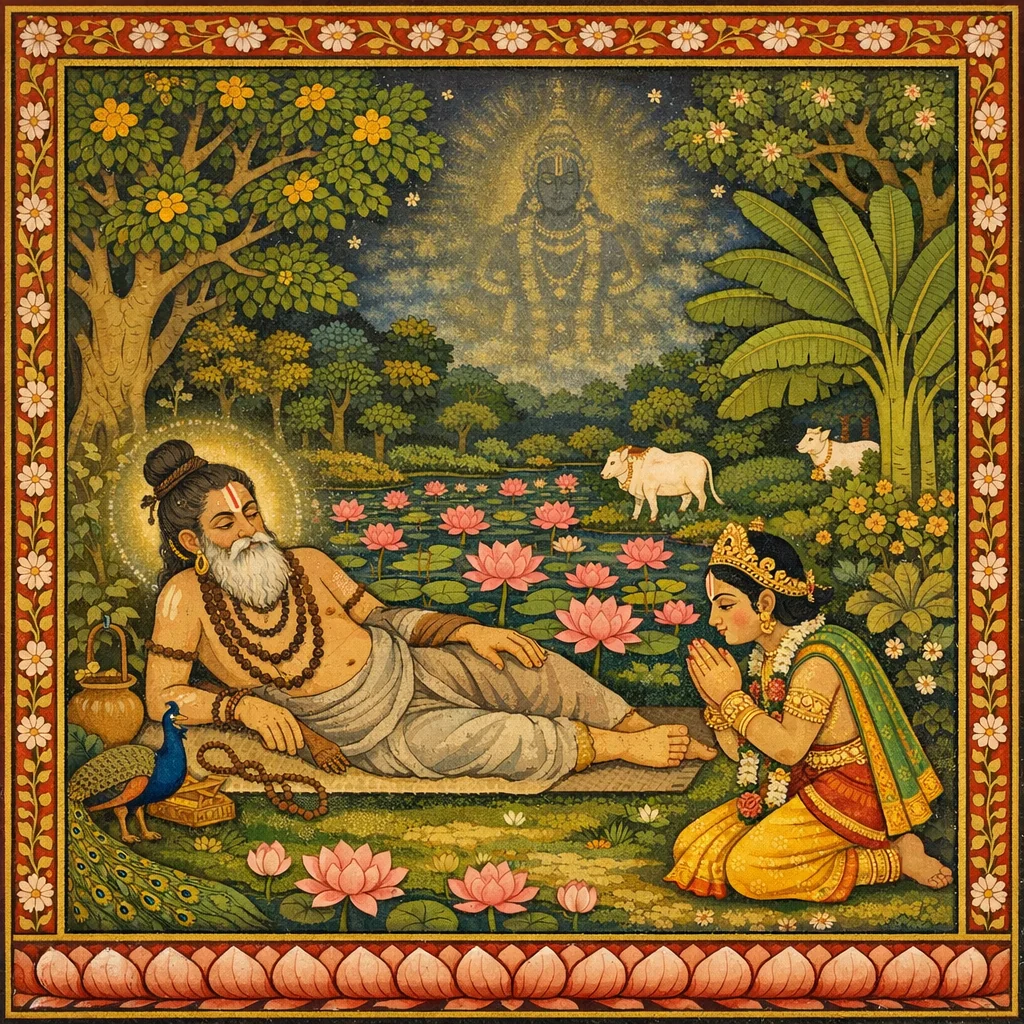
Continuing the canto’s shift from Prahlāda’s personal ordeal to his instructional role for society, Nārada Muni outlines the conduct of a true renunciant: minimal dependence, non-accumulation, freedom from sectarian quarrel, and vision of the Supreme pervading all. External symbols (daṇḍa, kamaṇḍalu, dress) are treated as secondary to inner realization, and the saint may conceal his stature—appearing childish or mute—to avoid worldly entanglement. Nārada then introduces an illustrative itihāsa: Prahlāda, touring to study saintly character, meets an advanced brāhmaṇa living “like a python,” inactive yet well-nourished. Prahlāda’s respectful inquiry elicits a penetrating diagnosis of material life: sense-driven action yields only the threefold miseries and anxiety, especially in wealth and prestige. The saint teaches contentment through the models of the bee (non-hoarding) and python (patient non-endeavor), accepting whatever comes by destiny. The chapter closes with Prahlāda grasping the duties of the paramahaṁsa, preparing the narrative to proceed toward further institutional and ethical teachings grounded in detachment and bhakti.
Shlokas
Verse 1
श्रीनारद उवाच कल्पस्त्वेवं परिव्रज्य देहमात्रावशेषित: । ग्रामैकरात्रविधिना निरपेक्षश्चरेन्महीम् ॥ १ ॥
Śrī Nārada Muni said: A person able to cultivate spiritual knowledge should renounce all material connections, and merely keeping the body inhabitable, he should travel from one place to another, passing only one night in each village. In this way, without dependence in regard to the needs of the body, the sannyāsī should travel all over the world.
Verse 2
बिभृयाद् यद्यसौ वास: कौपीनाच्छादनं परम् । त्यक्तं न लिङ्गाद् दण्डादेरन्यत् किञ्चिदनापदि ॥ २ ॥
A person in the renounced order of life may try to avoid even a dress to cover himself. If he wears anything at all, it should be only a loincloth, and when there is no necessity, a sannyāsī should not even accept a daṇḍa. A sannyāsī should avoid carrying anything but a daṇḍa and kamaṇḍalu.
Verse 3
एक एव चरेद्भिक्षुरात्मारामोऽनपाश्रय: । सर्वभूतसुहृच्छान्तो नारायणपरायण: ॥ ३ ॥
The sannyāsī, completely satisfied in the self, should live on alms begged from door to door. Not being dependent on any person or any place, he should always be a friendly well-wisher to all living beings and be a peaceful, unalloyed devotee of Nārāyaṇa. In this way he should move from one place to another.
Verse 4
पश्येदात्मन्यदो विश्वं परे सदसतोऽव्यये । आत्मानं च परं ब्रह्म सर्वत्र सदसन्मये ॥ ४ ॥
The sannyāsī should always try to see the Supreme pervading everything and see everything, including this universe, resting on the Supreme.
Verse 5
सुप्तिप्रबोधयो: सन्धावात्मनो गतिमात्मदृक् । पश्यन्बन्धं च मोक्षं च मायामात्रं न वस्तुत: ॥ ५ ॥
During unconsciousness and consciousness, and between the two, he should try to understand the self and be fully situated in the self. In this way, he should realize that the conditional and liberated stages of life are only illusory and not actually factual. With such a higher understanding, he should see only the Absolute Truth pervading everything.
Verse 6
नाभिनन्देद् ध्रुवं मृत्युमध्रुवं वास्य जीवितम् । कालं परं प्रतीक्षेत भूतानां प्रभवाप्ययम् ॥ ६ ॥
Since the material body is sure to be vanquished and the duration of one’s life is not fixed, neither death nor life is to be praised. Rather, one should observe the eternal time factor, in which the living entity manifests himself and disappears.
Verse 7
नासच्छास्त्रेषु सज्जेत नोपजीवेत जीविकाम् । वादवादांस्त्यजेत्तर्कान्पक्षं कंच न संश्रयेत् ॥ ७ ॥
Literature that is a useless waste of time — in other words, literature without spiritual benefit — should be rejected. One should not become a professional teacher as a means of earning one’s livelihood, nor should one indulge in arguments and counterarguments. Nor should one take shelter of any cause or faction.
Verse 8
न शिष्याननुबध्नीत ग्रन्थान्नैवाभ्यसेद् बहून् । न व्याख्यामुपयुञ्जीत नारम्भानारभेत्क्वचित् ॥ ८ ॥
A sannyāsī must not present allurements of material benefits to gather many disciples, nor should he unnecessarily read many books or give discourses as a means of livelihood. He must never attempt to increase material opulences unnecessarily.
Verse 9
न यतेराश्रम: प्रायो धर्महेतुर्महात्मन: । शान्तस्य समचित्तस्य बिभृयादुत वा त्यजेत् ॥ ९ ॥
A peaceful, equipoised person who is factually advanced in spiritual consciousness does not need to accept the symbols of a sannyāsī, such as the tridaṇḍa and kamaṇḍalu. According to necessity, he may sometimes accept those symbols and sometimes reject them.
Verse 10
अव्यक्तलिङ्गो व्यक्तार्थो मनीष्युन्मत्तबालवत् । कविर्मूकवदात्मानं स दृष्टया दर्शयेन्नृणाम् ॥ १० ॥
Although a saintly person may not expose himself to the vision of human society, by his behavior his purpose is disclosed. To human society he should present himself like a restless child, and although he is the greatest thoughtful orator, he should present himself like a dumb man.
Verse 11
अत्राप्युदाहरन्तीममितिहासं पुरातनम् । प्रह्रादस्य च संवादं मुनेराजगरस्य च ॥ ११ ॥
As a historical example of this, learned sages recite the story of an ancient discussion between Prahlāda Mahārāja and a great saintly person who was feeding himself like a python.
Verse 12
तं शयानं धरोपस्थे कावेर्यां सह्यसानुनि । रजस्वलैस्तनूदेशैर्निगूढामलतेजसम् ॥ १२ ॥ ददर्श लोकान्विचरन् लोकतत्त्वविवित्सया । वृतोऽमात्यै: कतिपयै: प्रह्रादो भगवत्प्रिय: ॥ १३ ॥
Prahlāda Mahārāja, the most dear servitor of the Supreme Personality of Godhead, once went out touring the universe with some of his confidential associates just to study the nature of saintly persons. Thus he arrived at the bank of the Kāverī, where there was a mountain known as Sahya. There he found a great saintly person who was lying on the ground, covered with dirt and dust, but who was deeply spiritually advanced.
Verse 13
तं शयानं धरोपस्थे कावेर्यां सह्यसानुनि । रजस्वलैस्तनूदेशैर्निगूढामलतेजसम् ॥ १२ ॥ ददर्श लोकान्विचरन् लोकतत्त्वविवित्सया । वृतोऽमात्यै: कतिपयै: प्रह्रादो भगवत्प्रिय: ॥ १३ ॥
Prahlāda Mahārāja, the most dear servitor of the Supreme Personality of Godhead, once went out touring the universe with some of his confidential associates just to study the nature of saintly persons. Thus he arrived at the bank of the Kāverī, where there was a mountain known as Sahya. There he found a great saintly person who was lying on the ground, covered with dirt and dust, but who was deeply spiritually advanced.
Verse 14
कर्मणाकृतिभिर्वाचा लिङ्गैर्वर्णाश्रमादिभि: । न विदन्ति जना यं वै सोऽसाविति न वेति च ॥ १४ ॥
Neither by that saintly person’s activities, by his bodily features, by his words nor by the symptoms of his varṇāśrama status could people understand whether he was the same person they had known.
Verse 15
तं नत्वाभ्यर्च्य विधिवत्पादयो: शिरसा स्पृशन् । विवित्सुरिदमप्राक्षीन्महाभागवतोऽसुर: ॥ १५ ॥
The advanced devotee Prahlāda Mahārāja duly worshiped and offered obeisances to the saintly person who had adopted a python’s means of livelihood. After thus worshiping the saintly person and touching his own head to the saint’s lotus feet, Prahlāda Mahārāja, in order to understand him, inquired very submissively as follows.
Verse 16
बिभर्षि कायं पीवानं सोद्यमो भोगवान्यथा ॥ १६ ॥ वित्तं चैवोद्यमवतां भोगो वित्तवतामिह । भोगिनां खलु देहोऽयं पीवा भवति नान्यथा ॥ १७ ॥
Seeing the saintly person to be quite fat, Prahlāda Mahārāja said: My dear sir, you undergo no endeavor to earn your livelihood, but you have a stout body, exactly like that of a materialistic enjoyer. I know that if one is very rich and has nothing to do, he becomes extremely fat by eating and sleeping and performing no work.
Verse 17
बिभर्षि कायं पीवानं सोद्यमो भोगवान्यथा ॥ १६ ॥ वित्तं चैवोद्यमवतां भोगो वित्तवतामिह । भोगिनां खलु देहोऽयं पीवा भवति नान्यथा ॥ १७ ॥
Seeing the saintly person to be quite fat, Prahlāda Mahārāja said: My dear sir, you undergo no endeavor to earn your livelihood, but you have a stout body, exactly like that of a materialistic enjoyer. I know that if one is very rich and has nothing to do, he becomes extremely fat by eating and sleeping and performing no work.
Verse 18
न ते शयानस्य निरुद्यमस्य ब्रह्मन्नु हार्थो यत एव भोग: । अभोगिनोऽयं तव विप्र देह: पीवा यतस्तद्वद न: क्षमं चेत् ॥ १८ ॥
O brāhmaṇa, fully in knowledge of transcendence, you have nothing to do, and therefore you are lying down. It is also understood that you have no money for sense enjoyment. How then has your body become so fat? Under the circumstances, if you do not consider my question impudent, kindly explain how this has happened.
Verse 19
कवि: कल्पो निपुणदृक् चित्रप्रियकथ: सम: । लोकस्य कुर्वत: कर्म शेषे तद्वीक्षितापि वा ॥ १९ ॥
Your Honor appears learned, expert and intelligent in every way. You can speak very well, saying things that are pleasing to the heart. You see that people in general are engaged in fruitive activities, yet you are lying here inactive.
Verse 20
श्रीनारद उवाच \स इत्थं दैत्यपतिना परिपृष्टो महामुनि: । स्मयमानस्तमभ्याह तद्वागमृतयन्त्रित: ॥ २० ॥
Nārada Muni continued: When the saintly person was thus questioned by Prahlāda Mahārāja, the King of the Daityas, he was captivated by this shower of nectarean words, and he replied to the inquisitiveness of Prahlāda Mahārāja with a smiling face.
Verse 21
श्रीब्राह्मण उवाच वेदेदमसुरश्रेष्ठ भवान् नन्वार्यसम्मत: । ईहोपरमयोर्नृणां पदान्यध्यात्मचक्षुषा ॥ २१ ॥
The saintly brāhmaṇa said: O best of the asuras, Prahlāda Mahārāja, who are recognized by advanced and civilized men, you are aware of the different stages of life because of your inherent transcendental eyes, with which you can see a man’s character and thus know clearly the results of acceptance and rejection of things as they are.
Verse 22
यस्य नारायणो देवो भगवान्हृद्गत: सदा । भक्त्या केवलयाज्ञानं धुनोति ध्वान्तमर्कवत् ॥ २२ ॥
Nārāyaṇa, the Supreme Personality of Godhead, who is full of all opulences, is predominant within the core of your heart because of your being a pure devotee. He always drives away all the darkness of ignorance, as the sun drives away the darkness of the universe.
Verse 23
तथापि ब्रूमहे प्रश्नांस्तव राजन्यथाश्रुतम् । सम्भाषणीयो हि भवानात्मन: शुद्धिमिच्छता ॥ २३ ॥
My dear King, although you know everything, you have posed some questions, which I shall try to answer according to what I have learned by hearing from authorities. I cannot remain silent in this regard, for a personality like you is just fit to be spoken to by one who desires self-purification.
Verse 24
तृष्णया भववाहिन्या योग्यै: कामैरपूर्यया । कर्माणि कार्यमाणोऽहं नानायोनिषु योजित: ॥ २४ ॥
Because of insatiable material desires, I was being carried away by the waves of material nature’s laws, and thus I was engaging in different activities, struggling for existence in various forms of life.
Verse 25
यदृच्छया लोकमिमं प्रापित: कर्मभिर्भ्रमन् । स्वर्गापवर्गयोर्द्वारं तिरश्चां पुनरस्य च ॥ २५ ॥
In the course of the evolutionary process, which is caused by fruitive activities due to undesirable material sense gratification, I have received this human form of life, which can lead to the heavenly planets, to liberation, to the lower species, or to rebirth among human beings.
Verse 26
तत्रापि दम्पतीनां च सुखायान्यापनुत्तये । कर्माणि कुर्वतां दृष्ट्वा निवृत्तोऽस्मि विपर्ययम् ॥ २६ ॥
In this human form of life, men and women unite for the sensual pleasure of sex, but by actual experience we have observed that none of them are happy. Therefore, seeing the contrary results, I have stopped taking part in materialistic activities.
Verse 27
सुखमस्यात्मनो रूपं सर्वेहोपरतिस्तनु: । मन:संस्पर्शजान् दृष्ट्वा भोगान्स्वप्स्यामि संविशन् ॥ २७ ॥
The actual form of life for the living entities is one of spiritual happiness, which is real happiness. This happiness can be achieved only when one stops all materialistic activities. Material sense enjoyment is simply an imagination. Therefore, considering this subject matter, I have ceased from all material activities and am lying down here.
Verse 28
इत्येतदात्मन: स्वार्थं सन्तं विस्मृत्य वै पुमान् । विचित्रामसति द्वैते घोरामाप्नोति संसृतिम् ॥ २८ ॥
In this way the conditioned soul living within the body forgets his self-interest because he identifies himself with the body. Because the body is material, his natural tendency is to be attracted by the varieties of the material world. Thus the living entity suffers the miseries of material existence.
Verse 29
जलं तदुद्भवैश्छन्नं हित्वाज्ञो जलकाम्यया । मृगतृष्णामुपाधावेत्तथान्यत्रार्थदृक् स्वत: ॥ २९ ॥
Just as a deer, because of ignorance, cannot see the water within a well covered by grass, but runs after water elsewhere, the living entity covered by the material body does not see the happiness within himself, but runs after happiness in the material world.
Verse 30
देहादिभिर्दैवतन्त्रैरात्मन: सुखमीहत: । दु:खात्ययं चानीशस्य क्रिया मोघा: कृता: कृता: ॥ ३० ॥
The living entity tries to achieve happiness and rid himself of the causes of distress, but because the various bodies of the living entities are under the full control of material nature, all his plans in different bodies, one after another, are ultimately baffled.
Verse 31
आध्यात्मिकादिभिर्दु:खैरविमुक्तस्य कर्हिचित् । मर्त्यस्य कृच्छ्रोपनतैरर्थै: कामै: क्रियेत किम् ॥ ३१ ॥
Materialistic activities are always mixed with three kinds of miserable conditions — adhyātmika, adhidaivika and adhibautika. Therefore, even if one achieves some success by performing such activities, what is the benefit of this success? One is still subjected to birth, death, old age, disease and the reactions of his fruitive activities.
Verse 32
पश्यामि धनिनां क्लेशं लुब्धानामजितात्मनाम् । भयादलब्धनिद्राणां सर्वतोऽभिविशङ्किनाम् ॥ ३२ ॥
The brāhmaṇa continued: I am actually seeing how a rich man, who is a victim of his senses, is very greedy to accumulate wealth, and therefore suffers from insomnia due to fear from all sides, despite his wealth and opulence.
Verse 33
राजतश्चौरत: शत्रो: स्वजनात्पशुपक्षित: । अर्थिभ्य: कालत: स्वस्मान्नित्यं प्राणार्थवद्भयम् ॥ ३३ ॥
Those who are considered materially powerful and rich are always full of anxieties because of governmental laws, thieves and rogues, enemies, family members, animals, birds, persons seeking charity, the inevitable time factor and even their own selves. Thus they are invariably afraid.
Verse 34
शोकमोहभयक्रोधरागक्लैब्यश्रमादय: । यन्मूला: स्युर्नृणां जह्यात्स्पृहां प्राणार्थयोर्बुध: ॥ ३४ ॥
Those in human society who are intelligent should give up the original cause of lamentation, illusion, fear, anger, attachment, poverty and unnecessary labor. The original cause of all of these is the desire for unnecessary prestige and money.
Verse 35
मधुकारमहासर्पौ लोकेऽस्मिन्नो गुरूत्तमौ । वैराग्यं परितोषं च प्राप्ता यच्छिक्षया वयम् ॥ ३५ ॥
The bee and the python are two excellent spiritual masters who give us exemplary instructions regarding how to be satisfied by collecting only a little and how to stay in one place and not move.
Verse 36
विराग: सर्वकामेभ्य: शिक्षितो मे मधुव्रतात् । कृच्छ्राप्तं मधुवद्वित्तं हत्वाप्यन्यो हरेत्पतिम् ॥ ३६ ॥
From the bumblebee I have learned to be unattached to accumulating money, for although money is as good as honey, anyone can kill its owner and take it away.
Verse 37
अनीह: परितुष्टात्मा यदृच्छोपनतादहम् । नो चेच्छये बह्वहानि महाहिरिव सत्त्ववान् ॥ ३७ ॥
I do not endeavor to get anything, but am satisfied with whatever is achieved in its own way. If I do not get anything, I am patient and unagitated like a python and lie down in this way for many days.
Verse 38
क्वचिदल्पं क्वचिद्भूरि भुञ्जेऽन्नं स्वाद्वस्वादु वा । क्वचिद्भूरि गुणोपेतं गुणहीनमुत क्वचित् । श्रद्धयोपहृतं क्वापि कदाचिन्मानवर्जितम् । भुञ्जे भुक्त्वाथ कस्मिंश्चिद्दिवा नक्तं यदृच्छया ॥ ३८ ॥
Sometimes I eat a very small quantity and sometimes a great quantity. Sometimes the food is very palatable, and sometimes it is stale. Sometimes prasāda is offered with great respect, and sometimes food is given neglectfully. Sometimes I eat during the day and sometimes at night. Thus I eat what is easily available.
Verse 39
क्षौमं दुकूलमजिनं चीरं वल्कलमेव वा । वसेऽन्यदपि सम्प्राप्तं दिष्टभुक्तुष्टधीरहम् ॥ ३९ ॥
To cover my body I use whatever is available, whether it be linen, silk, cotton, bark or deerskin, according to my destiny, and I am fully satisfied and unagitated.
Verse 40
क्वचिच्छये धरोपस्थे तृणपर्णाश्मभस्मसु । क्वचित्प्रासादपर्यङ्के कशिपौ वा परेच्छया ॥ ४० ॥
Sometimes I lie on the surface of the earth, sometimes on leaves, grass or stone, sometimes on a pile of ashes, or sometimes, by the will of others, in a palace on a first-class bed with pillows.
Verse 41
क्वचित्स्नातोऽनुलिप्ताङ्ग: सुवासा: स्रग्व्यलङ्कृत: । रथेभाश्वैश्चरे क्वापि दिग्वासा ग्रहवद्विभो ॥ ४१ ॥
O my lord, sometimes I bathe myself very nicely, smear sandalwood pulp all over my body, put on a flower garland, and dress in fine garments and ornaments. Then I travel like a king on the back of an elephant or on a chariot or horse. Sometimes, however, I travel naked, like a person haunted by a ghost.
Verse 42
नाहं निन्दे न च स्तौमि स्वभावविषमं जनम् । एतेषां श्रेय आशासे उतैकात्म्यं महात्मनि ॥ ४२ ॥
Different people are of different mentalities. Therefore it is not my business either to praise them or to blaspheme them. I only desire their welfare, hoping that they will agree to become one with the Supersoul, the Supreme Personality of Godhead, Kṛṣṇa.
Verse 43
विकल्पं जुहुयाच्चित्तौ तां मनस्यर्थविभ्रमे । मनो वैकारिके हुत्वा तं मायायां जुहोत्यनु ॥ ४३ ॥
The mental concoction of discrimination between good and bad should be accepted as one unit and then invested in the mind, which should then be invested in the false ego. The false ego should be invested in the total material energy. This is the process of fighting false discrimination.
Verse 44
आत्मानुभूतौ तां मायां जुहुयात्सत्यदृङ्मुनि: । ततो निरीहो विरमेत् स्वानुभूत्यात्मनि स्थित: ॥ ४४ ॥
A learned, thoughtful person must realize that material existence is illusion. This is possible only by self-realization. A self-realized person, who has actually seen the truth, should retire from all material activities, being situated in self-realization.
Verse 45
स्वात्मवृत्तं मयेत्थं ते सुगुप्तमपि वर्णितम् । व्यपेतं लोकशास्त्राभ्यां भवान्हि भगवत्पर: ॥ ४५ ॥
Prahlāda Mahārāja, you are certainly a self-realized soul and a devotee of the Supreme Lord. You do not care for public opinion or so-called scriptures. For this reason I have described to you without hesitation the history of my self-realization.
Verse 46
श्रीनारद उवाच धर्मं पारमहंस्यं वै मुने: श्रुत्वासुरेश्वर: । पूजयित्वा तत: प्रीत आमन्त्र्यप्रययौ गृहम् ॥ ४६ ॥
Nārada Muni continued: After Prahlāda Mahārāja, the King of the demons, heard these instructions from the saint, he understood the occupational duties of a perfect person [paramahaṁsa]. Thus he duly worshiped the saint, took his permission and then left for his own home.
Frequently Asked Questions
Ajagara-vṛtti symbolizes radical dependence on the Lord rather than on personal enterprise: the saint does not hoard or scheme, accepts what comes of its own accord, and remains equipoised in gain and loss. The teaching is not laziness but nirodha—checking the compulsive drive for sense enjoyment—so that ātmā-jñāna and bhakti can remain unobstructed.
The chapter distinguishes inner realization from outer markers. Symbols may be adopted or set aside according to necessity, but the defining feature of a paramahaṁsa is steady absorption in the Self and devotion to Nārāyaṇa, non-violence, non-dependence, and equal vision—seeing everything resting on the Supreme.
Honey resembles wealth: it takes effort to collect, but it can be seized by others, even at the cost of the collector’s life. The bee lesson teaches aparigraha—take only what is needed—because hoarding invites fear, conflict, and loss, keeping consciousness bound to anxiety rather than to the Absolute.
Prahlāda acts as a realized examiner for the benefit of listeners. The saint explicitly notes that Prahlāda ‘knows everything’ yet asks to draw out articulated instruction (śravaṇa-paramparā) so that the principles of paramahaṁsa-dharma can be transmitted as a public teaching within the Bhāgavata’s narrative.