Adhyaya 12
Brahmacarya and Vānaprastha Duties; Gradual Dissolution of Bodily Identity
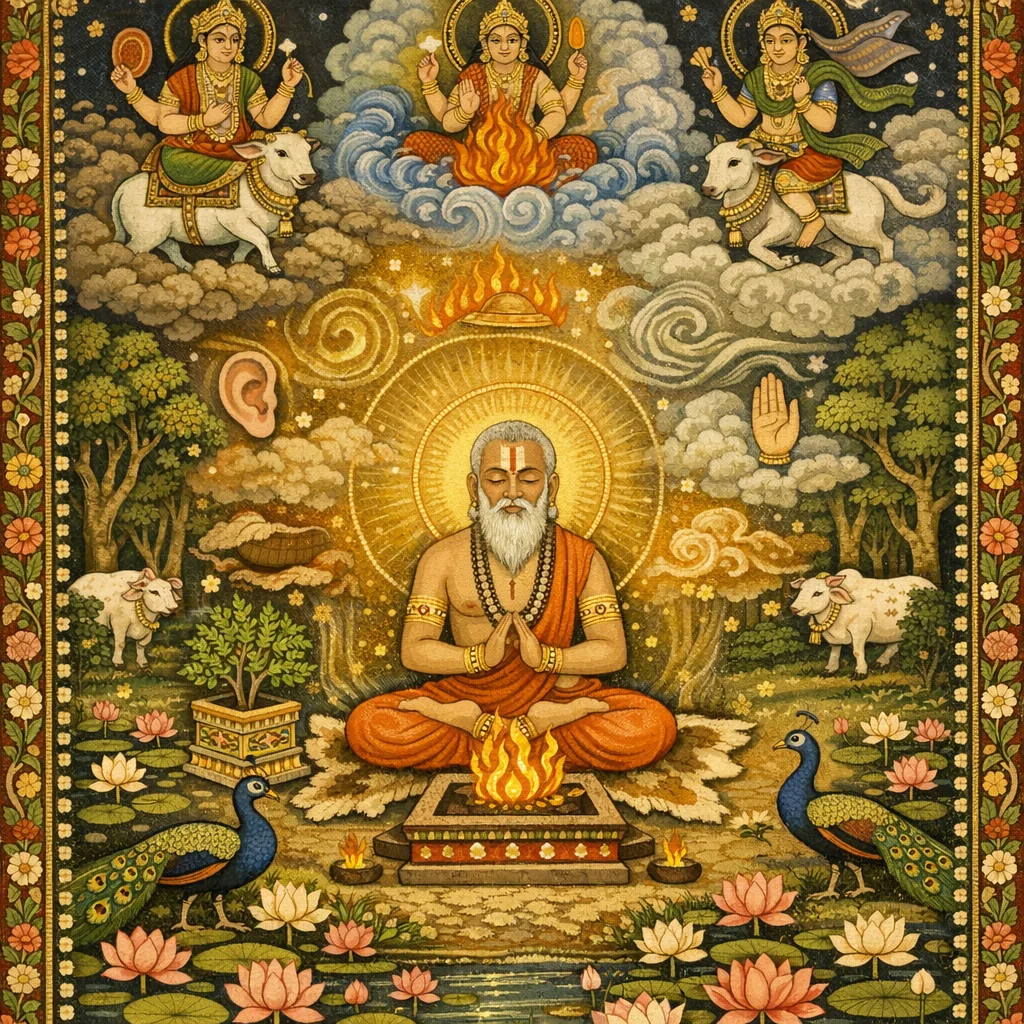
Continuing Nārada Muni’s varṇāśrama exposition to King Yudhiṣṭhira (following the canto’s climax of divine protection and the ethical lessons drawn from Prahlāda), this chapter details the formative discipline of brahmacarya: sense-control, submissive service in the gurukula, daily sandhyā worship (Gāyatrī), Vedic study, regulated dress and conduct, alms-gathering for the guru, and strict boundaries regarding association with women and sense-agitating luxuries. Nārada then transitions to vānaprastha, prescribing forest-based austerities, non-agricultural sustenance, endurance of climatic hardship, and a sober, non-excessive approach to tapas. The latter portion presents a contemplative exit strategy from bodily identification: merging the body’s constituents into the pañca-bhūtas and returning the senses and their powers to presiding deities, culminating in the cessation of material designations and the remaining spiritual identity (Brahman) aligned in quality with Parabrahman. The narrative progression moves from social-spiritual formation (student life) to mature withdrawal (forest life), preparing the ground for fuller renunciation and liberation teachings that follow.
Shlokas
Verse 1
श्रीनारद उवाच ब्रह्मचारी गुरुकुले वसन्दान्तो गुरोर्हितम् । आचरन्दासवन्नीचो गुरौ सुदृढसौहृद: ॥ १ ॥
Nārada Muni said: A student should practice completely controlling his senses. He should be submissive and should have an attitude of firm friendship for the spiritual master. With a great vow, the brahmacārī should live at the gurukula, only for the benefit of the guru.
Verse 2
सायं प्रातरुपासीत गुर्वग्न्यर्कसुरोत्तमान् । सन्ध्ये उभे च यतवाग्जपन्ब्रह्म समाहित: ॥ २ ॥
At both junctions of day and night, namely, in the early morning and in the evening, he should be fully absorbed in thoughts of the spiritual master, fire, the sun-god and Lord Viṣṇu and by chanting the Gāyatrī mantra he should worship them.
Verse 3
छन्दांस्यधीयीत गुरोराहूतश्चेत् सुयन्त्रित: । उपक्रमेऽवसाने च चरणौ शिरसा नमेत् ॥ ३ ॥
Being called by the spiritual master, the student should study the Vedic mantras regularly. Every day, before beginning his studies and at the end of his studies, the disciple should respectfully offer obeisances unto the spiritual master.
Verse 4
मेखलाजिनवासांसि जटादण्डकमण्डलून् । बिभृयादुपवीतं च दर्भपाणिर्यथोदितम् ॥ ४ ॥
Carrying pure kuśa grass in his hand, the brahmacārī should dress regularly with a belt of straw and with deerskin garments. He should wear matted hair, carry a rod and waterpot and be decorated with a sacred thread, as recommended in the śāstras.
Verse 5
सायं प्रातश्चरेद्भैक्ष्यं गुरवे तन्निवेदयेत् । भुञ्जीत यद्यनुज्ञातो नो चेदुपवसेत् क्वचित् ॥ ५ ॥
The brahmacārī should go out morning and evening to collect alms, and he should offer all that he collects to the spiritual master. He should eat only if ordered to take food by the spiritual master; otherwise, if the spiritual master does not give this order, he may sometimes have to fast.
Verse 6
सुशीलो मितभुग्दक्ष: श्रद्दधानो जितेन्द्रिय: । यावदर्थं व्यवहरेत् स्त्रीषु स्त्रीनिर्जितेषु च ॥ ६ ॥
A brahmacārī should be quite well-behaved and gentle and should not eat or collect more than necessary. He must always be active and expert, fully believing in the instructions of the spiritual master and the śāstra. Fully controlling his senses, he should associate only as much as necessary with women or those controlled by women.
Verse 7
वर्जयेत्प्रमदागाथामगृहस्थो बृहद्व्रत: । इन्द्रियाणि प्रमाथीनि हरन्त्यपि यतेर्मन: ॥ ७ ॥
A brahmacārī, or one who has not accepted the gṛhastha-āśrama [family life], must rigidly avoid talking with women or about women, for the senses are so powerful that they may agitate even the mind of a sannyāsī, a member of the renounced order of life.
Verse 8
केशप्रसाधनोन्मर्दस्नपनाभ्यञ्जनादिकम् । गुरुस्त्रीभिर्युवतिभि: कारयेन्नात्मनो युवा ॥ ८ ॥
If the wife of the spiritual master is young, a young brahmacārī should not allow her to care for his hair, massage his body with oil, or bathe him with affection like a mother.
Verse 9
नन्वग्नि: प्रमदा नाम घृतकुम्भसम: पुमान् । सुतामपि रहो जह्यादन्यदा यावदर्थकृत् ॥ ९ ॥
Woman is compared to fire, and man is compared to a butter pot. Therefore a man should avoid associating even with his own daughter in a secluded place. Similarly, he should also avoid association with other women. One should associate with women only for important business and not otherwise.
Verse 10
कल्पयित्वात्मना यावदाभासमिदमीश्वर: । द्वैतं तावन्न विरमेत्ततो ह्यस्य विपर्यय: ॥ १० ॥
As long as a living entity is not completely self-realized — as long as he is not independent of the misconception of identifying with his body, which is nothing but a reflection of the original body and senses — he cannot be relieved of the conception of duality, which is epitomized by the duality between man and woman. Thus there is every chance that he will fall down because his intelligence is bewildered.
Verse 11
एतत्सर्वं गृहस्थस्य समाम्नातं यतेरपि । गुरुवृत्तिर्विकल्पेन गृहस्थस्यर्तुगामिन: ॥ ११ ॥
All the rules and regulations apply equally to the householder and the sannyāsī, the member of the renounced order of life. The gṛhastha, however, is given permission by the spiritual master to indulge in sex during the period favorable for procreation.
Verse 12
अञ्जनाभ्यञ्जनोन्मर्दस्त्र्यवलेखामिषं मधु । स्रग्गन्धलेपालङ्कारांस्त्यजेयुर्ये बृहद्व्रता: ॥ १२ ॥
Brahmacārīs or gṛhasthas who have taken the vow of celibacy as described above should not indulge in the following: applying powder or ointment to the eyes, massaging the head with oil, massaging the body with the hands, seeing a woman or painting a woman’s picture, eating meat, drinking wine, decorating the body with flower garlands, smearing scented ointment on the body, or decorating the body with ornaments. These they should give up.
Verse 13
उषित्वैवं गुरुकुले द्विजोऽधीत्यावबुध्य च । त्रयीं साङ्गोपनिषदं यावदर्थं यथाबलम् ॥ १३ ॥ दत्त्वा वरमनुज्ञातो गुरो: कामं यदीश्वर: । गृहं वनं वा प्रविशेत्प्रव्रजेत्तत्र वा वसेत् ॥ १४ ॥
According to the rules and regulations mentioned above, one who is twice-born, namely a brāhmaṇa, kṣatriya or vaiśya, should reside in the gurukula under the care of the spiritual master. There he should study and learn all the Vedic literatures along with their supplements and the Upaniṣads, according to his ability and power to study. If possible, the student or disciple should reward the spiritual master with the remuneration the spiritual master requests, and then, following the master’s order, the disciple should leave and accept one of the other āśramas, namely the gṛhastha-āśrama, vānaprastha-āśrama or sannyāsa-āśrama, as he desires.
Verse 14
उषित्वैवं गुरुकुले द्विजोऽधीत्यावबुध्य च । त्रयीं साङ्गोपनिषदं यावदर्थं यथाबलम् ॥ १३ ॥ दत्त्वा वरमनुज्ञातो गुरो: कामं यदीश्वर: । गृहं वनं वा प्रविशेत्प्रव्रजेत्तत्र वा वसेत् ॥ १४ ॥
According to the rules and regulations mentioned above, one who is twice-born, namely a brāhmaṇa, kṣatriya or vaiśya, should reside in the gurukula under the care of the spiritual master. There he should study and learn all the Vedic literatures along with their supplements and the Upaniṣads, according to his ability and power to study. If possible, the student or disciple should reward the spiritual master with the remuneration the spiritual master requests, and then, following the master’s order, the disciple should leave and accept one of the other āśramas, namely the gṛhastha-āśrama, vānaprastha-āśrama or sannyāsa-āśrama, as he desires.
Verse 15
अग्नौ गुरावात्मनि च सर्वभूतेष्वधोक्षजम् । भूतै: स्वधामभि: पश्येदप्रविष्टं प्रविष्टवत् ॥ १५ ॥
One should realize that in the fire, in the spiritual master, in one’s self and in all living entities — in all circumstances and conditions — the Supreme Personality of Godhead, Viṣṇu, has simultaneously entered and not entered. He is situated externally and internally as the full controller of everything.
Verse 16
एवं विधो ब्रह्मचारी वानप्रस्थो यतिर्गृही । चरन्विदितविज्ञान: परं ब्रह्माधिगच्छति ॥ १६ ॥
By practicing in this way, whether one be in the brahmacārī-āśrama, gṛhastha-āśrama, vānaprastha-āśrama or sannyāsa-āśrama, one must always realize the all-pervading presence of the Supreme Lord, for in this way it is possible to understand the Absolute Truth.
Verse 17
वानप्रस्थस्य वक्ष्यामि नियमान्मुनिसम्मतान् । यानास्थाय मुनिर्गच्छेदृषिलोकमुहाञ्जसा ॥ १७ ॥
O King, I shall now describe the qualifications for a vānaprastha, one who has retired from family life. By rigidly following the rules and regulations for the vānaprastha, one can easily be elevated to the upper planetary system known as Maharloka.
Verse 18
न कृष्टपच्यमश्नीयादकृष्टं चाप्यकालत: । अग्निपक्वमथामं वा अर्कपक्वमुताहरेत् ॥ १८ ॥
A person in vānaprastha life should not eat grains grown by tilling of the fields. He should also not eat grains that have grown without tilling of the field but are not fully ripe. Nor should a vānaprastha eat grains cooked in fire. Indeed, he should eat only fruit ripened by the sunshine.
Verse 19
वन्यैश्चरुपुरोडाशान् निर्वपेत् कालचोदितान् । लब्धे नवे नवेऽन्नाद्ये पुराणं च परित्यजेत् ॥ १९ ॥
A vānaprastha should prepare cakes to be offered in sacrifice from fruits and grains grown naturally in the forest. When he obtains some new grains, he should give up his old stock of grains.
Verse 20
अग्न्यर्थमेव शरणमुटजं वाद्रिकन्दरम् । श्रयेत हिमवाय्वग्निवर्षार्कातपषाट्स्वयम् ॥ २० ॥
A vānaprastha should prepare a thatched cottage or take shelter of a cave in a mountain only to keep the sacred fire, but he should personally practice enduring snowfall, wind, fire, rain and the shining of the sun.
Verse 21
केशरोमनखश्मश्रुमलानि जटिलो दधत् । कमण्डल्वजिने दण्डवल्कलाग्निपरिच्छदान् ॥ २१ ॥
The vānaprastha should wear matted locks of hair on his head and let his body hair, nails and moustache grow. He should not cleanse his body of dirt. He should keep a waterpot, deerskin and rod, wear the bark of a tree as a covering, and use garments colored like fire.
Verse 22
चरेद्वने द्वादशाब्दानष्टौ वा चतुरो मुनि: । द्वावेकं वा यथा बुद्धिर्न विपद्येत कृच्छ्रत: ॥ २२ ॥
Being very thoughtful, a vānaprastha should remain in the forest for twelve years, eight years, four years, two years or at least one year. He should behave in such a way that he will not be disturbed or troubled by too much austerity.
Verse 23
यदाकल्प: स्वक्रियायां व्याधिभिर्जरयाथवा । आन्वीक्षिक्यां वा विद्यायां कुर्यादनशनादिकम् ॥ २३ ॥
When because of disease or old age one is unable to perform his prescribed duties for advancement in spiritual consciousness or study of the Vedas, he should practice fasting, not taking any food.
Verse 24
आत्मन्यग्नीन् समारोप्य सन्न्यस्याहं ममात्मताम् । कारणेषु न्यसेत् सम्यक्सङ्घातं तु यथार्हत: ॥ २४ ॥
He should properly place the fire element in his own self and in this way give up bodily affinity, by which one thinks the body to be one’s self or one’s own. One should gradually merge the material body into the five elements [earth, water, fire, air and sky].
Verse 25
खे खानि वायौ निश्वासांस्तेज:सूष्माणमात्मवान् । अप्स्वसृक्श्लेष्मपूयानि क्षितौ शेषं यथोद्भवम् ॥ २५ ॥
A sober, self-realized person who has full knowledge should merge the various parts of the body in their original sources. The holes in the body are caused by the sky, the process of breathing is caused by the air, the heat of the body is caused by fire, and semen, blood and mucus are caused by water. The hard substances, like skin, muscle and bone, are caused by earth. In this way all the constituents of the body are caused by various elements, and they should be merged again into those elements.
Verse 26
वाचमग्नौ सवक्तव्यामिन्द्रे शिल्पं करावपि । पदानि गत्या वयसि रत्योपस्थं प्रजापतौ ॥ २६ ॥ मृत्यौ पायुं विसर्गं च यथास्थानं विनिर्दिशेत् । दिक्षु श्रोत्रं सनादेन स्पर्शेनाध्यात्मनि त्वचम् ॥ २७ ॥ रूपाणि चक्षुषा राजन् ज्योतिष्यभिनिवेशयेत् । अप्सु प्रचेतसा जिह्वां घ्रेयैर्घ्राणं क्षितौ न्यसेत् ॥ २८ ॥
Thereafter, the object of speech, along with the sense of speech [the tongue], should be bestowed upon fire. Craftsmanship and the two hands should be given to the demigod Indra. The power of movement and the legs should be given to Lord Viṣṇu. Sensual pleasure, along with the genitals, should be bestowed upon Prajāpati. The rectum, with the power of evacuation, should be bestowed, in its proper place, unto Mṛtyu. The aural instrument, along with sound vibration, should be given to the deities presiding over the directions. The instrument of touch, along with the sense objects of touch, should be given to Vāyu. Form, with the power of sight, should be bestowed upon the sun. The tongue, along with the demigod Varuṇa, should be bestowed upon water, and the power of smell, along with the two Aśvinī-kumāra demigods, should be bestowed upon the earth.
Verse 27
वाचमग्नौ सवक्तव्यामिन्द्रे शिल्पं करावपि । पदानि गत्या वयसि रत्योपस्थं प्रजापतौ ॥ २६ ॥ मृत्यौ पायुं विसर्गं च यथास्थानं विनिर्दिशेत् । दिक्षु श्रोत्रं सनादेन स्पर्शेनाध्यात्मनि त्वचम् ॥ २७ ॥ रूपाणि चक्षुषा राजन् ज्योतिष्यभिनिवेशयेत् । अप्सु प्रचेतसा जिह्वां घ्रेयैर्घ्राणं क्षितौ न्यसेत् ॥ २८ ॥
Thereafter, the object of speech, along with the sense of speech [the tongue], should be bestowed upon fire. Craftsmanship and the two hands should be given to the demigod Indra. The power of movement and the legs should be given to Lord Viṣṇu. Sensual pleasure, along with the genitals, should be bestowed upon Prajāpati. The rectum, with the power of evacuation, should be bestowed, in its proper place, unto Mṛtyu. The aural instrument, along with sound vibration, should be given to the deities presiding over the directions. The instrument of touch, along with the sense objects of touch, should be given to Vāyu. Form, with the power of sight, should be bestowed upon the sun. The tongue, along with the demigod Varuṇa, should be bestowed upon water, and the power of smell, along with the two Aśvinī-kumāra demigods, should be bestowed upon the earth.
Verse 28
वाचमग्नौ सवक्तव्यामिन्द्रे शिल्पं करावपि । पदानि गत्या वयसि रत्योपस्थं प्रजापतौ ॥ २६ ॥ मृत्यौ पायुं विसर्गं च यथास्थानं विनिर्दिशेत् । दिक्षु श्रोत्रं सनादेन स्पर्शेनाध्यात्मनि त्वचम् ॥ २७ ॥ रूपाणि चक्षुषा राजन् ज्योतिष्यभिनिवेशयेत् । अप्सु प्रचेतसा जिह्वां घ्रेयैर्घ्राणं क्षितौ न्यसेत् ॥ २८ ॥
Thereafter, the object of speech, along with the sense of speech [the tongue], should be bestowed upon fire. Craftsmanship and the two hands should be given to the demigod Indra. The power of movement and the legs should be given to Lord Viṣṇu. Sensual pleasure, along with the genitals, should be bestowed upon Prajāpati. The rectum, with the power of evacuation, should be bestowed, in its proper place, unto Mṛtyu. The aural instrument, along with sound vibration, should be given to the deities presiding over the directions. The instrument of touch, along with the sense objects of touch, should be given to Vāyu. Form, with the power of sight, should be bestowed upon the sun. The tongue, along with the demigod Varuṇa, should be bestowed upon water, and the power of smell, along with the two Aśvinī-kumāra demigods, should be bestowed upon the earth.
Verse 29
मनो मनोरथैश्चन्द्रे बुद्धिं बोध्यै: कवौ परे । कर्माण्यध्यात्मना रुद्रे यदहं ममताक्रिया । सत्त्वेन चित्तं क्षेत्रज्ञे गुणैर्वैकारिकं परे ॥ २९ ॥ अप्सु क्षितिमपो ज्योतिष्यदो वायौ नभस्यमुम् । कूटस्थे तच्च महति तदव्यक्तेऽक्षरे च तत् ॥ ३० ॥
The mind, along with all material desires, should be merged in the moon demigod. All the subject matters of intelligence, along with the intelligence itself, should be placed in Lord Brahmā. False ego, which is under the influence of the material modes of nature and which induces one to think, “I am this body, and everything connected with this body is mine,” should be merged, along with material activities, in Rudra, the predominating deity of false ego. Material consciousness, along with the goal of thought, should be merged in the individual living being, and the demigods acting under the modes of material nature should be merged, along with the perverted living being, into the Supreme Being. The earth should be merged in water, water in the brightness of the sun, this brightness into the air, the air into the sky, the sky into the false ego, the false ego into the total material energy, the total material energy into the unmanifested ingredients [the pradhāna feature of the material energy], and at last the ingredient feature of material manifestation into the Supersoul.
Verse 30
मनो मनोरथैश्चन्द्रे बुद्धिं बोध्यै: कवौ परे । कर्माण्यध्यात्मना रुद्रे यदहं ममताक्रिया । सत्त्वेन चित्तं क्षेत्रज्ञे गुणैर्वैकारिकं परे ॥ २९ ॥ अप्सु क्षितिमपो ज्योतिष्यदो वायौ नभस्यमुम् । कूटस्थे तच्च महति तदव्यक्तेऽक्षरे च तत् ॥ ३० ॥
The mind, along with all material desires, should be merged in the moon demigod. All the subject matters of intelligence, along with the intelligence itself, should be placed in Lord Brahmā. False ego, which is under the influence of the material modes of nature and which induces one to think, “I am this body, and everything connected with this body is mine,” should be merged, along with material activities, in Rudra, the predominating deity of false ego. Material consciousness, along with the goal of thought, should be merged in the individual living being, and the demigods acting under the modes of material nature should be merged, along with the perverted living being, into the Supreme Being. The earth should be merged in water, water in the brightness of the sun, this brightness into the air, the air into the sky, the sky into the false ego, the false ego into the total material energy, the total material energy into the unmanifested ingredients [the pradhāna feature of the material energy], and at last the ingredient feature of material manifestation into the Supersoul.
Verse 31
इत्यक्षरतयात्मानं चिन्मात्रमवशेषितम् । ज्ञात्वाद्वयोऽथ विरमेद् दग्धयोनिरिवानल: ॥ ३१ ॥
When all the material designations have thus merged into their respective material elements, the living beings, who are all ultimately completely spiritual, being one in quality with the Supreme Being, should cease from material existence, as flames cease when the wood in which they are burning is consumed. When the material body is returned to its various material elements, only the spiritual being remains. This spiritual being is Brahman and is equal in quality with Parabrahman.
Frequently Asked Questions
The chapter’s logic is psychological and soteriological: until one is fully self-realized and free from bodily identification, the mind remains vulnerable to duality (especially man–woman polarity), which can bewilder intelligence and cause spiritual fall-down. Therefore, the brahmacārī adopts protective boundaries—not as hatred or denial of personhood, but as disciplined conservation of attention and vitality for Vedic study, guru-sevā, and Viṣṇu-smaraṇa.
SB 7.12 states that core rules of sense-restraint apply across āśramas, but the gṛhastha is specifically permitted sexual life under guru authorization and only during periods favorable for procreation. The principle is that household life is not license for indulgence; it is a regulated concession meant to integrate dharma with responsibility and gradual purification.
The text specifies the twice-born (dvija)—brāhmaṇa, kṣatriya, and vaiśya—residing under the spiritual master’s care to study the Vedas along with supplementary literatures (vedāṅgas) and Upaniṣads, according to capacity. Completion includes guru-dakṣiṇā (as requested) and then transition, by the guru’s order, into gṛhastha, vānaprastha, or sannyāsa.
It is a contemplative dissolution (nirodha-oriented practice) meant to dismantle bodily possessiveness. The practitioner recognizes each bodily component as arising from and belonging to its elemental source (earth, water, fire, air, sky), and similarly returns sensory powers to their presiding deities. This reverses the false ego’s claim—“I am the body, and everything related is mine”—so that, when material designations cease, the spiritual self remains.
The chapter teaches a non-sectarian but distinctly Vaiṣṇava theism: Viṣṇu is simultaneously ‘entered and not entered’—present within and without as the controller. Therefore worship at sandhyā includes guru, agni, sūrya, and Viṣṇu, not as competing absolutes but as loci through which the same Supreme Lord is recognized and served, cultivating constant awareness of His all-pervading presence.