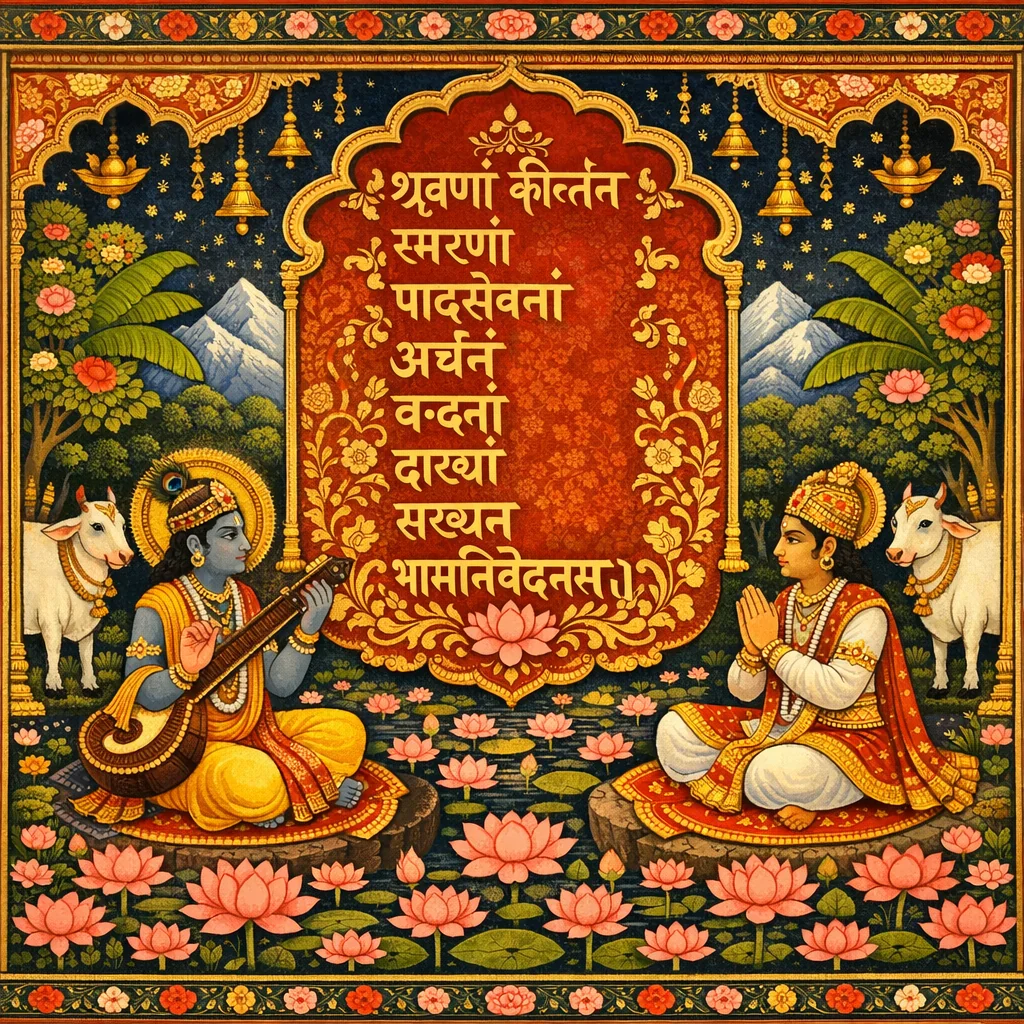
Adhyaya 11
Varṇāśrama-Dharma and the Thirty Qualities of a Human Being
After the account of Prahlāda’s exalted character—celebrated even by Brahmā and Śiva—Mahārāja Yudhiṣṭhira, delighted and eager for applicable guidance, questions Nārada Muni about the principles of religion that lead to the ultimate goal: devotional service. Nārada begins by offering obeisances to Kṛṣṇa, the protector of dharma, and grounds his teaching in revelation received from Nārāyaṇa (Nara-Nārāyaṇa at Badarikāśrama). He then outlines universal sādhāraṇa-dharma: a comprehensive set of thirty virtues culminating in the ninefold/complete bhakti attitudes (hearing, chanting, remembering, serving, worship, obeisances, servitorship, friendship, surrender). The chapter proceeds to applied varṇāśrama: who is dvija by saṁskāra, the duties of brāhmaṇa/kṣatriya/vaiśya/śūdra, emergency livelihoods and prohibitions, defining symptoms (lakṣaṇa) of each varṇa, and conduct for chaste women. It concludes by stressing guṇa-and-symptom-based classification over birth alone, preparing the reader for further refinements of righteous living as a support for devotion in subsequent teachings.
Shlokas
Verse 1
श्रीशुक उवाच श्रुत्वेहितं साधु सभासभाजितं महत्तमाग्रण्य उरुक्रमात्मन: । युधिष्ठिरो दैत्यपतेर्मुदान्वित: पप्रच्छ भूयस्तनयं स्वयम्भुव: ॥ १ ॥
Śukadeva Gosvāmī continued: After hearing about the activities and character of Prahlāda Mahārāja, which are adored and discussed among great personalities like Lord Brahmā and Lord Śiva, Yudhiṣṭhira Mahārāja, the most respectful king among exalted personalities, again inquired from the great saint Nārada Muni in a mood of great pleasure.
Verse 2
श्रीयुधिष्ठिर उवाच भगवन् श्रोतुमिच्छामि नृणां धर्मं सनातनम् । वर्णाश्रमाचारयुतं यत्पुमान्विन्दते परम् ॥ २ ॥
Mahārāja Yudhiṣṭhira said: My dear lord, I wish to hear from you about the principles of religion by which one can attain the ultimate goal of life — devotional service. I wish to hear about the general occupational duties of human society and the system of social and spiritual advancement known as varṇāśrama-dharma.
Verse 3
भवान्प्रजापते: साक्षादात्मज: परमेष्ठिन: । सुतानां सम्मतो ब्रह्मंस्तपोयोगसमाधिभि: ॥ ३ ॥
O best of the brāhmaṇas, you are directly the son of Prajāpati [Lord Brahmā]. Because of your austerities, mystic yoga and trance, you are considered the best of all of Lord Brahmā’s sons.
Verse 4
नारायणपरा विप्रा धर्मं गुह्यं परं विदु: । करुणा: साधव: शान्तास्त्वद्विधा न तथापरे ॥ ४ ॥
No one is superior to you in peaceful life and mercy, and no one knows better than you how to execute devotional service or how to become the best of the brāhmaṇas. Therefore, you know all the principles of confidential religious life, and no one knows them better than you.
Verse 5
श्रीनारद उवाच नत्वा भगवतेऽजाय लोकानां धर्मसेतवे । वक्ष्ये सनातनं धर्मं नारायणमुखाच्छ्रुतम् ॥ ५ ॥
Śrī Nārada Muni said: After first offering my obeisances unto Lord Kṛṣṇa, the protector of the religious principles of all living entities, let me explain the principles of the eternal religious system, of which I have heard from the mouth of Nārāyaṇa.
Verse 6
योऽवतीर्यात्मनोंऽशेन दाक्षायण्यां तु धर्मत: । लोकानां स्वस्तयेऽध्यास्ते तपो बदरिकाश्रमे ॥ ६ ॥
Lord Nārāyaṇa, along with His partial manifestation Nara, appeared in this world through the daughter of Dakṣa Mahārāja known as Mūrti. He was begotten by Dharma Mahārāja for the benefit of all living entities. Even now, He is still engaged in executing great austerities near the place known as Badarikāśrama.
Verse 7
धर्ममूलं हि भगवान्सर्ववेदमयो हरि: । स्मृतं च तद्विदां राजन्येन चात्मा प्रसीदति ॥ ७ ॥
The Supreme Being, the Personality of Godhead, is the essence of all Vedic knowledge, the root of all religious principles, and the memory of great authorities. O King Yudhiṣṭhira, this principle of religion is to be understood as evidence. On the basis of this religious principle, everything is satisfied, including one’s mind, soul and even one’s body.
Verse 8
सत्यं दया तप: शौचं तितिक्षेक्षा शमो दम: । अहिंसा ब्रह्मचर्यं च त्याग: स्वाध्याय आर्जवम् ॥ ८ ॥ सन्तोष: समदृक्सेवा ग्राम्येहोपरम: शनै: । नृणां विपर्ययेहेक्षा मौनमात्मविमर्शनम् ॥ ९ ॥ अन्नाद्यादे: संविभागो भूतेभ्यश्च यथार्हत: । तेष्वात्मदेवताबुद्धि: सुतरां नृषु पाण्डव ॥ १० ॥ श्रवणं कीर्तनं चास्य स्मरणं महतां गते: । सेवेज्यावनतिर्दास्यं सख्यमात्मसमर्पणम् ॥ ११ ॥ नृणामयं परो धर्म: सर्वेषां समुदाहृत: । त्रिंशल्लक्षणवान् राजन्सर्वात्मा येन तुष्यति ॥ १२ ॥
These are the general principles to be followed by all human beings: truthfulness, mercy, austerity (observing fasts on certain days of the month), bathing twice a day, tolerance, discrimination between right and wrong, control of the mind, control of the senses, nonviolence, celibacy, charity, reading of scripture, simplicity, satisfaction, rendering service to saintly persons, gradually taking leave of unnecessary engagements, observing the futility of the unnecessary activities of human society, remaining silent and grave and avoiding unnecessary talk, considering whether one is the body or the soul, distributing food equally to all living entities (both men and animals), seeing every soul (especially in the human form) as a part of the Supreme Lord, hearing about the activities and instructions given by the Supreme Personality of Godhead (who is the shelter of the saintly persons), chanting about these activities and instructions, always remembering these activities and instructions, trying to render service, performing worship, offering obeisances, becoming a servant, becoming a friend, and surrendering one’s whole self. O King Yudhiṣṭhira, these thirty qualifications must be acquired in the human form of life. Simply by acquiring these qualifications, one can satisfy the Supreme Personality of Godhead.
Verse 9
सत्यं दया तप: शौचं तितिक्षेक्षा शमो दम: । अहिंसा ब्रह्मचर्यं च त्याग: स्वाध्याय आर्जवम् ॥ ८ ॥ सन्तोष: समदृक्सेवा ग्राम्येहोपरम: शनै: । नृणां विपर्ययेहेक्षा मौनमात्मविमर्शनम् ॥ ९ ॥ अन्नाद्यादे: संविभागो भूतेभ्यश्च यथार्हत: । तेष्वात्मदेवताबुद्धि: सुतरां नृषु पाण्डव ॥ १० ॥ श्रवणं कीर्तनं चास्य स्मरणं महतां गते: । सेवेज्यावनतिर्दास्यं सख्यमात्मसमर्पणम् ॥ ११ ॥ नृणामयं परो धर्म: सर्वेषां समुदाहृत: । त्रिंशल्लक्षणवान् राजन्सर्वात्मा येन तुष्यति ॥ १२ ॥
These are the general principles to be followed by all human beings: truthfulness, mercy, austerity (observing fasts on certain days of the month), bathing twice a day, tolerance, discrimination between right and wrong, control of the mind, control of the senses, nonviolence, celibacy, charity, reading of scripture, simplicity, satisfaction, rendering service to saintly persons, gradually taking leave of unnecessary engagements, observing the futility of the unnecessary activities of human society, remaining silent and grave and avoiding unnecessary talk, considering whether one is the body or the soul, distributing food equally to all living entities (both men and animals), seeing every soul (especially in the human form) as a part of the Supreme Lord, hearing about the activities and instructions given by the Supreme Personality of Godhead (who is the shelter of the saintly persons), chanting about these activities and instructions, always remembering these activities and instructions, trying to render service, performing worship, offering obeisances, becoming a servant, becoming a friend, and surrendering one’s whole self. O King Yudhiṣṭhira, these thirty qualifications must be acquired in the human form of life. Simply by acquiring these qualifications, one can satisfy the Supreme Personality of Godhead.
Verse 10
सत्यं दया तप: शौचं तितिक्षेक्षा शमो दम: । अहिंसा ब्रह्मचर्यं च त्याग: स्वाध्याय आर्जवम् ॥ ८ ॥ सन्तोष: समदृक्सेवा ग्राम्येहोपरम: शनै: । नृणां विपर्ययेहेक्षा मौनमात्मविमर्शनम् ॥ ९ ॥ अन्नाद्यादे: संविभागो भूतेभ्यश्च यथार्हत: । तेष्वात्मदेवताबुद्धि: सुतरां नृषु पाण्डव ॥ १० ॥ श्रवणं कीर्तनं चास्य स्मरणं महतां गते: । सेवेज्यावनतिर्दास्यं सख्यमात्मसमर्पणम् ॥ ११ ॥ नृणामयं परो धर्म: सर्वेषां समुदाहृत: । त्रिंशल्लक्षणवान् राजन्सर्वात्मा येन तुष्यति ॥ १२ ॥
These are the general principles to be followed by all human beings: truthfulness, mercy, austerity (observing fasts on certain days of the month), bathing twice a day, tolerance, discrimination between right and wrong, control of the mind, control of the senses, nonviolence, celibacy, charity, reading of scripture, simplicity, satisfaction, rendering service to saintly persons, gradually taking leave of unnecessary engagements, observing the futility of the unnecessary activities of human society, remaining silent and grave and avoiding unnecessary talk, considering whether one is the body or the soul, distributing food equally to all living entities (both men and animals), seeing every soul (especially in the human form) as a part of the Supreme Lord, hearing about the activities and instructions given by the Supreme Personality of Godhead (who is the shelter of the saintly persons), chanting about these activities and instructions, always remembering these activities and instructions, trying to render service, performing worship, offering obeisances, becoming a servant, becoming a friend, and surrendering one’s whole self. O King Yudhiṣṭhira, these thirty qualifications must be acquired in the human form of life. Simply by acquiring these qualifications, one can satisfy the Supreme Personality of Godhead.
Verse 11
सत्यं दया तप: शौचं तितिक्षेक्षा शमो दम: । अहिंसा ब्रह्मचर्यं च त्याग: स्वाध्याय आर्जवम् ॥ ८ ॥ सन्तोष: समदृक्सेवा ग्राम्येहोपरम: शनै: । नृणां विपर्ययेहेक्षा मौनमात्मविमर्शनम् ॥ ९ ॥ अन्नाद्यादे: संविभागो भूतेभ्यश्च यथार्हत: । तेष्वात्मदेवताबुद्धि: सुतरां नृषु पाण्डव ॥ १० ॥ श्रवणं कीर्तनं चास्य स्मरणं महतां गते: । सेवेज्यावनतिर्दास्यं सख्यमात्मसमर्पणम् ॥ ११ ॥ नृणामयं परो धर्म: सर्वेषां समुदाहृत: । त्रिंशल्लक्षणवान् राजन्सर्वात्मा येन तुष्यति ॥ १२ ॥
These are the general principles to be followed by all human beings: truthfulness, mercy, austerity (observing fasts on certain days of the month), bathing twice a day, tolerance, discrimination between right and wrong, control of the mind, control of the senses, nonviolence, celibacy, charity, reading of scripture, simplicity, satisfaction, rendering service to saintly persons, gradually taking leave of unnecessary engagements, observing the futility of the unnecessary activities of human society, remaining silent and grave and avoiding unnecessary talk, considering whether one is the body or the soul, distributing food equally to all living entities (both men and animals), seeing every soul (especially in the human form) as a part of the Supreme Lord, hearing about the activities and instructions given by the Supreme Personality of Godhead (who is the shelter of the saintly persons), chanting about these activities and instructions, always remembering these activities and instructions, trying to render service, performing worship, offering obeisances, becoming a servant, becoming a friend, and surrendering one’s whole self. O King Yudhiṣṭhira, these thirty qualifications must be acquired in the human form of life. Simply by acquiring these qualifications, one can satisfy the Supreme Personality of Godhead.
Verse 12
सत्यं दया तप: शौचं तितिक्षेक्षा शमो दम: । अहिंसा ब्रह्मचर्यं च त्याग: स्वाध्याय आर्जवम् ॥ ८ ॥ सन्तोष: समदृक्सेवा ग्राम्येहोपरम: शनै: । नृणां विपर्ययेहेक्षा मौनमात्मविमर्शनम् ॥ ९ ॥ अन्नाद्यादे: संविभागो भूतेभ्यश्च यथार्हत: । तेष्वात्मदेवताबुद्धि: सुतरां नृषु पाण्डव ॥ १० ॥ श्रवणं कीर्तनं चास्य स्मरणं महतां गते: । सेवेज्यावनतिर्दास्यं सख्यमात्मसमर्पणम् ॥ ११ ॥ नृणामयं परो धर्म: सर्वेषां समुदाहृत: । त्रिंशल्लक्षणवान् राजन्सर्वात्मा येन तुष्यति ॥ १२ ॥
These are the general principles to be followed by all human beings: truthfulness, mercy, austerity (observing fasts on certain days of the month), bathing twice a day, tolerance, discrimination between right and wrong, control of the mind, control of the senses, nonviolence, celibacy, charity, reading of scripture, simplicity, satisfaction, rendering service to saintly persons, gradually taking leave of unnecessary engagements, observing the futility of the unnecessary activities of human society, remaining silent and grave and avoiding unnecessary talk, considering whether one is the body or the soul, distributing food equally to all living entities (both men and animals), seeing every soul (especially in the human form) as a part of the Supreme Lord, hearing about the activities and instructions given by the Supreme Personality of Godhead (who is the shelter of the saintly persons), chanting about these activities and instructions, always remembering these activities and instructions, trying to render service, performing worship, offering obeisances, becoming a servant, becoming a friend, and surrendering one’s whole self. O King Yudhiṣṭhira, these thirty qualifications must be acquired in the human form of life. Simply by acquiring these qualifications, one can satisfy the Supreme Personality of Godhead.
Verse 13
संस्कारा यत्राविच्छिन्ना: स द्विजोऽजो जगाद यम् । इज्याध्ययनदानानि विहितानि द्विजन्मनाम् । जन्मकर्मावदातानां क्रियाश्चाश्रमचोदिता: ॥ १३ ॥
Those who have been reformed by the garbhādhāna ceremony and other prescribed reformatory methods, performed with Vedic mantras and without interruption, and who have been approved by Lord Brahmā, are dvijas, or twice-born. Such brāhmaṇas, kṣatriyas and vaiśyas, purified by their family traditions and by their behavior, should worship the Lord, study the Vedas and give charity. In this system, they should follow the principles of the four āśramas [brahmacarya, gṛhastha, vānaprastha and sannyāsa].
Verse 14
विप्रस्याध्ययनादीनि षडन्यस्याप्रतिग्रह: । राज्ञो वृत्ति: प्रजागोप्तुरविप्राद्वा करादिभि: ॥ १४ ॥
For a brāhmaṇa there are six occupational duties. A kṣatriya should not accept charity, but he may perform the other five of these duties. A king or kṣatriya is not allowed to levy taxes on brāhmaṇas, but he may make his livelihood by levying minimal taxes, customs duties, and penalty fines upon his other subjects.
Verse 15
वैश्यस्तु वार्तावृत्ति: स्यान्नित्यं ब्रह्मकुलानुग: । शूद्रस्य द्विजशुश्रूषा वृत्तिश्च स्वामिनो भवेत् ॥ १५ ॥
The mercantile community should always follow the directions of the brāhmaṇas and engage in such occupational duties as agriculture, trade, and protection of cows. For the śūdras the only duty is to accept a master from a higher social order and engage in his service.
Verse 16
वार्ता विचित्रा शालीनयायावरशिलोञ्छनम् । विप्रवृत्तिश्चतुर्धेयं श्रेयसी चोत्तरोत्तरा ॥ १६ ॥
As an alternative, a brāhmaṇa may also take to the vaiśya’s occupational duty of agriculture, cow protection, or trade. He may depend on that which he has received without begging, he may beg in the paddy field every day, he may collect paddy left in a field by its proprietor, or he may collect food grains left here and there in the shops of grain dealers. These are four means of livelihood that may also be adopted by brāhmaṇas. Among these four, each of them in succession is better than the one preceding it.
Verse 17
जघन्यो नोत्तमां वृत्तिमनापदि भजेन्नर: । ऋते राजन्यमापत्सु सर्वेषामपि सर्वश: ॥ १७ ॥
Except in a time of emergency, lower persons should not accept the occupational duties of those who are higher. When there is such an emergency, of course, everyone but the kṣatriya may accept the means of livelihood of others.
Verse 18
ऋतामृताभ्यां जीवेत मृतेन प्रमृतेन वा । सत्यानृताभ्यामपि वा न श्ववृत्त्या कदाचन ॥ १८ ॥ ऋतमुञ्छशिलं प्रोक्तममृतं यदयाचितम् । मृतं तु नित्ययाच्ञा स्यात्प्रमृतं कर्षणं स्मृतम् ॥ १९ ॥ सत्यानृतं च वाणिज्यं श्ववृत्तिर्नीचसेवनम् । वर्जयेत्तां सदा विप्रो राजन्यश्च जुगुप्सिताम् । सर्ववेदमयो विप्र: सर्वदेवमयो नृप: ॥ २० ॥
In time of emergency, one may accept any of the various types of professions known as ṛta, amṛta, mṛta, pramṛta and satyānṛta, but one should not at any time accept the profession of a dog. The profession of uñchaśila, collecting grains from the field, is called ṛta. Collecting without begging is called amṛta, begging grains is called mṛta, tilling the ground is called pramṛta, and trade is called satyānṛta. Engaging in the service of low-grade persons, however, is called śva-vṛtti, the profession of the dogs. Specifically, brāhmaṇas and kṣatriyas should not engage in the low and abominable service of śūdras. Brāhmaṇas should be well acquainted with all the Vedic knowledge, and kṣatriyas should be well acquainted with the worship of demigods.
Verse 19
ऋतामृताभ्यां जीवेत मृतेन प्रमृतेन वा । सत्यानृताभ्यामपि वा न श्ववृत्त्या कदाचन ॥ १८ ॥ ऋतमुञ्छशिलं प्रोक्तममृतं यदयाचितम् । मृतं तु नित्ययाच्ञा स्यात्प्रमृतं कर्षणं स्मृतम् ॥ १९ ॥ सत्यानृतं च वाणिज्यं श्ववृत्तिर्नीचसेवनम् । वर्जयेत्तां सदा विप्रो राजन्यश्च जुगुप्सिताम् । सर्ववेदमयो विप्र: सर्वदेवमयो नृप: ॥ २० ॥
In time of emergency, one may accept any of the various types of professions known as ṛta, amṛta, mṛta, pramṛta and satyānṛta, but one should not at any time accept the profession of a dog. The profession of uñchaśila, collecting grains from the field, is called ṛta. Collecting without begging is called amṛta, begging grains is called mṛta, tilling the ground is called pramṛta, and trade is called satyānṛta. Engaging in the service of low-grade persons, however, is called śva-vṛtti, the profession of the dogs. Specifically, brāhmaṇas and kṣatriyas should not engage in the low and abominable service of śūdras. Brāhmaṇas should be well acquainted with all the Vedic knowledge, and kṣatriyas should be well acquainted with the worship of demigods.
Verse 20
ऋतामृताभ्यां जीवेत मृतेन प्रमृतेन वा । सत्यानृताभ्यामपि वा न श्ववृत्त्या कदाचन ॥ १८ ॥ ऋतमुञ्छशिलं प्रोक्तममृतं यदयाचितम् । मृतं तु नित्ययाच्ञा स्यात्प्रमृतं कर्षणं स्मृतम् ॥ १९ ॥ सत्यानृतं च वाणिज्यं श्ववृत्तिर्नीचसेवनम् । वर्जयेत्तां सदा विप्रो राजन्यश्च जुगुप्सिताम् । सर्ववेदमयो विप्र: सर्वदेवमयो नृप: ॥ २० ॥
In time of emergency, one may accept any of the various types of professions known as ṛta, amṛta, mṛta, pramṛta and satyānṛta, but one should not at any time accept the profession of a dog. The profession of uñchaśila, collecting grains from the field, is called ṛta. Collecting without begging is called amṛta, begging grains is called mṛta, tilling the ground is called pramṛta, and trade is called satyānṛta. Engaging in the service of low-grade persons, however, is called śva-vṛtti, the profession of the dogs. Specifically, brāhmaṇas and kṣatriyas should not engage in the low and abominable service of śūdras. Brāhmaṇas should be well acquainted with all the Vedic knowledge, and kṣatriyas should be well acquainted with the worship of demigods.
Verse 21
शमो दमस्तप: शौचं सन्तोष: क्षान्तिरार्जवम् । ज्ञानं दयाच्युतात्मत्वं सत्यं च ब्रह्मलक्षणम् ॥ २१ ॥
The symptoms of a brāhmaṇa are control of the mind, control of the senses, austerity and penance, cleanliness, satisfaction, forgiveness, simplicity, knowledge, mercy, truthfulness, and complete surrender to the Supreme Personality of Godhead.
Verse 22
शौर्यं वीर्यं धृतिस्तेजस्त्यागश्चात्मजय: क्षमा । ब्रह्मण्यता प्रसादश्च सत्यं च क्षत्रलक्षणम् ॥ २२ ॥
To be influential in battle, unconquerable, patient, challenging and charitable, to control the bodily necessities, to be forgiving, to be attached to the brahminical nature and to be always jolly and truthful — these are the symptoms of the kṣatriya.
Verse 23
देवगुर्वच्युते भक्तिस्त्रिवर्गपरिपोषणम् । आस्तिक्यमुद्यमो नित्यं नैपुण्यं वैश्यलक्षणम् ॥ २३ ॥
Being always devoted to the demigods, the spiritual master and the Supreme Lord, Viṣṇu; endeavoring for advancement in religious principles, economic development and sense gratification [dharma, artha and kāma]; believing in the words of the spiritual master and scripture; and always endeavoring with expertise in earning money — these are the symptoms of the vaiśya.
Verse 24
शूद्रस्य सन्नति: शौचं सेवा स्वामिन्यमायया । अमन्त्रयज्ञो ह्यस्तेयं सत्यं गोविप्ररक्षणम् ॥ २४ ॥
Offering obeisances to the higher sections of society [the brāhmaṇas, kṣatriyas and vaiśyas], being always very clean, being free from duplicity, serving one’s master, performing sacrifices without uttering mantras, not stealing, always speaking the truth and giving all protection to the cows and brāhmaṇas — these are the symptoms of the śūdra.
Verse 25
स्त्रीणां च पतिदेवानां तच्छुश्रूषानुकूलता । तद्बन्धुष्वनुवृत्तिश्च नित्यं तद्व्रतधारणम् ॥ २५ ॥
To render service to the husband, to be always favorably disposed toward the husband, to be equally well disposed toward the husband’s relatives and friends, and to follow the vows of the husband — these are the four principles to be followed by women described as chaste.
Verse 26
सम्मार्जनोपलेपाभ्यां गृहमण्डनवर्तनै: । स्वयं च मण्डिता नित्यं परिमृष्टपरिच्छदा ॥ २६ ॥ कामैरुच्चावचै: साध्वी प्रश्रयेण दमेन च । वाक्यै: सत्यै: प्रियै: प्रेम्णा काले काले भजेत्पतिम् ॥ २७ ॥
A chaste woman must dress nicely and decorate herself with golden ornaments for the pleasure of her husband. Always wearing clean and attractive garments, she should sweep and clean the household with water and other liquids so that the entire house is always pure and clean. She should collect the household paraphernalia and keep the house always aromatic with incense and flowers and must be ready to execute the desires of her husband. Being modest and truthful, controlling her senses, and speaking in sweet words, a chaste woman should engage in the service of her husband with love, according to time and circumstances.
Verse 27
सम्मार्जनोपलेपाभ्यां गृहमण्डनवर्तनै: । स्वयं च मण्डिता नित्यं परिमृष्टपरिच्छदा ॥ २६ ॥ कामैरुच्चावचै: साध्वी प्रश्रयेण दमेन च । वाक्यै: सत्यै: प्रियै: प्रेम्णा काले काले भजेत्पतिम् ॥ २७ ॥
A chaste woman must dress nicely and decorate herself with golden ornaments for the pleasure of her husband. Always wearing clean and attractive garments, she should sweep and clean the household with water and other liquids so that the entire house is always pure and clean. She should collect the household paraphernalia and keep the house always aromatic with incense and flowers and must be ready to execute the desires of her husband. Being modest and truthful, controlling her senses, and speaking in sweet words, a chaste woman should engage in the service of her husband with love, according to time and circumstances.
Verse 28
सन्तुष्टालोलुपा दक्षा धर्मज्ञा प्रियसत्यवाक् । अप्रमत्ता शुचि: स्निग्धा पतिं त्वपतितं भजेत् ॥ २८ ॥
A chaste woman should not be greedy, but satisfied in all circumstances. She must be very expert in handling household affairs and should be fully conversant with religious principles. She should speak pleasingly and truthfully and should be very careful and always clean and pure. Thus a chaste woman should engage with affection in the service of a husband who is not fallen.
Verse 29
या पतिं हरिभावेन भजेत् श्रीरिव तत्परा । हर्यात्मना हरेर्लोके पत्या श्रीरिव मोदते ॥ २९ ॥
The woman who engages in the service of her husband, following strictly in the footsteps of the goddess of fortune, surely returns home, back to Godhead, with her devotee husband, and lives very happily in the Vaikuṇṭha planets.
Verse 30
वृत्ति: सङ्करजातीनां तत्तत्कुलकृता भवेत् । अचौराणामपापानामन्त्यजान्तेवसायिनाम् ॥ ३० ॥
Among the mixed classes known as saṅkara, those who are not thieves are known as antevasāyī or caṇḍālas [dog-eaters], and they also have their hereditary customs.
Verse 31
प्राय: स्वभावविहितो नृणां धर्मो युगे युगे । वेददृग्भि: स्मृतो राजन्प्रेत्य चेह च शर्मकृत् ॥ ३१ ॥
My dear King, brāhmaṇas well conversant in Vedic knowledge have given their verdict that in every age [yuga] the conduct of different sections of people according to their material modes of nature is auspicious both in this life and after death.
Verse 32
वृत्त्या स्वभावकृतया वर्तमान: स्वकर्मकृत् । हित्वा स्वभावजं कर्म शनैर्निर्गुणतामियात् ॥ ३२ ॥
If one acts in his profession according to his position in the modes of nature and gradually gives up these activities, he attains the niṣkāma stage.
Verse 33
उप्यमानं मुहु: क्षेत्रं स्वयं निर्वीर्यतामियात् । न कल्पते पुन: सूत्यै उप्तं बीजं च नश्यति ॥ ३३ ॥ एवं कामाशयं चित्तं कामानामतिसेवया । विरज्येत यथा राजन्नग्निवत् कामबिन्दुभि: ॥ ३४ ॥
My dear King, if an agricultural field is cultivated again and again, the power of its production decreases, and whatever seeds are sown there are lost. Just as drops of ghee on a fire never extinguish the fire but a flood of ghee will, similarly, overindulgence in lusty desires mitigates such desires entirely.
Verse 34
उप्यमानं मुहु: क्षेत्रं स्वयं निर्वीर्यतामियात् । न कल्पते पुन: सूत्यै उप्तं बीजं च नश्यति ॥ ३३ ॥ एवं कामाशयं चित्तं कामानामतिसेवया । विरज्येत यथा राजन्नग्निवत् कामबिन्दुभि: ॥ ३४ ॥
My dear King, if an agricultural field is cultivated again and again, the power of its production decreases, and whatever seeds are sown there are lost. Just as drops of ghee on a fire never extinguish the fire but a flood of ghee will, similarly, overindulgence in lusty desires mitigates such desires entirely.
Verse 35
यस्य यल्लक्षणं प्रोक्तं पुंसो वर्णाभिव्यञ्जकम् । यदन्यत्रापि दृश्येत तत्तेनैव विनिर्दिशेत् ॥ ३५ ॥
If one shows the symptoms of being a brāhmaṇa, kṣatriya, vaiśya or śūdra, as described above, even if he has appeared in a different class, he should be accepted according to those symptoms of classification.
Frequently Asked Questions
They function as sādhāraṇa-dharma—universal virtues for all humans—culminating in direct bhakti practices (hearing, chanting, remembering, service, worship, obeisances, servitorship, friendship, surrender). The text presents them as sufficient to satisfy the Supreme Lord, indicating that ethical cultivation is meant to mature into loving devotion.
By lakṣaṇa (observable symptoms) rooted in guṇa and karma: brāhmaṇas are marked by self-control, cleanliness, truthfulness, mercy, knowledge, and surrender; kṣatriyas by valor, leadership, charity, patience, and discipline; vaiśyas by devotion to guru and Viṣṇu, competence in earning, and pursuit of dharma-artha-kāma under guidance; śūdras by service, cleanliness, truthfulness, and respect toward higher orders. The chapter explicitly concludes that one should be accepted according to symptoms even if born elsewhere.