Sukta 4
Rishi: Atharvanic/anonymous (as typical for many AV domestic-apotropaic verses; hymn-level attribution varies by anukramaṇī tradition)
Devata: Apotropaic address to misfortune/hostile agents (alakṣmī-type personifications rather than a single deva)
Chandas: Anuṣṭubh (probable; AV 12.4 largely uses anuṣṭubh-like cadence)
Mantras
Mantra 1
वशा गौः। ददामीत्येव ब्रूयादनु चैनामभुत्सत । वशां ब्रह्मभ्यो याचद्भ्यस्तत् प्रजावदपत्यवत्
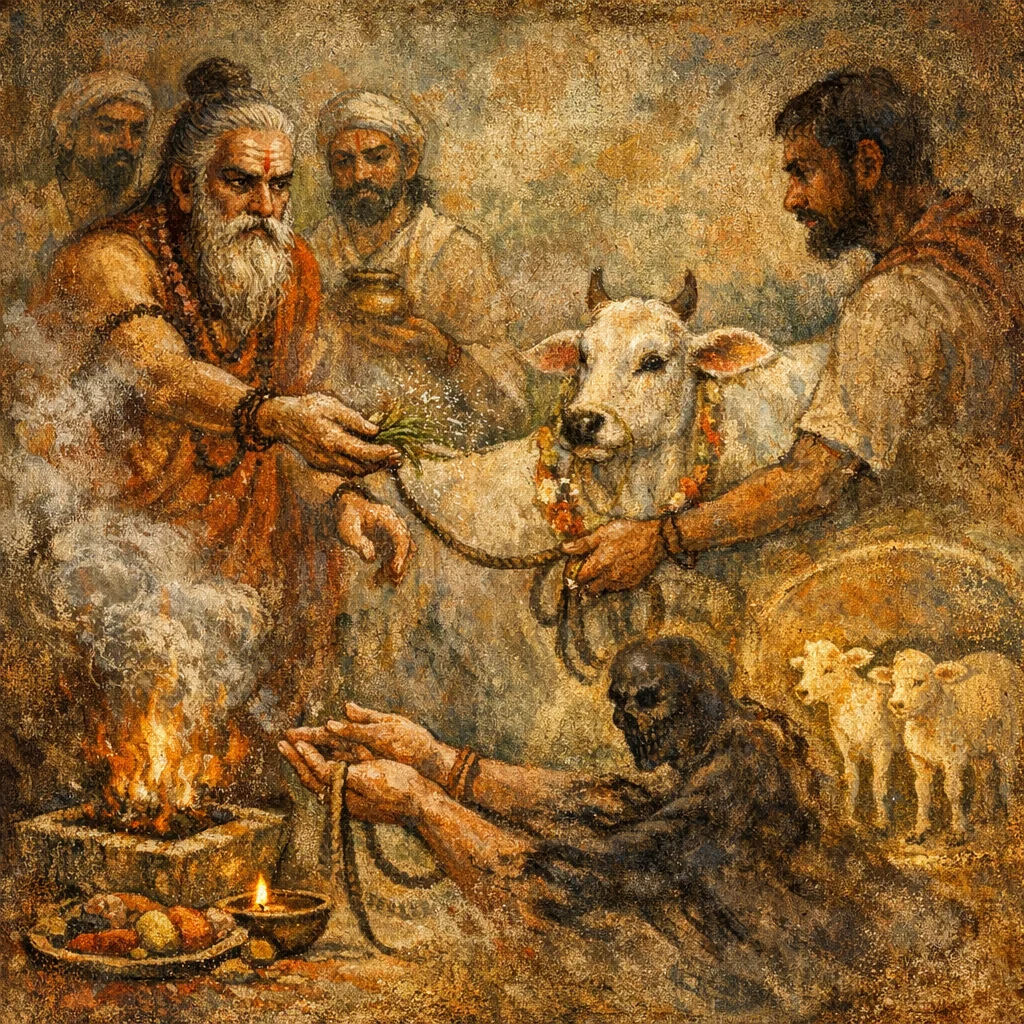
A vashā-cow. ‘I give,’—thus indeed should he say, and thereafter should he cause her to be led up. The vashā-cow to the Brahmans who ask: that act is rich in progeny, rich in children.
Mantra 2
प्रजया स वि क्रीणीते पशुभिश्चोप दस्यति । य आर्षेयेभ्यो याचद्भ्यो देवानां गां न दित्सति
With progeny he buys it off, and with cattle moreover he is smitten—whoso, when the Ārṣeyas ask, is unwilling to give the gods’ cow.
Mantra 3
कूटयास्य सं शीर्यन्ते श्लोणया काटमर्दति । बण्डया दह्यन्ते गृहाः काणया दीयते स्वम्
By the hump-backed one his substance is shattered utterly; by the lame one the household couch is crushed. By the bald one houses are burned; by the one-eyed one his very own is yielded up and lost.
Mantra 4
विलोहितो अधिष्ठानाच्छक्नो विन्दति गोपतिम्। तथा वशायाः संविद्यं दुरदभ्ना ह्यु१च्यसे
The Red One, from his seat of power, being able, wins him who is lord of cattle. Even so, the compact of Vāśā—thou art, in truth, proclaimed hard to assail.
Mantra 5
पदोरस्या अधिष्ठानाद् विक्लिन्दुर्नाम विन्दति । अनामनात् सं शीर्यन्ते या मुखेनोपजिघ्रति
From the footing of her feet there finds him one named Viklindu. From want of reverent bowing they are shattered utterly—she who with her mouth draws near to sniff.
Mantra 6
यो अस्याः कर्णावास्कुनोत्या स देवेषु वृश्चते । लक्ष्म कुर्व इति मन्यते कनीयः कृणुते स्वम्
Whoso tugs at her two ears—he is cut off among the Gods. ‘I make me Fortune,’ so he imagines; but he makes his own estate the lesser.
Mantra 7
यदस्याः कस्मै चिद् भोगाय बालान् कश्चित् प्रकृन्तति । ततः किशोरा म्रियन्ते वत्सांश्च घातुको वृकः
If any man, for any pleasure’s use, cut off her young, then thence the juveniles die—and the calves; the slaughtering Wolf comes upon them.
Mantra 8
यदस्या गोपतौ सत्या लोम ध्वाङ्क्षो अजीहिडत्। ततः कुमारा म्रियन्ते यक्ष्मो विन्दत्यनामनात्
When, at her keeper’s stall, the sure portent comes to pass—when the crow hath licked her hair—therefrom the boys die; wasting-disease findeth (them) through lack of due obeisance.
Mantra 9
यदस्याः पल्पूलनं शकृद् दासी समस्यति । ततोऽपरूपं जायते तस्मादव्येष्यदेनसः
When her afterbirth the serving-woman, with dung, doth cast together in a heap, therefrom is born a thing ill-shaped; therefore should one avoid the taint of sin.
Mantra 10
जायमानाभि जायते देवान्त्सब्राह्मणान् वशा। तस्माद् ब्रह्मभ्यो देयैषा तदाहुः स्वस्य गोपनम्
Being born, she is born, as it were, unto the Gods together with the Brahmans—the vāśā-cow. Therefore must she be given to the Brahmans: that, they say, is the safeguarding of one’s own.
Mantra 11
य एनां वनिमायन्ति तेषां देवकृता वशा। ब्रह्मज्येयं तदब्रुवन् य एनां निप्रियायते
They who would bargain over her, for them the vāśā-cow is a god-wrought (bane). ‘A wrong against Brahman-power,’ so have they said, (is the deed) of him who withholdeth her in grudging wise.
Mantra 12
य आर्षेयेभ्यो याचद्भ्यो देवानां गां न दित्सति । आ स देवेषु वृश्चते ब्राह्मणानां च मन्यवे
Whoso, when the Ārṣeyas ask, will not bestow the cow that is the Gods’, he is cut off among the Gods, and (is delivered) to the Brahmans’ wrath.
Mantra 13
यो अस्य स्याद् वशाभोगो अन्यामिच्छेत तर्हि सः । हिंस्ते अदत्ता पुरुषं याचितां च न दित्सति
Whoso should be the enjoyer of this Vaśā, and yet should covet another, then he—by what is not duly given—wrongeth a man, and to the petitioner he will not render (what is due).
Mantra 14
यथा शेवधिर्निहितो ब्राह्मणानां तथा वशा। तामेतदच्छायन्ति यस्मिन् कस्मिंश्च जायते
As a treasure-deposit laid away for Brahmans, so is the Vaśā: this (guardianship) they keep over her, in whatsoever place she is born.
Mantra 15
स्वमेतदच्छायन्ति यद् वशां ब्राह्मणा अभि। यथैनानन्यस्मिन् जिनीयादेवास्या निरोधनम्
They guard this as their own, in that the Brahmans have power over the Vaśā; so that none may win her away unto another—this, verily, is her restraint.
Mantra 16
चरेदेवा त्रैहायणा दविज्ञातगदा सती। वशां च विद्यान्नारद ब्राह्मणास्तर्ह्येष्याः
Go forth, O Gods of the three-days’ course, (she) being with malady hard to discern; and do thou, O Nārada, know the Vaśā: then shall the Brahmans come unto thee.
Mantra 17
य एनामवशामाह देवानां निहितं निधिम्। उभौ तस्मै भवाशर्वौ परिक्रम्येषुमस्यतः
Whoso declareth her ‘no Vaśā,’—the treasure-deposit of the Gods laid up—against him do Bhava and Śarva twain, encompassing, hurl the arrow.
Mantra 18
यो अस्या ऊधो न वेदाथो अस्या स्तनानुत। उभयेनैवास्मै दुहे दातुं चे दशकद् वशाम्
Whoso knoweth not her udder, and likewise her teats—by both, in very deed, she is milked for him; and he must give a Vashā-cow tenfold.
Mantra 19
दुरदभ्नैनमा शये याचितां च न दित्सति । नास्मै कामाः समृध्यन्ते यामदत्त्वा चिकीर्षति
With stubborn, unassailable temper this man lies sunk, and the thing besought he will not give. No desires prosper for him, who, having not bestowed what was asked, would yet essay his undertakings.
Mantra 20
देवा वशामयाचन् मुखं कृत्वा ब्राह्मणम्। तेषां सर्वेषामददद्धेडं न्येऽति मानुषः
The Gods a Vashā-cow besought, having made the Brahmin their mouth. Of all those Gods, the mortal who gave not—on him the wrath, the offense, comes down and settles.
Mantra 21
हेडं पशूनां न्येऽति ब्राह्मणेभ्योऽददद् वशाम्। देवानां निहितं भागं मर्त्यश्चेन्निप्रियायते
The offense comes down upon his cattle—who to the Brahmins gave not the Vashā. For it is the Gods’ deposited share; if a mortal thereto bears ill-will,
Mantra 22
यदन्ये शतं याचेयुर्ब्राह्मणा गोपतिं वशाम्। अथैनां देवा अब्रुवन्नेवं ह विदुषो वशा
Though others, a hundred, should beg of the cattle-lord a Vashā-cow, then spake the Gods of her: ‘Thus, verily, the Vashā is the knowing man’s.’
Mantra 23
य एवं विदुषेऽदत्त्वाथान्येभ्यो ददद् वशाम्। दुर्गा तस्मा अधिष्ठाने पृथिवी सहदेवता
Whoso, though knowing thus, hath not bestowed (the vāśā) upon the wise, but giveth the barren cow unto others—perilous for him, in his very station, is Earth, with the Gods for her confederates.
Mantra 24
देवा वशामयाचन् यस्मिन्नग्रे अजायत । तामेतां विद्यान्नारदः सह देवैरुदाजत
The Gods demanded the vāśā, at the first, when she was brought to birth: this very (ordinance) let Nārada know; with the Gods he set her forth on high.
Mantra 25
अनपत्यमल्पपशुं वशा कृणोति पूरुषम्। ब्राह्मणैश्च याचितामथैनां निप्रियायते
Childless, scant of cattle, the vāśā maketh a man—(even) when demanded by the Brahmans; and then toward her he waxeth ill-affected (and refuseth).
Mantra 26
अग्नीषोमाभ्यां कामाय मित्राय वरुणाय च । तेभ्यो याचन्ति ब्राह्मणास्तेष्वा वृश्चतेऽददत्
For Agni-Soma, for Desire, for Mitra and for Varuṇa—unto these the Brahmans make request: against them he cutteth (his bond), who giveth not.
Mantra 27
यावदस्या गोपतिर्नोपशृणुयादृचः स्वयम्। चरेदस्य तावद् गोषु नास्य श्रुत्वा गृहे वसेत्
So long as his cattle-lord shall not himself overhear the verses, so long let him move about among the kine; nor, having heard, let him abide within the house.
Mantra 28
यो अस्या ऋच उपश्रुत्याथ गोष्वचीचरत्। आयुश्च तस्य भूतिं च देवा वृश्चन्ति हीडिताः
Whoso hath overheard her holy verses, and thereafter hath prowled amid the kine—his life, and his prosperity likewise, the Gods, being angered, shear away.
Mantra 29
वशा चरन्ती बहुधा देवानां निहितो निधिः । आविष्कृणुष्व रूपाणि यदा स्थाम जिघांसति
The Vashā, roaming manifoldly, a treasure of the Gods laid up: reveal thy forms, whene’er the foe would smite.
Mantra 30
आविरात्मानं कृणुते यदा स्थाम जिघांसति । अथो ह ब्रह्मभ्यो वशा याञ्च्याय कृणुते मनः
She maketh herself manifest whene’er the foe would slay; and then, for Brahmans verily, the Vashā maketh her mind to be besought.
Mantra 31
मनसा सं कल्पयति तद् देवां अपि गच्छति । ततो ह ब्रह्माणो वशामुपप्रयन्ति याचितुम्
With mind he setteth it in order: that verily goeth unto the Gods. Thereupon the Brahmans draw nigh unto the Vashā, to make request.
Mantra 32
स्वधाकारेण पितृभ्यो यज्ञेन देवताभ्यः । दानेन राजन्योऽ वशाया मातुर्हेडं न गच्छति
By Svadhā-call unto the Fathers, by sacrifice unto the Gods, by gift—the noble Kṣatriya cometh not under the mother’s wrath of the Vashā.
Mantra 33
वशा माता राजन्यऽस्य तथा संभूतमग्रशः । तस्या आहुरनर्पणं यद् ब्रह्मभ्यः प्रदीयते
The Vashā is the mother of the Rājanya; thus was it generated from the first beginning. Of her, they say, the gift is not to be reclaimed—when she is bestowed upon the Brahmans.
Mantra 34
यथाज्यं प्रगृहीतमालुम्पेत् स्रुचो अग्नये । एवा ह ब्रह्मभ्यो वशा मग्नय आ वृश्चतेऽददत्
As ghee, when taken up, one should let fall from the ladle unto Agni, even so indeed the Vashā—he gave her to the Brahmans, to the bounteous, to him that cuts away (evil).
Mantra 35
पुरोडाशवत्सा सुदुघा लोकेऽस्मा उप तिष्ठति । सास्मै सर्वान् कामान् वशा प्रददुषे दुहे
With the sacrificial cake for calf, a good milker, she stands near him in the world: the Vashā milks out for him all desires—to him who hath bestowed her.
Mantra 36
सर्वान् कामान् यमराज्ये वशा प्रददुषे दुहे । अथाहुर्नारकं लोकं निरुन्धानस्य याचिताम्
All desires, in Yama’s kingdom, the Vashā milks out for him who hath bestowed her. But then, they say, a hellish world awaits the man who bars (the gift) from one that hath entreated.
Mantra 37
प्रवीयमाना चरति क्रुद्धा गोपतये वशा। वेहतं मा मन्यमानो मृत्योः पाशेषु बध्यताम्
Driven onward she goes, wrathful, the Vashā, against the cattle-lord. Let him who, deeming her ‘barren’ (or ‘worthless’), so thinks—be bound fast in the nooses of Death.
Mantra 38
यो वेहतं मन्यमानोऽमा च पचते वशाम्। अप्यस्य पुत्रान् पौत्रांश्च याचयते बृहस्पतिः
Whoso, deeming a barren cow fit, doth cook the Vashā at home,—Bṛhaspati, moreover, bringeth even his sons and grandsons to beggary.
Mantra 39
महदेषाव तपति चरन्ती गोषु गौरपि । अथो ह गोपतये वशाददुषे विषं दुहे
Greatly this cow, as she roameth among the kine, doth scorch; and, moreover, for the herd-lord, for him that eateth the Vashā, she milketh poison.
Mantra 40
प्रियं पशूनां भवति यद् ब्रह्मभ्यः प्रदीयते । अथो वशायास्तत् प्रियं यद् देवत्रा हविः स्यात्
Pleasing unto the beasts it is, when it is bestowed upon the Brahmans; and likewise for the Vashā that is her pleasure, when the oblation is godward.
Mantra 41
या वशा उदकल्पयन् देवा यज्ञादुदेत्य । तासां विलिप्त्यं भीमामुदाकुरुत नारदः
Those Vashās which the Gods, arising forth from sacrifice, did appoint,—of them Nārada made the dread ‘smearing’ (their marked condition).
Mantra 42
तां देवा अमीमांसन्त वशेया३मवशेति । तामब्रवीन्नारद एषा वशानां वशतमेति
Her the Gods debated: ‘Shall she be Vashā, or non-Vashā?’ Nārada spake of her: ‘This is the most Vashā among Vashās.’
Mantra 43
कति नु वशा नारद यास्त्वं वेत्थ मनुष्यजाः । तास्त्वा पृच्छामि विद्वांसं कस्या नाश्नीयादब्राह्मणः
How many, pray, are the Vashā-cows, O Nārada, which thou knowest as born among men? These I question thee, the wise: for whose sake should the non-Brahman not eat thereof?
Mantra 44
विलिप्त्या बृहस्पते या च सूतवशा वशा। तस्या नाश्नीयादब्राह्मणो या आशंसेत भूत्याम्
The Viliptī, O Bṛhaspati, and the Vashā called Sūtavaśā—of her let not the non-Brahman eat, who would fain look for prosperity.
Mantra 45
नमस्ते अस्तु नारदानुष्ठु विदुषे वशा। कतमासां भीमतमा यामदत्त्वा पराभवेत्
Homage be to thee, O Nārada, who knowest in due order, O Vashā. Which of them is the most dreadful—she whom, if one eat, would bring him to overthrow?
Mantra 46
विलिप्ती या बृहस्पतेऽथो सूतवशा वशा। तस्या नाश्नीयादब्राह्मणो य आशंसेत भूत्याम्
The Viliptī, which is thine, O Bṛhaspati, and also the Vashā called Sūtavaśā—of her let not the non-Brahman eat, who would hope for prosperity.
Mantra 47
त्रीणि वै वशाजातानि विलिप्ती सूतवशा वशा। ताः प्र यच्छेद् ब्रह्मभ्यः सोऽनाव्रस्कः प्रजापतौ
Three, verily, are the Vashā-born kinds—Viliptī, Sūtavaśā, and Vashā. These let him bestow forth upon the Brahmins: so shall he be unassailed, under Prajāpati.
Mantra 48
एतद् वो ब्राह्मणा हविरिति मन्वीत याचितः । वशां चेदेनं याचेयुर्या भीमाददुषो गृहे
‘This is your oblation, O Brahmans’: so, when he is petitioned, let him deem it. If they should ask him for the barren cow, even her that is in the house of Bhīma the non-giver—
Mantra 49
देवा वशां पर्यवदन् न नोऽदादिति हीडिताः । एताभिरृग्भिर्भेदं तस्माद् वै स पराभवत्
The Gods spake concerning the barren cow: ‘He hath not given it unto us,’—incensed thereat. With these ṛc-verses they overcame Bheda; therefore indeed was he brought to ruin.
Mantra 50
उतैनां भेदो नाददाद् वशामिन्द्रेण याचितः । तस्मात् तं देवा आगसोऽवृश्चन्नहमुत्तरे
Moreover, Bheda gave her not—the barren cow—though Indra himself had made request. Therefore the Gods, for his offense, cut him off; and I (declare it) in the after-time.
Mantra 51
ये वशाया अदानाय वदन्ति परिरापिणः । इन्द्रस्य मन्यवे जाल्मा आ वृश्चन्ते अचित्त्या
They who, bent on non-giving of the barren cow, speak forth as harmful plotters—those knaves are cut down for Indra’s wrath, through their own senselessness.
Mantra 52
ये गोपतिं पराणीयाथाहुर्मा ददा इति । रुद्रस्यास्तां ते हेतिं परि यन्त्यचित्त्या
They who, having led the Lord of cattle astray, then say, ‘Give not,’—upon them, through their folly, there cometh round about the missile of Rudra: so be it.
Mantra 53
यदि हुतं यद्यहुताममा च पचते वशाम्। देवान्त्सब्राह्मणानृत्वा जिह्मो लोकान्निरृच्छति
If he have offered, or if he have not offered, and at home moreover he cook the barren cow—having wronged the Gods together with the Brahmans, the crooked man is cast forth from the worlds.
Frequently Asked Questions
It is used to ward off household misfortune—fire, loss of property, disease, hostile witchcraft, and dangerous omens—by naming the threat and ritually expelling it beyond the home’s boundary.
Because the cattle-stall is treated as a sensitive ritual space; certain signs (like a crow touching an animal) are read as omens that can lead to illness (yakṣma) or child-harm unless promptly countered by observance and protective recitation.
Both. Alongside expulsion of hostile forces, it reinforces correct conduct—especially around gifts and obligations—by warning that contempt or wrongdoing can invite punitive consequences symbolized by Mṛtyu’s noose.