Adhyaya 4
Kaṃsa’s Council of Asuras and the Strategy Against the ‘Powerful Child’
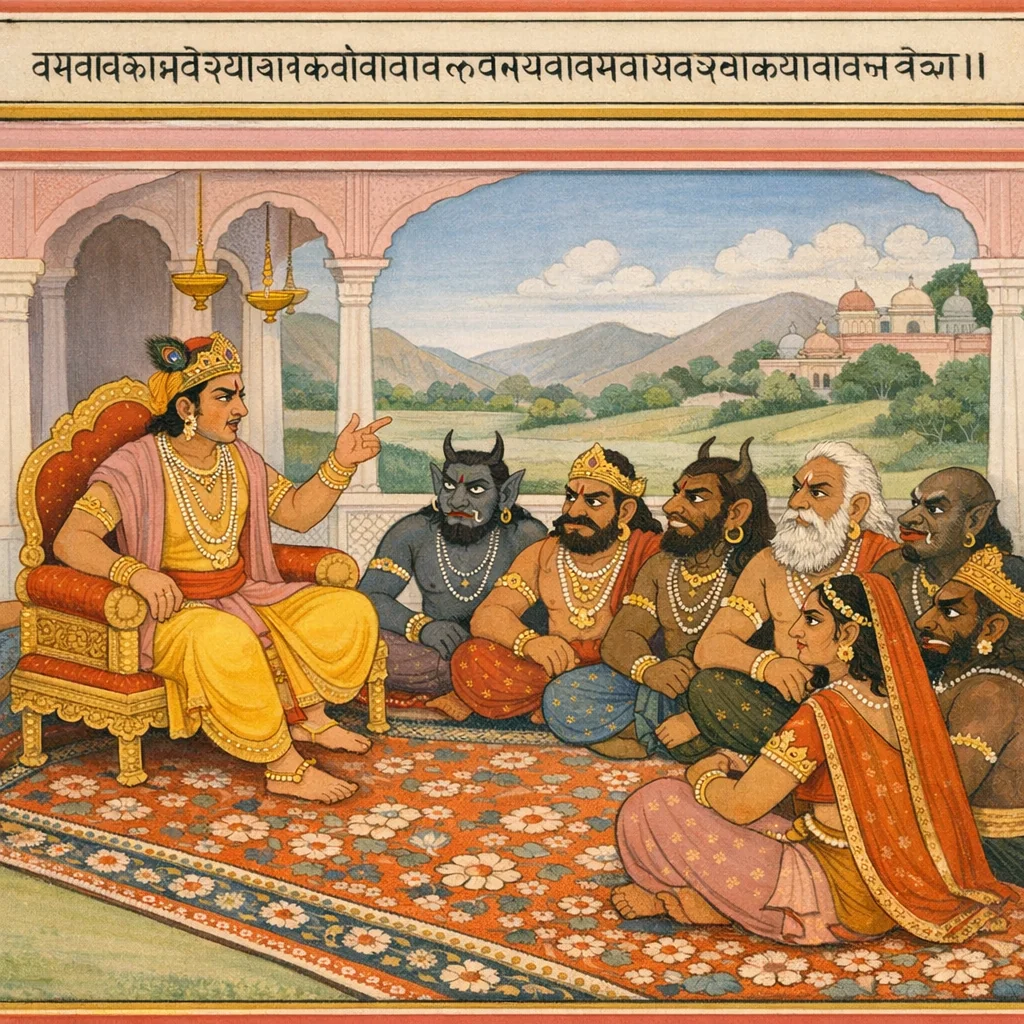
Parashara narrates to Maitreya that Kamsa, shaken by fear, summons Pralamba, Kesin, Dhenuka, Putana, Arista, and other asuras. In court, Kamsa derides Indra and the devas, boasting of his own strength. Yet, he resolves to intensify hostility against ascetics and watch for children with extraordinary power. Following Yogamaya's warning that his slayer is born elsewhere, Kamsa releases Vasudeva and Devaki, confessing the futility of his past crimes, though he remains inwardly suspicious as he returns to his chambers.
Shlokas
Verse 1
कंसस् ततौद्विग्नमनाः प्राह सर्वान् महासुरान् प्रलम्बकेशिप्रमुखान् आहूयासुरपुंगवान्
Then Kaṃsa, his mind shaken by anxious dread, summoned the foremost Asuras—Pralamba and Keśin at their head—and addressed all those mighty demons.
Verse 2
हे प्रलम्ब महाबाहो केशिन् धेनुक पूतने अरिष्टाद्यैस् तथा चान्यैः श्रूयतां वचनं मम
“O Pralamba, mighty-armed; O Keśin, Dhenuka, Pūtanā, Ariṣṭa, and all the rest—hear my words with care.”
Verse 3
मां हन्तुम् अमरैर् यत्नः कृतः किल दुरात्मभिः मद्वीर्यतापितैर् वीरा न त्व् एतान् गणयाम्य् अहम्
“It seems the immortals—wicked at heart and scorched by the heat of my prowess—have indeed sought to slay me. Yet, O heroes, I count them as nothing.”
Verse 4
किम् इन्द्रेणाल्पवीर्येण किं हरेणैकचारिणा हरिणा वापि किं साध्यं छिद्रेष्व् असुरघातिना
“What can be done by Indra, whose might is slight? What can Hari accomplish if he must act alone? And even Hari, slayer of Asuras—if he strikes only through loopholes and moments of weakness, what can truly be achieved?”
Verse 5
किम् आदित्यैः सवसुभिर् अल्पवीर्यैः किम् अग्निभिः किं वान्यैर् अमरैः सर्वैर् मद्बाहुबलनिर्जितैः
“What need have I of the Ādityas and the Vasus, so scant in might? What need of Agni? And what need of any other immortals, when all have already been subdued by the strength of my own arms?”
Verse 6
किं न दृष्टो ऽमरपतिर् मया संयुगम् एत्य सः पृष्ठेनैव वहन् बाणान् अपागच्छन् न वक्षसा
Why did I not behold the Lord of the immortals when he came onto the battlefield? He withdrew bearing the arrows upon his back—retreating not with his chest facing me, but turned away.
Verse 7
मद्राष्ट्रे वारिता वृष्टिर् यदा शक्रेण किं तदा मद्बाणभिन्नैर् जलदैर् आपो मुक्ता यथेप्सिताः
When Indra held back the rains over the land of Madra, what then? Pierced by my arrows, the clouds released their waters—freely, exactly as I desired.
Verse 8
किम् उर्व्याम् अवनीपाला मद्बाहुबलभीरवः न सर्वे सन्नतिं याता जरासंधम् ऋते गुरुम्
What is this, on the earth? Are the kings of the land so frightened of the strength of my arms that not all of them have come to bow down—except for Jarāsandha, that venerable elder?
Verse 9
अमरेषु ममावज्ञा जायते दैत्यपुंगवाः हास्यं मे जायते वीरास् तेषु यत्नपरेष्व् अपि
O foremost of the Daityas—when I behold the gods, contempt rises in me; and, O heroes, even when they strain with all their effort, laughter comes to me at their striving.
Verse 10
तथापि खलु दुष्टानां तेषाम् अभ्यधिकं मया अपकाराय दैत्येन्द्रा यतनीयं दुरात्मनाम्
Even so, O lords of the Daityas, I must strive all the more to bring about the downfall of those wicked, ill-intentioned beings—for their harm is the very work demanded by the preservation of order.
Verse 11
तद् ये तपस्विनः केचित् पृथिव्यां ये च यज्विनः कार्यो देवापकाराय तेषां सर्वात्मना वधः
Therefore, whatever ascetics there may be upon the earth, and whatever sacrificers as well—if their aim is to harm the gods and overturn the order of dharma, then their destruction must be carried out wholly, leaving nothing behind.
Verse 12
उत्पन्नश् चापि मृत्युर् मे भूतपूर्वश् च मे किल इत्य् एतद् बालिका प्राह देवकीगर्भसंभवा
“My death has been born—and indeed it already existed before,” declared the young maiden, born from Devakī’s womb, uttering the truth of fate.
Verse 13
तस्माद् बालेषु परमो यत्नः कार्यो महीतले यत्रोद्रिक्तं बलं बाले स हन्तव्यः प्रयत्नतः
Therefore, upon this earth, the utmost vigilance must be kept regarding the young; for wherever excessive power arises in a child, that one must be restrained with deliberate effort—if need be, destroyed—lest the order of the world be overturned.
Verse 14
इत्य् आज्ञाप्यासुरान् कंसः प्रविश्यात्मगृहं ततः मुमोच वसुदेवं च देवकीं च निरोधतः
Having thus issued his commands to men of asura-like nature, Kaṃsa entered his own residence; thereafter he released Vasudeva and Devakī from their confinement.
Verse 15
युवयोर् घातिता गर्भा वृथैवैते मयाधुना को ऽप्य् अन्य एव नाशाय बालो मम समुद्गतः
“The pregnancies of you both that I had destroyed—alas, I have ended them in vain; for to bring about my ruin, some other child, unknown to me, has now arisen.”
Verse 16
तद् अलं परितापेन नूनं तद् भाविनो हि ते अर्भका युवयोः को वा नायुषो ऽन्ते विहन्यते
Enough of this grief. Your children were indeed destined thus; for who, at the end of one’s allotted span, is not struck down?
Verse 17
इत्य् आश्वास्य विमुक्त्वा च कंसस् तौ परिशङ्कितः अन्तर्गृहं द्विजश्रेष्ठ प्रविवेश पुनः स्वकम्
Thus having reassured them and then released them, Kaṃsa—still inwardly troubled by suspicion—entered once more his own inner apartments, O best of the twice-born.
Frequently Asked Questions
To operationalize a targeted assassination program in response to the prophecy of his death—mobilizing specialist asura-agents who can infiltrate pastoral Vraja and kill the child who embodies Viṣṇu’s protective descent.
It signals avatāra-niyati: the destroyer of adharma is already manifest, and Kaṃsa’s attempts to control outcomes only serve the divine plan; the prophecy functions as a narrative hinge from prison-politics to Vraja-līlā.
As adharma-driven ahaṅkāra: apparent power over devas is temporary and within Viṣṇu’s overarching causality; it heightens the contrast between worldly dominance and Bhagavān’s effortless sovereignty.