Adhyaya 31
पारिजातहरणम्, द्वारकाप्रवेशः, षोडशसहस्रविवाहः (Pārijāta, Return to Dvārakā, and the Lord’s Many Forms)
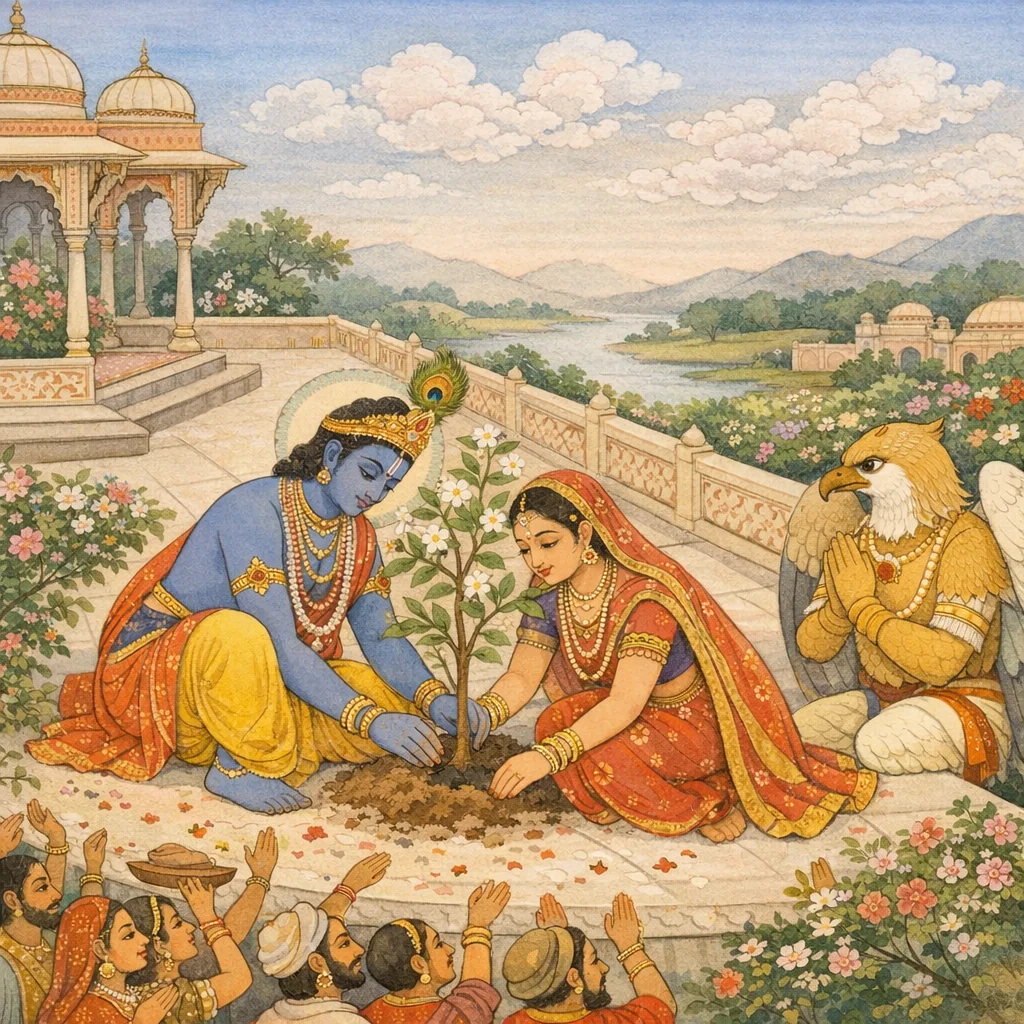
Parāśara tells Maitreya how the Pārijāta dispute is settled: Kṛṣṇa, with calm authority, upholds satya and the tree’s rightful placement, returns Indra’s Vajra, and restores divine propriety without enmity. Indra yields and asks that the celestial tree be taken to Dvārakā. Hari returns, sounds the conch above the city, and installs the Pārijāta in the palace garden with Satyabhāmā; its fragrance and memory-awakening power are praised, then an ominous vision appears of non-human forms bound upon the tree. The narrative turns to Kṛṣṇa receiving Naraka’s spoils and marrying the rescued maidens at an auspicious time, taking their hands according to dharma. To be fully present with each wife, Madhusūdana manifests as many forms as there are brides and dwells at night in all their homes—revealing the Lord’s viśvarūpa-pervasion and limitless agency within līlā.
Shlokas
Verse 1
संस्तुतो भगवान् इत्थं देवराजेन केशवः प्रहस्य भावगम्भीरम् उवाचेन्द्रं द्विजोत्तम
Thus praised by Indra, king of the gods, the Blessed Lord Keśava—smiling, yet with deep intent—addressed Indra; O best of the twice-born.
Verse 2
देवराजो भवान् इन्द्रो वयं मर्त्या जगत्पते क्षन्तव्यं भवतैवैतद् अपराधकृतं मम
You are Indra, sovereign of the gods; we are but mortals, O Lord of the worlds. Therefore, you alone must forgive this fault that has been committed by me.
Verse 3
पारिजाततरुश् चायं नीयताम् उचितास्पदम् गृहीतो ऽयं मया शक्र सत्यावचनकारणात्
Let this Pārijāta tree now be taken to its rightful abode. O Śakra, I have claimed it for the sake of truthfulness; a word once given must not be made false.
Verse 4
वज्रं चेदं गृहाण त्वं यद् ग्रस्तं प्रहितं त्वया तवैवैतत् प्रहरणं शक्र वैरिविदारणम्
Take back this very Vajra—the thunderbolt that was swallowed after being hurled by you. It is indeed your own weapon, O Śakra, fashioned to tear apart the foe.
Verse 5
विमोहयसि माम् ईश मर्त्यो ऽहम् इति किं वदन् जानीमस् त्वां भगवतो न तु सूक्ष्मविदो वयम्
O Īśa, you bewilder me. I who say, “I am but a mortal”—what can I truly know of you, O Bhagavān? We are not knowers of the subtle truth of your reality.
Verse 6
यो ऽसि सो ऽसि जगत्त्राणप्रवृत्तौ नाथ संस्थितः जगतः शल्यनिष्कर्षं करोष्य् असुरसूदन
O Lord, You are truly what You are—steadfast in the sacred resolve to protect the worlds. O Slayer of the Asuras, You will draw out the thorn lodged in creation and remove the world’s torment from its very root.
Verse 7
नीयतां पारिजातो ऽयं कृष्ण द्वारवतीं पुरीम् मर्त्यलोके त्वया मुक्ते नायं संस्थास्यते भुवि
“O Krishna, let this Pārijāta be taken to the city of Dvāravatī. For once you release it into the mortal world, it will no longer remain established upon the earth.”
Verse 8
तथेत्य् उक्त्वा च देवेन्द्रम् आजगाम भुवं हरिः प्रसक्तैः सिद्धगन्धर्वैः स्तूयमानः सुरर्षिभिः
Saying, “So be it,” to Devendra, Hari returned to the earth—praised unceasingly by Siddhas and Gandharvas, and hymned by the seer-sages of the gods.
Verse 9
ततः शङ्खम् उपाध्माय द्वारकोपरि संस्थितः हर्षम् उत्पादयाम् आस द्वारकावासिनां द्विज
Then, stationed above Dvārakā, he blew his conch; and, O brāhmaṇa, he awakened a sudden surge of joy in the hearts of all who dwelt in Dvārakā.
Verse 10
अवतीर्याथ गरुडात् सत्यभामासहायवान् निष्कुटे स्थापयाम् आस पारिजातं महातरुम्
Then, descending from Garuḍa, the Lord—accompanied by Satyabhāmā—set the great Pārijāta tree within the palace-garden and established it there.
Verse 11
यम् अभ्येत्य जनः सर्वो जातिं स्मरति पौर्विकीम् वास्यते यस्य पुष्पोत्थगन्धेनोर्वी त्रियोजनम्
Approaching it, every person recalls his former state of birth; and by the fragrance rising from its blossoms, the earth for three yojanas around is perfumed.
Verse 12
ततस् ते यादवाः सर्वे देहबन्धान् अमानुषान् ददृशुः पादपे तस्मिन् कुर्वतो मुखदर्शनम्
Then all the Yādavas beheld upon that tree non-human forms bound to bodies, manifesting as if to show their faces.
Verse 13
किंकरैः समुपानीतं हस्त्यश्वादि ततो धनम् स्त्रियश् च कृष्णो जग्राह नरकस्य परिग्रहान्
Then, brought forward by his attendants, there came elephants, horses, wealth, and the women; and Kṛṣṇa took these possessions that had belonged to Naraka.
Verse 14
ततः काले शुभे प्राप्ते उपयेमे जनार्दनः ताः कन्या नरकेणासन् सर्वतो याः समाहृताः
Then, when the auspicious time had arrived, Janārdana duly accepted in marriage those maidens whom Naraka had gathered from every quarter.
Verse 15
एकस्मिन्न् एव गोविन्दः काले तासां महामुने जग्राह विधिवत् पाणीन् पृथग्गेहेषु धर्मतः
O great sage, at one appointed time Govinda, in due sacred rite and in harmony with dharma, took the hands of those maidens in marriage—each within her own separate household.
Verse 16
षोडशस्त्रीसहस्राणि शतम् एकं तथाधिकम् तावन्ति चक्रे रूपाणि भगवान् मधुसूदनः
The Blessed Lord Madhusūdana assumed as many distinct forms as there were wives—sixteen thousand and one hundred more—so that to each He might be wholly present.
Verse 17
एकैकश्येन ताः कन्या मेनिरे मधुसूदनः ममैव पाणिग्रहणं भगवान् कृतवान् इति
Each maiden, one by one, thought: “Madhusūdana himself—the Blessed Lord—has taken my hand in marriage; it is I alone whom He has accepted.”
Verse 18
निशासु च जगत्स्रष्टा तासां गेहेषु केशवः उवास विप्र सर्वासां विश्वरूपधरो हरिः
And at night, O brāhmaṇa, Keśava—the Creator of the worlds—dwelt within the homes of them all; for Hari, bearing the form of the universe, pervades everywhere and yet remains the Supreme.
Frequently Asked Questions
Kṛṣṇa frames the act as satya-rakṣaṇa (protecting truth) and dharma: His given word must not become false, and cosmic order is upheld when even Indra aligns with the Lord’s sovereign will—showing Viṣṇu as the higher regulator of the devas.
It illustrates Bhagavān’s ananta-śakti and viśvarūpa-pervasion: the Lord can be fully present to each devotee without division, indicating transcendence over spatial limitation and reinforcing Viṣṇu’s supremacy as all-pervading cause and support.