Adhyaya 22
Jarāsandha’s Sieges and the Lord’s Human-Conforming Strategy (Rāja-dharma as Līlā)
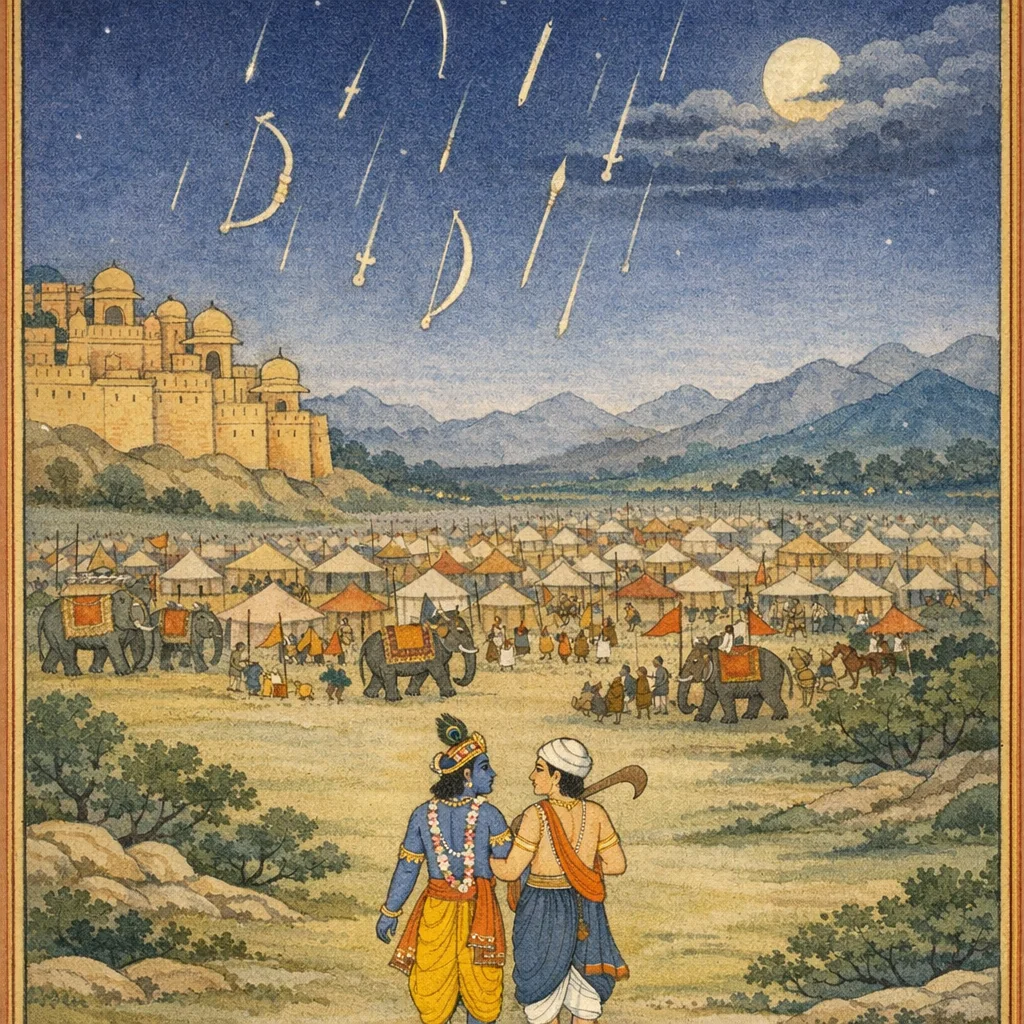
Parāśara tells Maitreya that Kaṃsa marries Jarāsandha’s daughters, Asti and Prāpti, stirring Jarāsandha’s wrath against the Yādavas. Jarāsandha besieges Mathurā with twenty-three akṣauhiṇīs, yet Balarāma and Śrī Kṛṣṇa face him with a small retinue, and their ‘ancient’ divine weapons descend from the sky—Śārṅga, inexhaustible quivers, Kaumodakī, and for Balarāma the plough and Saunanda—revealing divine sovereignty within historical battle. Though defeated again and again, Jarāsandha returns; eighteen wars follow, and Parāśara stresses that Kṛṣṇa does not deem an enemy finished while he still lives. The teaching then becomes explicit: the Yādavas’ strength is truly the glory of the presence of Viṣṇu’s aṃśa, and Kṛṣṇa’s exertion is līlā, for the Lord creates and dissolves by will alone. Yet He still follows human rāja-dharma—peace with the strong, war with the weak, the four upāyas (sāma, dāna, bheda, daṇḍa), even retreat—showing statecraft under divine freedom (svatantratā).
Shlokas
Verse 1
जरासंधसुते कंस उपयेमे महाबलः अस्तिं प्राप्तिं च मैत्रेय तयोर् भर्तृहणं हरिम्
O Maitreya, the mighty Kaṃsa married Jarāsandha’s two daughters, Asti and Prāpti, seeking strength through alliance; yet for them, Hari—the slayer of their husband—became fate’s turning point.
Verse 2
महाबलपरीवारो मगधाधिपतिर् बली हन्तुम् अभ्याययौ कोपाज् जरासंधः स यादवम्
Surrounded by a host of mighty warriors, Jarāsandha—the powerful lord of Magadha—advanced in wrath, intent on slaying that Yādava leader.
Verse 3
उपेत्य मथुरां सो ऽथ रुरोध मगधेश्वरः अक्षौहिणीभिः सैन्यस्य त्रयोविंशतिभिर् वृतः
Then the lord of Magadha advanced upon Mathurā and laid it under siege, encircled by an army of twenty-three akṣauhiṇīs.
Verse 4
निष्क्रम्याल्पपरीवाराव् उभौ रामजनार्दनौ युयुधाते समं तस्य बलिनौ बलिसैनिकैः
Stepping forth with only a small retinue, Rāma and Janārdana together engaged in battle against his powerful forces; mighty themselves, they fought the soldiers of that mighty one.
Verse 5
ततो रामश् च कृष्णश् च चक्राते मतिम् उत्तमाम् आयुधानां पुराणानाम् आदाने मुनिसत्तम
Then Rāma (Balarāma) and Kṛṣṇa, O best of sages, devised an excellent plan to take up their ancient weapons.
Verse 6
अनन्तरं हरेः शार्ङ्गं तूणौ चाक्षयसायकौ आकाशाद् आगतौ विप्र तथा कौमोदकी गदा
Thereafter, O brahmin, Hari’s bow Śārṅga, together with two quivers filled with inexhaustible arrows, descended from the sky; and so too came the mace Kaumodakī.
Verse 7
हलं च बलभद्रस्य गगनाद् आगतं ज्वलत् मनसाभिमतं विप्र सौनन्दं मुसलं तथा
And for Balabhadra, a blazing ploughshare descended from the sky—exactly as he had willed it; and likewise, O brahmin, the Saunanda mace came to him.
Verse 8
ततो युद्धे पराजित्य ससैन्यं मगधाधिपम् पुरीं विविशतुर् वीराव् उभौ रामजनार्दनौ
Then, having defeated in battle the lord of Magadha along with his armies, the two heroic brothers—Rāma (Balarāma) and Janārdana (Śrī Kṛṣṇa)—entered the city.
Verse 9
जिते तस्मिन् सुदुर्वृत्ते जरासंधे महामुने जीवमाने गते कृष्णस् तं नामन्यत निर्जितम्
O great sage, though the wicked Jarāsandha had been overcome, as long as he still lived and could return again, Kṛṣṇa did not regard him as truly vanquished.
Verse 10
पुनर् अप्य् आजगामाथ जरासंधो बलान्वितः जितश् च रामकृष्णाभ्याम् अपक्रान्तो द्विजोत्तम
Again Jarāsandha returned, strengthened by his armies; yet, defeated by Rāma and Kṛṣṇa, he withdrew once more—O best of the twice-born.
Verse 11
दश चाष्टौ च संग्रामान् एवम् अत्यन्तदुर्मदः यदुभिर् मागधो राजा चक्रे कृष्णपुरोगमैः
Thus the king of Magadha, Jarāsandha—blinded by extreme arrogance—waged eighteen battles against the Yadus, with Śrī Kṛṣṇa at the forefront.
Verse 12
सर्वेष्व् एतेषु युद्धेषु यादवैः स पराजितः अपक्रान्तो जरासंधः स्वल्पसैन्यैर् बलाधिकः
In every one of those battles he was defeated by the Yādavas; and Jarāsandha—though superior in strength—withdrew, reduced to a small remnant of his forces.
Verse 13
तद् बलं यादवानां तैर् अजितं यद् अनेकशः तत् तु संनिधिमाहात्म्यं विष्णोर् अंशस्य चक्रिणः
That very might of the Yādavas—by which they proved unconquerable again and again—was, in truth, the glory of proximity: the sanctifying power of the Presence of Viṣṇu’s portion, the discus-bearing Lord.
Verse 14
मनुष्यधर्मशीलस्य लीला सा जगतः पतेः अस्त्राण्य् अनेकरूपाणि यद् अरातिषु मुञ्चति
That conduct—seemingly shaped by the codes of human righteousness—is in truth the divine play of the Lord of the universe, when He releases weapons of many forms against His foes.
Verse 15
मनसैव जगत्सृष्टिं संहारं च करोति यः तस्यारिपक्षक्षपणे कियान् उद्यमविस्तरः
He who, by mere will, brings forth the universe and dissolves it again—what need has He of any elaborate exertion simply to destroy the hostile ranks?
Verse 16
तथापि ये मनुष्याणां धर्मास् तदनुवर्तनम् कुर्वन् बलवता संधिं हीनैर् युद्धं करोत्य् असौ
Yet, conforming to the practical dharmas ordained for human society, he makes peace with the powerful and wages war against the weaker.
Verse 17
साम चोपप्रदानं च तथा भेदं प्रदर्शयन् करोति दण्डपातं च क्वचिद् एव पलायनम्
Employing conciliation, offering inducements, and, when needed, exposing divisions, he also brings down punishment—and at times chooses retreat alone.
Verse 18
मनुष्यदेहिनां चेष्टाम् इत्य् एवम् अनुवर्ततः लीला जगत्पतेस् तस्य छन्दतः संप्रवर्तते
Thus, even while conforming to the actions of embodied human beings, the līlā of that Lord of the universe unfolds solely according to His own will.
Frequently Asked Questions
It is the ‘glory of proximity’: Parāśara explains that the Yādavas’ repeated invincibility arises from being near Viṣṇu’s aṃśa (Kṛṣṇa), not merely from martial capacity.
Parāśara teaches that the Lord, who can create/dissolve by will, still adopts human-appearing effort as līlā and as an exemplification of practical dharma and governance.