Adhyaya 10
पुंसां क्रिया-विभागः, संस्काराः, नामकरणम्, विवाहविधानम्
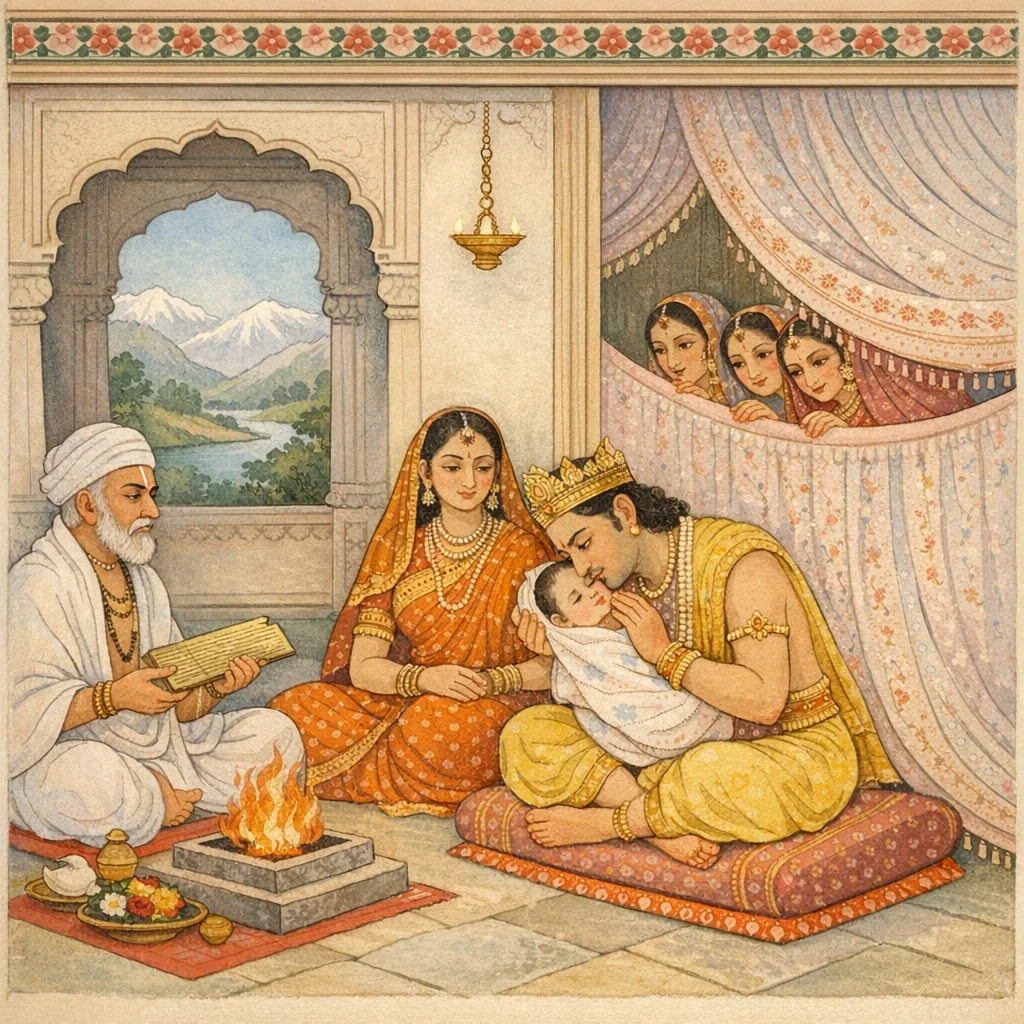
Continuing the guru–disciple dialogue, Maitreya asks Parāśara to explain the full range of human rites—nitya, naimittika, and kāmya. Parāśara begins with life-cycle saṁskāras from jātakarma onward and the ābhyudayika śrāddha for prosperity, prescribing the feeding of an even number of east-facing brāhmaṇas and the proper offerings to devas and pitṛs, including piṇḍa to the Nāndīmukha ancestors. He then describes nāmakaraṇa on the tenth day, giving varṇa-appropriate name endings (śarman/varman/gupta/dāsa) and auspicious phonetic rules. The account moves from education in the guru’s house to entry into gṛhastha through marriage, while acknowledging other āśrama paths (brahmacarya, vānaprastha/vaikhānasa, or saṁnyāsa). It concludes with norms for choosing a spouse, lunar timing guidance, the eight forms of marriage, insistence on varṇa-appropriate dharma, condemnation of adultery, and praise of the dharma-companion wife as the foundation of great fruit.
Shlokas
Verse 1
कथितं चातुराश्रम्यं चातुर्वर्ण्यक्रियास् तथा पुंसः क्रियाम् अहं श्रोतुम् इच्छामि द्विजसत्तम
You have explained the order of the four āśramas, and likewise the prescribed observances of the four varṇas. Now, O best of the twice-born, I wish to hear from you the rites and duties that pertain to a person.
Verse 2
नित्यां नैमित्तिकीं काम्यां क्रियां पुंसाम् अशेषतः समाख्याहि भृगुश्रेष्ठ सर्वज्ञो ह्य् असि मे मतः
O best of the Bhṛgu line, tell me fully, leaving nothing out, the threefold sacred duties of men—daily (nitya), occasional (naimittika), and desire-motivated (kāmya)—for I deem you truly all-knowing.
Verse 3
यद् एतद् उक्तं भवता नित्यनैमित्तिकाश्रितम् तद् अहं कथयिष्यामि शृणुष्वैकमना नृप
What you have asked, grounded in the nitya and naimittika duties, I shall now declare. Listen with a single, undistracted mind, O king.
Verse 4
जातस्य जातकर्मादि क्रियाकाण्डम् अशेषतः पुत्रस्य कुर्वीत पिता श्राद्धं चाभ्युदयात्मकम्
When a son is born, the father should perform in due order, without omission, the full course of prescribed rites beginning with the jātakarma; and he should also undertake the auspicious abhyudaya śrāddha for welfare and prosperity.
Verse 5
युग्मांस् तु प्राङ्मुखान् विप्रान् भोजयेन् मनुजेश्वर यथावृत्ति तथा कुर्याद् दैवं पित्र्यं द्विजन्मनाम्
O lord among men, let him feed Brahmins in an even number, seated facing east; and according to his means, let him duly perform both the offerings to the gods and the ancestral rite prescribed for the twice-born.
Verse 6
दध्ना यवैः सबदरैर् मिश्रान् पिण्डान् मुदा युतः नान्दीमुखेभ्यस् तीर्थेन दद्याद् दैवेन पार्थिव
O king, with a joyful and reverent heart one should offer piṇḍas—made by mixing barley with curds and jujube fruits—to the Nāndīmukha ancestors, presenting them with the sanctified tīrtha-water used in rites to the gods.
Verse 7
प्राजापत्येन वा सर्वम् उपचारं प्रदक्षिणम् कुर्वीत तत् तथाशेषवृद्धिकालेषु भूपते
Or else, O king, let him perform every rite of reverent attendance and the sacred circumambulation in accordance with the Prajāpatya ordinance; and let the same be done in every season of increase and prosperity.
Verse 8
ततश् च नाम कुर्वीत पितैव दशमे ऽहनि देवपूर्वं नराख्यं हि शर्मवर्मादिसंयुतम्
Thereafter, on the tenth day, the father himself should perform the rite of naming—bestowing a human name preceded by a divine element and completed with an ending such as “śarman,” “varman,” and the like.
Verse 9
शर्मेति ब्राह्मणस्योक्तं वर्मेति क्षत्रसंश्रयम् गुप्तदासात्मकं नाम प्रशस्तं वैश्यशूद्रयोः
‘Śarma’ is declared as the proper appellation for a Brāhmaṇa; ‘Varma’ is said to belong to those established in Kṣatriya status. Names formed with ‘Gupta’ and ‘Dāsa’ are praised as fitting for Vaiśyas and Śūdras.
Verse 10
नार्थहीनं न चाशस्तं नापशब्दयुतं तथा नामङ्गल्यं जुगुप्स्यं वा नाम कुर्यात् समाक्षरम्
One should not bestow a name that is meaningless or improper, nor one mixed with vulgar words, nor one that is inauspicious or repellent; the name should be formed of well-matched, harmonious syllables.
Verse 11
नातिदीर्घं न ह्रस्वं वा नातिगुर्वक्षरान्वितम् सुखोच्चार्यं तु तन् नाम कुर्याद् यत् प्रवणाक्षरम्
The name should be neither excessively long nor unduly short, nor burdened with heavy, difficult syllables; rather, let it be easy to pronounce, naturally inclining the heart toward reverence and devotion.
Verse 12
ततो ऽनन्तरसंस्कारसंस्कृतो गुरुवेश्मनि यथोक्तं विधिम् आश्रित्य कुर्याद् विद्यापरिग्रहम्
Thereafter, refined by the subsequent sacraments, he should enter the teacher’s household; and, taking refuge in the prescribed discipline, he should duly receive sacred learning.
Verse 13
गृहीतविद्यो गुरवे दत्त्वा च गुरुदक्षिणाम् गार्हस्थ्यम् इच्छन् भूपाल कुर्याद् दारपरिग्रहम्
Having received sacred knowledge and offered the teacher the proper guru-dakṣiṇā, the king—desiring the householder’s path—should enter married life, accepting a wife in accordance with dharma.
Verse 14
ब्रह्मचर्येण वा कालं कुर्यात् संकल्पपूर्वकम् गुरोः शुश्रूषणं कुर्यात् तत्पुत्रादेर् अथापि वा
Or else, having first made a firm resolve, he should spend his time in disciplined student-life (brahmacarya). He should devote himself to attentive service of the guru—or, if need be, to the service of the guru’s son and other dependents as well.
Verse 15
वैखानसो वापि भवेत् परिव्राड् अथवेच्छया पूर्वसंकल्पितं यादृक् तादृक् कुर्यान् महीपते
He may become a Vaikhānasa, devoted to the forest-discipline, or he may become a wandering renunciant. Or else, O lord of the earth, according to his own resolve, he should carry out the course of life he had previously determined—just as he had envisioned it.
Verse 16
वर्षैर् एकगुणां भार्याम् उद्वहेत् त्रिगुणः स्वयम् नातिकेशाम् अकेशां वा नातिकृष्णां न पिङ्गलाम्
A man who has reached thrice her years should take a wife younger by a single measure of years. Yet he should choose neither one excessively hairy nor one lacking hair; neither one overly dark nor one tawny or pale—thus does dharma counsel moderation and fitness in the household order.
Verse 17
निसर्गतो विकलाङ्गीम् अधिकाङ्गीं च नोद्वहेत् नाविशुद्धां सरोमां वा ऽकुलजां वातिरोगिणीम्
By nature, one should not take in marriage a woman who is physically impaired, nor one with supernumerary limbs; nor one who is impure, nor excessively hairy; nor one born of an unknown or improper lineage, nor one afflicted with chronic disorders.
Verse 18
न दुष्टां दुष्टवाचालां व्यङ्गिनीं पितृमातृतः न श्मश्रुव्यञ्जनवतीं न चैव पुरुषाकृतिम्
One should not accept a woman of corrupt conduct, nor one whose speech is harsh and wicked; nor one marked by deformity inherited from her parents; nor one bearing masculine traits—such as the signs of a beard—or one whose appearance is like that of a man.
Verse 19
न घर्घरस्वरां क्षामवाक्यां काकस्वरां न च नातिबद्धेक्षणां तद्वद् वृत्ताक्षीं नोद्वहेत् स्त्रियम्
One should not marry a woman whose voice is harsh and grating, whose speech is thin and unpleasant, or whose tone resembles a crow’s cry; nor one whose gaze is excessively fixed. Likewise, one should not take as wife a woman with unnaturally round, staring eyes.
Verse 20
यस्याश् च लोमशे जङ्घे गुल्फौ यस्यास् तथोन्नतौ कूपो यस्या हसन्त्याश् च गण्डयोस् तां च नोद्वहेत्
One should not marry a woman whose shanks are excessively hairy, whose ankles are unduly prominent, or whose cheeks form deep hollows when she laughs.
Verse 21
नातिरूक्षच्छविं पाण्डुकरजाम् अरुणेक्षणाम् आपीनहस्तपादां च न कन्याम् उद्वहेद् बुधः
A wise man should not marry a maiden whose complexion is excessively harsh and lusterless, whose nails are pale, whose eyes are reddish, and whose hands and feet are swollen.
Verse 22
न वामनां नातिदीर्घां नोद्वहेत् संहतभ्रुवम् न चातिच्छिद्रदशनां न करालमुखीं नरः
A man should not take in marriage a woman who is excessively short or excessively tall, nor one whose eyebrows meet; nor should he wed one with overly gapped teeth, nor one whose mouth appears fearsome.
Verse 23
पञ्चमीं मातृपक्षाच् च पितृपक्षाच् च सप्तमीम् गृहस्थस् तूद्वहेत् कन्यां न्याय्येन विधिना नृप
O king, a householder should wed a maiden by a dharma-sanctioned rite—choosing the fifth lunar day on the mother’s side and the seventh on the father’s side, and performing the ceremony according to proper rule.
Verse 24
ब्राह्मो दैवस् तथैवार्षः प्राजापत्यस् तथासुरः गान्धर्वराक्षसौ चान्यौ पैशाचश् चाष्टमो ऽधमः
The eight forms of marriage are declared: Brāhma, Daiva, Ārṣa, Prājāpatya, and Asura; also Gāndharva and Rākṣasa; while the eighth, Paiśāca, is the lowest and most reprehensible.
Verse 25
एतेषां यस्य यो धर्मो वर्णस्योक्तो महर्षिभिः कुर्वीत दाराहरणं तेनान्यं परिवर्जयेत्
For each of these, the great seers have declared the duty proper to one’s own varṇa. Let a man follow that alone; and if he seizes another’s wife, he must be rejected by all and kept at a distance.
Verse 26
सधर्मचारिणीं प्राप्य गार्हस्थ्यं सहितस् तया समुद्वहेद् ददात्य् एतत् सम्यगूढं महाफलम्
Having obtained a wife who walks with him in dharma, let him, together with her, duly undertake the burdens and rites of the householder’s life. For this—well guarded and rightly practiced—bestows a great and enduring fruit.
Frequently Asked Questions
He asks for an exhaustive explanation of nitya (daily), naimittika (occasional/triggered), and kāmya (desire-motivated/votive) kriyās—i.e., the ritual-ethical acts that order human life in dharma.
Names should be meaningful, non-vulgar, auspicious, phonetically balanced, and easy to pronounce; additionally, traditional varṇa-suffixes are recommended: śarman (brāhmaṇa), varman (kṣatriya), and gupta/dāsa (vaiśya/śūdra).
Paiśāca is explicitly labeled the eighth and the most reprehensible (adhama) among the eight forms of marriage.