Adhyaya 3
कालनिर्णयः (युग-मन्वन्तर-कल्पप्रमाणम्) — Measures of Time and Cosmic Cycles
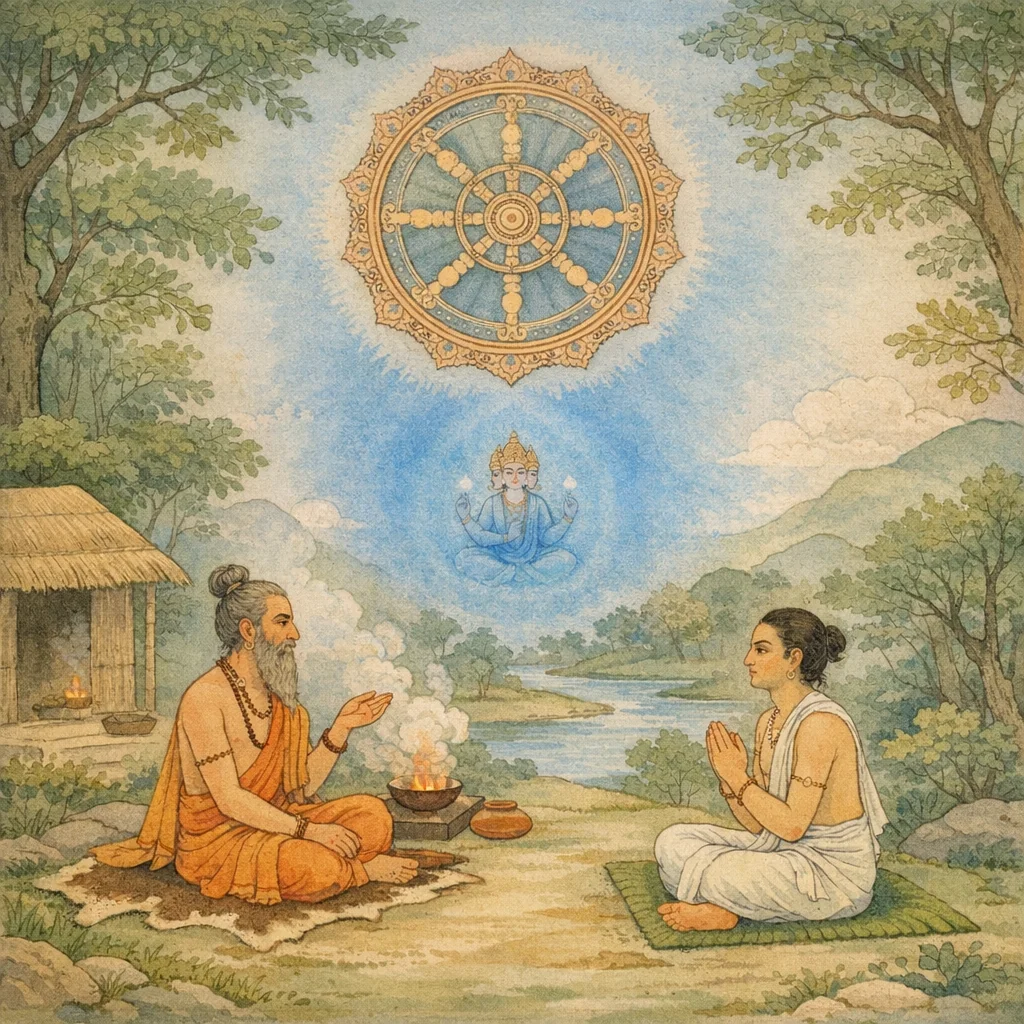
Maitreya objects: if Brahman is nirguṇa and stainless, how can it be accepted as the doer of creation and other cosmic acts? Parāśara replies that Brahman’s acintya-śakti—innate powers inseparable from Him, as heat from fire—accounts for creation, preservation, and dissolution. Thus “Nārāyaṇa becomes Brahmā” is only customary speech; Bhagavān remains eternal. He then teaches measures of time (kāla-parimāṇa): human units such as nimeṣa, kāṣṭhā, kalā, and muhūrta; the structure of month and year; the divine day and night by the two ayanas; and the yuga system with sandhyā and sandhyāṃśa. A thousand caturyugas make Brahmā’s day; within it arise fourteen Manus, each manvantara spanning seventy-one caturyugas with junction periods. He concludes with the naimittika pralaya at the end of Brahmā’s day, Brahmā’s night upon Śeṣa’s serpent-couch, and identifies the present aeon as the first of the second parārdha: the Vārāha-kalpa.
Shlokas
Verse 1
निर्गुणस्याप्रमेयस्य शुद्धस्याप्य् अमलात्मनः कथं सर्गादिकर्तृत्वं ब्रह्मणो ऽभ्युपगम्यते
If Brahman is without qualities, beyond all measure, and—though perfectly pure—of stainless essence, then how can one accept that such Brahman becomes the doer of creation and the other cosmic acts?
Verse 2
शक्तयः सर्वभावानाम् अचिन्त्यज्ञानगोचराः यतो ऽतो ब्रह्मणस् तास् तु सर्गाद्या भावशक्तयः भवन्ति तपतां श्रेष्ठ पावकस्य यथोष्णता
The powers (śaktis) of all beings are inconceivable, beyond thought and ordinary knowledge. Therefore, O best of ascetics, they are understood as belonging to Brahman; from them arise the modes of becoming, beginning with creation—just as heat is inseparable from fire.
Verse 3
तन् निबोध यथा सर्गे भगवान् संप्रवर्तते नारायणाख्यो भगवान् ब्रह्मा लोकपितामहः
Understand, then, how at the time of creation the Blessed Lord sets the process in motion: that very Lord, known as Nārāyaṇa, becomes Brahmā, the Grandfather and progenitor of the worlds.
Verse 4
उत्पन्नः प्रोच्यते विद्वन् नित्य एवोपचारतः
O wise one, he is spoken of as “born” only by customary expression; in truth, he is eternal alone.
Verse 5
निजेन तस्य मानेन आयुर् वर्षशतं स्मृतम् तत् पराख्यं तदर्धं च परार्धम् अभिधीयते
By that being’s own measure, its lifespan is remembered to be a hundred years. That span is called the “Parā” measure, and its half is known as “Parārdha” (half of Parā).
Verse 6
कालस्वरूपं विष्णोश् च यन् मयोक्तं तवानघ तेन तस्य निबोध त्वं परिमाणोपपादनम्
O sinless one, by the very teaching I have given you on Time as it pertains to Lord Viṣṇu, now understand how its measures and determinations are to be established.
Verse 7
अन्येषां चैव जन्तूनां चराणाम् अचराश् च ये भूभूभृत्सागरादीनाम् अशेषाणां च सत्तम
And for all other beings as well—those that move and those that do not—Earth, the mountains that uphold it, the oceans, and every support without remainder—O best among the virtuous—He is the inner ruler and the sovereign ground of all.
Verse 8
काष्ठा पञ्चदशाख्याता निमेषा मुनिसत्तम काष्ठात्रिंशत् कला त्रिंशत् कला मौहूर्तिको विधिः
O best of sages, fifteen (units) are known as a nimeṣa; thirty kāṣṭhās make a kalā; and thirty kalās constitute a muhūrta—such is the ordained method of reckoning time.
Verse 9
तावत्संख्यैर् अहोरात्रं मुहूर्तैर् मानुषं स्मृतम् अहोरात्राणि तावन्ति मासः पक्षद्वयात्मकः
By that very count of muhūrtas, a human day and night are declared. And that same number of day-nights makes a month, consisting of two fortnights—the bright and the dark halves.
Verse 10
तैः षड्भिर् अयनं वर्षं द्वे ऽयने दक्षिणोत्तरे अयनं दक्षिणं रात्रिर् देवानाम् उत्तरं दिनम्
By those six (seasons) an ayana is formed; and the year is made of two ayanas—southern and northern. Of these, the southern course is the night of the gods, while the northern course is their day.
Verse 11
दिव्यैर् वर्षसहस्रैस् तु कृतत्रेतादिसंज्ञितम् चतुर्युगं द्वादशभिस् तद्विभागं निबोध मे
Measured in thousands of divine years is the fourfold age called Kṛta, Tretā, and the rest—the Caturyuga. Now learn from me its division into twelve parts.
Verse 12
चत्वारि त्रीणि द्वे चैकं कृतादिषु यथाक्रमम् दिव्याब्दानां सहस्राणि युगेष्व् आहुः पुराविदः
The sages of old declare that, in the yugas beginning with Kṛta, the thousands of divine years are—respectively—four, three, two, and one, in due order.
Verse 13
तत्प्रमाणैः शतैः संध्या पूर्वा तत्राभिधीयते संध्यांशकश् च तत्तुल्यो युगस्यानन्तरो हि सः
By those same measures, the preceding interval is called the Sandhyā—the “dawn” that ushers in the age. And the Sandhyāṃśa, equal in measure, is the concluding “twilight,” for it follows the yuga immediately.
Verse 14
संध्यासंध्यांशयोर् अन्तर् यः कालो मुनिसत्तम युगाख्यः स तु विज्ञेयः कृतत्रेतादिसंज्ञितः
O best of sages, the span of time that lies between the Sandhyā and the Sandhyāṃśa is known as a yuga; it bears the names Kṛta, Tretā, and the other ages.
Verse 15
कृतं त्रेता द्वापरश् च कलिश् चैव चतुर्युगम् प्रोच्यते तत्सहस्रं च ब्रह्मणो दिवसं मुने
Kṛta, Tretā, Dvāpara, and Kali—these four together are declared to be one caturyuga. And a thousand such caturyugas, O sage, constitute a single day of Brahmā.
Verse 16
ब्रह्मणो दिवसे ब्रह्मन् मनवस् तु चतुर्दश भवन्ति परिमाणं च तेषां कालकृतं शृणु
O Brahmin, within a single day of Brahmā there arise fourteen Manus; now hear the measure of time that determines their span.
Verse 17
सप्तर्षयः सुराः शक्रो मनुस् तत्सूनवो नृपाः एककाले हि सृज्यन्ते संह्रियन्ते च पूर्ववत्
The Seven Seers, the gods, Śakra (Indra), the Manu, and his sons who become kings—all are brought forth together at one time, and likewise, as before, are withdrawn into dissolution.
Verse 18
चतुर्युगाणां संख्याता साधिका ह्य् एकसप्ततिः मन्वन्तरं मनोः कालः सुरादीनां च सत्तम
Seventy-one cycles of the four yugas, together with their junction-periods, are declared to be a Manvantara: the span of a Manu’s rule, and likewise the ordained measure of time for the gods and other celestial orders.
Verse 19
अष्टौ शतसहस्राणि दिव्यया संख्यया स्मृतम् द्वापञ्चाशत् तथान्यानि सहस्राण्य् अधिकानि तु
In the reckoning of the gods, it is remembered as eight hundred thousand, with fifty-two thousand more besides.
Verse 20
त्रिंशत्कोट्यस् तु संपूर्णाः संख्याताः संख्यया द्विज सप्तषष्टिस् तथान्यानि नियुतानि महामुने
O twice-born one, O great sage, the complete measures by number are these: thirty koṭis in full, and further sixty-seven niyutas besides.
Verse 21
विंशतिश् च सहस्राणि कालो ऽयम् अधिकं विना मन्वन्तरस्य संख्येयं मानुषैर् वत्सरैर् द्विज
O twice-born one, this span of time, reckoned in human years, is exactly twenty thousand with no remainder; such is the measure of a Manvantara.
Verse 22
चतुर्दशगुणो ह्य् एष कालो ब्राह्मम् अहः स्मृतम् ब्राह्मो नैमित्तिको नाम तस्यान्ते प्रतिसंचरः
This span of time, fourteenfold, is remembered as a single day of Brahmā. That cycle is called Brāhma, also Naimittika; at its end occurs pratisaṃcara, the periodic re-absorption of the worlds.
Verse 23
तदा हि दह्यते सर्वं त्रैलोक्यं भूर्भुवादिकम् जनं प्रयान्ति तापार्ता महर्लोकनिवासिनः
Then indeed the entire triple world—beginning with Bhūḥ and Bhuvaḥ—burns. Tormented by that scorching heat, the inhabitants of Maharloka depart to Janaloka.
Verse 24
एकार्णवे तु त्रैलोक्ये ब्रह्मा नारायणात्मकः भोगिशय्यागतः शेते त्रैलोक्यग्रासबृंहितः
When the three worlds become a single ocean, Brahmā—whose very essence is Nārāyaṇa—reclines upon the serpent-couch (Śeṣa), as though enlarged by having absorbed the threefold cosmos into Himself.
Verse 25
जनस्थैर् योगिभिर् देवश् चिन्त्यमानो ऽब्जसंभवः तत्प्रमाणां हि तां रात्रिं तदन्ते सृजते पुनः
The lotus-born Lord (Brahmā), contemplated by steadfast yogins, passes through that Night in measure befitting him; and when that Night comes to its end, he creates again.
Verse 26
एवं तु ब्रह्मणो वर्षम् एवं वर्षशतं च यत् शतं हि तस्य वर्षाणां परमायुर् महात्मनः
Thus is defined a single ‘year’ of Brahmā; and thus, too, is understood his century of years. A hundred such years is declared to be the supreme lifespan of that great-souled Brahmā.
Verse 27
एकम् अस्य व्यतीतं तु परार्धं ब्रह्मणो ऽनघ तस्यान्ते ऽभून् महाकल्पः पाद्म इत्य् अभिविश्रुतः
O sinless one, one parārdha of Brahmā’s lifespan has already passed; and at the close of that half-span there occurred the great aeon renowned as the Pādma Mahākalpa.
Verse 28
द्वितीयस्य परार्धस्य वर्तमानस्य वै द्विज वाराह इति कल्पो ऽयं प्रथमः परिकीर्तितः
O twice-born one, within the currently unfolding latter half of the second great division of Brahmā’s life, this present aeon is proclaimed as the first—known as the Vārāha Kalpa.
Frequently Asked Questions
He compares śakti’s inseparability from Brahman to heat’s inseparability from fire: creation arises through inherent power, not by compromising Brahman’s purity or transcendence.
A yuga is the span between the introductory twilight (sandhyā) and the concluding twilight portion (sandhyāṃśa), with Kṛta, Tretā, Dvāpara, and Kali forming a caturyuga.
It is the periodic dissolution at the end of Brahmā’s day (Brāhma ahar), when the worlds burn, Maharloka’s beings move to Janaloka, and the cosmos becomes a single ocean during Brahmā’s night before creation resumes.