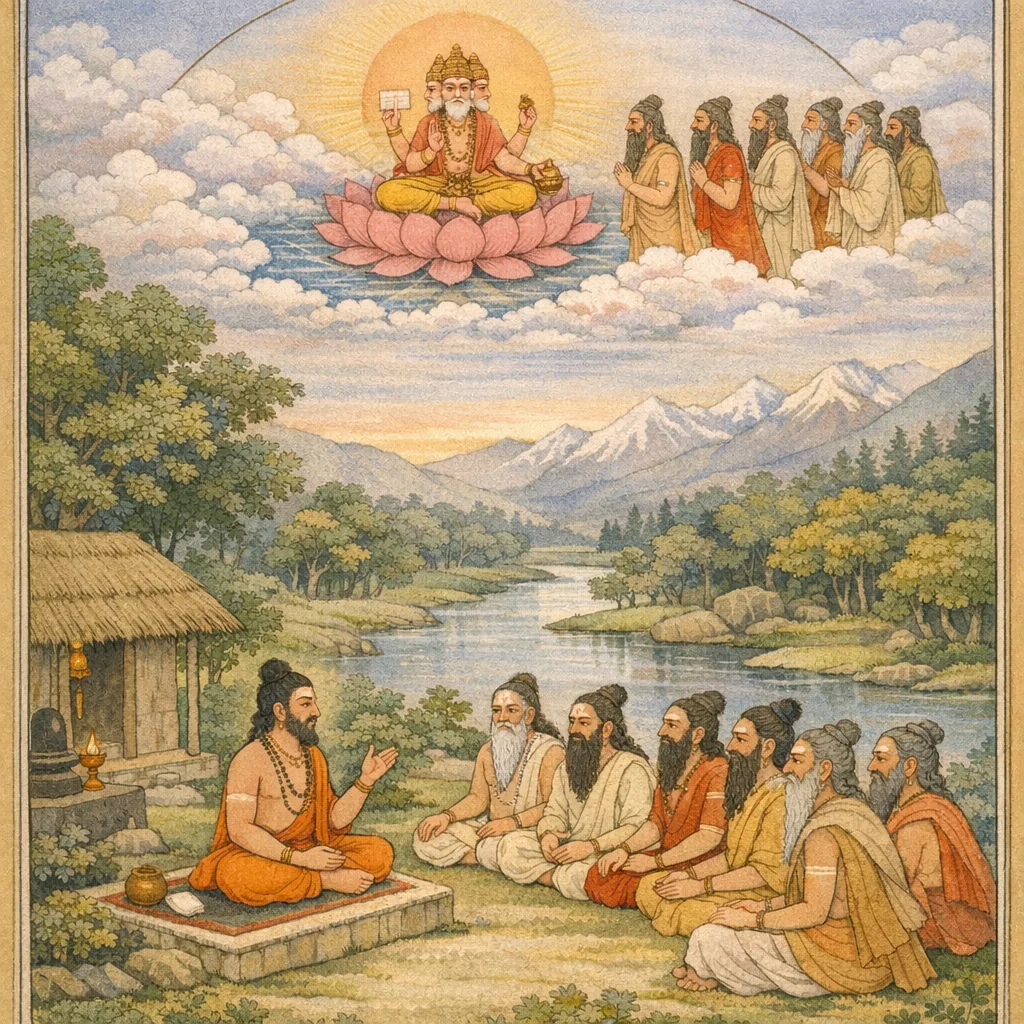
पुराणश्रवणप्रस्तावः (Prologue to the Recitation of the Śaiva Purāṇa)
This chapter serves as a formal opening frame for transmission. After hearing Sūta’s earlier words, the assembled great sages request an extraordinary Purāṇa, praised as the essence of Vedānta (vedāntasāra) and the sum of its meaning. Delighted, Sūta remembers Śaṅkara and invites all ṛṣis to listen to a Śaiva Purāṇa said to be born of the Vedic essence (vedasāraja). The narrative then shifts to a cosmogonic setting: in a former cycle and again in the present kalpa at the start of creation, sages of six lineages dispute—“this is supreme, not that”—over ultimate priority. To settle the hierarchy of principles, they approach the imperishable creator Brahmā with humility and folded hands, acknowledging him as the world’s support and the “cause of causes.” Thus the chapter establishes the text’s authority chain, its Vedāntic grounding, and a thematic entry into theological adjudication through debate and appeal to cosmic authority.
Shlokas
Verse 1
व्यास उवाच । इत्याकर्ण्य वचः सौतं प्रोचुस्ते परमर्षयः । वेदांतसारसर्वस्वं पुराणं श्रावयाद्भुतम्
Vyāsa said: Having thus heard the words of Sūta, those supreme sages addressed him: “Please recite to us that wondrous Purāṇa which is the very all-in-all—the distilled essence—of Vedānta.”
Verse 2
इति श्रुत्वा मुनीनां स वचनं सुप्रहर्षितः । संस्मरञ्छंकरं सूतः प्रोवाच मुनिसत्तमान्
Having thus heard the words of the sages, he became exceedingly delighted. Remembering Śaṅkara (Lord Śiva), Sūta then addressed those foremost among the munis.
Verse 3
इति श्रीशिवमहापुराणे विद्येश्वरसंहितायां साध्यसाधनखण्डे । तृतीयोऽध्यायः
Thus ends the Third Chapter in the Sādhyasādhana-khaṇḍa of the Vidyeśvara-saṃhitā of the Śrī Śiva Mahāpurāṇa.
Verse 4
यत्र गीतं त्रिकं प्रीत्या भक्तिज्ञानविरागकम्
Where, with loving delight, the threefold teaching—devotion, true knowledge, and dispassion—is sung and celebrated.
Verse 5
वेदांतवेद्यं सद्वस्तु विशेषेण प्रवर्णितम्
That Real Being—knowable through the Vedānta—has been described here with particular clarity and distinction.
Verse 6
सूत उवाच । शृण्वंतु ऋषयः सर्वे पुराणं वेदसारजम् । पुरा कालेन महता कल्पेऽतीते पुनःपुनः
Sūta said: “Let all the sages listen to this Purāṇa, born of the very essence of the Vedas. Long ago—after a vast passage of time—when a former Kalpa had repeatedly come to its end, (this sacred account was proclaimed again).”
Verse 7
अस्मिन्नुपस्थिते कल्पे प्रवृत्ते सृष्टिकर्मणि । मुनीनां षट्कुलीनानां ब्रुवतामितरेतरम्
In this Kalpa that had now arrived, when the work of creation had begun, the sages of the six lineages were conversing among themselves.
Verse 8
इदं परमिदं नेति विवादः सुमहानभूत् । तेऽभिजग्मुर्विधातारं ब्रह्माणं प्रष्टुमव्ययम्
A very great dispute arose between them—each insisting, “This is supreme,” and the other replying, “No, this is not.” Therefore they approached the Creator, Brahmā, the imperishable one, to question him.
Verse 9
वाग्भिर्विनयगर्भाभिः सर्वे प्रांजलयोऽब्रुवन् । त्वं हि सर्वजगद्धाता सर्वकारणकारणम्
Then all of them, with palms joined, spoke words filled with humility: “You indeed are the sustainer of the entire universe, the Cause of all causes.”
Verse 10
कः पुमान्सर्वतत्त्वेभ्यः पुराणः परतः परः । ब्रह्मोवाच । यतो वाचो निवर्तंते अप्राप्य मनसा सह
Brahmā said: “Who is that Person—more ancient than all the tattvas, and transcendent beyond the transcendent—from whom words turn back, unable to reach Him, along with the mind?”
Verse 11
यस्मात्सर्वमिदं ब्रह्मविष्णुरुद्रे द्रं पूर्वकम् । सहभूतेंद्रि यैः सर्वैः प्रथमं संप्रसूयते
From Him alone this entire manifested order is first brought forth—beginning with Brahmā, Viṣṇu, Rudra, and Indra—together with all beings and all the senses.
Verse 12
एष देवो महादेवः सर्वज्ञो जगदीश्वरः । अयं तु परया भक्त्या दृश्यते नाऽन्यथा क्वचित्
This Deva is Mahādeva—omniscient, the Lord of the universe. He is beheld only through supreme devotion; in no other way is He seen at any time.
Verse 13
रुद्रो हरिर्हरश्चैव तथान्ये च सुरेश्वराः । भक्त्या परमया तस्य नित्यं दर्शनकांक्षिणः
Rudra, Hari (Viṣṇu), Hara, and the other lords of the gods—through supreme devotion to Him—ever long for His divine vision (darśana).
Verse 14
बहुनात्र किमुक्तेन शिवे भक्त्या विमुच्यते । प्रसादाद्देवताभक्तिः प्रसादो भक्तिसंभवः । यथेहांकुरतो बीजं बीजतो वा यथांकुरः
What need is there to say much here? By devotion to Śiva one is liberated. From His grace (prasāda) arises devotion toward the deity, and that grace itself is born of devotion—just as a seed comes from a sprout and a sprout again from a seed.
Verse 15
तस्मादीशप्रसादार्थं यूयं गत्वा भुवं द्विजाः । दीर्घसत्रं समाकृध्वं यूयं वर्षसहस्रकम्
“Therefore, O twice-born ones, go to the earth; and for the sake of obtaining the Lord’s gracious favor, undertake a long sacrificial session (dīrgha-satra) and carry it out for a thousand years.”
Verse 16
अमुष्यैवाध्वरेशस्य शिवस्यैव प्रसादतः । वेदोक्तविद्यासारं तु ज्ञायते साध्यसाधनं
By the grace of that very Śiva—the Lord of sacrifice—one comes to know the essential purport of the Veda-taught knowledge: what is to be attained and the means by which it is attained.
Verse 17
मुनय ऊचुः । अथ किं परमं साध्यं किंवा तत्साधनं परम् । साधकः कीदृशस्तत्र तदिदं ब्रूहि तत्त्वतः
The sages said: “Now, what is the supreme goal to be attained? And what is the highest means for attaining it? What kind of aspirant is fit for that path? Tell us this—truly and in accordance with reality.”
Verse 18
ब्रह्मोवाच । साध्यं शिवपदप्राप्तिः साधनं तस्य सेवनम् । साधकस्तत्प्रसादाद्योऽनित्यादिफलनिःस्पृहः
Brahmā said: “The goal to be attained is the attainment of Śiva’s state (Śivapada). The means to that is devoted service to Him. And the true practitioner—by His grace—becomes free from craving for transient and other lesser results.”
Verse 19
कर्म कृत्वा तु वेदोक्तं तदर्पितमहाफलम् । परमेशपदप्राप्तः सालोक्यादिक्रमात्ततः
Having performed the Veda-enjoined rites and offering their great fruit to Parameśvara (Lord Śiva), one attains the state of the Supreme Lord—then, step by step, reaches the divine modes of liberation beginning with sālokya and the rest.
Verse 20
तत्तद्भक्त्यनुसारेण सर्वेषां परमं फलम् । तत्साधनं बहुविधं साक्षादीशेन बोधितम्
In accordance with each person’s devotion, the supreme fruit comes to all. The means for attaining that fruit are many, and they were taught directly by Īśa (Lord Śiva) Himself.
Verse 21
संक्षिप्य तत्र वः सारं साधनं प्रब्रवीम्यहम् । श्रोत्रेण श्रवणं तस्य वचसा कीर्तनं तथा
Now, in brief, I shall tell you the essence of the means of practice: with the ears, the listening to Him; and with speech, the kīrtana—praising Him—likewise.
Verse 22
मनसा मननं तस्य महासाधनमुच्यते । श्रोतव्यः कीर्तितव्यश्च मन्तव्यश्च महेश्वरः
To contemplate Him with the mind is said to be a great means of sādhanā. Maheshvara is to be listened to, praised in kīrtana, and reflected upon.
Verse 23
इति श्रुतिप्रमाणं नः साधनेनाऽमुना परम् । साध्यं व्रजत सर्वार्थसाधनैकपरायणाः
“Thus, for us, the authority of Śruti (the Vedas) stands as the proof: by this very spiritual means, proceed to the supreme goal to be attained—remaining wholly devoted to the one practice that accomplishes all aims.”
Verse 24
प्रत्यक्षं चक्षुषा दृष्ट्वा तत्र लोकः प्रवर्तते । अप्रत्यक्षं हि सर्वत्र ज्ञात्वा श्रोत्रेण चेष्टते
Seeing with the eyes what is directly perceptible, people engage in it. But regarding what is not directly perceptible everywhere, once it is understood, they proceed by relying on hearing—authoritative instruction.
Verse 25
तस्माच्छ्रवणमेवादौ श्रुत्वा गुरुमुखाद्बुधः । ततः संसाधयेदन्यत्कीर्तनं मननं सुधीः
Therefore, in the beginning, the wise seeker should indeed take up listening—having heard the teaching from the mouth of the Guru. Thereafter, the discerning one should duly cultivate the other practices: kīrtana (devotional praise) and manana (deep contemplation).
Verse 26
क्रमान्मननपर्यंते साधनेऽस्मिन्सुसाधिते । शिवयोगो भवेत्तेन सालोक्यादिक्रमाच्छनैः
When this discipline is well accomplished step by step—up to the stage of manana (deep contemplation)—there arises through it Śiva-yoga, union with Śiva; and then, gradually in due order, the states beginning with sālokya (dwelling in Śiva’s realm) are attained.
Verse 27
सर्वांगव्याधयः पश्चात्सर्वानंदश्च लीयते । अभ्यासात्क्लेशमेतद्वै पश्चादाद्यंतमंगलम्
Thereafter, the diseases of all the limbs subside, and one becomes absorbed in all-bliss. Indeed, through sustained practice there is at first hardship, but afterwards it culminates in auspiciousness from beginning to end.
Frequently Asked Questions
A doctrinal dispute among sages—framed as “this is supreme, not that”—is introduced as the catalyst for seeking authoritative resolution from Brahmā, signaling that the text will adjudicate ultimate reality through a cosmological-theological inquiry.
The chapter’s key “symbols” are methodological: remembering Śaṅkara before teaching signifies epistemic purification and alignment with the highest principle; calling the Purāṇa “vedasāra/vedāntasāra” encodes a claim that Purāṇic narrative is a valid carrier of Vedāntic truth when oriented to Śiva.
No distinct iconographic form of Śiva or Devī is developed in the cited portion; Śiva appears primarily as Śaṅkara invoked through smaraṇa, establishing presence and authority rather than a particular mūrti or avatāra.