Śiva-Naivedya-Grāhyatā-Nirṇayaḥ (On the Proper Acceptance and Merit of Śiva’s Consecrated Food-Offering)
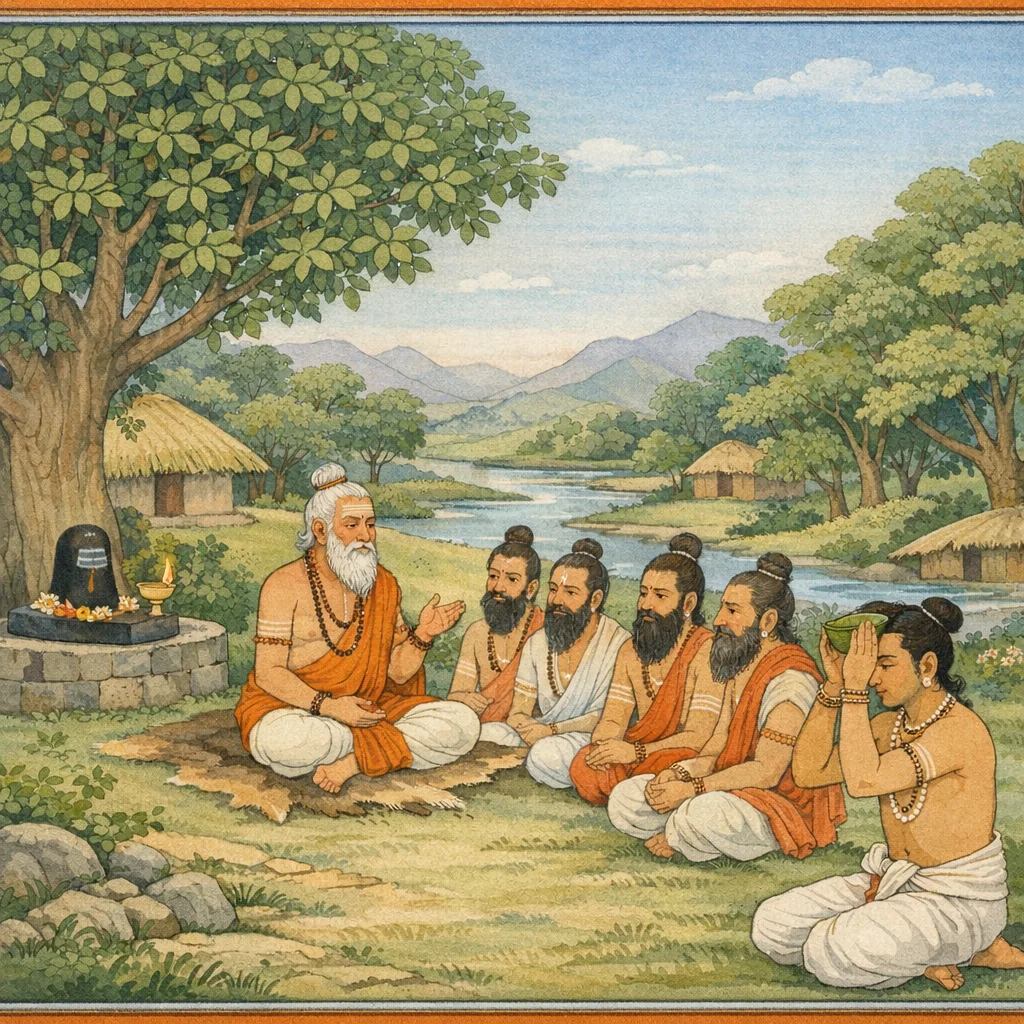
Adhyāya 22 is a question-and-answer nirṇaya: the ṛṣis report an earlier claim that “Śiva-naivedya is agrāhya” (not to be accepted or eaten) and ask for a final ruling, along with bilva-māhātmya. Sūta replies with a dense instruction: a qualified Śiva-bhakta—pure, disciplined, and steadfast in vrata—should accept and consume Śiva’s consecrated food-offering (prasāda), abandoning the notion of ineligibility. The chapter sets a graded doctrine of contact: merely seeing Śiva-naivedya dispels sins, while devoted consumption multiplies merit, surpassing even great sacrificial rites in salvific fruit. It also sacralizes the home, declaring that any house where Śiva-naivedya circulates becomes purifying for others. Proper etiquette and urgency are taught: receive it reverently (touching it to the head), eat it after remembering Śiva, and do not delay, for delay is said to breed sinful association. The chapter ends by warning against reluctance to accept Śiva-naivedya and by hinting at devotional criteria of eligibility (such as the dīkṣā-endowed bhakta), turning a contested ritual question into a theology of prasāda, purity, and liberation-oriented practice.
Shlokas
Verse 1
ऋषयः ऊचुः । अग्राह्यं शिवनैवेद्यमिति पूर्वं श्रुतं वचः । ब्रूहि तन्निर्णयं बिल्वमाहात्म्यमपि सन्मुने
The sages said: “Earlier we have heard the statement that the food-offering (naivedya) made to Śiva is not to be taken by others. O noble sage, please explain the correct decision on that matter—and also the sacred greatness of the bilva tree.”
Verse 2
सूत उवाच । शृणुध्वं मुनयः सर्वे सावधानतयाधुना । सर्वं वदामि संप्रीत्या धन्या यूयं शिवव्रताः
Sūta said: “Listen now, all you sages, with full attentiveness. I shall tell you everything with heartfelt joy. Blessed indeed are you—votaries vowed to Śiva.”
Verse 3
शिवभक्तः शुचिः शुद्धः सद्व्रतीदृढनिश्चयः । भक्षयेच्छिवनैवेद्यं त्यजेदग्राह्यभावनाम्
A devotee of Śiva—clean, inwardly pure, steadfast in righteous vows, and firm in resolve—should partake of the naivedya, the food-offering made to Śiva, and abandon the notion that such consecrated offerings are unfit to be accepted.
Verse 4
दृष्ट्वापि शिवनैवेद्ये यांति पापानि दूरतः । भक्ते तु शिवनैवेद्ये पुण्यान्या यांति कोटिशः
Even by merely beholding the naivedya offered to Lord Śiva, sins retreat far away. But when that Śiva-naivedya is taken with devotion, merits arise in millions.
Verse 5
अलं यागसहस्रेणाप्यलं यागार्बुदैरपि । भक्षिते शिवनैवेद्ये शिवसायुज्यमाप्नुयात्
No thousands of sacrifices are needed, nor even tens of millions of sacrificial rites: by partaking of the Śiva-naivedya, one attains Śiva-sāyujya—union with Śiva.
Verse 6
यद्गृहे शिवनैवेद्यप्रचारोपि प्रजायते । तद्गृहं पावनं सर्वमन्यपावनकारणम्
That house in which even the offering and distribution of Śiva-naivedya takes place—though only in a small measure—becomes wholly purifying, and itself becomes a cause for the purification of others.
Verse 7
आगतं शिवनैवेद्यं गृहीत्वा शिरसा मुदा । भक्षणीयं प्रयत्नेन शिवस्मरणपूर्वकम्
Receiving the naivedya, the food-offering presented to Śiva, one should accept it with joy and reverence, as though placing it upon the head; then one should partake of it carefully, first establishing remembrance of Śiva.
Verse 8
आगतं शिवनैवेद्यमन्यदा ग्राह्यमित्यपि । विलंबे पापसंबंधो भवत्येव हि मानवे
Even if one thinks, “I will accept the naivedya (food-offering) made to Śiva at some other time,” still—when there is delay—contact with demerit (pāpa) surely arises for a person. Therefore, Śiva’s naivedya should be received and honored promptly, with reverence.
Verse 9
न यस्य शिवनैवेद्यग्रहणेच्छा प्रजायते । स पापिष्ठो गरिष्ठः स्यान्नरकं यात्यपि ध्रुवम्
One in whom no desire arises to accept Lord Śiva’s consecrated food-offering (naivedya) becomes the most sinful and most blameworthy; such a person surely goes to hell.
Verse 10
हृदये चन्द्र कान्ते च स्वर्णरूप्यादिनिर्मिते । शिवदीक्षावता भक्तेनेदं भक्ष्यमितीर्य्यते
In a heart-shaped vessel, or a moonstone vessel, or one made of gold, silver, and the like, the devotee who has received Śiva-dīkṣā should declare: “This is sacred food to be offered (bhakṣya).”
Verse 11
शिवदीक्षान्वितो भक्तो महाप्रसादसंज्ञकम् । सर्वेषामपि लिंगानां नैवेद्यं भक्षयेच्छुभम्
A devotee who has received Śiva-dīkṣā should reverently partake of the auspicious naivedya from any Śiva-liṅga, regarding it as “Mahāprasāda.”
Verse 12
अन्यदीक्षायुजां नॄणां शिवभक्तिरतात्मनाम् । शृणुध्वं निर्णयं प्रीत्या शिवनैवेद्यभक्षणे
For those who have received other initiations, yet whose hearts are devoted to Śiva-bhakti—listen with joy to the settled rule regarding the eating of Śiva’s naivedya.
Verse 13
शालग्रामोद्भवे लिंगे रसलिंगे तथा द्विजाः । पाषाणे राजते स्वर्णे सुरसिद्धप्रतिष्ठिते
O twice-born ones, whether the Liṅga is formed from Śālagrāma-stone, or is a Rasaliṅga made of sacred mercurial essence, or is of stone, silver, or gold—especially when duly installed by the gods or perfected Siddhas—it is fit for worship as the manifest form of Śiva.
Verse 14
काश्मीरे स्फाटिके रात्ने ज्योतिर्लिंगेषु सर्वशः । चान्द्रायणसमं प्रोक्तं शंभोर्नैवेद्यभक्षणम्
In Kāśmīra, at the Sphāṭika crystal jewel, and likewise at all the Jyotirliṅgas, it is declared that partaking of Śambhu’s consecrated naivedya is equal in merit to performing the Cāndrāyaṇa vow.
Verse 15
ब्रह्महापि शुचिर्भूत्वा निर्माल्यं यस्तु धारयेत् । भक्षयित्वा द्रुतं तस्य सर्वपापं प्रणश्यति
Even a slayer of a brāhmaṇa, once purified, if he wears the Lord’s nirmālya—the sanctified remnants from Śiva’s worship—and then consumes it, all his sins quickly perish.
Verse 16
चंडाधिकारो यत्रास्ति तद्भोक्तव्यं न मानवैः । चंडाधिकारो नो यत्र भोक्तव्यं तच्च भक्तितः
Where a violent and impure claim over offerings (caṇḍādhikāra) prevails, people should not partake of it. But where no such harsh entitlement exists, that pure offering should be accepted reverently, as an act of devotion (bhakti).
Verse 17
बाणलिंगे च लौहे च सिद्धे लिंगे स्वयंभुवि । प्रतिमासु च सर्वासु न चंडोधिकृतो भवेत्
In the worship of the Bāṇa-liṅga, the iron liṅga, the duly consecrated (siddha) liṅga, the self-manifest (svayaṃbhū) liṅga, and all sacred images (pratimās), one should never appoint a fierce, harsh, or violent person as the officiant or superintendent of the rite.
Verse 18
स्नापयित्वा विधानेन यो लिंगस्नापनोदकम् । त्रिःपिबेत्त्रिविधं पापं तस्येहाशु विनश्यति
He who, after bathing the Śiva-liṅga according to the prescribed rite, drinks the water of that liṅga-ablution three times—his threefold sin is quickly destroyed here itself.
Verse 19
अग्राह्यं शिवनैवेद्यं पत्रं पुष्पं फलं जलम् । शालग्रामशिलासंगात्सर्वं याति पवित्रिताम्
Even if leaves, flowers, fruits, or water are considered unfit to be accepted as an offering (naivedya) to Lord Śiva, by coming into contact with the Śālagrāma stone they all become purified and thus attain fitness for sacred use.
Verse 20
लिंगोपरि च यद्द्रव्यं तदग्राह्यं मुनीश्वराः । सुपवित्रं च तज्ज्ञेयं यल्लिंगस्पर्शबाह्यतः
O best of sages, whatever substance has been offered upon the Liṅga is not to be taken back. Know it to be supremely pure, for once it has touched the Liṅga it stands beyond ordinary notions of contact and contamination.
Verse 21
नैवेद्यनिर्णयः प्रोक्तं इत्थं वो मुनिसत्तमाः । शृणुध्वं बिल्वमाहात्म्यं सावधानतयाऽदरात्
Thus, O best of sages, the proper rule regarding the offering of naivedya has been explained to you. Now, with attentive care and reverence, listen to the greatness of the Bilva leaves used in the worship of Lord Śiva.
Verse 22
महादेवस्वरूपोयं बिल्वो देवैरपि स्तुतिः । यथाकथंचिदेतस्य महिमा ज्ञायते कथम्
This Bilva tree is verily of the very nature of Mahādeva, and it is praised even by the gods. If its greatness can be known only in part, how could its full glory ever be truly comprehended?
Verse 23
पुण्यतीर्थानि यावंति लोकेषु प्रथितान्यपि । तानि सर्वाणि तीर्थानिबिल्वमूलेव संति हि
All the holy pilgrimage places—however many are famed throughout the worlds—are truly present at the very root of the bilva tree.
Verse 24
बिल्वमूले महादेवं लिंगरूपिणमव्ययम् । यः पूजयति पुण्यात्मा स शिवं प्राप्नुयाद्ध्रुवम्
At the root of the bilva tree, the virtuous soul who worships Mahādeva—who abides in the form of the imperishable Liṅga—surely attains Śiva.
Verse 25
बिल्वमूले जलैर्यस्तु मूर्द्धानमभिषिंचति । स सर्वतीर्थस्नातः स्यात्स एव भुवि पावनः
Whoever, at the root of a bilva tree, pours water upon his head as a purifying ablution, becomes as one who has bathed in all sacred pilgrimage waters; indeed, he alone becomes a purifier upon the earth.
Verse 26
एतस्य बिल्वमूलस्याथालवालमनुत्तमम् । जलाकुलं महादेवो दृष्ट्वा तुष्टोभवत्यलम्
Seeing the excellent basin at the root of this bilva tree, brimming with water, Mahādeva becomes exceedingly pleased.
Verse 27
पूजयेद्बिल्वमूलं यो गंधपुष्पादिभिर्नरः । शिवलोकमवाप्नोति संततिर्वर्द्धते सुखम्
Whoever worships the bilva tree at its root with fragrance, flowers, and the like attains Śiva’s realm; and their lineage increases, along with happiness.
Verse 28
बिल्वमूले दीपमालां यः कल्पयति सादरम् । स तत्त्वज्ञानसंपन्नो महेशांतर्गतो भवेत्
Whoever, with reverence, arranges a garland of lamps at the root of the bilva tree becomes endowed with true knowledge of reality (tattva-jñāna) and attains inward union with Mahesha (Lord Śiva).
Verse 29
बिल्वशाखां समादाय हस्तेन नवपल्लवम् । गृहीत्वा पूजयेद्बिल्वं स च पापैः प्रमुच्यते
Taking in one’s hand a bilva branch bearing nine fresh leaflets, one should worship Śiva with that bilva offering; thereby the devotee is freed from sins.
Verse 30
बिल्वमूले शिवरतं भोजयेद्यस्तु भक्तितः । एकं वा कोटिगुणितं तस्य पुण्यं प्रजायते
Whoever, with devotion, feeds at the foot of a bilva tree a devotee absorbed in Śiva—even if only once—gains merit multiplied a crore-fold.
Verse 31
बिल्वमूले क्षीरमुक्तमन्नमाज्येन संयुतम् । यो दद्याच्छिवभक्ताय स दरिद्रो न जायते
Whoever, at the root of a bilva tree, gives to a devotee of Śiva food prepared without milk and mixed with ghee—such a person is never born poor.
Verse 32
सांगोपांगमिति प्रोक्तं शिवलिंगप्रपूजनम् । प्रवृत्तानां निवृत्तानां भेदतो द्विविधं द्विजाः
O twice-born ones, the worship of the Śiva-liṅga is declared to be “with its limbs and auxiliaries,” complete in every part. By distinction it is of two kinds—suited to those on the path of worldly engagement (pravṛtti) and to those on the path of renunciation (nivṛtti).
Verse 34
प्रवृत्तानां पीठपूजां सर्वपूजां समाचरेत् । अभिषेकान्ते नैवेद्यं शाल्यन्नेन समाचरेत् । पूजान्ते स्थापयेल्लिंगं पुटे शुद्धे पृथग्गृहे
For those on the path of pravṛtti, one should duly perform the worship of the pīṭha (pedestal) and the complete worship in all its parts. At the conclusion of the abhiṣeka, one should offer naivedya, especially cooked rice. Then, at the end of the worship, one should place the Liṅga in a clean, consecrated enclosure, in a separate, purified dwelling.
Verse 35
करपूजानिवृत्तानां स्वभोज्यं तु निवेदयेत् । निवृत्तानां परं सूक्ष्मं लिंगमेव विशिष्यते
For those who have concluded the hand-performed (external) worship, one should offer one’s own food as an offering. For such renunciant, inward-turned devotees, the supreme and most subtle Reality is distinguished as the Liṅga alone.
Verse 36
विभूत्यभ्यर्चनं कुर्याद्विभूतिं च निवेदयेत् । पूजां कृत्वा तथा लिंगं शिरसाधारयेत्सदा
One should worship with vibhūti, the sacred ash, and also offer that vibhūti in devotion. Having thus completed the worship, one should ever uphold the Śiva-liṅga upon one’s head—meaning, honor it as supreme and keep it established in reverent consciousness.
Frequently Asked Questions
It overturns the claim that Śiva-naivedya is inherently “agrāhya” by asserting that a qualified Śiva-bhakta should accept and consume it; the chapter argues from soteriological outcomes—pāpa-kṣaya by mere sight, puṇya multiplication by devoted consumption, and even Śiva-sāyujya as the stated result.
Śiva-naivedya functions as a sacramental medium: contact (darśana), reception (śirasā gṛhītvā), and consumption (bhakṣaṇa) are treated as progressively intensifying modes of participation in Śiva’s grace, with Śiva-smaraṇa as the inner rite that converts food-offering into liberation-oriented praxis.
Rather than a named iconographic form, the chapter highlights Śiva as the giver of prasāda and the category of the “śivadīkṣā-vat bhakta” (initiated/authorized devotee) as the paradigmatic recipient, indicating that devotional status and purity govern the proper handling of Śiva’s consecrated offering.