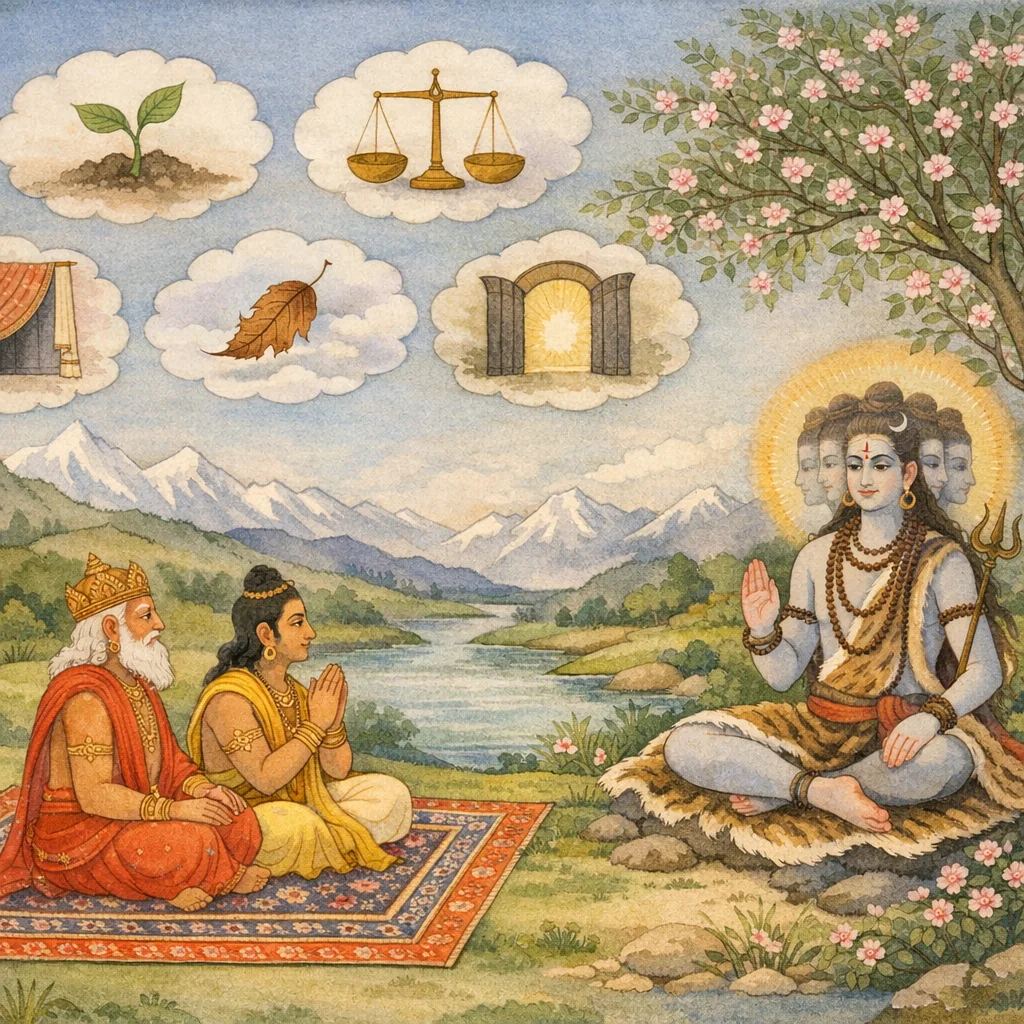
पञ्चकृत्यलक्षणनिर्णयः (Definition of Śiva’s Five Cosmic Acts—Pañcakṛtya)
This chapter is a doctrinal dialogue in which Brahmā and Viṣṇu ask Śiva for a precise definition (lakṣaṇa) of the pañcakṛtya, Śiva’s five cosmic acts. Śiva gives an esoteric clarification: sṛṣṭi (creation), sthiti (maintenance), saṃhāra (dissolution), tirobhāva (concealment/veiling), and anugraha (grace). Each is defined in turn—creation as the beginning of saṃsāra’s expansion, maintenance as its establishment, dissolution as the crushing and withdrawal of manifestation, concealment as the principle that occludes truth, and grace as mokṣa itself. The chapter then correlates these functions with the five elements (earth, water, fire, air, space), offering a cosmological-ritual mapping by which the elements are read as signs of Śiva’s agency. Finally, it provides an iconographic-theological rationale: Śiva’s five faces are said to bear these five acts, with hints of delegated roles (e.g., creation and maintenance granted through tapas) while affirming Śiva as the ultimate source.
Shlokas
Verse 1
ब्रह्मविष्णू ऊचतुः । सर्गादिपंचकृत्यस्य लक्षणं ब्रूहि नौ प्रभो । शिव उवाच । मत्कृत्यबोधनं गुह्यं कृपया प्रब्रवीमि वाम्
Brahmā and Viṣṇu said: “O Lord, tell us the defining characteristics of the five acts, beginning with creation.” Śiva replied: “Out of compassion, I shall explain to you both this secret teaching that illumines My divine acts.”
Verse 2
सृष्टिः स्थितिश्च संहारस्तिरोभावोऽप्यनुग्रहः । पंचैव मे जगत्कृत्यं नित्यसिद्धमजाच्युतौ
Creation, preservation, dissolution, concealment, and grace—these five alone are My cosmic acts with regard to the universe; I, the Unborn and the Imperishable, accomplish them eternally.
Verse 3
सर्गः संसारसंरंभस्तत्प्रतिष्ठा स्थितिर्मता । संहारो मर्दनं तस्य तिरोभावस्तदुत्क्रमः
Creation is the bringing forth of worldly existence; its establishment is known as sustenance. Dissolution is the crushing— the withdrawal of that manifested world; and concealment (tirobhāva) is its veiling, its retreat from clear manifestation.
Verse 4
तन्मोक्षोऽनुग्रहस्तन्मे कृत्यमेवं हि पंचकम् । कृत्यमेतद्वहत्यन्यस्तूष्णीं गोपुरबिंबवत्
That final act is liberation—My grace (anugraha). Thus, this indeed is My fivefold divine activity. Another power, like the silent reflection of a gateway-tower (gopura), merely bears this action without truly acting.
Verse 5
सर्गादि यच्चतुष्कृत्यं संसारपरिजृंभणम् । पंचमं मुक्तिहेतुर्वै नित्यं मयि च सुस्थिरम्
That fourfold activity beginning with creation—by which the expanse of saṃsāra unfolds—is taught; and the fifth, indeed, is the cause of liberation: to be forever firmly established in Me (Śiva).
Verse 6
तदिदं पंचभूतेषु दृश्यते मामकैर्जनैः । सृष्टिर्भूमौ स्थितिस्तोये संहारः पावके तथा
This very principle is perceived by My devotees within the five great elements: creation in earth, preservation in water, and dissolution likewise in fire.
Verse 7
तिरोभावोऽनिले तद्वदनुग्रह इहाम्बरे । सृज्यते धरया सर्वमद्भिः सर्वं प्रवर्द्धते
In the element of wind is seen the power of concealment (tirobhāva); likewise, in the sky is seen the power of grace (anugraha). By the earth all things are brought forth, and by the waters everything is nourished and made to flourish.
Verse 8
अर्द्यते तेजसा सर्वं वायुना चापनीयते । व्योम्नानुगृह्यते सर्वं ज्ञेयमेवं हि सूरिभिः
By fire (tejas) all things are warmed and brought to ripeness; by wind they are borne along and set in motion; by space (vyoman) all things are received and upheld—thus indeed is it to be understood by the wise.
Verse 9
पंचकृत्यमिदं वोढुं ममास्ति मुखपंचकम् । चतुर्दिक्षु चतुर्वक्त्रं तन्मध्ये पंचमं मुखम्
To uphold this fivefold divine activity, I possess five faces. Four faces are set toward the four directions, and in their midst abides the fifth face.
Verse 10
इति श्रीशिवमहापुराणे विद्येश्वरसंहितायां दशमोऽध्यायः
Thus ends the tenth chapter in the Vidyeśvara Saṃhitā of the Śrī Śiva Mahāpurāṇa.
Verse 11
तथा रुद्र महेशाभ्यामन्यत्कृत्यद्वयं परम् । अनुग्रहाख्यं केनापि लब्धुं नैव हि शक्यते
Likewise, apart from Rudra and Maheśa, no one at all can obtain that supreme twofold divine function known as anugraha—grace.
Verse 12
तत्सर्वं पौर्विकं कर्म युवाभ्यां कालविस्मृतम् । न तद्रुद्र महेशाभ्यां विस्मृतं कर्म तादृशम्
All those ancient deeds have, for you two, been forgotten through the passage of time; but for Rudra and Maheśa, no such deed is ever forgotten.
Verse 13
रूपे वेशे च कृत्ये च वाहने चासने तथा । आयुधादौ च मत्साम्यमस्माभिस्तत्कृते कृतम्
In form, in attire, in deeds, and likewise in mount and seat, and even in weapons and the rest—by us, for his sake, a likeness to Me has been fashioned.
Verse 14
मद्ध्यानविरहाद्वत्सौ मौढ्यं वामेवमागतम् । मज्ज्ञाने सति नैवं स्यान्मानं रूपे महेशवत्
O dear children, because you have become separated from meditation upon Me, this delusion has arisen in you. If the true knowledge of Me were present, such pride in form would not occur—as though one were Maheshvara Himself.
Verse 15
तस्मान्मज्ज्ञानसिद्ध्यर्थं मंत्रमओंकारनामकम् । इतः परं प्रजपतं मामकं मानभंजनम्
Therefore, for the attainment of knowledge of Me, you should henceforth recite the mantra called Oṁkāra—My own mantra—which shatters pride (ego) and brings the soul toward liberation.
Verse 16
उपादिशं निजं मंत्रमओंकारमुरुमंगलम् । ओंकारो मन्मुखाज्जज्ञे प्रथमं मत्प्रबोधकः
I instructed him in My own mantra—Oṃkāra, the supremely auspicious sound. That Oṃkāra was first born from My mouth, as the primal awakener of knowledge concerning Me.
Verse 17
वाचकोऽयमहं वाच्यो मंत्रोऽयं हि मदात्मकः । तदनुस्मरणं नित्यं ममानुस्मरणं भवेत्
“I myself am the utterer, and I am also the One to be expressed; this mantra is indeed of My very essence. Therefore, constant recollection of this becomes, in truth, recollection of Me.”
Verse 18
अकार उत्तरात्पूर्वमुकारः पश्चिमाननात् । मकारो दक्षिणमुखाद्बिंदुः प्राण्मुखतस्तथा
The syllable “A” is to be contemplated from the northern side, facing the east; the syllable “U” from the western face; the syllable “M” from the southern face; and likewise the bindu (the nasal point of Oṃ) from the eastern face. Thus one should meditate upon the Praṇava in the Liṅga’s directional faces.
Verse 19
नादो मध्यमुखादेवं पंचधाऽसौ विजृंभितः । एकीभूतः पुनस्तद्वदोमित्येकाक्षरो भवेत्
Thus, the primordial sound (nāda), issuing from the middle mouth, expands in fivefold form. When it again becomes unified, it becomes the single imperishable syllable, “Oṃ.”
Verse 20
नामरूपात्मकं सर्वं वेदभूतकुलद्वयम् । व्याप्तमेतेन मंत्रेण शिवशक्त्योश्च बोधकः
All that consists of name and form—indeed the two Vedic lineages (sound and meaning)—is pervaded by this mantra; and it is the revealer of Śiva and Śakti.
Verse 21
अस्मात्पंचाक्षरं जज्ञे बोधकं सकलस्यतत् । आकारादिक्रमेणैव नकारादियथाक्रमम्
From this arose the five-syllabled mantra (Pañcākṣara), which reveals the truth of all tattvas. It should be understood in the proper sequence—beginning with “ā” and then, in due order, from “na”, according to the mantra’s syllabic progression.
Verse 22
अस्मात्पंचाक्षराज्जाता मातृकाः पंचभेदतः । तस्माच्छिरश्चतुर्वक्त्रात्त्रिपाद्गाय त्रिरेव हि
From this five-syllabled mantra arise the Mātrikā letters in five distinct divisions. From that same sacred source also comes the Gāyatrī—three-footed indeed—proceeding from the four-faced Brahmā.
Verse 23
वेदः सर्वस्ततो जज्ञे ततो वै मंत्रकोटयः । तत्तन्मंत्रेण तत्सिद्धिः सर्वसिद्धिरितो भवेत्
From Him, indeed, the entire Veda was born; from that, verily, arose crores of mantras. By each specific mantra, its corresponding attainment is accomplished—thus, from this mantra-discipline, every kind of spiritual accomplishment may arise.
Verse 24
अनेन मंत्रकंदेन भोगो मोक्षश्च सिद्ध्यति । सकला मंत्रराजानः साक्षाद्भोगप्रदाः शुभाः
By this very core of mantra, both worldly enjoyment (bhoga) and liberation (mokṣa) are accomplished. Indeed, all sovereign mantras are auspicious and directly bestow enjoyments, when grounded in Śiva’s grace and in right worship.
Verse 25
नंदिकेश्वर उवाच । पुनस्तयोस्तत्र तिरः पटं गुरुः प्रकल्प्य मंत्रं च समादिशत्परम् । निधाय तच्छीर्ष्णि करांबुजं शनैरुदण्मुखं संस्थितयोः सहांबिकः
Nandikeśvara said: Then again, the Guru arranged a curtain between the two and imparted to them the supreme mantra. Placing his lotus-hand gently upon their head, he caused them—together with Ambikā—to stand facing north.
Verse 26
त्रिरुच्चार्याग्रहीन्मंत्रं यंत्रतंत्रोक्तिपूर्वकम् । शिष्यौ च तौ दक्षिणायामात्मानं च समर्पयत्
After uttering the mantra three times, he duly received it in accordance with the injunctions of yantra and tantra. Then, placing those two disciples to his right, he surrendered himself as well, in humble dedication.
Verse 27
प्रबद्धहस्तौ किल तौ तदंतिके तमेव देवं जगतुर्जगद्गुरुम्
With hands joined in reverence, the two then approached Him alone— that very Lord, the God of the world and the Guru of the universe.
Verse 28
ब्रह्माच्युतावूचतुः । नमो निष्कलरूपाय नमो निष्कलतेजसे । नमः सकलनाथाय नमस्ते सकलात्मने
Brahmā and Acyuta (Viṣṇu) said: “Salutations to You whose form is partless (niṣkala), salutations to You whose radiance is partless. Salutations to You, the Lord of all that has parts (sakala), and salutations to You, the very Self within all that is manifest.”
Verse 29
नमः प्रणववाच्याय नमः प्रणवलिंगिने । नमः सृष्ट्यादिकर्त्रे च नमः पंचमुखायते
Salutations to Him who is denoted by the Pranava (Om). Salutations to Him whose very emblem is the Pranava, the Linga. Salutations to the Lord who initiates creation and all beginnings. Salutations to the Five-faced One.
Verse 30
पंचब्रह्मस्वरूपाय पंच कृत्यायते नमः । आत्मने ब्रह्मणे तुभ्यमनंतगुणशक्तये
Salutations to You whose very form is the Five Brahmas, and who preside over the five divine acts. Salutations to You—the Supreme Self and the Absolute Brahman—endowed with endless qualities and powers.
Verse 31
सकलाकलरूपाय शंभवे गुरवे नमः । इति स्तुत्वा गुरुं पद्यैर्ब्रह्मा विष्णुश्च नेमतुः
Salutations to Śambhu, the Guru, whose nature is both with parts (manifest) and without parts (transcendent). Having thus praised the Guru with verses, Brahmā and Viṣṇu bowed down.
Verse 32
ईश्वर उवाच । वत्सकौ सर्वतत्त्वं च कथितं दर्शितं च वाम् । जपतं प्रणवं मंत्रं देवीदिष्टं मदात्मकम्
Īśvara said: “O dear sons, I have explained to you and also shown you the entire truth (tattva). Now repeat the Pranava—‘Om’—the mantra prescribed by the Goddess, which is of My very essence.”
Verse 33
ज्ञानं च सुस्थिरं भाग्यं सर्वं भवति शाश्वतम् । आद्रा र्यां च चतुर्दश्यां तज्जाप्यं त्वक्षयं भवेत्
Knowledge and well-established good fortune become enduring. And on the fourteenth lunar day (caturdaśī) under the Ārdrā nakṣatra, the repetition (japa) of that mantra becomes imperishable in its merit.
Verse 34
सूर्यगत्या महाद्रा र्यामेकं कोटिगुणं भवेत् । मृगशीर्षांतिमो भागः पुनर्वस्वादिमस्तथा
By the Sun’s course, within the great sequence of time-divisions, a single unit becomes magnified a koṭi-fold. The final portion of Mṛgaśīrṣa is declared, and likewise the beginning portion of Punarvasu as well.
Verse 35
आद्रा र्समः सदा ज्ञेयः पूजाहोमादितर्पणे । दर्शनं तु प्रभाते च प्रातःसंगवकालयोः
For pūjā, homa, and tarpaṇa, one should always understand the ritually fit time to be the cool, moist period. But for the auspicious darśana of Śiva, the suitable times are in the morning—at early dawn and during the forenoon.
Verse 36
चतुर्दशी तथा ग्राह्या निशीथव्यापिनी भवेत् । प्रदोषव्यापिनी चैव परयुक्ता प्रशस्यते
The fourteenth lunar day (Caturdaśī) is to be observed when it extends into the midnight period (niśītha). Likewise, that Caturdaśī which also pervades the pradoṣa time and is joined with the higher, more spiritually efficacious condition is especially praised.
Verse 37
लिंगं बेरं च मेतुल्यं यजतां लिंगमुत्तमम् । तस्माल्लिंगं परं पूज्यं बेरादपि मुमुक्षुभिः
To Me, the Liṅga and the consecrated icon (bera) are alike as objects of worship; yet for worshippers, worship of the Liṅga is the highest. Therefore, for those who seek liberation, the Liṅga is supremely worthy of worship—even more than the icon.
Verse 38
लिंगमओंकारमंत्रेण बेरं पंचाक्षरेण तु । स्वयमेव हि सद्द्रव्यैः प्रतिष्ठाप्यं परैरपि
The Liṅga is to be installed with the Oṁkāra mantra, while the sacred icon (bera) is to be installed with the Pañcākṣarī. Indeed, the consecration should be performed with pure and proper substances—whether one does it oneself or has it done by others.
Verse 39
पूजयेदुपचारैश्च मत्पदं सुलभं भवेत् । इति शास्य तथा शिष्यौ तत्रैवांऽतर्हितः शिवः
“Let him worship with the prescribed offerings; then My state—My abode of liberation—becomes easily attainable.” Having thus instructed the two disciples, Śiva vanished from that very spot.
Frequently Asked Questions
It argues that the universe is governed by a unified fivefold divine operation (pañcakṛtya) belonging to Śiva, culminating not in cosmology alone but in soteriology: anugraha is explicitly identified with mokṣa.
The chapter encodes doctrine through correspondences: the pañcabhūtas are read as visible indices of Śiva’s five operations, and the mukha-pañcaka functions as an iconographic schema that ‘carries’ these acts—turning cosmology and image-theology into a single interpretive grid.
Śiva is highlighted as the five-faced (mukha-pañcaka) Lord whose faces correspond to the pañcakṛtya; the emphasis is less on a narrative avatāra and more on a doctrinal form that explains how Śiva’s agency is articulated in the cosmos.