पिप्पलाद-मुनिना पद्मा-विवाहः (Pippalāda’s Marriage to Padmā and the Establishment of Dharma)
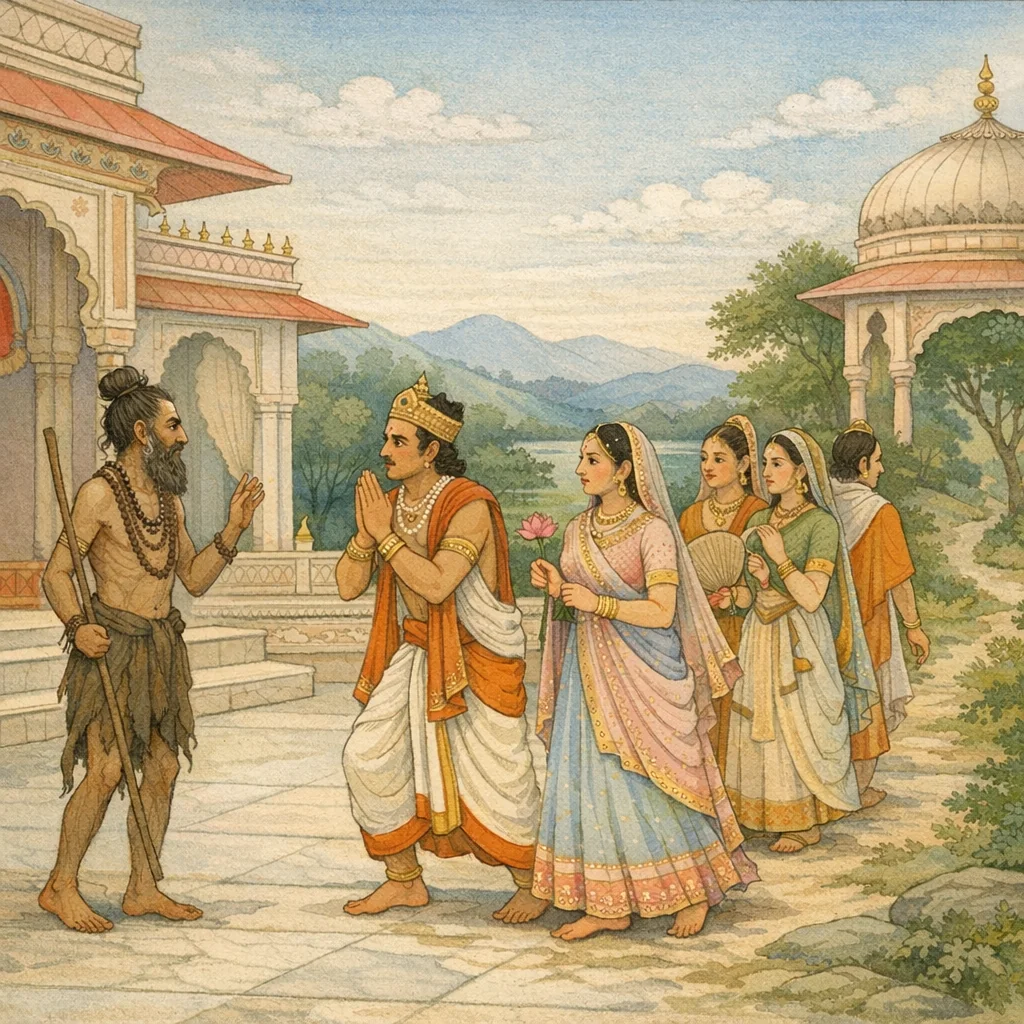
This chapter is framed as Nandīśvara’s discourse, declaring the episode to be Śiva’s mahālīlā undertaken to stabilize dharma and the world’s order (lokavyavasthā). The ascetic sage Pippalāda, blazing with formidable tapas-tejas, encounters the captivating maiden Padmā, said to bear a share of Śiva (śivāṃśā), and seeks her in marriage. He approaches her father, King Anaraṇya, who receives him with ritual hospitality such as madhuparka, yet falls silent in fear when the sage demands the girl. Pippalāda presses the demand with a threat to reduce all to ashes (bhasmasāt) if refused, showing how ascetic power functions as a coercive, world-ordering force in Purāṇic ethics. Overwhelmed, the king yields and offers the adorned Padmā to the aged sage; the marriage is performed and they return to the āśrama. The implied esoteric teaching is that dharma is not mere social convention: upheld by Śiva’s governance, tapas, destiny, and divine presence within beings reshape worldly hierarchies and compel alignment with cosmic law.
Shlokas
Verse 1
नन्दीश्वर उवाच । अथ लोके व्यवस्थाय धर्मस्य स्थापनेच्छया । महालीलां चकारेशस्तामहो सन्मुने शृणु
Nandīśvara said: Then, desiring to establish dharma and set the world in proper order, the Lord performed a great divine līlā. O noble sage, listen to that wondrous account.
Verse 2
एकदा पुष्पभद्रायां स्नातुं गच्छन्मुनीश्वरः । ददर्श पद्मां युवतीं शिवांशां सुमनोहराम्
Once, as the lordly sage was going to bathe at Puṣpabhadrā, he beheld Padmā—a young maiden, exceedingly enchanting, who bore a portion of Śiva’s divine power.
Verse 3
तल्लिप्सुस्तत्पितुः स्थानमनरण्यस्य भूपतेः । जगाम भुवनाचारी लोकतत्त्वविचक्षणः
Desiring to obtain her, he went to the abode of his father—the king Anaraṇya. A traveler of the worlds and a discerning knower of the principles governing life and society, he set forth there.
Verse 4
राजा नराणां तं दृष्ट्वा प्रणम्य च भयाकुलः । मधुपर्कादिकं दत्त्वा पूजयामास भक्तितः
Seeing Him, the king of men bowed down, his heart trembling with awe. Offering madhuparka and other honoring gifts, he worshipped with devoted faith.
Verse 5
स्नेहात्सर्वं गृहीत्वा स ययाचे कन्यकां मुनिः । मौनी बभूव नृपतिः किंचिन्निर्वक्तुमक्षमः
Out of affection, the sage accepted everything and then asked for the maiden. The king fell silent, unable to utter even a single word.
Verse 6
मुनिः प्रोवाच नृपतिं कन्यां मे देहि भक्तितः । अन्यथा भस्मसात्सर्वं करिष्येहं त्वया सह
The sage said to the king: “Give me your daughter with devoted reverence. Otherwise, along with you, I shall reduce everything here to ashes.”
Verse 7
अथो बभूवुराच्छन्नाः सर्वे राजजनास्तदा । तेजसा पिप्पलादस्य दाधीचस्य महामुने
Then, O great sage, all the king’s attendants were at once covered over—overpowered by the radiance of Pippalāda, the illustrious son of Dadhīci.
Verse 8
अथ राजा महाभीतो विलप्य च मुहुर्मुहुः । कन्यामलंकृताम्पद्मां वृद्धाय मुनये ददौ
Then the king, seized by great fear, lamented again and again; and he gave the maiden Padmā—adorned with ornaments—to the aged sage.
Verse 9
पद्मां विवाह्य स मुनिश्शिवांशाम्भूपतेः सुताम् । पिप्पलादो गृहीत्वा तां मुदितः स्वाश्रमं ययौ
Having married Padmā—the daughter of King Śivāṃśa, who bore a portion of Śiva—sage Pippalāda took her with him and joyfully returned to his own hermitage.
Verse 10
तत्र गत्वा मुनिवरो वयसा जर्जरोधिकः । उवाच नार्या स तया तपस्वीनातिलम्पटः
Having gone there, the excellent sage—greatly bent and worn by age—spoke to that woman. He was an ascetic, not given to lustful conduct.
Verse 11
अथोऽनरण्यकन्या सा सिषेवे भक्तितो मुनिम् । कर्मणा मनसा वाचा लक्ष्मीर्नारायणं यथा
Then that maiden of the forest devotedly attended upon the sage—by her actions, by her mind, and by her speech—just as Lakṣmī serves Nārāyaṇa.
Verse 12
इत्थं स पिप्पलादो हि शिवांशो मुनिसत्तमः । रेमे तया युवत्या च युवाभूय स्वलीलया
Thus, Pippalāda—an exalted sage and a manifestation of Śiva’s own portion—became youthful again by his divine play, and delighted with that young woman, enjoying her company.
Verse 13
दश पुत्रा महात्मानो बभूवुस्सुतपस्विनः । मुनेः पितुस्समाः सर्वे पद्मायाः सुखवर्द्धनाः
Ten sons were born—great-souled and rich in austere merit. All of them were equal to their sage-father in virtue, and they became increasers of Padmā’s joy and well-being.
Verse 14
एवं लीलावतारो हि शंकरस्य महाप्रभोः । पिप्पलादो मुनिवरो नानालीलाकरः प्रभुः
Thus, Pippalāda—the excellent sage—was indeed a divine play-incarnation (līlā-avatāra) of Śaṅkara, the Great Lord, the sovereign who performs many wondrous līlās.
Verse 15
येन दत्तो वरः प्रीत्या लोकेभ्यो हि दयालुना । दृष्ट्वा लोके शनेः पीडां सर्वेषामनिवारिणीम्
He—compassionate and gracious—bestowed a boon with delight upon the worlds, after seeing in the world the affliction caused by Śani, an unavoidable torment that befalls all.
Verse 16
षोडशाब्दावधि नृणां जन्मतो न भवेच्च सा । तथा च शिवभक्तानां सत्यमेतद्धि मे वचः
From birth up to the age of sixteen, full accountability for sin does not arise in human beings; and so it is also for the devotees of Śiva. This indeed is my truthful word.
Verse 17
अथानादृत्य मद्वाक्यं कुर्यात्पीडां शनिः क्वचित् । तेषां नृणां तदा स स्याद्भस्मसान्न हि संशयः
But if, disregarding my instruction, Śani should at any time inflict torment, then for those men he will become like ashes and chaff—of this there is no doubt.
Verse 18
इति तद्भयतस्तात विकृतोपि शनैश्चरः । तेषां न कुरुते पीडां कदाचिद्ग्रहसत्तमः
Thus, O dear one, even Śanaiścara (Saturn)—though fierce in form—out of that fear does not at any time cause affliction to them; for he is the foremost among the grahas.
Verse 19
इति लीलामनुष्यस्य पिप्पलादस्य सन्मुने । कथितं सुचरित्रन्ते सर्वकामफलप्रदम्
Thus, O noble sage, I have narrated to you the excellent sacred account of Pippalāda—Śiva’s playful human manifestation—which bestows the fruits of all righteous desires.
Verse 20
गाधिश्च कौशिकश्चैव पिप्पलादो महामुनिः । शनैश्चरकृतां पीडां नाशयन्ति स्मृतास्त्रयः
Gādhi, Kauśika, and the great sage Pippalāda—these three, when remembered, destroy the affliction brought about by Śanaiścara (Saturn).
Verse 21
पिप्पलादस्य चरितं पद्माचरितसंयुतम् । यः पठेच्छृणुयाद्वापि सुभक्त्या भुवि मानवः
Whoever on earth, with true devotion, reads or even listens to this sacred account of Pippalāda—together with the narrative of Padma—receives its holy fruit and merit.
Verse 22
शनिपीडाविनाशार्थमेतच्चरितमुत्तमम् । यः पठेच्छणुयाद्वापि सर्वान्कामानवाप्नुयात्
This excellent sacred account is meant to destroy the afflictions of Śani (Saturn). Whoever recites it—or even listens to it—attains all desired aims through Śiva’s grace.
Verse 23
धन्यो मुनिवरो ज्ञानी महाशैवः सताम्प्रियः । अस्य पुत्रो महेशानः पिप्पलादाख्य आत्मवान्
Blessed is that foremost sage—wise, a great devotee of Śiva, and beloved of the virtuous. His son is Maheśāna, self-possessed and renowned by the name Pippalāda.
Verse 24
इदमाख्यानमनघं स्वर्ग्यं कुग्रहपोषहृत् । सर्वकामप्रदन्तात शिवभक्तिविवर्द्धनम्
This spotless sacred narrative bestows heaven; it removes the afflictions fostered by evil planetary influences. It grants all rightful desires, bestows gifts, and increases devotion to Lord Śiva.
Verse 25
इति श्रीशिवमहापुराणे तृतीयायां शतरुद्रसंहितायां पिप्पलादावतारचरितवर्णनं नाम पंचविंशोऽध्यायः
Thus ends the twenty-fifth chapter, entitled “The Description of the Life and Deeds of the Incarnation Pippalāda,” in the third section of the Śrī Śiva Mahāpurāṇa, in the Śatarudra Saṃhitā.
Frequently Asked Questions
Nandīśvara narrates a dharma-stabilizing līlā in which the ascetic Pippalāda seeks and marries Padmā (described as śivāṃśā), compelling King Anaraṇya’s compliance; the episode argues that worldly order is subordinated to Śiva’s providence expressed through tapas-born authority.
The chapter uses tejas (ascetic radiance) and the threat of bhasmasāt (reduction to ash) as symbols of Rudra’s purifying sovereignty: tapas is not merely personal austerity but a cosmic force that burns adharmic resistance, while śivāṃśa indicates divine immanence guiding events beyond ordinary social calculus.
Rather than an explicit iconographic form, the chapter highlights Śiva’s operative presence as īśa orchestrating mahālīlā and as immanence (śivāṃśa) within Padmā, signaling divine agency working through human actors to re-establish dharma.