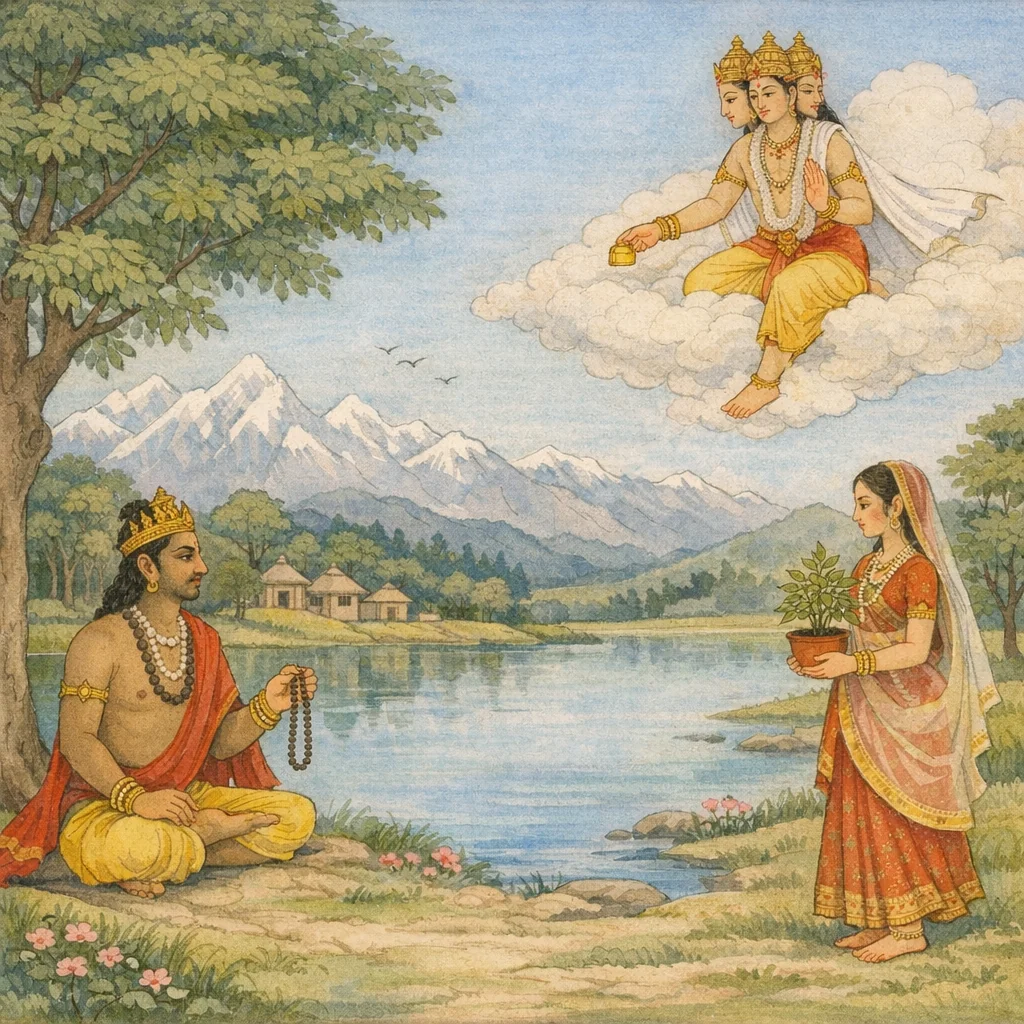
शङ्खचूडकृततपः—ब्रह्मवरकवचप्राप्तिः / Śaṅkhacūḍa’s Austerity—Brahmā’s Boon and the Bestowal of the Kavaca
Sanatkumāra recounts Śaṅkhacūḍa’s disciplined austerity at Puṣkara, undertaken on Jaigīṣavya’s instruction. Having received brahma-vidyā from his guru, he performs japa with restrained senses and a concentrated mind. Brahmā, the preceptor of Brahmaloka, appears to grant a boon and bids the dānava-lord choose his desire. Śaṅkhacūḍa bows, praises Brahmā, and asks for invincibility against the devas; Brahmā gladly assents. He also bestows the divine protective armour/mantra-text, the Śrīkṛṣṇakavaca, famed as universally auspicious and victory-giving. Brahmā then commands him to go to Badarī with Tulasī and solemnize marriage there, declaring her the daughter of Dharmadhvaja. Brahmā vanishes; Śaṅkhacūḍa, successful in tapas, dons the kavaca and hastens to Badarikāśrama to fulfill the command, setting the stage for the ensuing conflict and its moral consequences.
Shlokas
Verse 1
सनत्कुमार उवाच । ततश्च शंखचूडोऽसौ जैगीषव्योपदेशतः । ततश्चकार सुप्रीत्या ब्रह्मणः पुष्करे चिरम्
Sanatkumāra said: Thereafter, that Śaṅkhacūḍa, following Jaigīṣavya’s instruction, for a long time performed with great devotion the worship of Brahmā at Puṣkara.
Verse 2
गुरुदत्तां ब्रह्मविद्यां जजाप नियतेन्द्रियः । स एकाग्रमना भूत्वा करणानि निगृह्य च
With his senses disciplined, he repeated the Brahma-vidyā—the liberating knowledge and mantra bestowed by his guru; becoming one-pointed in mind, he restrained the instruments of action and perception as well.
Verse 3
तपंतं पुष्करे तं वै शंखचूडं च दानवम् । वरं दातुं जगामाशु ब्रह्मालोकगुरुर्विभुः
Seeing the Dānava Śaṅkhacūḍa performing austerities at Puṣkara, the mighty Lord Brahmā—revered as the preceptor of Brahmaloka—quickly went there to grant him a boon.
Verse 4
वरं ब्रूहीति प्रोवाच दानवेन्द्रं विधिस्तदा । स दृष्ट्वा तं ननामाति नम्रस्तुष्टाव सद्गिरा
Then Vidhī (Brahmā) spoke to the lord of the Dānavas, saying, “Ask for a boon.” Seeing him, the Dānava-king bowed down in reverence and, humbled, praised him with noble words.
Verse 5
वरं ययाचे ब्रह्माणमजेयत्वं दिवौकसाम् । तथेत्याह विधिस्तं वै सुप्रसन्नेन चेतसा
He asked Brahmā for a boon—invincibility against the gods. Vidhī (Brahmā), his heart fully pleased, replied, “So be it,” and granted it.
Verse 6
श्रीकृष्णकवचं दिव्यं जगन्मंगलमंगलम् । दत्तवाञ्शंखचूडाय सर्वत्र विजयप्रदम्
He bestowed upon Śaṅkhacūḍa the divine Śrī-Kṛṣṇa kavaca, the supreme auspiciousness for all the worlds, granting him victory everywhere.
Verse 7
बदरीं संप्रयाहि त्वं तुलस्या सह तत्र वै । विवाहं कुरु तत्रैव सा तपस्यति कामतः
“Go at once to Badarī together with Tulasī. Perform the marriage rite there itself, for she is practicing tapas there, intent on fulfilling her cherished desire.”
Verse 8
धर्मध्वजसुता सेति संदिदेश च तं विधिः । अन्तर्धानं जगामाशु पश्यतस्तस्य तत्क्षणात्
Brahmā (Vidhi) instructed him, saying, “She is Dharmadhvaja’s daughter.” Then, in that very moment—before his eyes—Brahmā swiftly vanished from sight.
Verse 9
ततस्स शंखचूडो हि तपःसिद्धोऽतिपुष्करे । गले बबंध कवचं जगन्मंगलमंगलम्
Then Śaṅkhacūḍa, empowered by the fruition of his tapas, joyfully fastened upon his neck that kavaca, supremely auspicious and a source of welfare for the worlds.
Verse 10
आज्ञया ब्राह्मणस्सोऽपि तपःसिद्धमनोरथः । समाययौ प्रहृष्टास्यस्तूर्णं बदरिकाश्रमम्
Obeying the command, that brāhmaṇa too—his cherished aim fulfilled through the power of tapas—set out at once for the Badarī hermitage, his face radiant with joy.
Verse 11
यदृच्छयाऽऽगतस्तत्र शंखचूडश्च दानवः । तपश्चरन्ती तुलसी यत्र धर्मध्वजात्मजा
By chance, the Dānava named Śaṅkhacūḍa arrived there—at the very place where Tulasī, the daughter of Dharmadhvaja, was engaged in austerities (tapas).
Verse 12
सुरूपा सुस्मिता तन्वी शुभभूषणभूषिता । सकटाक्षं ददर्शासौ तमेव पुरुषं परम्
Beautiful in form, gently smiling, slender, and adorned with auspicious ornaments, she cast a sidelong glance and beheld Him alone—the Supreme Person (Puruṣa).
Verse 13
दृष्ट्वा तां ललिता रम्यां सुशीलां सुन्दरीं सतीम् । उवास तत्समीपे तु मधुरं तामुवाच सः
Seeing that graceful Sati—charming, gentle-natured, and beautiful—he remained seated near her and spoke to her in sweet words.
Verse 14
शंखचूड उवाच । का त्वं कस्य सुता त्वं हि किं करोषि स्थितात्र किम् । मौनीभूता किंकरं मां संभावितुमिहार्हसि
Śaṅkhacūḍa said: “Who are you? Whose daughter are you? Why are you standing here, and what are you doing? Having become silent, how is it that you deem me—your servant—to be worthy of being addressed here?”
Verse 15
सनत्कुमार उवाच । इत्येवं वचनं श्रुत्वा सकामं तमुवाच सा
Sanatkumāra said: Hearing his words spoken in that manner, she then addressed him—who was still moved by desire.
Verse 16
तुलस्युवाच । धर्मध्वजसुताहं च तपस्यामि तपस्विनी । तपोवने च तिष्ठामि कस्त्वं गच्छ यथासुखम्
Tulasī said: “I am the daughter of Dharmadhvaja, a woman devoted to austerity. I practice penance and dwell here in this forest of tapas. Who are you? Go on your way, as you please.”
Verse 17
नारीजातिर्मोहिनी च ब्रह्मादीनां विषोपमा । निन्द्या दोषकरी माया शृंखला ह्यनुशायिनाम्
The female-kind is delusive even to Brahmā and the other gods—like poison in its effect. It is censurable, a cause of faults; a manifestation of māyā, and indeed a chain for those who remain bound to latent passions.
Verse 18
सनत्कुमार उवाच । इत्युक्त्वा तुलसी तं च सरसं विरराम ह । दृष्ट्वा तां सस्मितां सोपि प्रवक्तुमुपचक्रमे
Sanatkumāra said: Having spoken thus, Tulasī ceased her sweet and graceful words. Seeing her smiling, he too then began to speak.
Verse 19
शंखचूड उवाच । त्वया यत्कथितं देवि न च सर्वमलीककम् । किञ्चित्सत्यमलीकं च किंचिन्मत्तो निशामय
Śaṃkhacūḍa said: “O Goddess, what you have spoken is not wholly false. Some of it is true and some untrue; now hear something from me.”
Verse 20
पतिव्रताः स्त्रियो याश्च तासां मध्ये त्वमग्रणीः । न चाहं पापदृक्कामी तथा त्वं नेति धीर्मम
“Among all women devoted to their husbands, you are the foremost. I do not desire a sinful glance; my conviction is that you, too, are not of that kind.”
Verse 21
आगच्छामि त्वत्समीपमाज्ञया ब्रह्मणोऽधुना । गांधर्वेण विवाहेन त्वां ग्रहीष्यामि शोभने
“Now, by the command of Brahmā, I come into your presence. O lovely one, by a Gāndharva marriage I shall accept you as my wife.”
Verse 22
शंखचूडोऽहमेवास्मि देवविद्रावकारकः । मां न जानासि किं भद्रे न श्रुतोऽहं कदाचन
“I alone am Śaṅkhacūḍa, the one who puts the gods to flight. O fair one, do you not recognize me? Have you never even heard of me at any time?”
Verse 23
दनुवंश्यो विशेषेण मन्द पुत्रश्च दानवः । सुदामा नाम गोपोहं पार्षदश्च हरेः पुरा
“I am Sudāmā by name—a cowherd. In particular I belong to Danu’s lineage; I am the Dānava, the son of Manda. Formerly I was also an attendant (pārṣada) in the retinue of Lord Hari (Viṣṇu).”
Verse 24
अधुना दानवेन्द्रोऽहं राधिकायाश्च शापतः । जातिस्मरोऽहं जानामि सर्वं कृष्णप्रभावतः
“Now, by Rādhikā’s curse, I have become the lord of the Dānavas. Yet, through Kṛṣṇa’s divine power, I remember former births, and I know everything.”
Verse 25
सनत्कुमार उवाच । एवमुक्त्वा शंखचूडो विरराम च तत्पुरः । दानवेंद्रेण सेत्युक्ता वचनं सत्यमादरात् । सस्मितं तुलसी तुष्टा प्रवक्तुमुपचक्रमे
Sanatkumāra said: Having spoken thus, Śaṅkhacūḍa fell silent there. Then Tulasī—addressed by the lord of the Dānavas with the words “so be it”—honoured his truthful statement; pleased and smiling, she began to speak.
Verse 26
तुलस्युवाच । त्वयाहमधुना सत्त्वविचारेण पराजिता । स धन्यः पुरुषो लोके न स्त्रिया यः पराजितः
Tulasī said: “Just now, by your discerning judgment of truth and character, I have been defeated. Blessed indeed is that man in this world who is not overcome by a woman.”
Verse 27
सत्क्रियोप्यशुचिर्नित्यं स पुमान्यः स्त्रिया जितः । निन्दंति पितरो देवा मानवास्सकलाश्च तम्
Even if he performs the proper rites, the man who is conquered by a woman remains ever impure; the Pitṛs, the Devas, and all people censure him.
Verse 28
इति श्रीशिवमहापुराणे द्वितीयायां रुद्रसंहितायां पञ्चमे युद्धखण्डे शंखचूडतपःकरणविवाहवर्णनं नामाष्टविंशोऽध्यायः
Thus ends the twenty-eighth chapter, called “The Description of Śaṅkhacūḍa’s Austerities (tapas), their Performance, and his Marriage,” in the fifth section, the Yuddha-khaṇḍa, of the second part (Rudra-saṃhitā) of the Śrī Śiva Mahāpurāṇa.
Verse 29
शूद्रो मासेन शुध्येत्तु हीति वेदानुशासनम् । न शुचिः स्त्रीजितः क्वापि चितादाहं विना पुमान्
The Vedic injunction declares: “A Śūdra becomes purified after a month.” Yet a man conquered by lust for women is nowhere truly pure—unless he is reduced to ashes upon the funeral pyre.
Verse 30
न गृह्णतीच्छया तस्मात्पितरः पिण्डतर्पणम् । न गृह्णन्ति सुरास्तेन दत्तं पुष्पफलादिकम्
Therefore the Pitṛs do not willingly accept the piṇḍa-offerings and tarpaṇa libations made by him; likewise the Devas do not accept the flowers, fruits, and other offerings he presents.
Verse 31
तस्य किं ज्ञानसुतपो जपहोम प्रपूजनैः । विद्यया दानतः किं वा स्त्रीभिर्यस्य मनो हृतम्
What use are knowledge and austerities to him? What use are japa, homa, and elaborate worship? Of what avail are learning and charity, if his mind has been stolen away by women—by sense-pleasures and attachment?
Verse 32
विद्याप्रभावज्ञानार्थं मया त्वं च परीक्षितः । कृत्वा कांतपरीक्षां वै वृणुयात्कामिनी वरम्
To ascertain the true power and efficacy of your knowledge, I have tested you. Having thus examined the worthiness of a beloved, a woman should indeed choose an excellent husband.
Verse 33
सनत्कुमार उवाच । इत्येवं प्रवदंत्यां तु तुलस्यां तत्क्षणे विधिः । तत्राजगाम संसृष्टा प्रोवाच वचनं ततः
Sanatkumāra said: While Tulasī was speaking thus, at that very moment Vidhi (Brahmā), having been duly invoked, arrived there and then spoke these words.
Verse 34
ब्रह्मोवाच । किं करोषि शंखचूड संवादमनया सह । गांधर्वेण विवाहेन त्वमस्या ग्रहणं कुरु
Brahmā said: “O Śaṅkhacūḍa, why do you linger in long discourse with her? Accept her at once as your wife by a Gāndharva marriage, and take her hand without delay.”
Verse 35
त्वं वै पुरुषरत्नं च स्त्रीरत्नं च त्वियं सती । विदग्धाया विदग्धेन संगमो गुणवान् भवेत्
Truly, you are a jewel among men, and this Satī is a jewel among women. When a discerning woman is united with a discerning man, their union becomes virtuous indeed and rich in worthy fruit.
Verse 36
निर्विरोधं सुखं राजन् को वा त्यजति दुर्लभम् । योऽविरोधसुखत्यागी स पशुर्नात्र संशयः
O King, who would abandon that rare happiness which is free from conflict? He who gives up such untroubled joy is truly a paśu (a bound, unawakened being)—of this there is no doubt.
Verse 37
किं त्वं परीक्षसे कांतमीदृशं गुणिनं सति । देवानामसुराणां च दानवानां विमर्दकम्
O virtuous one, why do you test your beloved—such a noble and worthy man—who crushes alike the Devas, the Asuras, and the Dānavas?
Verse 38
अनेन सार्द्धं सुचिरं विहारं कुरु सर्वदा । स्थानेस्थाने यथेच्छं च सर्वलोकेषु सुन्दरि
“With him, ever delight in long companionship and free movement. O beautiful one, wander as you wish from place to place, through all the worlds.”
Verse 39
अंते प्राप्स्यति गोलोके श्रीकृष्णं पुनरेव सः । चतुर्भुजं च वैकुण्ठे मृते तस्मिंस्त्वमाप्स्यसि
In the end, he will again attain Śrī Kṛṣṇa in Goloka. And when that one departs, you will attain the four-armed Lord in Vaikuṇṭha.
Verse 40
सनत्कुमार उवाच । इत्येवमाशिषं दत्त्वा स्वालयं तु ययौ विधिः । गांधर्वेण विवाहेन जगृहे तां च दानवः
Sanatkumāra said: “Having thus bestowed his blessing, Vidhi (Brahmā) returned to his own abode. Then the Dānava took her as his wife by a Gāndharva marriage, by mutual consent.”
Verse 41
एवं विवाह्य तुलसीं पितुः स्थानं जगाम ह । स रेमे रमया सार्द्धं वासगेहे मनोरमे
Thus, having married Tulasī, he went to his father’s abode; and there, together with Ramā (Lakṣmī), he delighted in a charming residence.
Frequently Asked Questions
Śaṅkhacūḍa’s Puṣkara-austerity culminates in Brahmā granting him a boon (invincibility against the devas) and gifting the Śrīkṛṣṇakavaca, followed by the directive to marry Tulasī at Badarī.
It functions as a ritualized protection-and-victory mechanism (kavaca) that operationalizes boon-power through liturgy, indicating that dominance is mediated by sacred technologies, not merely by brute force.
Brahmā/Vidhi as boon-granter and cosmic legislator; the kavaca associated with Śrīkṛṣṇa as a protective divine potency; and the pilgrimage loci (Puṣkara, Badarī) as enacted sacred agencies shaping outcomes.