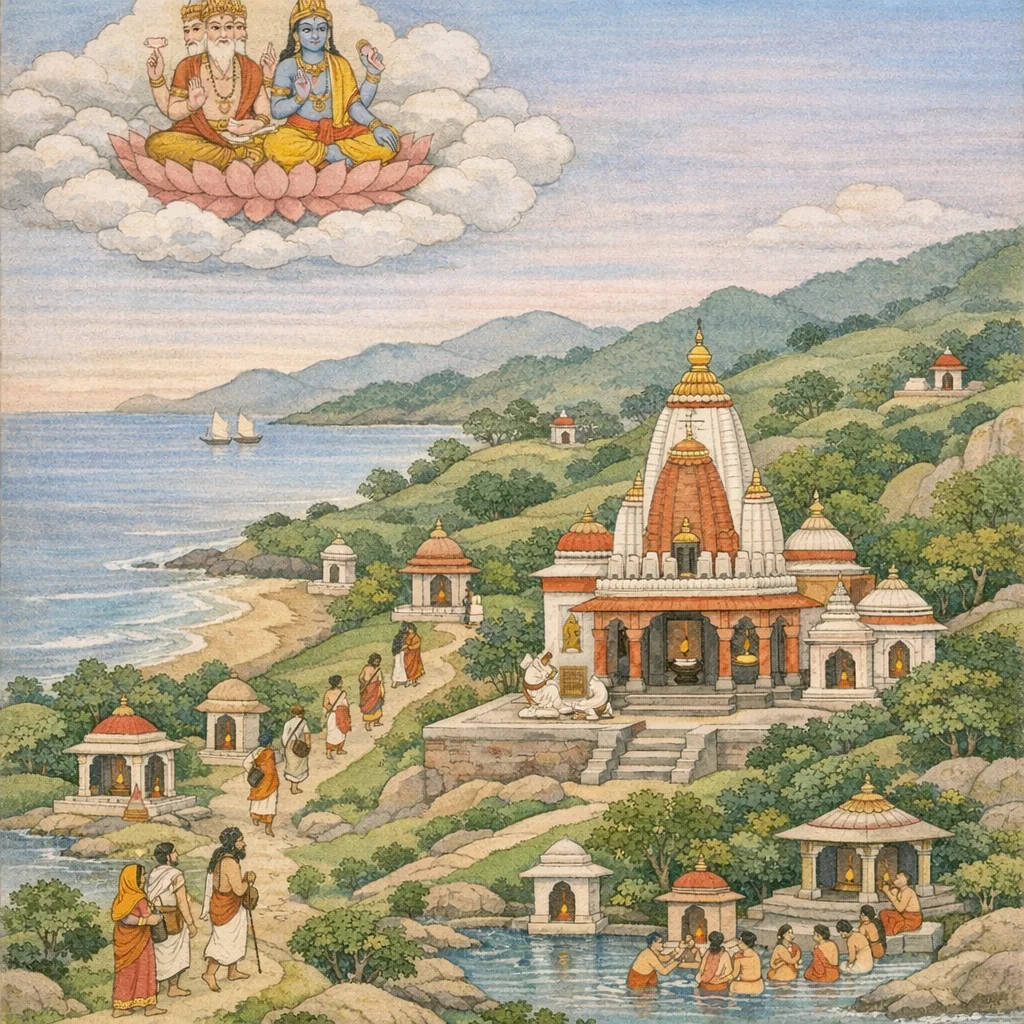
महाबलमाहात्म्यवर्णनम् (Mahābala Māhātmya-varṇanam) — “Account of the Greatness of Mahābala (and Western Sacred Liṅgas)”
In Sūta’s discourse to the dvijas, this chapter serves as an informational catalogue of renowned Śiva-liṅgas in the western direction (paścimā diś). It introduces a sacred installation connected with Kapilā-nagarī, known as Kālarāmeśvara, praised as a “mahā-divya” liṅga whose mere darśana removes sin. Śiva’s abiding presence there is affirmed under the name Mahābala, a beneficent establishment for the welfare of Brahmā, Viṣṇu, and other devas. The account then extends to the western sea-coast, naming Mahāsiddheśvara as a liṅga that grants dharma, artha, kāma, and also mokṣa, thus placing the full puruṣārtha scheme within sacred geography. Gokarṇa is exalted as an exemplary coastal kṣetra, said to destroy even grave sins such as brahmahatyā and to overflow with countless liṅgas and innumerable tīrthas “at every step.” The chapter concludes with a yuga-based description of colors (white/red-yellow/black), marking temporal variation in manifestation while maintaining the continuity of Śiva’s saving accessibility.
Shlokas
Verse 1
सूत उवाच । द्विजाः शृणुत सद्भक्त्या शिवलिंगानि तानि च । पश्चिमायां दिशायां वै यानि ख्यातानि भूतले
Sūta said: “O twice-born sages, listen with true devotion as I describe those sacred Śiva-liṅgas renowned upon the earth in the western direction.”
Verse 2
ब्रह्मविष्ण्वादिदेवानां शंकरो हित काम्यया । महाबलाभिधानेन देवः संनिहितस्सदा
For the welfare of Brahmā, Viṣṇu, and the other gods, Śaṅkara—desiring their good—ever remains present there as the Deity known by the name Mahābala.
Verse 3
पश्चिमे सागरे चैव महासिद्धेश्वरः स्मृतः । धर्मार्थकामदश्चैव तथा मोक्षप्रदोऽपि हि
In the western ocean, that (Jyotirliṅga) is remembered as Mahāsiddheśvara. It bestows dharma, artha, and kāma—and indeed it also grants mokṣa.
Verse 5
गोकर्णे शिवलिंगानि विद्यन्ते कोटिकोटिशः । असंख्यातानि तीर्थानि तिष्ठन्ति च पदेपदे
At Gokarṇa, Śiva-liṅgas exist in crores upon crores; and countless tīrthas stand there at every step.
Verse 6
बहुनात्र किमुक्तेन गोकर्णस्थानि सर्वशः । शिवप्रत्यक्षलिंगानि तीर्थान्यम्भांसि सर्वशः
What is the use of saying much here? Everywhere in Gokarṇa there are sacred sites—manifest Liṅgas of Śiva, visible directly—along with tīrthas, holy fords, and sanctifying waters in every direction.
Verse 7
गोकर्णे शिवलिंगानां तीर्थानामपि सर्वशः । वर्ण्यते महिमा तात पुराणेषु महर्षिभिः
O dear one, in Gokarṇa the glory of the Śiva-liṅgas and of all the sacred tīrthas is celebrated everywhere, as the great sages have described in the Purāṇas.
Verse 8
कृतेयुगे स हि श्वेतस्त्रेतायां सोतिलोहितः । द्वापरे पीतवर्णश्च कलौ श्यामो भविष्यति
In the Kṛta Yuga, He is indeed white in hue; in the Tretā Yuga, He becomes intensely red. In the Dvāpara Yuga, He is yellow in color; and in the Kali Yuga, He will be dark (śyāma).
Verse 9
आक्रान्तसप्तपातालकुहरोपि महाबलः । प्राप्ते कलियुगे घोरे मृदुतामुपयास्यति
Even that mighty one—able to overrun the cavernous depths of the seven Pātālas—when the dreadful Kali Yuga arrives, will grow softened and diminished.
Verse 10
महापातकिनश्चात्र समभ्यर्च्य महाबलम् । शिवलिंगं च गोकर्णे प्रयाताश्शांकरम्पदम्
Even those guilty of the gravest sins, having duly worshipped here the mighty Śiva-liṅga at Gokarṇa, attained Śaṅkara’s supreme abode.
Verse 11
गोकर्णे तत्र मुनयो गत्वा पुण्यर्क्षवासरे । येऽर्चयन्ति च तं भक्त्या ते रुद्राः स्युर्न संशय
Having gone there to Gokarṇa, the sages—on an auspicious day under a sacred lunar asterism—those who worship Him with devotion surely become Rudras; of this there is no doubt.
Verse 12
यदा कदाचिद्गोकर्णे यो वा को वापि मानवः । पूजयेच्छिवलिंगं तत्स गच्छेद्ब्रह्मणः पदम्
Whoever—any person at all—worships the Śiva-liṅga at Gokarṇa, even if only once at some time, attains the supreme abode of Brahman, the highest state of liberation.
Verse 14
घोरेण तपसा लब्धं रावणाख्येन रक्षसा । तल्लिंगं स्थापयामास गोकर्ण गणनायकः
That very Liṅga—obtained by the rākṣasa named Rāvaṇa through fierce austerities—was established by Gokarṇa, the leader of Śiva’s gaṇas, so that its worship might become firmly rooted.
Verse 15
विष्णुर्ब्रह्मा महेन्द्रश्च विश्वदेवो मरुद्गणाः । आदित्या वसवो दस्रौ शशांकश्च सतारकः
Vishnu, Brahma, and Mahendra (Indra), the Viśvedevas and the hosts of Maruts; the Ādityas, the Vasus, the twin Aśvins, and the Moon together with the stars—(all of these divine beings are present there), bearing witness to the supreme glory of Lord Śiva.
Verse 16
एते विमानगतयो देवाश्च सह पार्षदैः । पूर्वद्वारं निषेवन्ते तस्य वै प्रीतिकारणात्
These gods, seated in their celestial vimānas and accompanied by their attendants, continually resort to the eastern gateway, for it is indeed a cause of great delight to Him (Lord Śiva).
Verse 17
यमो मृत्युः स्वयं साक्षाच्चित्रगुप्तश्च पावकः । पितृभिः सह रुद्रैश्च दक्षिणद्वारमाश्रितः
Yama—Death itself in person—together with Chitragupta and the Fire-god, and in the company of the Pitṛs and the Rudras, stood stationed at the southern gate.
Verse 18
वरुणः सरितां नाथो गंगादिसरिता गणैः । महाबलं च सेवन्ते पश्चिमद्वारमाश्रिताः
Varuṇa, the lord of rivers, together with the hosts of rivers such as the Gaṅgā, and the mighty Mahābala, took their station at the western gate to serve and guard that sacred place.
Verse 19
तथा वायुः कुबेरश्च देवेशी भद्रकालिका । मातृभिश्चण्डिकाद्याभिरुत्तरद्वारमाश्रिताः
Likewise Vāyu and Kubera, and the Divine Lady—Bhadrakālī, Sovereign of the gods—together with the Mothers and with Caṇḍikā and the other goddesses, took their positions at the northern gate.
Verse 20
सर्वे देवास्सगन्धर्वाः पितरः सिद्धचारणाः । विद्याधराः किंपुरुषाः किन्नरा गुह्यकाः खगाः
All the gods—together with the Gandharvas—along with the Pitṛs, the Siddhas and Cāraṇas, the Vidyādharas, Kiṃpuruṣas, Kinnaras, the Guhyakas, and the winged beings (birds) assembled there.
Verse 21
नानापिशाचा वेताला दैतेयाश्च महाबलाः । नागाश्शेषादयस्सर्वे सिद्धाश्च मुनयोऽखिलाः
Many kinds of piśācas and vetālas, and the mighty Daityas; all the Nāgas beginning with Śeṣa; and likewise the Siddhas and all the sages—(all of them were present and assembled there).
Verse 22
प्रणुवन्ति च तं देवं प्रणमन्ति महाबलम् । लभन्त ईप्सितान्कामान्रमन्ते च यथासुखम्
They hymn that God and bow to the mighty Lord; and, obtaining their desired aims, they dwell in contentment and enjoy according to their rightful happiness.
Verse 23
बहुभिस्तत्र सुतपस्तप्तं सम्पूज्य तं विभुम् । लब्धा हि परमा सिद्धिरिहामुत्रापि सौख्यदा
There, by many devotees, severe austerities were performed; and having duly worshipped that all-pervading Lord (Śiva), the supreme attainment was indeed obtained—bestowing happiness both here in this world and in the next.
Verse 24
गोकर्णे शिवलिंगं तु मोक्षद्वार उदाहृतः । महाबलाभिधानोऽसौ पूजितः संस्तुतो द्विजाः
At Gokarṇa, that Śiva-liṅga is proclaimed to be the very “gateway to liberation” (mokṣa). Known by the name Mahābala, it is worshiped and praised—O twice-born sages.
Verse 25
माघासितचतुर्दश्यां महाबलसमर्चनम् । विमुक्तिदं विशेषेण सर्वेषां पापिनामपि
On the fourteenth day of the dark fortnight in the month of Māgha, the worship of Mahābala is especially liberation-giving—even for all who are burdened with sins.
Verse 26
अस्यां शिवतिथौ सर्वे महोत्सवदिदृक्षवः । आयांति सर्वदेशेभ्यश्चातुर्वर्ण्यमहाजनाः
On this sacred Śiva tithi, all who long to behold the great festival come—eminent people of the four varṇas arriving from every land.
Verse 27
स्त्रियो वृद्धाश्च बालाश्च चतुराश्रमवासिनः । दृष्ट्वा तत्रेत्य देवेशं लेभिरे कृतकृत्यताम्
Women, the aged, and children—along with people belonging to all four āśramas—came there and, upon beholding the Lord of the gods, became fulfilled, as if all the purpose of life had been accomplished.
Verse 28
महाबलप्रभावात्तु तच्च लिंगं शिवस्य तु । सम्पूज्यैकाथ चाण्डाली शिवलोकं गता द्रुतम्
By the mighty, transformative power of that very Liṅga of Lord Śiva, the Caṇḍālī, having worshipped it well, swiftly attained Śivaloka.
Frequently Asked Questions
Rather than a single extended myth, the chapter advances a theological geography: Sūta argues for Śiva’s constant accessibility by identifying named western liṅgas and asserting their salvific efficacy—especially that darśana itself can be pāpa-hāraka and that certain liṅgas grant all four puruṣārthas.
The liṅga functions as a stable axis of divine presence (saṃnidhāna) while the yuga-based color schema encodes a doctrine of adaptive manifestation: the form-signs may vary with cosmic time, yet Śiva’s liberating agency remains continuous, accessible through place, sight, and devotion.
The chapter highlights Śiva primarily through kṣetra-linked liṅga epithets—Kālarāmeśvara, Mahāsiddheśvara, and the Mahābala designation—emphasizing Śiva as the ever-present deity at these sites; Devī is not foregrounded in the cited passage.