Śiva–Hari–Rudra–Vidhīnāṃ Tattva-nirṇayaḥ (Identity of Śiva, Viṣṇu, Rudra, and Brahmā; Nirguṇa–Saguṇa Reconciliation)
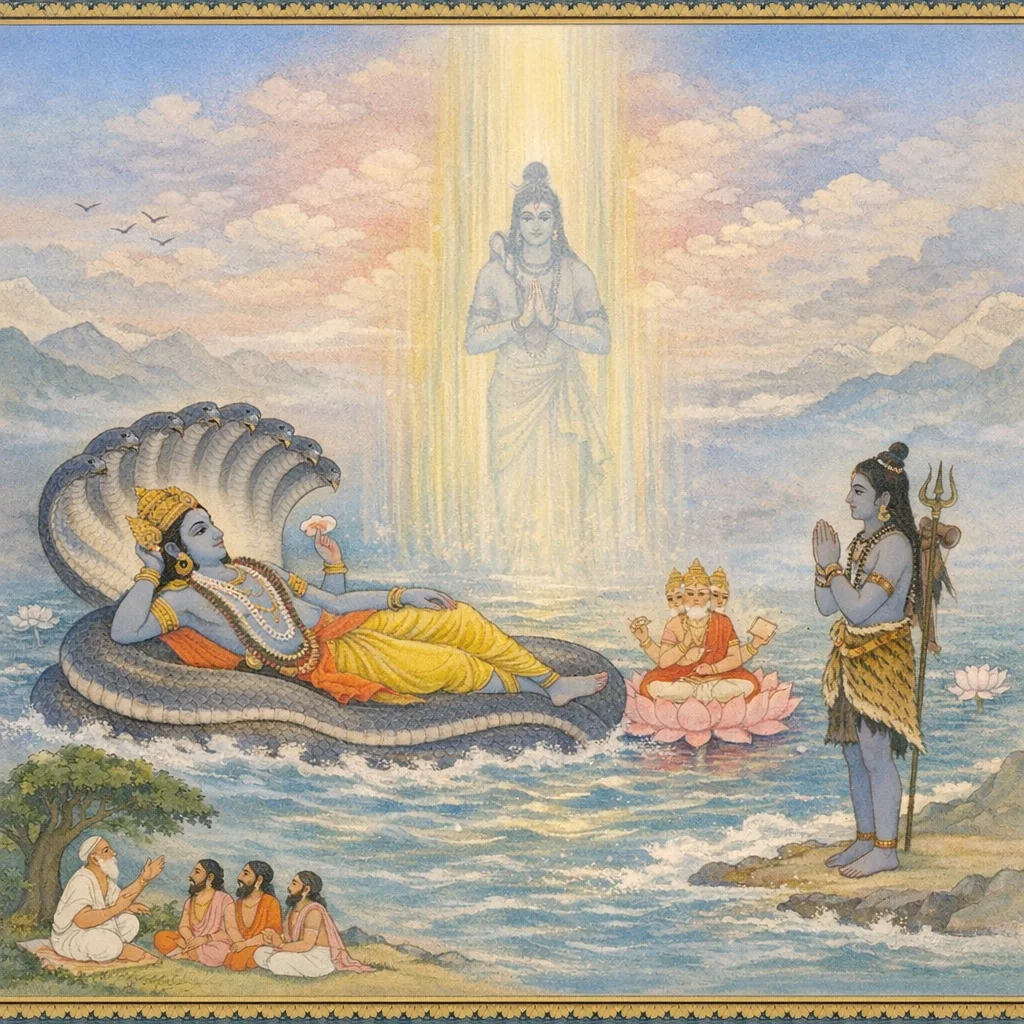
This adhyāya unfolds as a question–answer dialogue: the ṛṣis ask Sūta to resolve a metaphysical doubt—among Śiva, Hari (Viṣṇu), Rudra, and Vidhi (Brahmā), who is truly nirguṇa, and how their identities are to be understood. Sūta replies by placing the nirguṇa Paramātman at the very beginning and, in Vedānta-informed usage, identifying that supreme principle as “Śiva.” From this basis he describes the arising of prakṛti and puruṣa and their tapas in the primordial waters; within that cosmological setting, Hari/Nārāyaṇa rests in yogic sleep under māyā, and Brahmā (Pitāmaha) is born from the navel-lotus. A theological tension between Brahmā and Viṣṇu is then resolved by the manifestation of Mahādeva—explicitly linked to nirguṇa Śiva—who establishes Rudra as a beneficent agent for the world’s grace (loka-anugraha). The chapter ends with a hermeneutic key: the formless becomes “with form” for meditation and devotion, yet in essence there is no real difference among these divine names; like gold and ornaments, distinctions are functional and guṇa-related, not essential.
Shlokas
Verse 1
ऋषय ऊचुः । शिवः को वा हरिः को वा रुद्रः को वा विधिश्च कः । एतेषु निर्गुणः को वा ह्येतं नश्छिन्धि संशयम्
The sages said: “Who indeed is Śiva? Who is Hari (Viṣṇu)? Who is Rudra? And who is Vidhī (Brahmā)? Among these, who is truly nirguṇa—beyond all qualities? Please cut through this doubt of ours.”
Verse 2
सूत उवाच । यच्चादौ हि समुत्पन्नं निर्गुणात्परमात्मनः । तदेव शिवसंज्ञं हि वेदवेदांतिनो विदुः
Sūta said: “That which, in the beginning, arose from the attributeless Supreme Self—this indeed is known by the knowers of the Vedas and Vedānta by the name ‘Śiva.’”
Verse 3
तस्मात्प्रकृतिरुत्पन्ना पुरुषेण समन्विता । ताभ्यान्तपः कृतं तत्र मूलस्थे च जले सुधीः
From Him, Prakṛti arose, united with Puruṣa. Then those two undertook tapas, sacred austerity, there—at the very root, in the waters—O wise one.
Verse 4
पञ्चकोशीति विख्याता काशी सर्वातिवल्लभा । व्याप्तं च सकलं ह्येतत्तज्जलं विश्वतो गतम्
Kāśī, renowned as the Pañcakośī, is supremely beloved above all. Truly, this entire region is pervaded by Śiva’s sanctity, and its sacred waters spread in every direction, reaching throughout the world.
Verse 5
संभाव्य मायया युक्तस्तत्र सुप्तो हरिस्स वै । नारायणेति विख्यातः प्रकृतिर्नारायणी मता
There, Hari (Viṣṇu), joined with Māyā and sustained by her power, lay in yogic sleep. He became renowned as “Nārāyaṇa,” and that Prakṛti (Nature), in this teaching, is regarded as “Nārāyaṇī.”
Verse 6
तन्नाभिकमले यो वै जातस्स च पितामहः । तेनैव तपसा दृष्टस्स वै विष्णुरुदाहृतः
He who was born upon the lotus arising from (the Lord’s) navel is indeed the Grandsire, Brahmā. And by that very austerity, the Lord who was beheld is declared to be Viṣṇu.
Verse 7
उभयोर्वादशमने यद्रूपं स दर्शितं बुधाः । महादेवेति विख्यातं निर्गुणेन शिवेन हि
O wise ones, the form revealed at the culmination of both (paths or views) is renowned as “Mahādeva”; for it is truly Śiva in His nirguṇa reality—attributeless and transcendent.
Verse 8
तेन प्रोक्तमहं शम्भुर्भविष्यामि कभालतः । रुद्रो नाम स विख्यातो लोकानुग्रहकारकः
Thus, as declared by him, I—Śambhu—shall come forth from the skull. I shall be renowned by the name “Rudra,” the gracious benefactor who bestows compassion upon the worlds.
Verse 9
ध्यानार्थं चैव सर्वेषामरूपो रूपवानभूत् । स एव च शिवस्साक्षाद्भक्तवात्सल्यकारकः
For the sake of meditation for all beings, the Formless One Himself became possessed of form. He alone is verily Śiva in person, the very source of tender compassion and loving grace toward His devotees.
Verse 10
शिवे त्रिगुणसम्भिन्ने रुद्रे तु गुणधामनि । वस्तुतो न हि भेदोऽस्ति स्वर्णे तद्भूषणे यथा
In Śiva—who is associated with the three guṇas—and in Rudra—who is the very abode of the guṇas—there is, in truth, no real difference at all, just as there is no essential difference between gold and an ornament made of it.
Verse 11
समानरूपकर्माणौ समभक्तगतिप्रदौ । समानाखिलसंसेव्यौ नानालीलाविहारिणौ
They are alike in form and in divine activity; they bestow the same supreme goal upon their devotees. They are equally worthy of being honored by all, and they delight in manifesting many wondrous līlās.
Verse 12
सर्वथा शिवरूपो हि रुद्रो रौद्रपराक्रमः । उत्पन्नो भक्तकार्यार्थं हरिब्रह्मसहायकृत्
Rudra is, in every way, truly of the very form of Śiva—mighty with awe-inspiring Rudra-power. He manifested for the sake of accomplishing the devotees’ purpose, acting as a helper in concert with Hari (Viṣṇu) and Brahmā.
Verse 14
ते वै रुद्रं मिलित्वा तु प्रयान्ति प्रकृता इमे । इमान्रुद्रो मिलित्वा तु न याति श्रुतिशासनम्
Having met Rudra, these beings—driven by their own conditioned nature—depart again. But Rudra, even after meeting them, does not depart from the ordinance of the Śruti (the Vedic command).
Verse 15
सर्वे रुद्रं भजन्त्येव रुद्रः कञ्चिद्भजेन्न हि । स्वात्मना भक्तवात्सल्याद्भजत्येव कदाचन
All indeed worship Rudra; Rudra, however, does not worship anyone. Yet, out of tender affection for His devotees, He sometimes—of His own free will—shows devotion and service, as though a devotee Himself.
Verse 16
अन्यं भजन्ति ये नित्यं तस्मिंस्ते लीनतां गताः । तेनैव रुद्रं ते प्राप्ताः कालेन महता बुधाः
Those who continually worship another become absorbed into that very one. Yet, through that same devotion, in the course of a long time, the wise ultimately attain Rudra (Śiva) Himself.
Verse 17
रुद्रभक्तास्तु ये केचित्तत्क्षणं शिवतां गताः । अन्यापेक्षा न वै तेषां श्रुतिरेषा सनातनी
But those who are devoted to Rudra attain the state of Śiva at that very moment. For them there is no dependence on anything else—this is the eternal teaching of the Veda.
Verse 18
अज्ञानं विविधं ह्येतद्विज्ञानं विविधं न हि । तत्प्रकारमहं वक्ष्ये शृणुतादरतो द्विजाः
Indeed, this ignorance is of many kinds, but true knowledge is not manifold. I shall explain the modes of that ignorance; listen attentively, O twice-born sages.
Verse 19
ब्रह्मादि तृणपर्यंतं यत्किंचिद्दृश्यते त्विह । तत्सर्वं शिव एवास्ति मिथ्या नानात्वकल्पना
From Brahmā down to a single blade of grass, whatever is seen here—know it all to be Śiva alone. The imagining of multiplicity is false.
Verse 20
सृष्टेः पूर्वं शिवः प्रोक्तः सृष्टेर्मध्ये शिवस्तथा । सृष्टेरन्ते शिवः प्रोक्तस्सर्वशून्ये तदा शिवः
Shiva is declared to be before creation; Shiva likewise is in the midst of creation. Shiva is declared to be at the end of creation; and when all becomes void, then too it is Shiva alone.
Verse 21
तस्माच्चतुर्गुणः प्रोक्तः शिव एव मुनीश्वराः । स एव सगुणो ज्ञेयः शक्तिमत्त्वाद्द्विधापि सः
Therefore, O best of sages, Shiva alone is declared to be fourfold. He alone should be understood as Saguna (with attributes), for by possessing Śakti He is also twofold in manifestation.
Verse 22
येनैव विष्णवे दत्तास्सर्वे वेदास्सनातनाः । वर्णा मात्रा ह्यनैकाश्च ध्यानं स्वस्य च पूजनम्
By Him alone were all the eternal Vedas bestowed upon Viṣṇu; and from Him arise the many letters and measures of sacred sound, as well as meditation upon His own form and His worship.
Verse 23
ईशानः सर्वविद्यानां श्रुतिरेषा सनातनी । वेदकर्ता वेदपतिस्तस्माच्छंभुरुदाहृतः
Īśāna is the Lord of all branches of knowledge; this eternal Śruti proclaims it. He is the maker of the Vedas and the master of the Vedas—therefore He is celebrated as Śambhu, the benevolent auspicious One.
Verse 24
स एव शंकरः साक्षात्सर्वानुग्रहकारकः । कर्ता भर्ता च हर्ता च साक्षी निर्गुण एव सः
He alone is Śaṅkara in truth—the directly manifest Supreme who bestows grace upon all. He is the doer, the sustainer, and the withdrawer; He is the witness, and indeed He is nirguṇa, beyond all limiting qualities.
Verse 25
अन्येषां कालमानं च कालस्य कलना न हि । महाकालस्स्वयं साक्षान्महाकालीसमाश्रितः
For others there may be a measured span of time, but Time itself cannot be measured. Mahākāla is the directly self-manifest Lord, abiding with Mahākālī and supported by Her.
Verse 26
तथा च ब्राह्मणा रुद्रं तथा कालीं प्रचक्षते । सर्वं ताभ्यान्ततः प्राप्तमिच्छया सत्यलीलया
Thus the Brāhmaṇas proclaim Rudra, and likewise Kāli. In truth, everything is ultimately attained from those Two—through their sovereign will, in their real and purposeful divine play (līlā).
Verse 27
न तस्योत्पादकः कश्चिद्भर्ता हर्ता न तस्य हि । स्वयं सर्वस्य हेतुस्ते कार्यभूताच्युतादयः
He has no creator—indeed, for Him there is neither a sustainer nor a destroyer. He Himself is the cause of all; even Acyuta (Viṣṇu) and the others are effects brought forth by His power.
Verse 28
स्वयं च कारणं कार्यं स्वस्य नैव कदाचन । एकोव्यनेकतां यातोप्यनेकोप्येकतां व्रजेत्
The Self is never, at any time, both the cause and the effect of itself. Even the One may appear to enter multiplicity, and even the many may return to oneness.
Verse 29
एकं बीजं बहिर्भूत्वा पुनर्बीजं च जायते । बहुत्वे च स्वयं सर्वं शिवरूपी महेश्वरः
From the one Seed, manifesting outwardly, the seed is born again; and when it appears as many, all of it—truly—is Maheśvara Himself, whose very form is Śiva.
Verse 30
एतत्परं शिवज्ञानं तत्त्वतस्तदुदाहृतम् । जानाति ज्ञानवानेव नान्यः कश्चिदृषीश्वराः
This supreme knowledge of Śiva has been declared in accordance with the true principles (tattva). O lords among sages, only one who is truly wise understands it—no one else.
Verse 31
मुनय ऊचुः । ज्ञानं सलक्षणं ब्रूहि यज्ज्ञात्वा शिवताम्व्रजेत् । कथं शिवश्च तत्सर्वं सर्वं वा शिव एव च
The sages said: “Explain to us knowledge together with its defining characteristics—by knowing which one attains Śiva-hood. And how is Śiva that entire reality, and how indeed is everything none other than Śiva alone?”
Verse 32
व्यास उवाच । एतदाकर्ण्य वचनं सूतः पौराणिकोत्तमः । स्मृत्वा शिवपदाम्भोजं मुनींस्तानब्रवीद्वचः
Vyāsa said: Hearing these words, Sūta—the foremost among the Purāṇic narrators—remembered the lotus-feet of Lord Śiva, and then spoke his words to those sages.
Verse 42
इति श्रीशिवमहापुराणे चतुर्थ्यां कोटिरुद्रसंहितायां सगुणनिर्गुणभेदवर्णनं नाम द्विचत्वारिंशोऽध्यायः
Thus, in the Śrī Śiva Mahāpurāṇa, in the Fourth Saṃhitā called the Koṭirudra-saṃhitā, ends the forty-second chapter entitled “The Description of the Distinction between the Saguṇa and Nirguṇa (aspects).”
Verse 43
अन्ये च ये समुत्पन्ना यथानुक्रमतो लयम् । यांति नैव तथा रुद्रः शिवे रुद्रो विलीयते
All other beings that arise pass, in due order, into dissolution. But Rudra is not so; Rudra dissolves only into Śiva.
Frequently Asked Questions
A theological inquiry into who is truly nirguṇa is answered by Sūta through a cosmogonic sequence (prakṛti–puruṣa, waters, Nārāyaṇa’s yogic sleep, Brahmā from the navel-lotus) and a dispute-resolution motif where Mahādeva manifests to reconcile and to authorize Rudra as an agent of cosmic welfare.
The chapter encodes a teaching method: the arūpa (formless) becomes rūpavān (with form) for dhyāna, indicating that icon and name are contemplative instruments rather than ultimate limitations. The gold–ornament analogy functions as the rahasya: guṇa-conditioned appearances differ, but the underlying substance (Śiva-tattva) is one.
The adhyāya highlights Mahādeva as the revelatory form that resolves divine contention and explicitly links back to nirguṇa Śiva; it also foregrounds Rudra as the named manifestation appointed for loka-anugraha (benefit of worlds). (Gaurī is not a focal figure in the sampled verses for this chapter.)