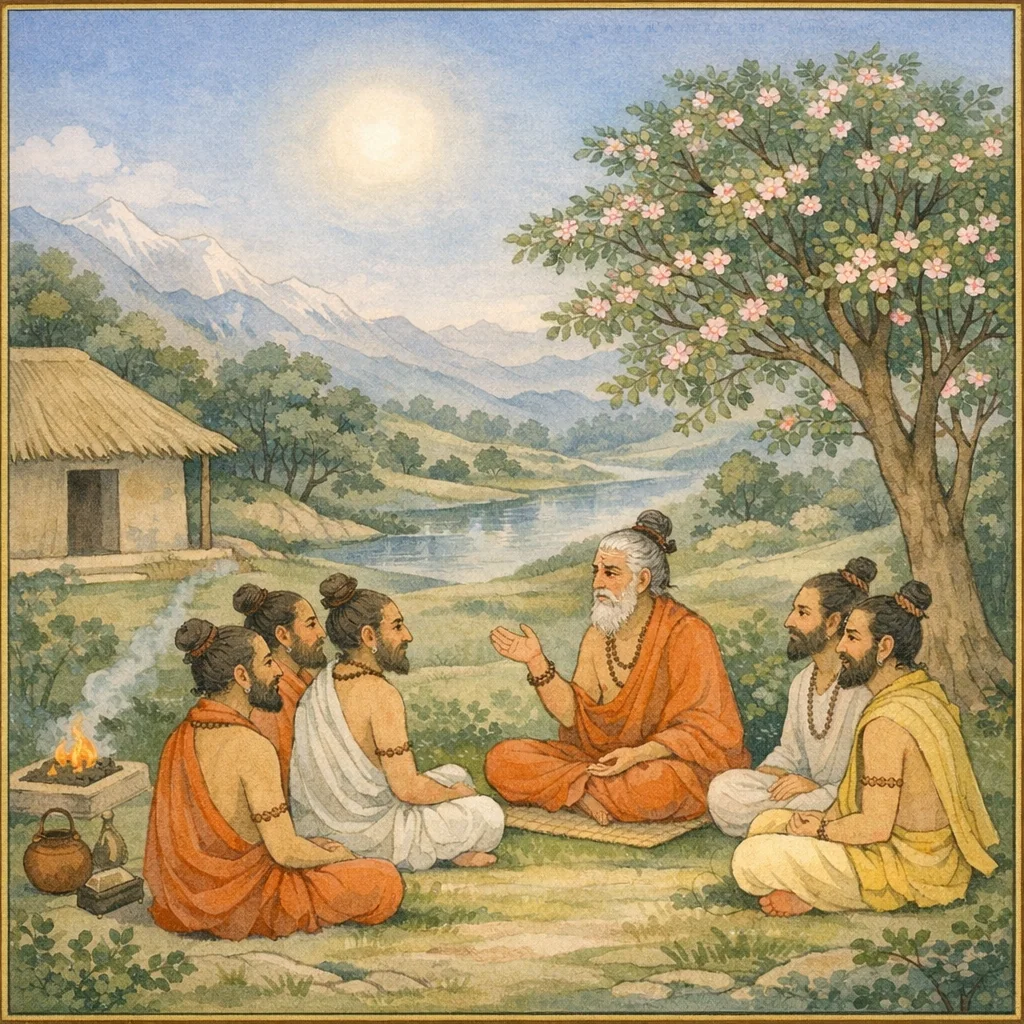
Mukti-bheda-nirūpaṇa (Classification of Liberation) and Śiva as the Sole Bestower of Mokṣa
This adhyāya unfolds as a didactic dialogue: the ṛṣis ask about the concrete nature of “mukti”—its defining state (avasthā) and lived experience. Sūta answers by classifying liberation in graded forms, first listing four—sārūpya, sālokya, sānnidhya, and sāyujya—attainable through the stated vrata. The teaching then asserts theological exclusivity: Śiva alone is the giver of mukti, while Brahmā and other deities are limited to granting the trivarga within guṇa-governed reality. Śiva is defined in precise metaphysical terms—beyond the three guṇas, nirvikāra, parabrahman, turya, and knowable through jñāna—thus grounding soteriology in ontology. The chapter introduces kaivalya as an exceptionally rare (durlabhā) liberation and gives a causal definition of the Absolute: that from which all arises, by which the world is sustained, and into which it dissolves; this all-pervasive principle is identified as Śiva. Finally, Śiva is distinguished as both sakala and niṣkala per Vedic description, and an apophatic incomprehensibility is stressed: even Viṣṇu, Brahmā, the Kumāras, and Nārada do not fully know the supreme reality, affirming Śiva’s transcendence and the limits of cosmological cognition.
Shlokas
Verse 1
ऋषय ऊचुः । मुक्तिर्नाम त्वया प्रोक्ता तस्यां किं नु भवेदिह । अवस्था कीदृशी तत्र भवेदिति वदस्व नः
The sages said: “You have spoken to us of ‘moksha’ (liberation). What, then, truly takes place there? What is the condition or state of the soul in that realm? Please tell us.”
Verse 2
सूत उवाच । मुक्तिश्चतुर्विधा प्रोक्ता श्रूयतां कथयामि वः । संसारक्लेशसंहर्त्री परमानन्ददायिनी
Sūta said: “Liberation (mukti) has been declared to be fourfold. Listen—I shall explain it to you. It is that which destroys the afflictions of saṃsāra and bestows the supreme bliss.”
Verse 3
सारूप्या चैव सालोक्या सान्निध्या च तथा परा । सायुज्या च चतुर्थी सा व्रतेनानेन या भवेत्
Through this sacred vow, one attains the four supreme states of closeness to Lord Śiva—sārūpya (a form like His), sālokya (dwelling in His world), sānnidhya (abiding in His immediate presence), and, as the fourth and highest, sāyujya (union with Him).
Verse 4
मुक्तेर्दाता मुनिश्रेष्ठाः केवलं शिव उच्यते । ब्रह्माद्या न हि ते ज्ञेया केवलं च त्रिवर्गदाः
O best of sages, the giver of liberation is declared to be Śiva alone. Brahmā and the other deities should not be understood as such; they grant only the three worldly aims (dharma, artha, and kāma).
Verse 5
ब्रह्माद्यास्त्रिगुणाधीशाश्शिवस्त्रिगुणतः परः । निर्विकारी परब्रह्म तुर्यः प्रकृतितः परः
Brahmā and the other deities preside over the three guṇas, but Śiva is beyond the three guṇas. He is the changeless Supreme Brahman—the ‘Fourth’ (turya), transcending Prakṛti itself.
Verse 6
ज्ञानरूपोऽव्ययः साक्षी ज्ञानगम्योऽद्वयस्स्वयम् । कैवल्यमुक्तिदस्सोऽत्र त्रिवर्गस्य प्रदोऽपि हि
He is of the very nature of consciousness, imperishable and the inner Witness. He is reached through true knowledge and is Himself non-dual. Indeed, He bestows liberation as absolute aloneness (kaivalya); and here, He also grants the three aims of worldly life (dharma, artha, and kāma).
Verse 7
कैवल्याख्या पंचमी च दुर्लभा सर्वथा नृणाम् । तल्लक्षणं प्रवक्ष्यामि श्रूयतामृषिसत्तमाः
The lunar fifth day known as “Kaivalyā” (leading to liberation) is indeed exceedingly rare for human beings. I shall now declare its distinguishing marks—listen, O best of sages.
Verse 8
उत्पद्यते यतः सर्वं येनैतत्पाल्यते जगत् । यस्मिंश्च लीयते तद्धि येन सर्वमिदं ततम्
He is that Supreme Lord from whom all this is born, by whom this universe is sustained, and into whom it dissolves; indeed, He is the One by whom all this is pervaded throughout.
Verse 9
तदेव शिवरूपं हि पठ्यते च मुनीश्वराः । सकलं निष्कलं चेति द्विविधं वेदवर्णितम्
That alone is taught as the true form of Śiva, O lordly sages. The Vedas declare it to be of two kinds—manifest, with form (sakala), and unmanifest, without form (niṣkala).
Verse 10
विष्णुना तच्च न ज्ञातं ब्रह्मणा न च तत्तथा । कुमाराद्यैश्च न ज्ञातं न ज्ञातं नारदेन वै
That Reality was not known even by Viṣṇu, nor in that manner by Brahmā. It was not known by Sanatkumāra and the other Kumāras either; indeed, it was not known even by Nārada.
Verse 11
शुकेन व्यास पुत्रेण व्यासेन च मुनीश्वरैः । तत्पूर्वैश्चाखिलैर्देवैर्वेदैः शास्त्रैस्तथा न हि
This sacred account has been affirmed by Śuka, the son of Vyāsa, by Vyāsa himself, and by the lordly sages; indeed, it is also supported by all the gods of former times, as well as by the Vedas and the Śāstras—there is no doubt of it.
Verse 12
सत्यं ज्ञानमनंतं च सच्चिदानन्दसंज्ञितम् । निर्गुणो निरुपाधिश्चाव्ययः शुद्धो निरंजनः
He is Truth and conscious Knowledge, infinite, and known as Sat–Cit–Ānanda (Existence–Consciousness–Bliss). He is beyond the guṇas, free from all limiting adjuncts (upādhis), imperishable, ever-pure, and stainless—untainted by any impurity.
Verse 13
न रक्तो नैव पीतश्च न श्वेतो नील एव च । न ह्रस्वो न च दीर्घश्च न स्थूलस्सूक्ष्म एव च
The Supreme Lord is neither red nor yellow; neither white nor blue. He is neither short nor long; neither gross nor subtle—thus He transcends all limiting attributes and measurable forms.
Verse 14
यतो वाचो निवर्तंते अप्राप्य मनसा सह । तदेव परमं प्रोक्तं ब्रह्मैव शिवसंज्ञकम्
That Reality from which words return—unable to reach it, along with the mind—has been declared the Supreme. It is Brahman itself, known by the name “Śiva.”
Verse 15
आकाशं व्यापकं यद्वत्तथैव व्यापकन्त्विदम् । मायातीतं परात्मानं द्वन्द्वातीतं विमत्सरम्
Just as space (ākāśa) is all-pervading, so too is This Reality all-pervading. It is the Supreme Self, beyond Māyā—beyond all dualities—and free from envy or rivalry.
Verse 16
तत्प्राप्तिश्च भवेदत्र शिवज्ञानोदयाद्ध्रुवम् । भजनाद्वा शिवस्यैव सूक्ष्ममत्या सतां द्विजाः
O twice-born ones of saintly conduct, the attainment of That here surely arises from the dawning of the knowledge of Śiva; or else it is attained through devoted worship of Śiva alone, performed with subtle and discerning understanding.
Verse 17
ज्ञानं तु दुष्करं लोके भजनं सुकरं मतम् । तस्माच्छिवं च भजत मुक्त्यर्थमपि सत्तमाः
In this world, liberating knowledge is indeed hard to attain, whereas bhajana—devotional worship—is held to be easy. Therefore, O best among the virtuous, worship Lord Śiva, even for the sake of liberation (mokṣa).
Verse 18
शिवो हि भजनाधीनो ज्ञानात्मा मोक्षदः परः । भक्त्यैव बहवः सिद्धा मुक्तिं प्रापुः परां मुदा
Truly, Śiva is won over by devoted worship; He is the very essence of divine knowledge and the supreme bestower of liberation. By devotion alone, many have attained perfection and, with great joy, reached the highest freedom (moksha).
Verse 19
ज्ञानमाता शंभुभक्तिर्मुक्तिभुक्तिप्रदा सदा । सुलभा यत्प्रसादाद्धि सत्प्रेमांकुर लक्षणा
Devotion to Śambhu is the very mother of true knowledge; it ever bestows both worldly enjoyment and liberation. By His grace it becomes easily attainable, and it is known by the sprouting of genuine love for Śiva within the heart.
Verse 20
सा भक्तिर्विविधा ज्ञेया सगुणा निर्गुणा द्विजाः । वैधी स्वाभाविकी याया वरा सासा स्मृता परा
O twice-born ones, know that bhakti is of many kinds—both with attributes (saguṇa) and without attributes (nirguṇa). Whether it is rule-guided (vaidhī) or spontaneous by nature (svābhāvikī), whichever form is superior—that indeed is remembered as the highest devotion.
Verse 21
नैष्ठिक्यनैष्ठिकीभेदाद्विविधैव हि कीर्तिता । षड्विधा नैष्ठिकी भेदाद्द्वितीयैकविधा स्मृता
Because of the distinction between (general) steadfastness and the Naiṣṭhikī form of steadfastness, it is indeed declared to be of two kinds. Of these, Naiṣṭhikī is said to be sixfold by its internal divisions, whereas the second (the other category) is remembered as only onefold.
Verse 22
विहिताविहिताभेदात्तामनेकां विदुर्बुधाः । तयोर्बहुविधत्वाच्च विस्तारो न हि वर्ण्यते
Because it is distinguished as ‘enjoined’ and ‘not enjoined’, the wise know that (this practice/observance) is of many kinds. And since both of these have numerous varieties, their detailed expansion is not described here.
Verse 23
ते नवांगे उभे ज्ञेये श्रवणादिकभेदतः । सुदुष्करे तत्प्रसादं विना च सुकरे ततः
Know that both (paths) are of nine limbs, distinguished by hearing and the other practices. Without His grace they are exceedingly difficult; but by that grace they become easy.
Verse 24
भक्तिज्ञाने न भिन्ने हि शंभुना वर्णिते द्विजाः । तस्माद्भेदो न कर्तव्यस्तत्कर्तुस्सर्वदा सुखम्
O twice-born sages, Śambhu has indeed declared that devotion (bhakti) and spiritual knowledge (jñāna) are not truly separate. Therefore no division should be made between them; for the one who practices them in harmony, there is happiness at all times.
Verse 25
विज्ञानं न भवत्येव द्विजा भक्तिविरोधिनः । शंभुभक्तिकरस्यैव भवेज्ज्ञानोदयो द्रुतम्
O twice-born ones, true realization never arises in those who oppose devotion. But for the one who cultivates devotion to Śambhu, the dawning of liberating knowledge comes swiftly.
Verse 26
तस्माद्भक्तिर्महेशस्य साधनीया मुनीश्वराः । तयैव निखिलं सिद्धं भविष्यति न संशयः
Therefore, O best of sages, devotion to Mahesha must be earnestly cultivated; by that devotion alone, everything becomes accomplished—of this there is no doubt.
Verse 27
इति पृष्टं भवद्भिर्यत्तदेव कथितं मया । तच्छुत्वा सर्वपापेभ्यो मुच्यते नात्र संशयः
Thus, whatever you asked has been told by me exactly as it is. Hearing it, one is freed from all sins—of this there is no doubt.
Verse 41
इति श्रीशिवमहापुराणे चतुर्थ्यां कोटिरुद्रसंहितायां मुक्तिनिरूपणं नामैकचत्वारिंशोऽध्यायः
Thus, in the holy Śiva Mahāpurāṇa, in the Fourth section—the Koṭirudra-saṃhitā—concludes the forty-first chapter called “Muktinirūpaṇa,” the exposition on liberation (mokṣa).
Frequently Asked Questions
It argues that mukti is categorically Śiva-dependent: Brahmā and Viṣṇu function within guṇa-conditioned cosmology and are associated with trivarga outcomes, whereas Śiva—triguṇātīta, nirvikāra parabrahman—is uniquely the ‘giver of liberation’ (mukti-dātā).
Sakala/niṣkala encodes a two-aspect ontology: Śiva is describable as the manifest ground of cosmic functions (origination, maintenance, dissolution) while remaining ultimately unmanifest and non-objectifiable; this allows devotion and ritual to address Śiva’s accessibility without collapsing the absolute into a merely cosmological deity.
The chapter foregrounds graded liberations—sārūpya (likeness), sālokya (same realm), sānnidhya (proximity), and sāyujya (union)—and additionally introduces kaivalya as a distinct, exceptionally rare attainment, framed as rooted in Śiva’s absolute nature and realized through jñāna.